
BOSU ball exercises are effective for improving total-body strength and balance because they combine resistance training with controlled instability, forcing your core and stabilizing muscles to work harder. Understanding how to use a BOSU ball properly matters because balance, coordination, and core control play a major role in everyday movement, injury prevention, and athletic performance.
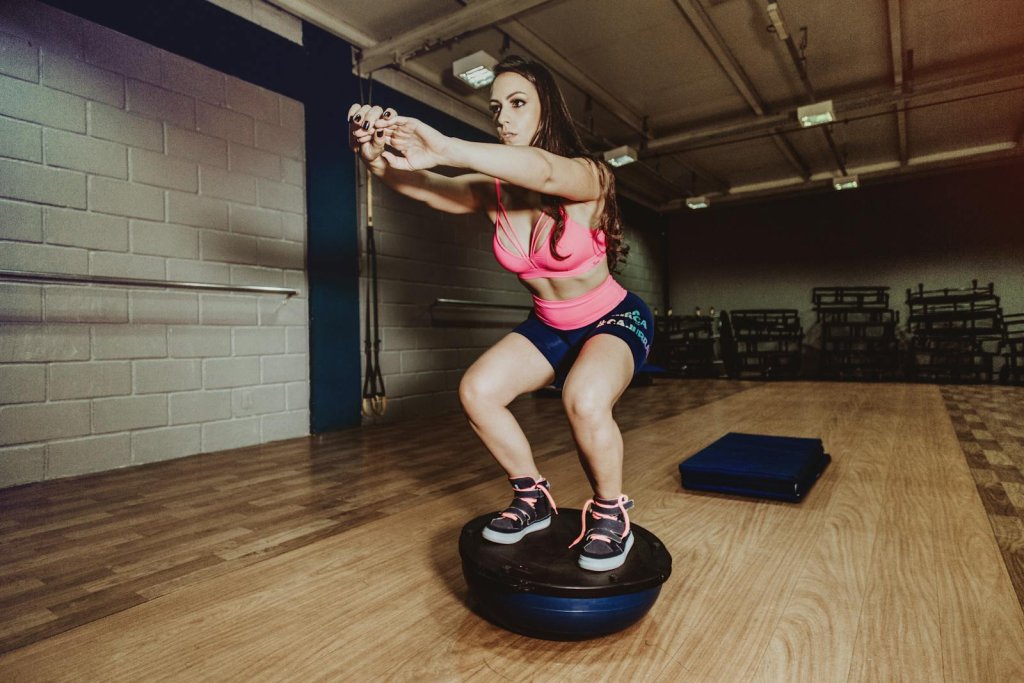
Whether you’re training at home or in the gym, BOSU ball exercises can support functional strength, posture, and movement control when used correctly.
What Are BOSU Ball Exercises?
BOSU ball exercises are movements performed on a BOSU trainer, which has a dome on one side and a flat platform on the other. “BOSU” stands for “Both Sides Up,” meaning you can change the difficulty by flipping the device.
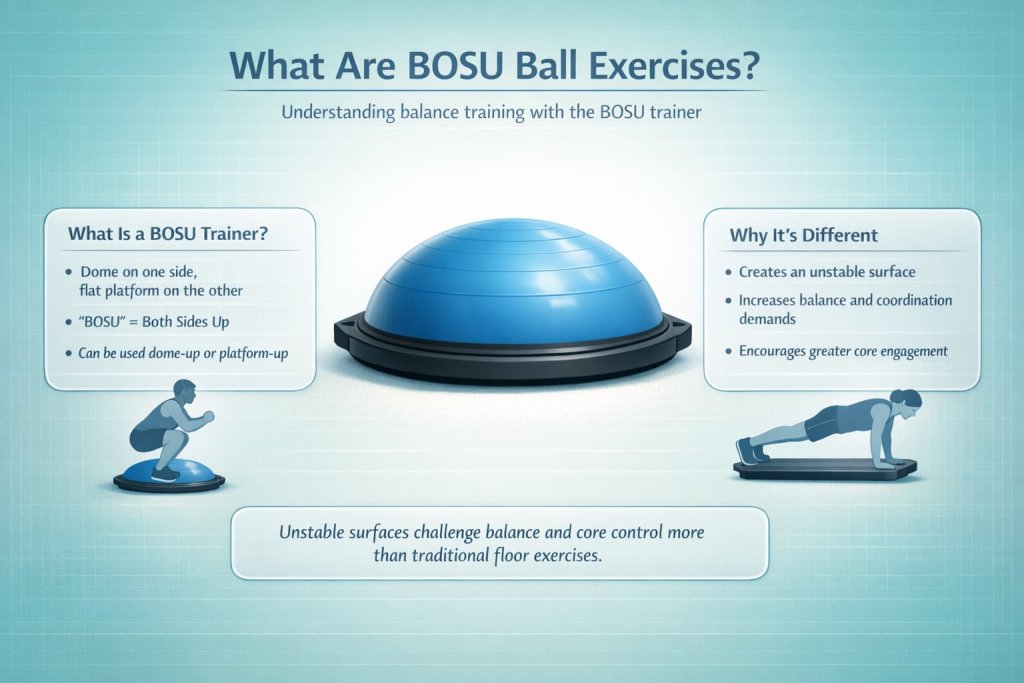
Using the unstable surface increases balance demands and encourages greater core engagement compared with traditional floor exercises.
12 Best BOSU Ball Exercises for Total-Body Strength and Balance
Build full-body strength, balance, and core control with these BOSU ball exercises that challenge stability while supporting functional movement. They’re suitable for beginners through advanced exercisers when performed with proper progression and control.
1. BOSU Squat
How to do it
- Place the BOSU ball dome side up on a flat, non-slip surface
- Stand on the center of the dome with feet about shoulder-width apart
- Keep your chest upright and core gently braced
- Push hips back and bend knees to lower into a squat
- Press through your heels to return to standing
- Perform 8–12 controlled reps
Why it works
The unstable surface increases balance demands, forcing the core and lower-body stabilizers to work harder than a standard squat. This supports functional strength and postural control.
Muscles worked
Quadriceps, glutes, hamstrings, calves, core stabilizers.
Trainer Tip
Start with shallow squats until balance improves. Hold a wall or dowel for support if needed.
2. BOSU Push-Up
How to do it
- Place the BOSU ball dome side down
- Position hands on the flat platform, shoulder-width apart
- Extend legs into a plank position
- Lower chest toward the BOSU with elbows tracking slightly back
- Push up while maintaining a straight body line
- Perform 6–10 reps
Why it works
The unstable base increases shoulder and core activation, improving upper-body stability and control.
Muscles worked
Chest, shoulders, triceps, core, serratus anterior.
Trainer Tip
Drop knees to the floor to reduce difficulty while maintaining form.
3. BOSU Plank
How to do it
- Place forearms or hands on the BOSU dome side down
- Extend legs behind you into a plank
- Keep shoulders stacked over elbows or wrists
- Brace the core and squeeze glutes
- Hold for 20–40 seconds
Why it works
BOSU planks enhance anti-extension and anti-rotation control, improving deep core stability.
Muscles worked
Abdominals, shoulders, glutes, spinal stabilizers.
Trainer Tip
Avoid letting hips sag or rise—maintain a neutral spine throughout.
4. BOSU Reverse Lunge
How to do it
- Stand facing away from the BOSU
- Step one foot back onto the dome
- Lower into a lunge with front knee aligned over toes
- Push through the front heel to return to standing
- Alternate sides for 8–10 reps per leg
Why it works
The reverse step reduces joint stress while challenging balance and unilateral strength.
Muscles worked
Glutes, quadriceps, hamstrings, calves, core.
Trainer Tip
Move slowly during the step-back phase to maintain control.
5. BOSU Mountain Climbers
How to do it
- Place hands on the BOSU platform, dome side down
- Extend legs into a plank position
- Drive one knee toward the chest, then switch
- Continue alternating at a controlled pace
- Perform for 20–30 seconds
Why it works
This dynamic movement combines core stabilization with cardiovascular demand.
Muscles worked
Core, shoulders, hip flexors, quads.
Trainer Tip
Focus on stability before speed—control matters more than pace.
6. BOSU Side Plank
How to do it
- Place forearm on the BOSU dome side down
- Stack feet and lift hips into a side plank
- Keep body aligned from head to heels
- Hold 15–30 seconds per side
Why it works
Side planks strengthen lateral core muscles and hip stabilizers important for balance.
Muscles worked
Obliques, glute medius, shoulders, core stabilizers.
Trainer Tip
Bend the bottom knee to make this variation more accessible.
7. BOSU Glute Bridge
How to do it
- Lie on your back with feet on the BOSU dome side up
- Bend knees and place arms by your sides
- Press heels into the BOSU and lift hips
- Pause briefly at the top, then lower slowly
- Perform 10–12 reps
Why it works
The unstable surface increases glute and hamstring activation while promoting pelvic control.
Muscles worked
Glutes, hamstrings, lower back stabilizers.
Trainer Tip
Avoid arching the lower back—lift hips by squeezing glutes.
8. BOSU Step-Ups
How to do it
- Place BOSU dome side up
- Step one foot onto the center of the dome
- Push through the heel to stand up
- Step back down with control
- Perform 8–10 reps per leg
Why it works
Step-ups reinforce single-leg strength and balance used in daily movement.
Muscles worked
Glutes, quadriceps, hamstrings, calves.
Trainer Tip
Start with a slow tempo to improve stability and confidence.
9. BOSU Dead Bug
How to do it
- Lie on your back holding the BOSU above your chest
- Lift arms and legs into a tabletop position
- Extend opposite arm and leg while holding BOSU steady
- Return to start and switch sides
- Perform 6–10 reps per side
Why it works
This exercise improves coordination and deep core control without spinal strain.
Muscles worked
Deep abdominals, hip flexors, spinal stabilizers.
Trainer Tip
Keep your lower back gently pressed into the floor.
10. BOSU Squat Hold
How to do it
- Stand on the BOSU dome side up
- Lower into a squat position
- Hold with chest upright and core engaged
- Maintain balance for 20–40 seconds
Why it works
Isometric holds increase endurance and postural awareness under instability.
Muscles worked
Quadriceps, glutes, core stabilizers.
Trainer Tip
Focus on steady breathing to maintain control.
11. BOSU Single-Leg Balance
How to do it
- Stand on the BOSU dome side up
- Lift one foot off the surface
- Balance while keeping hips level
- Hold 20–30 seconds per side
Why it works
This drill strengthens ankle, knee, and hip stabilizers critical for injury prevention.
Muscles worked
Ankles, calves, glutes, core.
Trainer Tip
Progress by closing your eyes or adding light arm movements.
12. BOSU Burpee (Advanced)
How to do it
- Start standing behind the BOSU
- Place hands on the platform and jump feet back into plank
- Perform a push-up
- Jump feet forward and stand up
- Repeat for 6–10 reps
Why it works
This full-body movement blends strength, balance, and conditioning.
Muscles worked
Chest, shoulders, legs, core, cardiovascular system.
Trainer Tip
Only attempt this variation after mastering basic BOSU movements.
How Often Should You Do BOSU Ball Exercises?
For most adults, BOSU ball exercises can be included:
- 2–3 days per week for balance and core training
- As part of a full-body strength routine
- In short circuits or focused stability sessions
The Centers for Disease Control and Prevention recommends incorporating balance-focused activities alongside regular strength training, particularly as people age.
Benefits of BOSU Ball Exercises for Strength and Balance
Research and professional training guidelines consistently show several potential benefits:
- Improved balance and postural control
- Increased core muscle activation
- Enhanced coordination and body awareness
- Greater challenge for stabilizing muscles
- Functional strength carryover to daily activities
The American College of Sports Medicine includes balance and neuromotor training as a key component of comprehensive fitness programs, especially when combined with strength and aerobic exercise.
Safety Tips for BOSU Ball Training
- Start with basic movements before progressing
- Use a non-slip surface and clear surrounding space
- Keep movements slow and controlled
- Stop if you feel dizzy or unstable
- Beginners may use a wall or support nearby
BOSU ball exercises are not required for results, but they can be a useful tool when used appropriately.
Who Should Be Careful Before Doing BOSU Ball Exercises
BOSU ball exercises increase balance demands, which may not be appropriate for everyone. Extra caution is advised for:
- People with recent ankle, knee, hip, or lower-back injuries
- Individuals with balance or vestibular disorders
- Those who feel unsteady during basic standing exercises
- Beginners who are new to balance training
Public health guidance from the Centers for Disease Control and Prevention encourages choosing exercises that match current ability levels, especially when balance is involved.
Can BOSU Ball Exercises Replace Traditional Strength Training?
BOSU ball exercises support balance and core stability, but they do not fully replace traditional strength training.
- Unstable surfaces limit how much resistance you can safely use
- Heavy strength gains require stable loading and progressive overload
- BOSU training works best as a supplement, not a substitute
The American College of Sports Medicine recommends combining balance training with regular resistance exercise for well-rounded fitness.
Frequently Asked Questions
Are BOSU ball exercises good for beginners?
Yes, many BOSU exercises can be modified for beginners by reducing range of motion or using support.
Do BOSU ball exercises build muscle?
They can support muscle activation and endurance, but traditional resistance training is usually more effective for maximal strength gains.
Can BOSU ball exercises help with balance?
Yes, BOSU training is widely used to improve balance and coordination when performed consistently.
Is BOSU training safe for older adults?
It may be appropriate with supervision and simplified exercises, depending on individual balance ability.
How long should a BOSU workout last?
Most BOSU-focused workouts last 15–30 minutes within a larger training session.
Can I use the BOSU ball every day?
Daily light balance work may be appropriate, but intense sessions should allow recovery time.
Conclusion
BOSU ball exercises offer a versatile way to challenge strength, balance, and core stability in one workout. When programmed thoughtfully, they can enhance functional fitness and movement control across all experience levels. Start with simple exercises, progress gradually, and focus on quality over speed.
If you’re ready to add variety and balance-focused challenges to your workouts, BOSU ball exercises can be a valuable addition to your routine.
References
- CDC: Physical Activity Guidelines for Older Adults (Includes Balance)
- Physical Activity Guidelines for Americans, 2nd Edition (HHS) PDF
- ACSM Position Stand (Garber et al., 2011): Quantity and Quality of Exercise (Includes Neuromotor/Balance)
- Systematic Review (Behm et al., 2015): Unstable vs Stable Strength Training Effects
- 2025 Meta-analysis: Effects of Unstable Training on Muscle Activation (PMC)
- Mayo Clinic: Strength Training Basics and Benefits (Progressive Strength Focus)