
Knee flexion exercises are targeted movements designed to improve how well your knee bends, supporting everyday activities like walking, sitting, climbing stairs, and getting up from a chair. When performed correctly and consistently, these exercises may help restore range of motion, support joint function, and improve movement confidence.
Understanding knee flexion is especially important after injury, surgery, or periods of stiffness, because limited bending can affect balance, independence, and overall quality of life. This guide explains what knee flexion exercises are, why they matter, how to perform them safely, and which exercises are most commonly recommended in evidence-based rehabilitation programs.
What Are Knee Flexion Exercises?
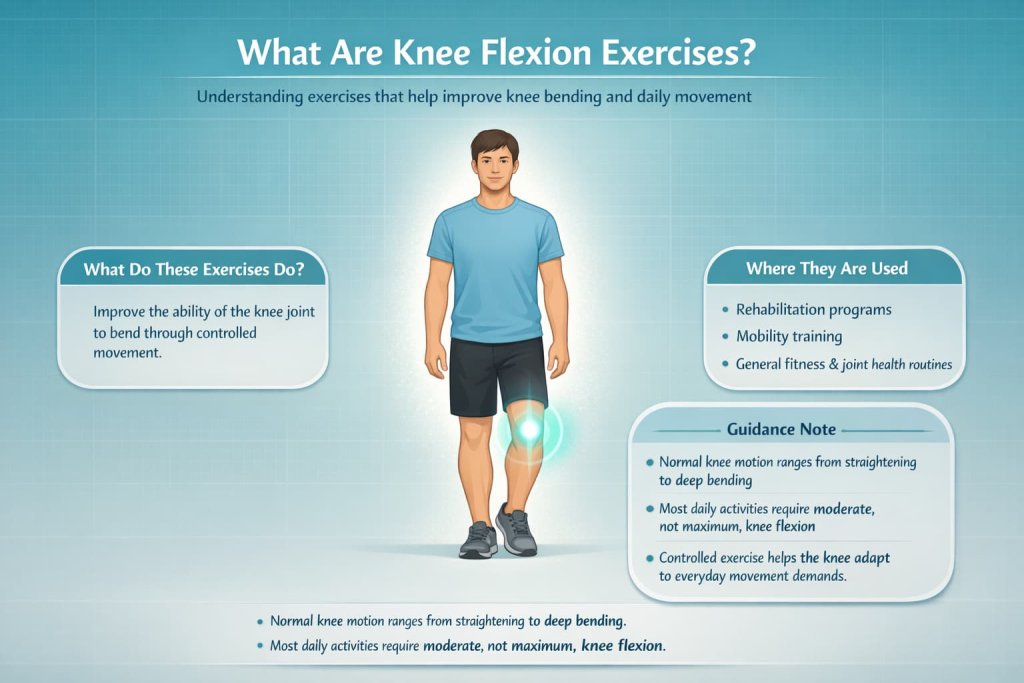
Knee flexion exercises focus on improving the ability of the knee joint to bend by engaging muscles and tissues that control knee movement. These exercises are commonly used in rehabilitation, mobility training, and general fitness programs.
Most knee flexion exercises aim to:
- Gradually increase bending range of motion
- Improve coordination between muscles and joints
- Support smoother, more comfortable daily movement
Clinical references commonly describe normal knee motion as ranging from full straightening to deep bending, though most daily activities require less than maximum flexion. Building tolerance through controlled exercise helps the knee move more efficiently under everyday loads.
Why Knee Flexion Exercises Matter
Limited knee flexion can make simple tasks harder and increase stress on surrounding joints. Improving knee bending capacity may help by:
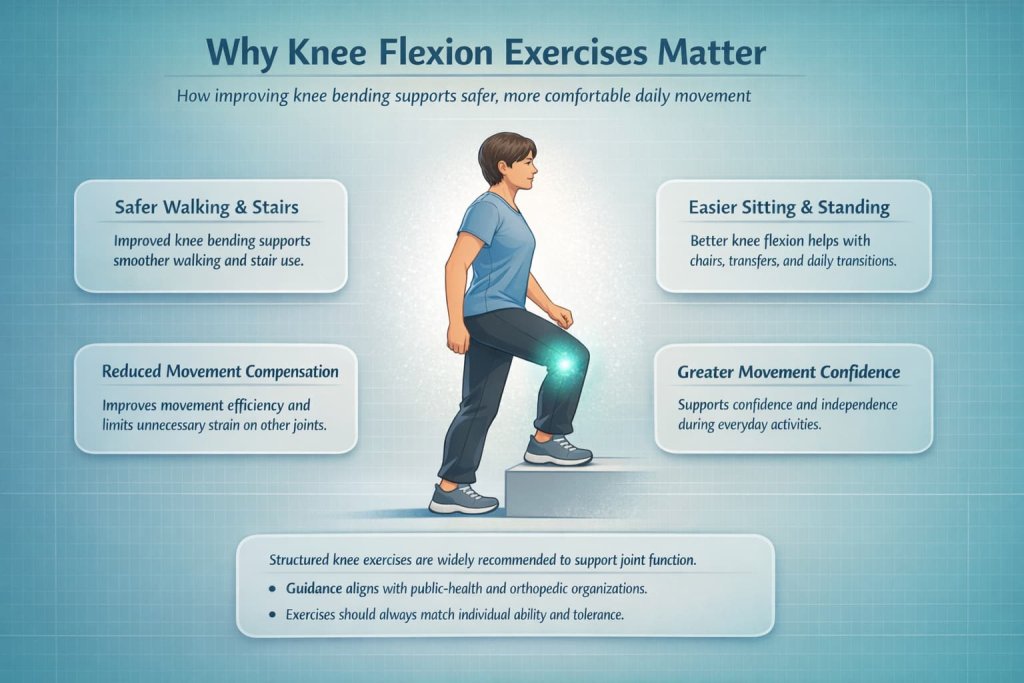
- Supporting safer walking and stair use
- Making sitting, standing, and transfers easier
- Reducing compensatory movement patterns
- Improving confidence in daily activities
Organizations such as the American Academy of Orthopaedic Surgeons and the National Institute on Aging recognize structured exercise as an important part of maintaining joint function and mobility when appropriately matched to individual ability.
8 Best Knee Flexion Exercises
Below are commonly used knee flexion exercises that progress from gentle range-of-motion work to functional bending patterns.
1. Supine Heel Slides
How to do it
- Lie on your back on a firm surface with both legs fully extended
- Keep your hips relaxed and toes pointing upward
- Slowly slide one heel along the floor toward your hips, bending the knee
- Stop at the point of mild stretch or comfort, not pain
- Hold briefly, then slide the heel back to the starting position
- Repeat with slow, controlled repetitions
Why it works
Supine heel slides gently reintroduce knee bending without placing bodyweight through the joint. This makes them ideal for early-stage mobility work, post-injury stiffness, or times when swelling or pain limits tolerance to standing movements.
Muscles worked
Quadriceps, hamstrings
Trainer Tip
Perform the movement slowly and focus on smooth control rather than how far the knee bends. Small, consistent gains matter more than forcing range.
2. Seated Knee Flexion (Assisted)
How to do it
- Sit upright on a chair with your feet flat on the floor
- Slowly slide one foot backward under the chair, bending the knee
- Use your hands or the opposite foot to assist if needed
- Pause briefly at the end range
- Return to the starting position with control
Why it works
Seated knee flexion allows you to practice bending in a stable, supported position. Because bodyweight is reduced, it helps improve range of motion while minimizing joint stress.
Muscles worked
Hamstrings, quadriceps
Trainer Tip
Avoid leaning backward or lifting your hips. Keeping your torso upright helps ensure the knee—not momentum—does the work.
3. Wall Heel Slides
How to do it
- Lie on your back with one foot placed flat against a wall
- Start with the knee slightly bent
- Slowly allow the heel to slide down the wall as the knee bends
- Let gravity assist the movement without pulling
- Slide the foot back up the wall to reset
Why it works
Wall heel slides use gravity to assist knee bending, which can help increase range of motion with less muscular effort. This is useful when active bending feels difficult or fatiguing.
Muscles worked
Quadriceps, hamstrings
Trainer Tip
Move slowly and stop if the knee feels unstable or painful. Controlled motion is more effective than letting the leg drop.
4. Standing Knee Flexion Stretch (Step Stretch)
How to do it
- Stand facing a low step or platform
- Place one foot on the step while keeping the other foot on the floor
- Gently shift your body weight forward to bend the front knee
- Keep the heel down and posture upright
- Hold briefly, then step back to the start
Why it works
This exercise introduces knee flexion in a weight-bearing position, helping the knee adapt to bending demands used in daily tasks like stairs and walking.
Muscles worked
Quadriceps, hamstrings, calves
Trainer Tip
Keep the knee aligned over the toes and avoid collapsing inward. Use a railing or wall if balance feels uncertain.
5. Stationary Cycling (Range of Motion Focus)
How to do it
- Sit on a stationary bike with the seat adjusted low enough to encourage knee bending
- Begin pedaling slowly with no or very light resistance
- Focus on smooth, even pedal strokes
- Stop or reduce range if discomfort increases
Why it works
Cycling provides repeated, rhythmic knee flexion in a low-impact environment. This helps reinforce bending range while promoting joint lubrication and circulation.
Muscles worked
Quadriceps, hamstrings, calves
Trainer Tip
If full pedal rotations are difficult, start by rocking the pedals forward and backward until your range improves.
6. Standing Hamstring Curls
How to do it
- Stand upright while holding a chair or wall for support
- Bend one knee, bringing the heel toward your glutes
- Pause briefly at the top
- Lower the foot back down with control
- Repeat before switching sides
Why it works
Standing hamstring curls actively strengthen the muscles that bend the knee, helping improve control and coordination during everyday movements.
Muscles worked
Hamstrings
Trainer Tip
Move slowly and avoid swinging the leg. Controlled lifting and lowering improves muscle engagement and joint stability.
7. Sit-to-Stand (Controlled Depth)
How to do it
- Sit on a chair with feet hip-width apart and flat on the floor
- Lean slightly forward through the hips
- Push through your feet to stand up
- Slowly lower yourself back down to the chair
- Use hands on armrests or thighs if needed
Why it works
Sit-to-stand movements train knee flexion and extension in a highly functional pattern that directly transfers to daily independence.
Muscles worked
Quadriceps, hamstrings, glutes
Trainer Tip
Choose a chair height that allows you to move without strain. A higher seat reduces knee demand if needed.
8. Supported Mini Squats
How to do it
- Stand while holding onto a stable surface for balance
- Bend your knees slightly as if sitting back into a chair
- Keep your chest upright and weight evenly distributed
- Return to standing with control
Why it works
Mini squats build tolerance for knee flexion under bodyweight while reinforcing proper alignment and movement control.
Muscles worked
Quadriceps, hamstrings, glutes
Trainer Tip
Only squat as deep as you can maintain good form. Quality of movement matters more than depth.
How Often Should You Do Knee Flexion Exercises?
Knee flexion exercises are typically most effective when practiced consistently and matched to your current tolerance level.
General guidance includes:
- Gentle range-of-motion exercises can often be done daily
- Strength-focused knee flexion movements are commonly performed 3–5 times per week
- Rest days may be helpful if stiffness, soreness, or fatigue increases
Progress is usually gradual. Small improvements in comfort, control, or bending range over weeks are more meaningful than rapid increases. Adjust frequency based on how your knee responds rather than following a rigid schedule.
How to Perform Knee Flexion Exercises Safely
Before starting knee flexion exercises, keep these safety principles in mind:
- Move slowly and with control
- Stop before sharp or worsening pain
- Avoid forcing the knee into deep bending
- Breathe normally and stay relaxed
- Increase range gradually over time
If you have recently had surgery, a significant injury, or ongoing joint swelling, consult a qualified healthcare or rehabilitation professional before progressing intensity.
Who Should Be Cautious With Knee Flexion Exercises?
Knee flexion exercises may need modification or supervision if you:
- Are recovering from recent knee surgery
- Have significant swelling or instability
- Experience locking or catching sensations
- Have been advised to limit knee bending
When to Seek Professional Guidance
While knee flexion exercises are commonly used in general mobility and rehabilitation programs, professional guidance is recommended in certain situations.
Consider consulting a qualified healthcare or rehabilitation professional if you:
- Have had recent knee surgery or a significant injury
- Experience persistent swelling, locking, or instability
- Notice pain that worsens rather than improves with exercise
- Are unsure how much knee bending is appropriate for your condition
- Have been advised previously to limit knee movement
Professional input can help ensure exercises are appropriate, safely progressed, and aligned with your individual needs.
Frequently Asked Questions
How often should I do knee flexion exercises?
Most programs recommend gentle daily practice or 3–5 sessions per week, depending on tolerance.
How long does it take to improve knee flexion?
Improvements may be noticed within a few weeks, though progress varies based on consistency and underlying conditions.
Should knee flexion exercises hurt?
Mild stretching discomfort may occur, but sharp or worsening pain is a signal to stop.
Can knee flexion exercises help after surgery?
They are commonly included in rehabilitation, but progression should follow professional guidance.
Are knee flexion exercises good for stiff knees?
Yes, when done gradually, they may help reduce stiffness and improve movement comfort.
Do I need equipment?
Most knee flexion exercises use bodyweight, chairs, steps, or a stationary bike.
Conclusion
Knee flexion exercises play an important role in restoring comfortable knee bending and supporting daily movement. By starting with gentle range-of-motion drills and progressing toward functional patterns, you can build confidence, mobility, and joint control over time. Focus on consistency, proper form, and gradual progression for the best results.
References
- Total Knee Arthroplasty Rehabilitation Protocol (Mass General Brigham PDF)
- Total Knee Arthroplasty Protocol (Brigham and Women’s Hospital PDF)
- Total Knee Replacement Exercise Guide (AAOS OrthoInfo)
- Knee Exercises (AAOS OrthoInfo)
- Knee Conditioning Program (AAOS OrthoInfo)
- Knee Pain: When to See a Doctor (Mayo Clinic)
- Adult Physical Activity Guidelines Overview (CDC)
- Physical Activity Guidelines for Americans, 2nd Edition (health.gov PDF)