
Meniscus tear exercises are structured, low-impact movements designed to support knee strength, stability, and everyday function while protecting the injured cartilage. Understanding how and when to use these exercises matters because the meniscus plays a key role in shock absorption, joint stability, and smooth knee movement—and improper loading can worsen symptoms.
This guide walks you through 10 best meniscus tear exercises commonly used in conservative rehab programs, along with safety guidance, FAQs, and clear next steps.
What Are Meniscus Tear Exercises?
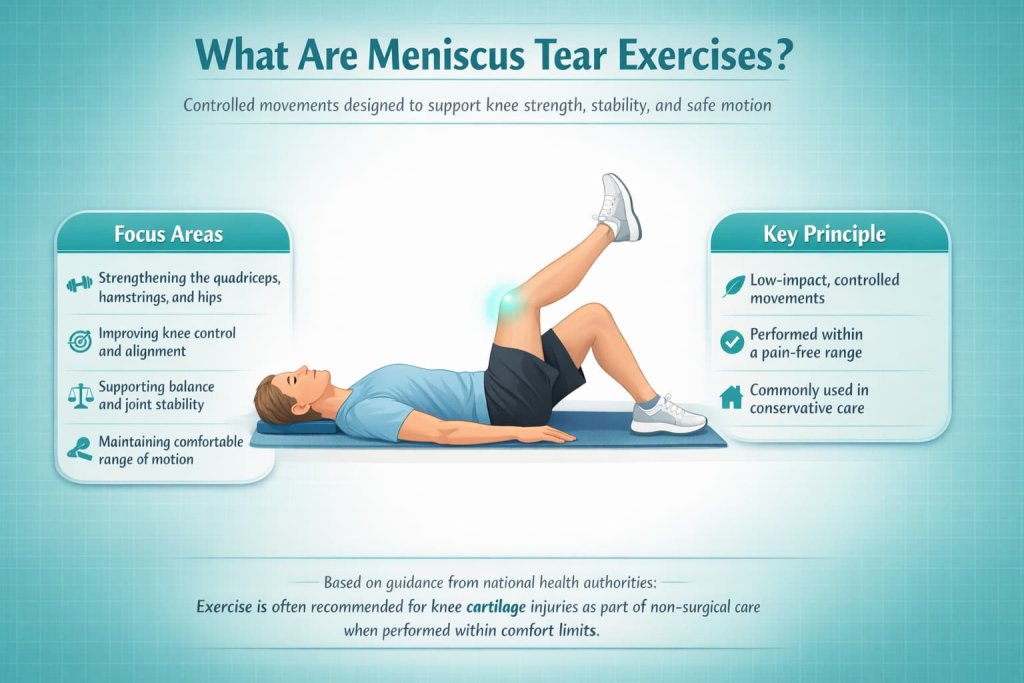
Meniscus tear exercises are controlled movements that focus on:
- Strengthening the quadriceps, hamstrings, and hips
- Improving knee control and alignment
- Supporting balance and joint stability
- Maintaining comfortable range of motion
According to guidance from the National Health Service, exercise is often recommended for knee cartilage injuries as part of non-surgical care, provided movements stay within a pain-free range.
Why Knee Strength and Stability Matter for a Meniscus Tear
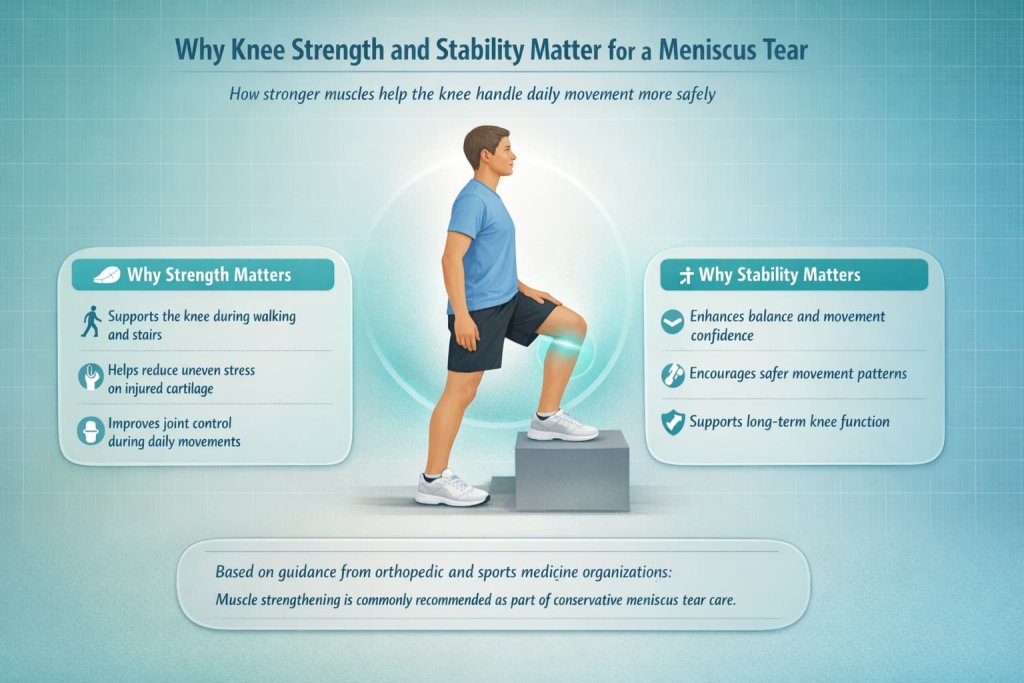
A meniscus tear can reduce the knee’s ability to absorb force and stay stable during movement. Strengthening the muscles around the knee helps the joint handle everyday activities more safely.
Key benefits of improved strength and stability include:
- Better knee support during walking and stairs
- Reduced uneven stress on the injured cartilage
- Improved control and confidence with movement
Medical guidance from the Mayo Clinic and the American Academy of Orthopaedic Surgeons highlights muscle strengthening as a core part of conservative meniscus tear care.
10 Best Meniscus Tear Exercises for Knee Strength and Stability
These exercises focus on improving knee strength, stability, and movement control without placing excessive stress on the injured meniscus. They are commonly used in conservative rehabilitation programs to support daily function and safe activity progression.
1. Quad Sets
How to do it
- Sit or lie on your back with the leg fully straight
- Tighten the front of your thigh by gently pressing the knee down toward the floor
- Hold the contraction for 5–10 seconds
- Relax completely before repeating
Why it works:
Quad sets activate the quadriceps without moving the knee joint, making them one of the safest early-stage exercises for meniscus tears. This activation helps prevent muscle shutdown and supports knee stability during standing and walking.
Muscles worked:
Quadriceps (especially the vastus medialis)
Trainer Tip:
Think about “squeezing” the thigh rather than pushing hard into the floor. Strong muscle engagement matters more than force.
2. Straight Leg Raises
How to do it
- Lie on your back with one knee bent and the other leg straight
- Tighten the thigh of the straight leg
- Slowly lift the straight leg to the height of the opposite knee
- Lower back down with control
Why it works:
This exercise strengthens the quadriceps while keeping knee movement minimal. It helps improve knee support during daily activities without compressing the meniscus.
Muscles worked:
Quadriceps, hip flexors
Trainer Tip:
If your knee bends during the lift, lower the height slightly and focus on maintaining full leg tension.
3. Heel Slides
How to do it
- Lie on your back with both legs extended
- Slowly slide one heel toward your hips, bending the knee
- Pause briefly at the end range
- Slide the heel back to the starting position
Why it works:
Heel slides promote gentle knee bending and help maintain joint mobility without excessive load. This can be useful for stiffness that develops after injury or reduced activity.
Muscles worked:
Hamstrings, quadriceps
Trainer Tip:
Use a towel or socks on a smooth surface if sliding feels difficult.
4. Hamstring Sets
How to do it
- Sit or lie with the leg straight and heel resting on the floor
- Gently press the heel downward as if trying to bend the knee
- Hold the tension for 5–10 seconds
- Relax and repeat
Why it works:
Hamstring sets strengthen the muscles behind the thigh without visible knee movement. Balanced hamstring strength helps reduce uneven forces across the knee joint.
Muscles worked:
Hamstrings
Trainer Tip:
You should feel muscle tension, not joint strain. If discomfort appears, reduce effort.
5. Standing Hip Abduction
How to do it
- Stand upright while holding a chair or wall for support
- Slowly lift one leg out to the side
- Keep toes facing forward
- Lower the leg with control
Why it works:
Strong hip abductors help control knee alignment during walking, stairs, and standing tasks. This support reduces unnecessary stress on the knee.
Muscles worked:
Gluteus medius, hip stabilizers
Trainer Tip:
Avoid leaning sideways. The movement should come from the hip, not the trunk.
6. Standing Hip Extension
How to do it
- Stand tall while holding support
- Move one leg straight backward without bending the knee
- Pause briefly
- Return to the starting position
Why it works:
Hip extension strengthens the glutes and hamstrings, which play a key role in knee control during walking and rising from chairs.
Muscles worked:
Gluteus maximus, hamstrings
Trainer Tip:
Keep your core engaged to prevent arching your lower back.
7. Mini Squats (Pain-Free Range)
How to do it
- Stand with feet shoulder-width apart
- Slowly bend your knees slightly, keeping heels on the floor
- Push through your heels to return to standing
Why it works:
Mini squats train coordinated knee and hip movement under light load, helping prepare the knee for everyday tasks like sitting and standing.
Muscles worked:
Quadriceps, glutes
Trainer Tip:
Only squat as low as comfortable. Depth can increase gradually over time.
8. Calf Raises
How to do it
- Stand holding a chair or wall
- Slowly rise up onto your toes
- Pause briefly at the top
- Lower heels back down with control
Why it works:
Calf strength supports ankle stability and walking mechanics, indirectly helping reduce stress on the knee during movement.
Muscles worked:
Gastrocnemius, soleus
Trainer Tip:
Control both the lift and the lowering phase—avoid bouncing.
9. Step-Ups (Low Height)
How to do it
- Stand facing a low step or stair
- Step up with one foot
- Bring the other foot up
- Step back down slowly and switch sides
Why it works:
Step-ups simulate daily movements such as stairs, improving functional knee strength and coordination in a controlled way.
Muscles worked:
Quadriceps, glutes
Trainer Tip:
Start with a very low step and increase height only if pain-free.
10. Single-Leg Balance
How to do it
- Stand near a wall or chair for safety
- Lift one foot slightly off the ground
- Hold balance for 10–30 seconds
- Switch legs
Why it works:
Balance training improves joint awareness and neuromuscular control, which are essential for knee stability and injury prevention.
Muscles worked:
Knee stabilizers, hip stabilizers, core muscles
Trainer Tip:
Progress by reducing hand support or closing your eyes only when balance feels steady.
How Often Should You Do Meniscus Tear Exercises?
Most rehabilitation programs recommend:
- 3–5 days per week
- 1–3 sets per exercise
- Slow, controlled repetitions
The American Academy of Orthopaedic Surgeons emphasizes consistency over intensity when rebuilding knee function.
Can Exercise Help a Meniscus Tear?
Exercise does not repair torn cartilage. However, research and clinical guidelines show that appropriate exercise may help improve function, reduce discomfort, and support daily activity for many people with meniscus tears.
Large clinical trials published in JAMA Network Open and recommendations in BMJ report that, for many degenerative meniscus tears, structured physical therapy can provide similar functional outcomes to surgery over time.
Safety Guidelines Before Starting Meniscus Tear Exercises
Before beginning any program:
- Avoid deep squatting, pivoting, or twisting early on
- Move slowly and stay within a pain-free range
- Stop if sharp pain, locking, or swelling increases
- Use support (wall, chair, rail) as needed
- Seek professional guidance if symptoms worsen
If your knee catches, locks, or gives way frequently, consult a healthcare professional before exercising.
When to Avoid These Exercises
Avoid or stop exercises if you experience:
- Knee locking or catching
- Sharp or worsening pain
- Significant swelling after activity
- Instability or giving way
Seek professional care if symptoms persist.
Who Should Be Cautious With Meniscus Tear Exercises?
Some individuals should seek professional guidance before starting exercises, especially if symptoms are severe or unstable.
Use extra caution if you:
- Have knee locking or catching
- Experience sharp pain or increasing swelling
- Struggle to bear weight on the leg
- Recently had a knee injury or surgery
- Have other knee conditions, such as arthritis or ligament injury
According to the National Health Service, true locking or sudden loss of motion should be medically assessed.
Common Mistakes to Avoid With Meniscus Tear Exercises
Avoiding common errors helps reduce the risk of symptom flare-ups and setbacks.
Common mistakes include:
- Performing deep squats or twisting motions too early
- Ignoring pain, swelling, or joint catching
- Letting the knee collapse inward during exercises
- Moving too quickly or using momentum
- Skipping balance and hip-strengthening exercises
The American Academy of Orthopaedic Surgeons emphasizes controlled movement and gradual progression when rebuilding knee strength.
Frequently Asked Questions
Are meniscus tear exercises safe without surgery?
Yes, for many people, conservative exercise-based care is recommended first when symptoms allow.
Can exercises heal a torn meniscus?
Exercises do not repair cartilage but may support function and comfort.
How long does it take to see improvement?
Many people notice functional improvement within 6–12 weeks of consistent rehab.
Should I avoid squats with a meniscus tear?
Deep squats and twisting should be avoided early; shallow, controlled squats may be introduced later.
Are these exercises good after meniscus surgery?
Some may be used post-surgery, but only with professional guidance.
Can seniors do meniscus tear exercises?
Yes, with modifications and focus on balance and control.
Conclusion
Meniscus tear exercises play an important role in supporting knee strength, stability, and daily movement for many people. When performed carefully and consistently, they may help you stay active and confident while protecting the knee joint. If symptoms are severe or persistent, professional evaluation is essential.
If you’re unsure where to start, a physical therapist can tailor these exercises to your specific needs and activity level.
This content is for informational purposes only and not medical advice.
References
- Mayo Clinic: Torn Meniscus (Diagnosis and Treatment)
- Mayo Clinic: Torn Meniscus (Symptoms and Causes)
- NHS: Meniscus Tear (Knee Cartilage Damage)
- AAOS OrthoInfo: Knee Conditioning Program (Strength and Flexibility Exercises)
- AAOS Clinical Practice Guideline: Acute Isolated Meniscal Pathology (June 10, 2024 PDF)
- JAMA Network Open (2022): Physical Therapy vs Arthroscopic Partial Meniscectomy (ESCAPE Trial, 5-Year Follow-up)
- BMJ (2017): Guideline on Arthroscopy for Degenerative Knee Disease (Includes Meniscal Tears)
- NEJM (2013): Arthroscopic Partial Meniscectomy vs Sham Surgery (Degenerative Meniscal Tear)