
Cable leg exercises are an effective way to build stronger, leaner legs by keeping constant tension on the muscles through every phase of the movement. They allow precise load control, smooth resistance, and joint-friendly angles—making them useful for beginners and experienced lifters alike.
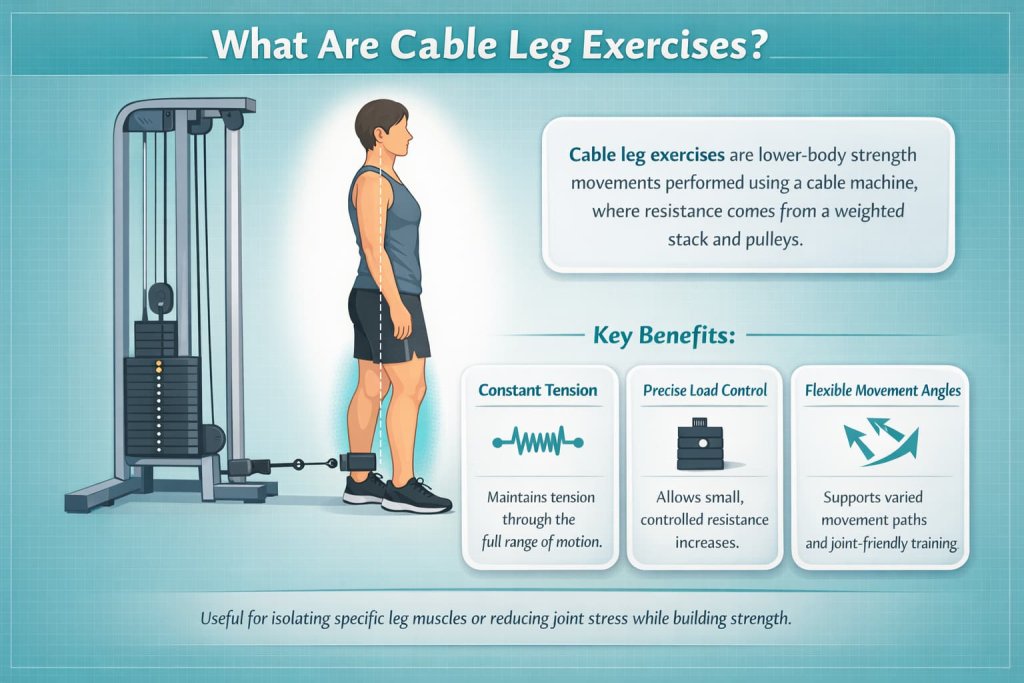
Understanding how to use the cable machine for leg training matters because it helps you target the quads, glutes, hamstrings, and inner/outer thighs more consistently than many free-weight movements. With the right exercise selection and progression, cable leg exercises can support muscle strength, balance, and long-term lower-body function.
10 Best Cable Leg Exercises for Stronger, Leaner Legs
Below are some of the most effective and commonly used cable leg exercises, organized to cover all major lower-body muscles.
1. Cable Squat
How to do it
- Attach a straight bar or rope to a low pulley.
- Face the machine and hold the handle close to your chest.
- Step back to create tension and stand with feet shoulder-width apart.
- Sit down into a squat while keeping your chest tall.
- Push through your heels to return to standing.
Why it works
The cable’s forward pull encourages an upright torso, which helps keep tension on the quads and glutes while reducing excessive forward lean.
Muscles worked
Quadriceps, gluteus maximus, hamstrings, core stabilizers.
Trainer Tip
Let the cable guide your balance—don’t rush the descent. Control improves muscle engagement.
2. Cable Reverse Lunge
How to do it
- Hold a cable handle at chest height.
- Step backward into a lunge while maintaining cable tension.
- Lower until the back knee approaches the floor.
- Drive through the front heel to return to standing.
- Alternate legs or complete all reps on one side.
Why it works
Stepping backward shifts emphasis toward the glutes and reduces forward knee stress compared to forward lunges.
Muscles worked
Glutes, quadriceps, hamstrings, adductors.
Trainer Tip
Think “long step back” to increase glute involvement and stability.
3. Cable Romanian Deadlift
How to do it
- Attach a straight bar to a low pulley.
- Stand tall and hinge at the hips while keeping the bar close to your legs.
- Lower until you feel tension in the hamstrings.
- Drive hips forward to stand up tall.
- Keep knees softly bent throughout.
Why it works
The constant pull from the cable maintains hamstring tension through the entire hinge pattern.
Muscles worked
Hamstrings, glutes, erector spinae.
Trainer Tip
Stop the descent once your back would round—range of motion should never sacrifice form.
4. Cable Step-Back Squat
How to do it
- Hold a cable handle at chest level.
- Step one foot backward into a split squat stance.
- Lower into a squat while maintaining cable tension.
- Push through the front foot to stand.
- Switch sides after completing reps.
Why it works
Unilateral loading challenges balance while allowing controlled resistance that improves leg symmetry.
Muscles worked
Quadriceps, glutes, hamstrings, core.
Trainer Tip
Keep hips square and avoid twisting toward the cable.
5. Cable Pull-Through
How to do it
- Attach a rope to a low pulley and face away from the machine.
- Hold the rope between your legs.
- Hinge at the hips while keeping your spine neutral.
- Drive hips forward and squeeze glutes at the top.
- Return slowly under control.
Why it works
The cable pulls from behind, reinforcing a proper hip hinge and glute-driven extension.
Muscles worked
Glutes, hamstrings, lower back stabilizers.
Trainer Tip
Imagine pushing the floor away with your heels to maximize glute activation.
6. Cable Leg Curl (Ankle Strap)
How to do it
- Attach an ankle strap to a low pulley.
- Stand facing the machine and hold it for balance.
- Curl your heel toward your glutes.
- Pause briefly at the top.
- Lower slowly and repeat.
Why it works
The cable provides smooth, continuous tension during knee flexion, ideal for isolating the hamstrings.
Muscles worked
Hamstrings (biceps femoris, semitendinosus, semimembranosus).
Trainer Tip
Slow down the lowering phase to increase time under tension.
7. Cable Leg Extension (Ankle Strap)
How to do it
- Attach an ankle strap to a low pulley behind you.
- Stand facing away from the machine.
- Extend the knee until the leg is straight.
- Pause briefly at the top.
- Return under control.
Why it works
Cables allow quad-focused work without heavy joint compression.
Muscles worked
Quadriceps (rectus femoris, vastus muscles).
Trainer Tip
Use lighter weight and strict control—momentum reduces quad activation.
8. Cable Hip Abduction
How to do it
- Attach an ankle strap to a low pulley.
- Stand sideways to the machine.
- Move the outside leg away from your body.
- Pause briefly at the end range.
- Return slowly.
Why it works
Targets the outer hip muscles that support pelvic and knee stability.
Muscles worked
Gluteus medius, gluteus minimus.
Trainer Tip
Keep your torso upright—leaning reduces effectiveness.
9. Cable Hip Adduction
How to do it
- Attach an ankle strap to a low pulley.
- Stand sideways with the working leg farthest from the machine.
- Pull the leg inward across your body.
- Pause briefly, then return under control.
- Switch sides.
Why it works
Strengthens inner thigh muscles that contribute to balance and lower-body control.
Muscles worked
Hip adductors (adductor longus, brevis, magnus).
Trainer Tip
Avoid swinging—slow reps improve control and muscle engagement.
10. Cable Standing Calf Raise
How to do it
- Hold a cable handle for balance.
- Stand with feet hip-width apart.
- Rise onto the balls of your feet.
- Pause briefly at the top.
- Lower slowly until heels reach the floor.
Why it works
The cable allows steady resistance without loading the spine.
Muscles worked
Gastrocnemius, soleus.
Trainer Tip
Pause at the top for 1–2 seconds to improve calf activation.
How to Program Cable Leg Exercises
For most adults, cable leg exercises can be programmed similarly to other resistance movements.
General guidelines:
- Frequency: 2–3 lower-body sessions per week
- Sets: 2–4 per exercise
- Reps: 8–15 for most movements
- Rest: 60–90 seconds between sets
The American College of Sports Medicine recommends progressive overload—gradually increasing resistance or volume as strength improves—while maintaining good form.
Cable Leg Exercises for Beginners
Cable machines are especially beginner-friendly because:
- Resistance is easy to adjust
- Movements are guided and predictable
- Balance demands are often lower than free weights
Beginners may start with:
- Cable squats
- Cable reverse lunges
- Cable leg curls
Focus on slow, controlled reps and stop sets before form breaks down.
Common Mistakes to Avoid During Cable Leg Exercises
Avoid these common issues to reduce injury risk:
- Using too much weight and relying on momentum
- Poor cable setup (incorrect pulley height or stance)
- Rushing through reps without control
- Ignoring unilateral work, which can address strength imbalances
Proper setup and controlled tempo matter more than heavy loads.
When to Modify or Stop Cable Leg Exercises
You should modify or stop if you experience:
- Sharp or sudden joint pain
- Loss of balance or control
- Persistent discomfort that does not improve with rest
The National Institute of Arthritis and Musculoskeletal and Skin Diseases advises seeking professional evaluation if pain is severe, persistent, or limits daily activity.
Frequently Asked Questions (FAQs)
Are cable leg exercises effective for building muscle?
Yes. When performed with sufficient resistance and progressive overload, cable leg exercises can support muscle strength and hypertrophy.
Can cable leg exercises replace free weights?
They can complement or temporarily replace free weights, but many programs benefit from using both.
Are cable leg exercises safe for knees?
They may be more joint-friendly for some people due to smoother resistance and controlled movement paths.
How often should I do cable leg exercises?
Most adults benefit from training legs 2–3 times per week, depending on recovery and goals.
Can beginners use cable machines?
Yes. Cable machines are often easier to learn and adjust than free weights.
Do cable leg exercises help with balance?
Unilateral cable movements can improve balance and lower-body control.
Conclusion
Cable leg exercises offer a versatile, joint-friendly way to build stronger, leaner legs while maintaining consistent muscle tension. By selecting the right movements and progressing gradually, you can effectively train all major lower-body muscles and support long-term strength and function.
If you want structured progress, consider building a full lower-body routine around these cable leg exercises and adjusting loads as your strength improves.