
A cable crossover is one of the best chest isolation moves for constant tension and better control of your range of motion. When you set the pulleys correctly and keep your shoulders stable, it can be a reliable finisher for chest growth and definition.
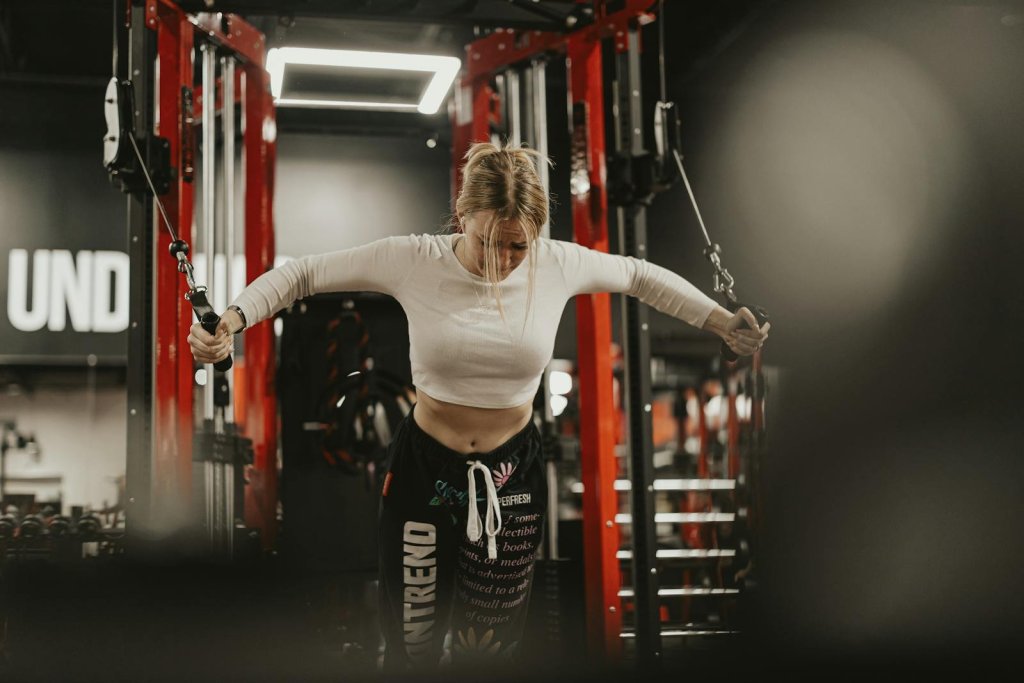
This guide breaks down the exact setup, form cues, and the best cable angles so you can feel your pecs working without turning the movement into a shoulder-dominant swing.
What Is a Cable Crossover?
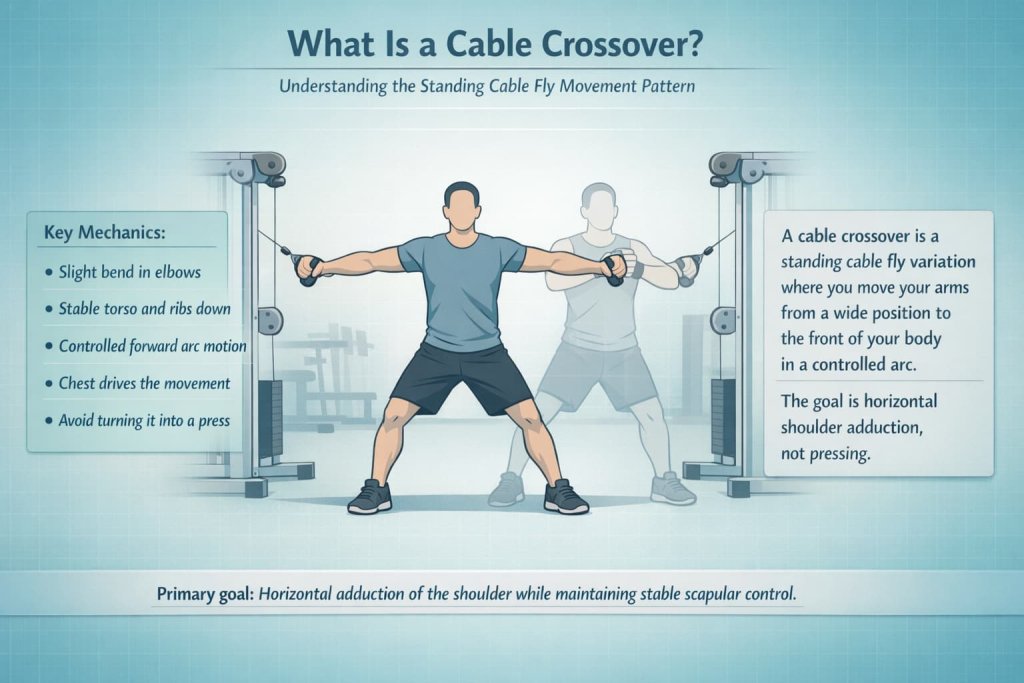
A cable crossover is a standing cable fly variation where you bring your arms from a wide position to the front of your body in a controlled hugging arc. Unlike a press, the goal is shoulder horizontal adduction (bringing the upper arm across the body) so the chest stays the main driver.
Cable Crossover Setup Checklist
Before you do a single rep, get the setup right. Most “I don’t feel it in my chest” issues start here.
Quick setup steps:
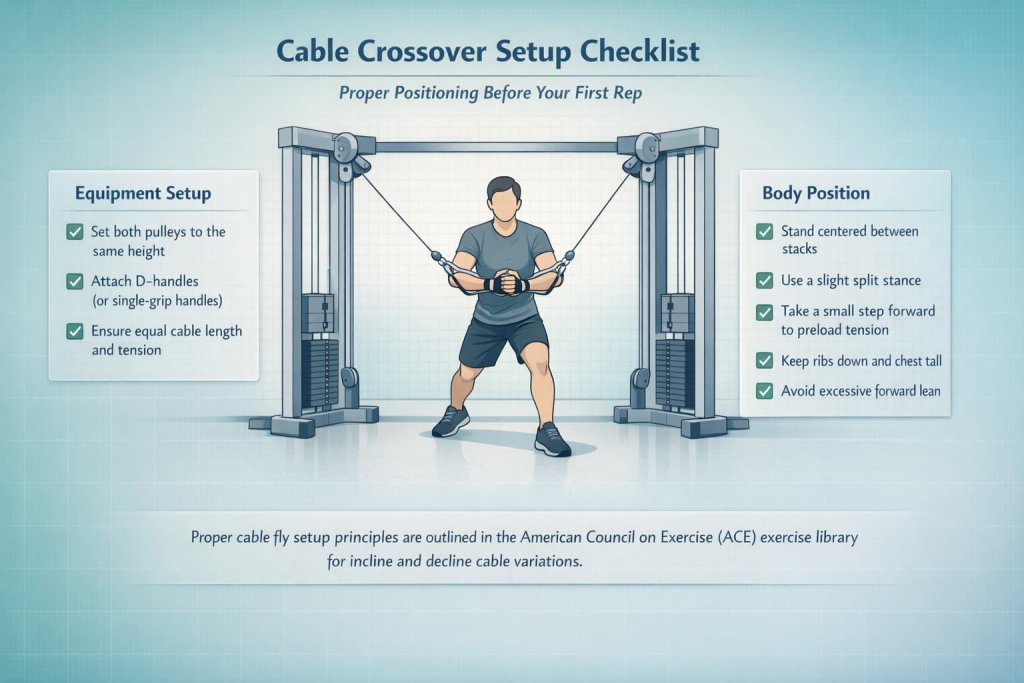
- Set both pulleys to the same height.
- Choose D-handles (or single-grip handles).
- Stand centered between the stacks, one foot slightly in front.
- Take a small step forward to create tension before you start the rep.
- Brace your ribs down and keep your chest proud (no excessive lean).
Cable Crossover Proper Form
Body Position and Joint Alignment
Use these form rules on every rep:
- Keep a slight bend in your elbows (do not lock out or over-bend).
- Keep shoulders set (avoid shrugging or rolling forward).
- Maintain a stable torso (no swinging or bouncing).
- Think “wrap the chest,” not “push the hands.”
Step-by-Step Cable Crossover Reps
How to do it:
- Step forward until the cables feel loaded at the start.
- Start with hands slightly behind your torso line only if it feels shoulder-friendly.
- Sweep your hands forward in an arc, keeping the elbow angle mostly the same.
- Stop when your hands meet in front of your chest (or slightly in front of your sternum).
- Pause briefly and squeeze the pecs.
- Return slowly until you feel a controlled stretch in the chest, then repeat.
Muscles Worked in a Cable Crossover
The primary target is the pectoralis major (your main chest muscle). You also use supporting muscles to keep your shoulders and torso steady.
Main muscles involved:
- Pectoralis major (sternal and clavicular fibers, depending on angle)
Secondary support:
- Anterior deltoids (front shoulders)
- Serratus anterior and scapular stabilizers
- Core and glutes (to prevent swaying and rib flare)
Why Cable Crossovers Are Effective for Chest Growth
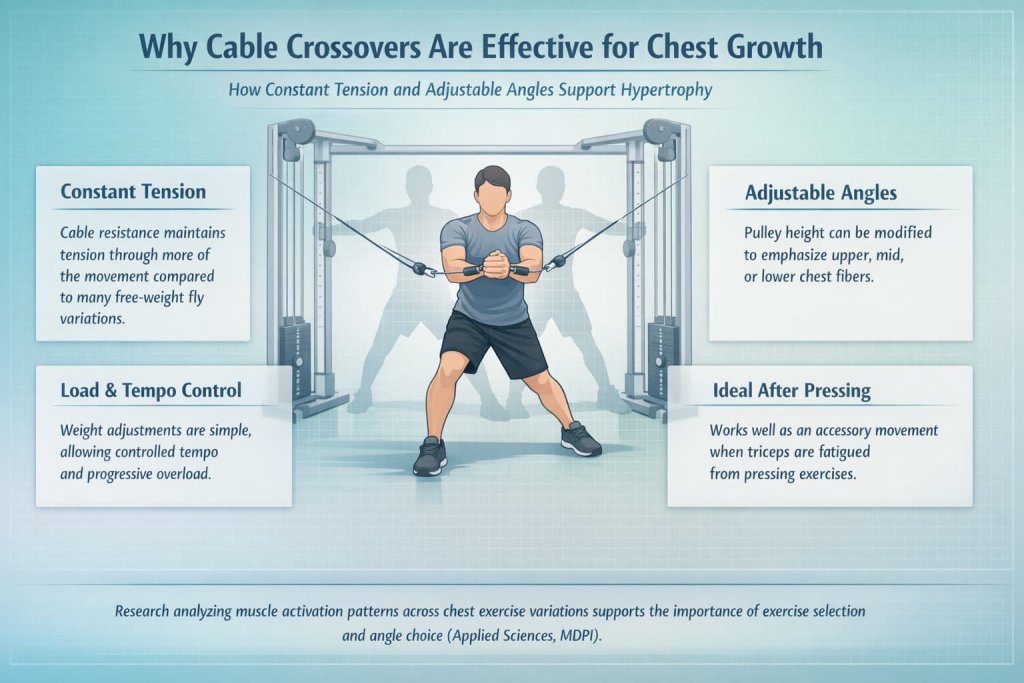
Cable crossovers are popular because they make it easier to keep tension on the chest throughout the rep.
Key benefits:
- Constant resistance through more of the range of motion compared with many dumbbell fly patterns
- Easy angle changes to bias different chest regions
- Simple to adjust load and control tempo
- Great accessory after presses when your triceps are already fatigued
Research comparing chest exercise variations often analyzes muscle activation patterns across movements and angles, which helps explain why exercise selection and execution matter for chest training, as discussed in a systematic review published in Applied Sciences (MDPI).
Best Cable Crossover Angles and What They Hit
Changing cable height changes the line of pull. In practice, you will feel different areas of your chest working harder.
Low-to-High Cable Crossover
What it emphasizes:
- Often feels more upper chest focused for many lifters
How to set it:
- Handles low (near ankle to knee height)
- Sweep up toward upper chest or collarbone line
Mid-Height Cable Crossover
What it emphasizes:
- Most balanced mid-chest feel for many people
How to set it:
- Handles around mid-chest to shoulder height
- Bring hands together in front of sternum
High-to-Low Cable Crossover
What it emphasizes:
- Often feels more lower chest focused for many lifters
How to set it:
- Handles high (above head height)
- Sweep down toward lower chest or upper abs line
Best Reps, Sets, and Weight for Cable Crossovers
Cable crossovers tend to work best as a controlled hypertrophy accessory, not a max-strength lift.
Practical starting guidelines:
- Sets: 2–4
- Reps: 10–15 (sometimes 15–20 if you can keep perfect form)
- Rest: 60–90 seconds
- Effort: Stop with 1–3 reps in reserve most of the time
Where Cable Crossovers Fit in a Chest Workout
Best placement:
- After your main press (bench press, dumbbell press, or machine press)
- As a second or third chest exercise
- As a finisher when you want a pump without heavy joint loading
Simple example:
- Press variation: 3–5 sets
- Secondary press or machine: 2–4 sets
- Cable crossovers: 2–4 sets of 10–15
Common Cable Crossover Mistakes
These are the most common reasons people feel cable crossovers in shoulders or arms instead of the chest.
Mistakes to avoid:
- Swinging your torso to move heavier weight
- Letting shoulders roll forward at the finish
- Turning it into a press (elbows bending more each rep)
- Going too deep into the stretch if it irritates the front shoulder
- Crossing hands aggressively past midline
Cable Crossover Variations for Different Goals
1. Single-Arm Cable Crossover
Why it works:
Training one arm at a time increases focus on unilateral control and exposes strength or coordination differences between sides. It also reduces compensation from the stronger side and can improve shoulder stability because your torso must resist rotation.
Muscles worked:
Pectoralis major (primary), anterior deltoid, serratus anterior, obliques and deep core stabilizers (anti-rotation support).
How to do it:
- Set one handle at your desired height (mid, high, or low).
- Stand in a split stance with the working arm slightly behind your torso.
- Lightly brace your free hand against your torso or the cable column.
- Sweep the handle forward in a controlled arc.
- Stop when your hand reaches midline of your chest.
- Slowly return to the start without rotating your torso.
Trainer Tip:
Keep your hips and ribs square. If your body twists toward the cable stack, the weight is too heavy.
2. Cable Crossover With a Slight Pause
Why it works:
Adding a pause increases time under tension and improves mind–muscle connection. It reduces momentum and forces the chest to stay engaged at peak contraction.
Muscles worked:
Pectoralis major (emphasis on peak contraction), anterior deltoid, scapular stabilizers.
How to do it:
- Perform a standard cable crossover at your chosen pulley height.
- Bring the handles together in front of your chest.
- Pause for 1–2 seconds while squeezing the pecs.
- Keep your ribs down and shoulders stable.
- Return slowly under control.
Trainer Tip:
Do not let your shoulders roll forward during the pause. Think “chest tall, squeeze inward.”
3. Cable Fly (No Crossover)
Why it works:
Removing the crossover reduces excessive shoulder protraction and may feel more shoulder-friendly for some lifters. It keeps the focus on controlled horizontal adduction rather than overreaching past midline.
Muscles worked:
Pectoralis major (sternal and clavicular fibers depending on angle), anterior deltoid, serratus anterior.
How to do it:
- Set both cables to your preferred height.
- Stand centered with a slight forward step.
- Bring the handles together until your hands meet in front of your sternum.
- Stop without crossing hands over each other.
- Return slowly to a controlled stretch.
Trainer Tip:
Focus on “bringing your biceps together,” not your hands. This cue often improves chest engagement without overextending the shoulders.
Who Should Avoid or Modify Cable Crossovers?
Be cautious and modify the range or angle if you have:
- Shoulder pain with horizontal adduction or stretching positions
- A history of shoulder instability or recent shoulder injury
- Sharp pain at the bottom range
Smart modifications:
- Reduce range of motion
- Use lighter loads with slower tempo
- Try mid-height flies instead of deep high-to-low crossovers
- Keep hands meeting in front of the chest rather than crossing far past midline
If pain is persistent or worsening, consult a qualified healthcare professional.
Frequently Asked Questions
Are cable crossovers better than bench press for chest growth?
Not better—different. Bench pressing is typically better for heavier loading, while cable crossovers are excellent for controlled tension after pressing.
Should I cross my hands at the top?
Most lifters do not need a large crossover. Bring the hands together and squeeze the chest without forcing excessive shoulder rounding.
What cable height is best for upper chest?
Many people feel low-to-high crossovers more in the upper chest region, but body position and arm path matter just as much.
Why do I feel cable crossovers in my shoulders?
Common causes include shoulder rounding, excessive depth, too much weight, or turning the movement into a press. Lighten the load and control the arc.
Can beginners do cable crossovers?
Yes, if they start light and focus on posture and control. Mid-height cables are often the easiest starting point.
How many times per week should I do cable crossovers?
Most people benefit from 1–3 times per week depending on total chest volume and recovery.
What’s a good tempo for cable crossovers?
A controlled 2–3 second lowering phase and a smooth lift works well. A brief pause at the squeeze can increase tension.
Conclusion
Cable crossovers are a high-value chest accessory when you prioritize setup, control, and the right cable angle for your goal. Keep the movement strict, choose a pulley height you can feel in your pecs, and use them after presses to add quality volume without relying on momentum.
References
- American Council on Exercise (ACE) Exercise Library: Standing Incline Cable Flyes
- American Council on Exercise (ACE) Exercise Library: Standing Decline Cable Flyes
- American Council on Exercise (ACE): Correct Cues for Scapular Motion
- Applied Sciences (2023): EMG Activity of the Pectoralis Major During Bench Press and Other Pectoral Exercises (Systematic Review and Meta-Analysis)
- PubMed: ACSM Position Stand (2009) Progression Models in Resistance Training for Healthy Adults
- National Library of Medicine (NCBI Bookshelf): Anatomy, Thorax, Pectoralis Major (StatPearls)
- PubMed Central (PMC): Electromyographic Comparison of Upper-Limb Muscle Activity During Chest Press Variations