
The Arnold press is a dumbbell shoulder press variation that adds rotation, helping you train the delts through a longer range of motion than a standard press. If you want fuller-looking shoulders and a solid overhead strength builder, it’s a smart accessory move when you do it with controlled form and an appropriate load.
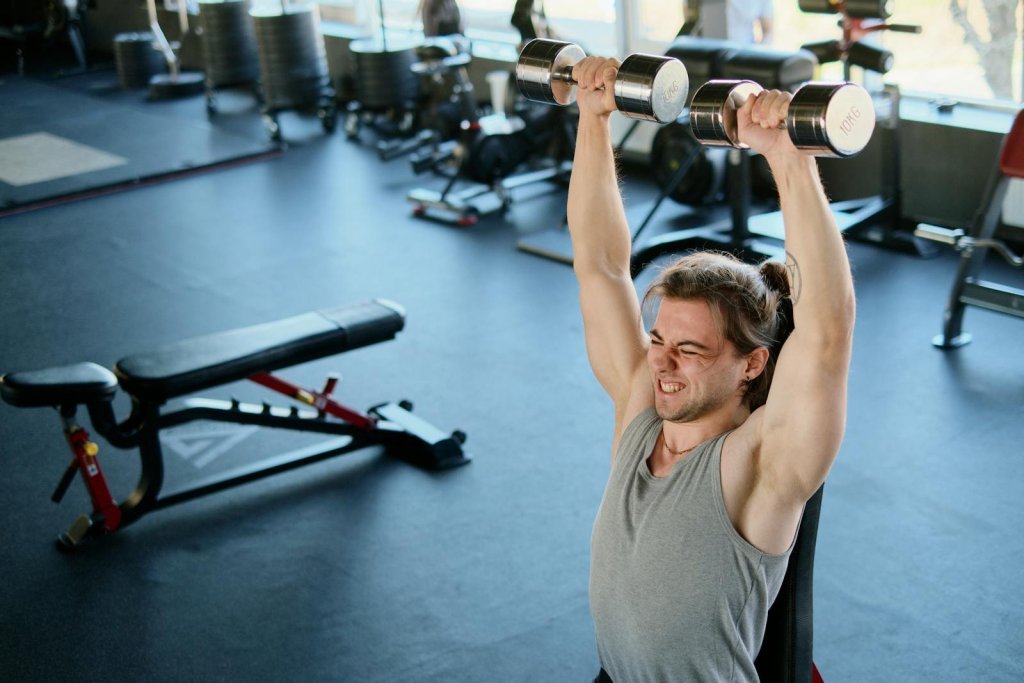
You’ll find the Arnold press in many shoulder programs because it’s simple to set up, easy to progress, and hits the shoulder from multiple angles. A step-by-step setup matters, though, because the rotation changes how your shoulder joint is loaded.
What Is the Arnold Press?
The Arnold press is an overhead dumbbell press where your palms start facing your body (neutral-to-in) and rotate outward as you press overhead. On the way down, you reverse the same path back to the start. The goal is one smooth “press-and-rotate” motion rather than two separate moves.
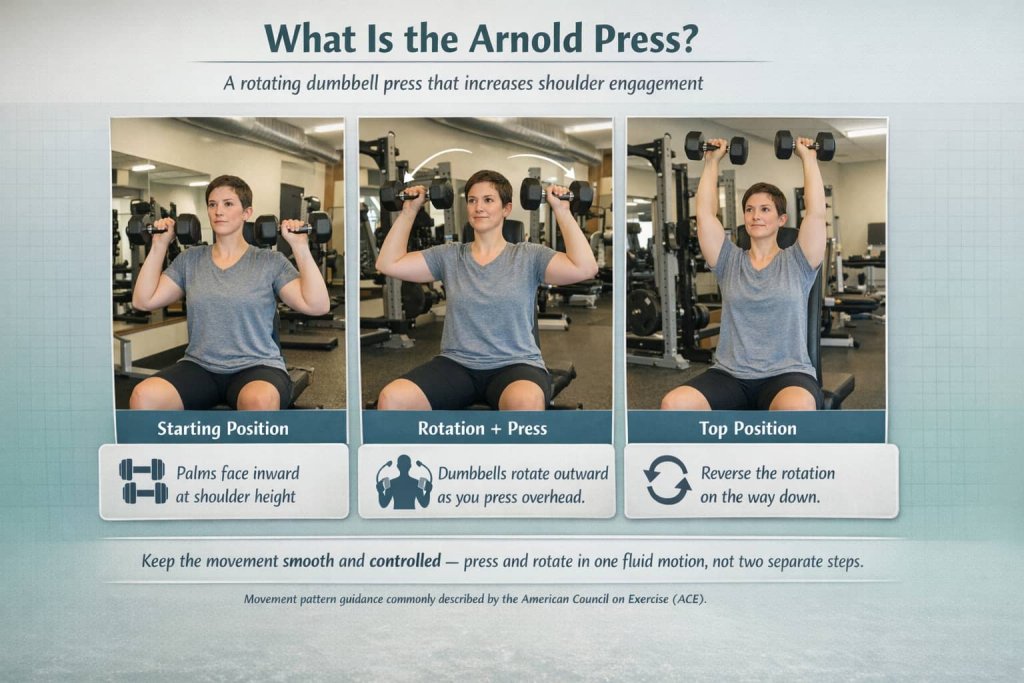
A clear breakdown of the movement pattern is explained by the American Council on Exercise, including how the palms start and finish during the press.
How to Do the Arnold Press With Proper Form
How to do it:
- Sit on a bench with back support (easiest to learn) or stand tall with ribs down and core braced
- Start with dumbbells at shoulder height, elbows slightly in front of your body, palms facing you
- Begin pressing up and rotate your hands so your palms face forward near the top
- Finish overhead without shrugging your shoulders up toward your ears
- Lower with control and rotate back so palms face you again at shoulder level
- Keep the reps smooth and steady (no bouncing)
Trainer Tip: Start lighter than your normal dumbbell shoulder press. If your reps get jerky during the turn, the weight is too heavy for the rotation you’re trying to control.
Arnold Press Variations and Progressions
Arnold press variations like seated, standing, and alternating versions help target your shoulders from different angles while improving stability and control. Progress gradually by adjusting load, tempo, or position to build strength safely and effectively.
1. Seated Arnold Press
Why it works: Sitting down reduces lower-body involvement and momentum, helping you focus purely on shoulder control and smooth rotation. It’s ideal for learning proper mechanics and maintaining consistent tension on the delts.
Muscles worked: Primarily anterior and lateral deltoids, triceps, and upper back stabilizers. Reduced leg drive increases shoulder demand.
How to do it:
- Sit on a bench with back support and feet flat on the floor
- Hold dumbbells at shoulder height, palms facing you
- Press upward while rotating palms outward
- Finish overhead without arching your lower back
- Lower slowly, reversing the rotation
- Maintain steady tempo throughout
Trainer Tip: Keep your head and upper back lightly pressed against the bench. If your shoulders shrug up, lower the weight and reset your posture.
2. Standing Arnold Press
Why it works: Standing increases total-body stabilization, engaging your core and glutes to control the press. It improves coordination and shoulder strength in a more functional position.
Muscles worked: Deltoids, triceps, upper back stabilizers, core muscles, and glutes for postural control.
How to do it:
- Stand tall with feet hip-width apart
- Brace your core and lightly squeeze your glutes
- Start with palms facing you at shoulder height
- Press upward while rotating palms forward
- Finish with arms extended overhead
- Lower under control, rotating back to the start
Trainer Tip: Avoid leaning back as the weight goes overhead. If you feel pressure in your lower back, switch to seated or reduce the load.
3. Alternating Arnold Press
Why it works: Pressing one arm at a time slows the movement, increases time under tension, and challenges shoulder stability. It also helps correct strength imbalances between sides.
Muscles worked: Deltoids and triceps on the working side, with added core activation for anti-rotation stability.
How to do it:
- Sit or stand with dumbbells at shoulder height
- Press and rotate one arm overhead while the other stays in the start position
- Lower that arm with control
- Repeat on the opposite side
- Continue alternating for the desired reps
Trainer Tip: Keep your torso steady and avoid shifting side to side. Move deliberately to maintain control.
4. Swap Option: Dumbbell Shoulder Press
Why it works: Removing the rotation simplifies the movement and may feel more comfortable for some shoulders. It allows you to lift heavier loads while still building shoulder strength.
Muscles worked: Primarily anterior and lateral deltoids, triceps, and upper back stabilizers.
How to do it:
- Sit or stand with dumbbells at shoulder height, palms facing forward
- Press straight overhead without rotating
- Lock out gently at the top
- Lower under control to shoulder height
- Keep ribs down and core braced
Trainer Tip: If rotation in the Arnold press causes discomfort, use this variation while continuing to strengthen your shoulders safely.
Arnold Press Muscles Worked
The Arnold press primarily targets the deltoids, with strong assistance from the triceps. The upper back and shoulder-blade muscles contribute to stability, especially when you keep the motion slow and controlled.
Many consumer health explainers describe the movement as a shoulder-dominant press that can increase overall shoulder involvement compared with a basic dumbbell press.
Common Arnold Press Mistakes That Limit Results
Turning it into two separate moves
If you rotate first and then press, you lose the smooth continuous tension that makes the Arnold press different. Aim for one clean arc.
Over-arching the lower back
This often happens when the weight is too heavy or your overhead mobility is limited. If your ribs flare up, switch to seated, reduce load, or shorten the range slightly.
Shrugging at the top
If your traps take over, your shoulders may not be stacking well. Think “reach up” without hiking the shoulders, and keep the neck long.
Arnold Press Benefits for Shoulder Size and Strength
More shoulder stimulus per rep
Because the press includes rotation and a longer path, many lifters feel it challenges more of the delt throughout the rep compared with a straight up-and-down press.
Great accessory lift for overhead strength days
If you already bench or overhead press heavy, the Arnold press can fit well as a moderate-load accessory to add volume without maxing out.
Helpful variety when standard pressing stalls
If you’ve done the same press variation for months, changing the stimulus (grip, path, tempo) can help you train hard without chasing heavier weights every week.
Who Should Avoid or Modify the Arnold Press
If you have current shoulder pain, a history of shoulder impingement, or limited overhead mobility, use extra caution. During arm elevation, healthy shoulder mechanics typically involve coordinated shoulder-blade motion (including upward rotation and posterior tilting), and poor control can contribute to irritation in some people. A detailed biomechanics overview of shoulder elevation mechanics is available through PubMed Central.
Practical modifications:
- Use a lighter load and a slower tempo
- Switch to a standard dumbbell shoulder press if rotation feels uncomfortable
- Use a partial range (stop slightly above eye level) if end-range overhead bothers you
- Consider a beginner-friendlier press variation if you’re new to overhead lifting.
How to Program the Arnold Press for Muscle Growth
A simple, effective approach:
- 2–4 sets of 8–12 reps
- Stop 1–3 reps before form breaks down
- Use it 1–2 times per week as an accessory after your main press
For most people, pairing shoulder work with a consistent weekly plan is more important than finding a single perfect exercise. Meeting basic strength-training frequency recommendations, such as those outlined by the Centers for Disease Control and Prevention, can help support overall muscle development and health.
People Also Ask About the Arnold Press
Is the Arnold press better than a shoulder press?
It’s not automatically better. The Arnold press adds rotation and often increases the movement path, while a standard shoulder press is simpler and usually easier to load heavier.
Does the Arnold press build all three deltoid heads?
It can involve the delts broadly, but no single press perfectly isolates every head. For balanced shoulders, combine pressing with lateral raise and rear-delt-focused pulling work.
FAQ
1) How heavy should I go on the Arnold press?
Start lighter than your normal dumbbell press so you can control the rotation without pain or wobbling.
2) Should I do the Arnold press seated or standing?
Seated is usually best for learning form. Standing adds more stability demand and is a good progression.
3) Can I do the Arnold press if I have shoulder pain?
If you have pain, it’s safer to avoid painful ranges and consider a different press variation. If pain persists, consider getting guidance from a qualified clinician or trainer.
4) Is it normal to feel this mostly in the front delts?
Yes, many people feel it strongly in the front delts. For more balanced development, also train lateral delts and rear delts with raises and rowing variations.
5) How often should I train Arnold presses?
Most lifters do well with 1–2 sessions per week as an accessory lift, depending on total shoulder volume.
6) What’s the biggest form cue that improves the Arnold press?
Keep it smooth. If the rotation becomes choppy, reduce the weight and slow down.
7) What should I do if my lower back arches during reps?
Switch to seated, reduce the load, brace your core, and keep your ribs down throughout the set.
Conclusion
The Arnold press is a classic shoulder builder because it combines pressing strength with a longer, rotating range of motion that can challenge the delts in a different way. Keep it controlled, start lighter than you think, and use it as an accessory move alongside other shoulder staples for the best long-term results.
References
- American Council on Exercise (ACE) — Dynamite Delts: ACE Research Identifies Top Shoulder Exercises
- National Strength and Conditioning Association (NSCA) — Shoulder Function During Overhead Lifting Tasks
- British Journal of Sports Medicine (BJSM) — Scapular Dyskinesis and Risk of Future Shoulder Pain
- Journal of Orthopaedic & Sports Physical Therapy (JOSPT) — 2022 Bern Consensus Statement on Shoulder Injury Prevention and Load Management
- PubMed Central (NIH) — Therapeutic Exercise for Subacromial Impingement (Systematic Review)
- World Health Organization (WHO) — Physical Activity Recommendations