
Morning exercises for women can be as simple as 10–20 minutes of mobility, strength, and light cardio that helps you wake up your body, build consistency, and chip away at weekly fitness targets. Major public-health guidelines recommend at least 150 minutes of moderate activity per week plus muscle-strengthening on two or more days, and a short morning routine is an easy way to work toward that goal, as outlined by the Centers for Disease Control and Prevention (CDC) and the World Health Organization (WHO).
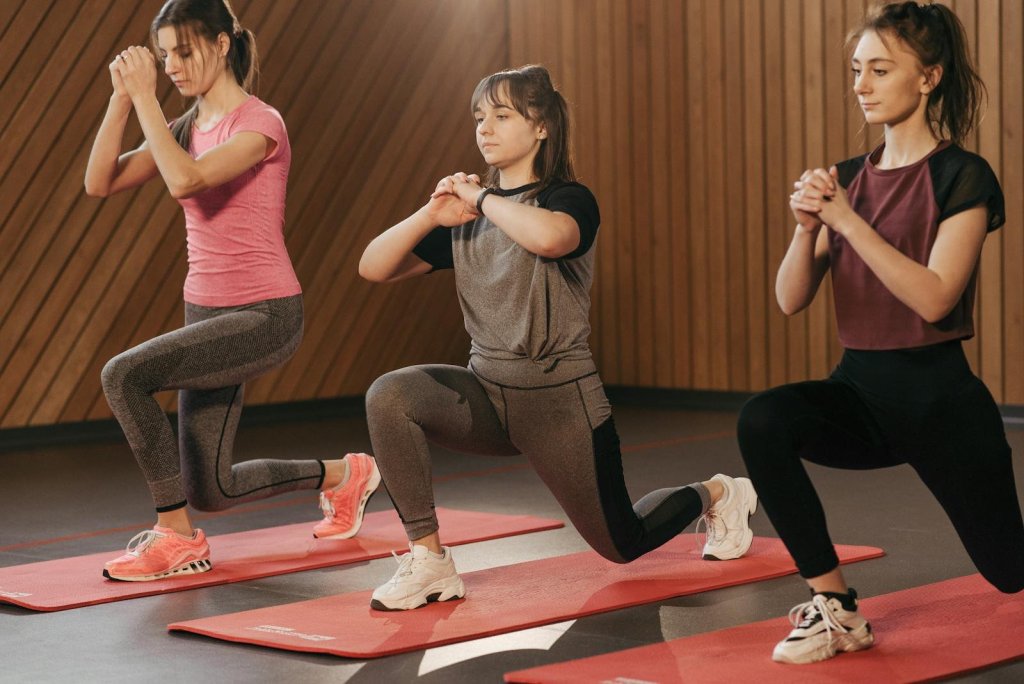
Below is an 11-exercise list designed to cover mobility, strength, core stability, balance, and light cardio—key components of a well-rounded fitness routine.
Why morning exercises for women can work so well
Morning workouts aren’t inherently better than workouts done later in the day, but they can be easier to stick with. Research suggests that consistent exercise timing may support long-term adherence, and some studies indicate that morning exercise may influence sleep timing and daily energy levels for certain individuals. Consistency, however, remains the most important factor.
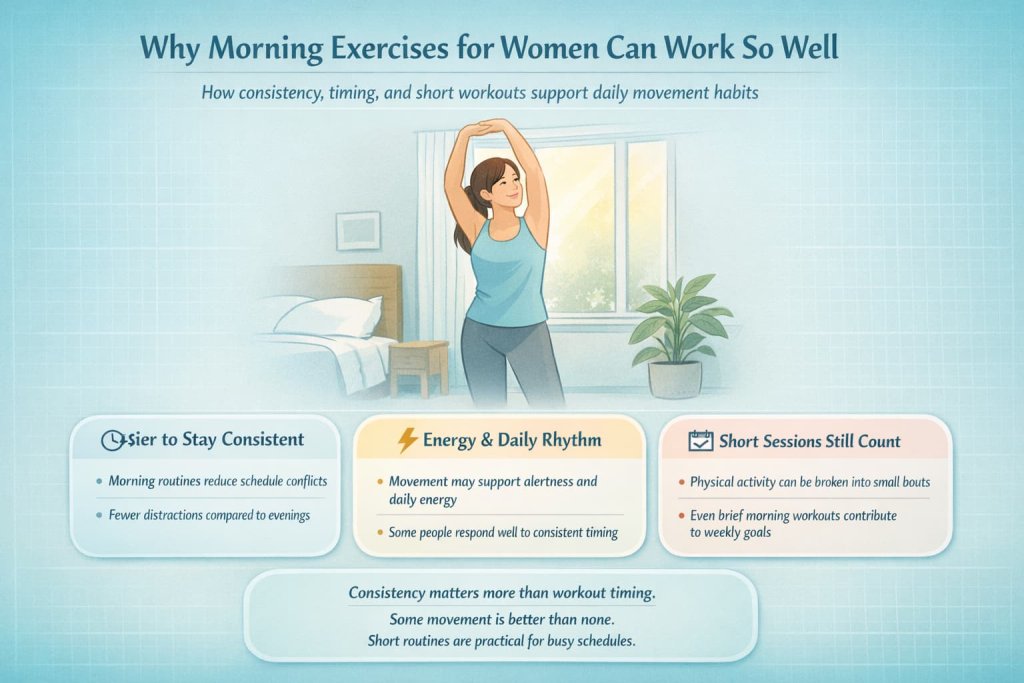
From a public-health perspective, the CDC emphasizes that physical activity can be broken into smaller sessions and that some movement is always better than none, making short morning workouts a practical option for busy schedules.
Why Morning Exercises for Women Matter
Morning exercise helps gently wake up the body and set a positive tone for the day.
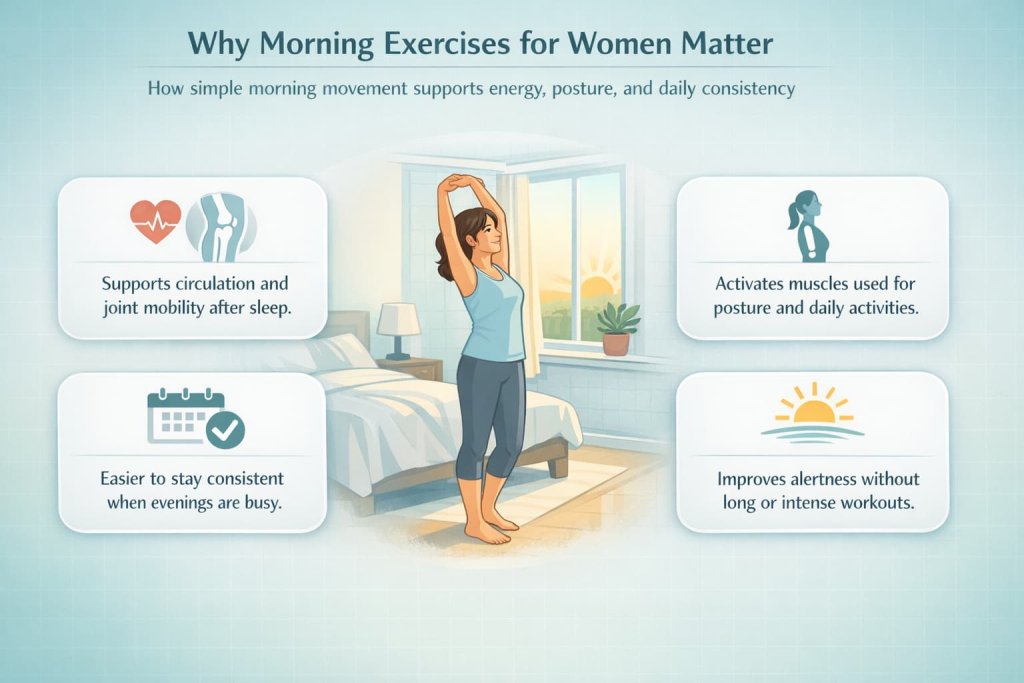
- Supports circulation and joint mobility after sleep
- Helps activate muscles used for posture and daily movement
- Encourages consistency when evenings are busy
- Can improve energy and focus without long workouts
11 best morning exercises for women
This list is designed to reflect commonly recommended exercise categories—mobility, resistance training, core stability, and balance—as supported by guidance from organizations such as the American College of Sports Medicine (ACSM).
1) Diaphragmatic Breathing With Rib Reset
How to do it
- Lie on your back with knees bent and feet flat on the floor
- Place one hand on your chest and one on your ribs
- Inhale slowly through your nose, allowing the rib cage to expand outward
- Exhale fully through the mouth and feel the ribs gently drop down
- Perform 5–8 slow, controlled breaths
Why it works
This breathing pattern helps reset rib and pelvic position after sleep, encouraging better trunk control and reducing early-morning stiffness. It prepares your core for movement before adding strength or mobility work.
Muscles worked
Diaphragm, deep abdominal muscles (including the transverse abdominis), pelvic floor, and intercostal muscles.
Trainer Tip
If your shoulders rise during inhalation, slow the breath and focus on expanding the ribs sideways rather than upward.
2) Cat-Cow
How to do it
- Start on hands and knees with wrists under shoulders and knees under hips
- Inhale as you gently arch your back and lift your chest
- Exhale as you round your spine and tuck your chin slightly
- Move slowly through the range for 6–10 repetitions
Why it works
Cat-cow moves the spine through flexion and extension in a controlled way, helping lubricate spinal joints and improve awareness of spinal movement first thing in the morning.
Muscles worked
Spinal extensors, abdominal muscles, hip flexors, and muscles surrounding the spine.
Trainer Tip
Avoid forcing the end ranges. The goal is smooth, comfortable motion—not maximal stretch.
3) World’s Greatest Stretch (Lunge With Rotation)
How to do it
- Step one foot forward into a long lunge position
- Place both hands inside the front foot
- Gently rotate your chest toward the front knee
- Return to center and repeat for 3–5 repetitions per side
Why it works
This movement combines hip mobility, thoracic rotation, and core engagement, making it an efficient full-body warm-up exercise.
Muscles worked
Hip flexors, glutes, hamstrings, spinal rotators, and core stabilizers.
Trainer Tip
If balance feels challenging, drop the back knee to the floor to reduce load and improve control.
4) Glute Bridge
How to do it
- Lie on your back with knees bent and feet hip-width apart
- Press through your heels and lift your hips upward
- Pause briefly at the top while keeping ribs down
- Lower slowly and repeat for 8–12 repetitions
Why it works
Glute bridges strengthen the hips while reinforcing proper hip extension, which can help counter prolonged sitting and improve lower-body mechanics.
Muscles worked
Gluteus maximus, hamstrings, and core stabilizers.
Trainer Tip
Avoid arching your lower back at the top—think “ribs down, hips up.”
5) Squat to Chair (or Air Squat)
How to do it
- Stand with feet about shoulder-width apart
- Sit back toward a chair as if lowering to sit
- Lightly touch the chair, then stand back up
- Perform 8–10 controlled repetitions
Why it works
This exercise reinforces a fundamental daily movement pattern and helps build leg strength in a joint-friendly, accessible way.
Muscles worked
Quadriceps, glutes, hamstrings, and core muscles.
Trainer Tip
Keep your chest tall and knees tracking in line with your toes throughout the movement.
6) Reverse Lunge
How to do it
- Step one leg backward into a lunge
- Lower with control while keeping the torso upright
- Push through the front heel to return to standing
- Perform 6–10 repetitions per side
Why it works
Reverse lunges emphasize single-leg strength and balance while often placing less stress on the knees than forward lunges.
Muscles worked
Glutes, quadriceps, hamstrings, and hip stabilizers.
Trainer Tip
If balance is an issue, lightly hold onto a wall or chair for support.
7) Incline Push-Up
How to do it
- Place hands on a wall, bench, or desk
- Keep your body in a straight line from head to heels
- Lower your chest toward your hands
- Push back up and perform 6–12 repetitions
Why it works
Incline push-ups allow you to strengthen the upper body and core with adjustable difficulty, making them ideal for morning workouts.
Muscles worked
Chest, shoulders, triceps, and core muscles.
Trainer Tip
The higher the surface, the easier the exercise—adjust the height to match your strength level.
8) Row (Band, Dumbbell, or Towel)
How to do it
- Hinge slightly at the hips with a neutral spine
- Pull elbows back while squeezing shoulder blades together
- Lower with control
- Perform 8–12 repetitions
Why it works
Rows strengthen the upper back, helping balance pushing movements and support better posture throughout the day.
Muscles worked
Upper back muscles, including the latissimus dorsi, rhomboids, and rear shoulders.
Trainer Tip
Think about pulling your elbows toward your back pockets rather than shrugging your shoulders.
9) Dead Bug
How to do it
- Lie on your back with arms and legs raised
- Slowly extend the opposite arm and leg
- Keep your lower back gently pressed into the floor
- Perform 6–10 repetitions per side
Why it works
Dead bugs train core stability while minimizing spinal load, making them a safe and effective morning core exercise.
Muscles worked
Deep abdominal muscles, hip flexors, and spinal stabilizers.
Trainer Tip
Move slowly—control matters more than speed with this exercise.
10) Side Plank
How to do it
- Lie on your side with elbow under shoulder
- Lift hips to form a straight line from head to knees or feet
- Hold briefly, then switch sides
- Hold 10–20 seconds per side
Why it works
Side planks target lateral core strength, which supports balance and everyday movements like walking and lifting.
Muscles worked
Obliques, glute medius, and deep core muscles.
Trainer Tip
If full side planks feel difficult, bend the knees to reduce leverage.
11) March in Place or Step-Ups
How to do it
- March briskly in place while swinging your arms
- Or step up and down on a low platform with control
- Continue for 30–60 seconds
Why it works
This light cardio movement gently raises heart rate, improves circulation, and helps you feel more alert in the morning.
Muscles worked
Hip flexors, glutes, calves, and cardiovascular system.
Trainer Tip
Focus on upright posture and smooth rhythm rather than speed.
Quick safety check before you start
Morning exercise should feel controlled and manageable—not sharp or alarming.
Extra caution and professional guidance may be appropriate if you experience:
- Chest pain, dizziness, fainting, or severe shortness of breath with light activity
- New or worsening joint swelling, numbness, tingling, or sudden weakness
- Pregnancy or postpartum recovery considerations, where general activity guidance is outlined by the American College of Obstetricians and Gynecologists (ACOG)
How long should a morning workout be
For most women, an effective morning workout can fall into one of these ranges:
- 5 minutes: Gentle mobility and breathing on low-energy days
- 10–15 minutes: Mobility plus strength work (often the most sustainable option)
- 20 minutes: Add a short cardio component for heart-rate elevation
These timeframes align with weekly activity recommendations from the CDC and WHO, which focus on cumulative movement rather than long single sessions.
How to Structure These Morning Exercises Into a Routine
A simple structure keeps morning workouts efficient and manageable.
- Start with breathing and mobility
- Move into lower- and upper-body strength exercises
- Add core stability work
- Finish with light cardio
One circuit works for busy mornings; two circuits can be used when time allows.
How to progress safely
Progress gradually by:
- Increasing repetitions slightly
- Extending hold times by 10–15 seconds
- Reducing incline for push-ups
- Adding light resistance once technique feels solid
General resistance-training principles supported by the ACSM emphasize gradual overload and consistent practice.
Common mistakes to avoid
- Skipping warm-up movements when stiff
- Turning every morning session into a maximal workout
- Rushing through exercises with poor form
- Ignoring recovery and sleep quality
Who Should Be Careful Before Doing Morning Exercises
Some women should approach morning workouts with extra care and gradual progress.
- Pregnant or recently postpartum
- Managing chronic joint, back, or balance issues
- Returning after a long break from exercise
- Experiencing dizziness, chest discomfort, or unusual weakness
Being cautious means modifying intensity—not avoiding movement altogether.
People also ask about morning exercises for women
Are morning workouts better than evening workouts?
The best time to exercise is the time you can maintain consistently. Individual responses to exercise timing vary.
Can I exercise every morning?
Many women can, provided intensity is managed and lighter days are included.
What if I only have five minutes?
Even brief mobility and light movement sessions contribute to overall activity levels.
FAQs
What are the best morning exercises for women at home?
Exercises that combine mobility, strength, core stability, and light cardio offer a balanced approach.
Are morning exercises good for weight loss?
Morning exercise may support consistency and energy balance, but overall weekly activity and nutrition habits matter most.
What if I feel stiff in the morning?
Start with breathing and mobility, then gradually add strength work.
Conclusion
Morning exercises for women don’t need to be long or complicated. A short, repeatable routine that blends mobility, strength, and gentle cardio can help you build consistency and move closer to weekly activity targets recommended by major health organizations. Choosing movements that feel sustainable is far more important than the time of day you exercise.