
The reverse clamshell exercise is a side-lying movement that targets the hip internal rotators to improve hip strength, pelvic control, and overall lower-body stability. It’s commonly used in physiotherapy, corrective exercise, and strength programs to support better movement mechanics during walking, running, and single-leg tasks.
Understanding how to perform the reverse clamshell correctly matters because weak or poorly controlled hip rotators are often linked to knee stress, hip discomfort, and reduced balance. This guide explains what the reverse clamshell exercise does, how to do it safely, which muscles it works, and how to progress it appropriately.
What Is the Reverse Clamshell Exercise?
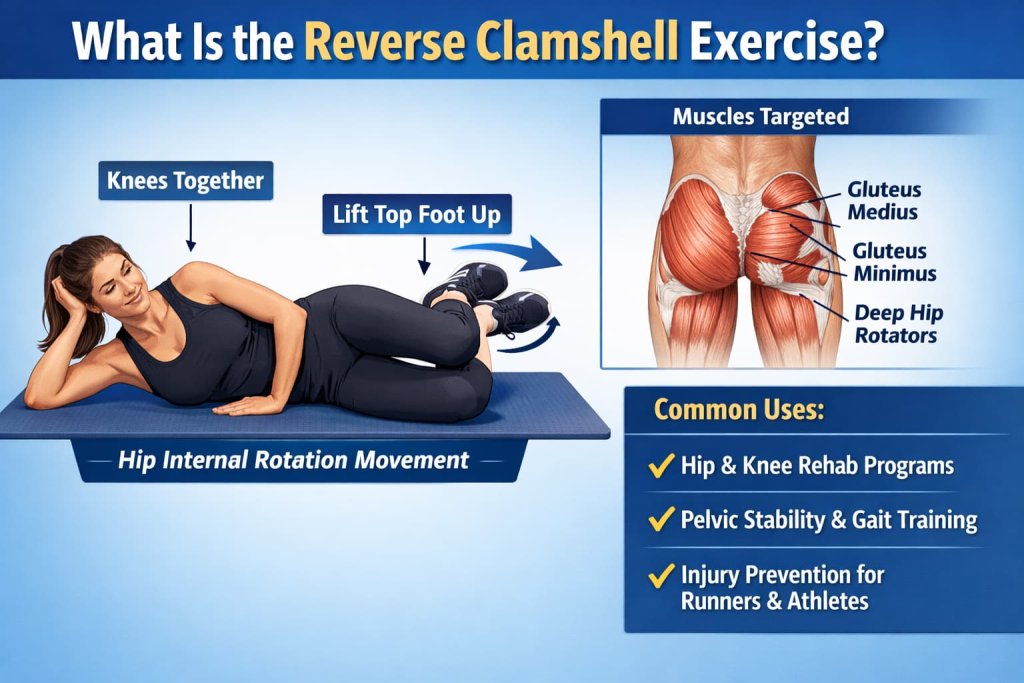
The reverse clamshell exercise is a side-lying hip internal rotation movement. Unlike the traditional clamshell (which opens the knees and emphasizes hip external rotation), the reverse clamshell keeps the knees together while the top foot lifts upward, rotating the thigh inward at the hip.
This subtle change shifts muscular emphasis toward the deep hip rotators and anterior portions of the gluteus medius and minimus, which play an important role in pelvic and femoral control.
The reverse clamshell is frequently prescribed in:
- Hip and knee rehabilitation programs
- Pelvic stability and gait retraining
- Injury-prevention routines for runners and athletes
How to Do the Reverse Clamshell Exercise Correctly
How to do it
- Lie on your side with hips and knees bent to about 90 degrees
- Stack your hips and shoulders, keeping your spine neutral
- Keep your knees gently pressed together
- Slowly lift the top foot toward the ceiling by rotating the thigh inward
- Pause briefly at the top without letting the hips roll backward
- Lower the foot slowly with control
- Repeat for the desired number of repetitions, then switch sides
Controlled movement is more important than height. Small, precise motion produces better results than forcing range.
Reverse Clamshell Exercise Benefits
Performing the reverse clamshell exercise regularly may help support:
- Improved hip internal rotation strength
- Better pelvic stability during walking and single-leg movements
- Enhanced coordination between the hip and knee
- Reduced compensatory movement from the lower back
- More balanced glute muscle function
Research on therapeutic hip exercises shows that different clamshell variations activate distinct muscle segments, reinforcing why exercise selection matters for targeted hip control rather than general strengthening alone.
Muscles Worked in the Reverse Clamshell Exercise
The reverse clamshell exercise emphasizes muscles responsible for hip internal rotation and stabilization, including:
Primary muscles
- Gluteus minimus
- Anterior fibers of the gluteus medius
- Tensor fasciae latae (TFL)
Secondary muscles
- Adductor group (as stabilizers)
- Deep hip rotators (supportive role)
- Core stabilizers (to maintain alignment)
These muscles help control femur position in the hip socket, which is critical for efficient movement and joint loading.
Common Mistakes to Avoid
- Letting the hips roll backward
- Separating the knees instead of rotating at the hip
- Moving too quickly or using momentum
- Arching the lower back to compensate for weak hip control
These errors reduce the effectiveness of the exercise and shift work away from the intended muscles.
How Often Should You Do the Reverse Clamshell Exercise?
General programming guidelines:
- 2–3 sets per side
- 8–15 controlled repetitions
- 2–4 times per week
This exercise works well as a warm-up, accessory movement, or part of a corrective or rehab-focused routine.
Reverse Clamshell Exercise Variations
Easier Options
Why it works:
Reducing range of motion or time under tension lowers the demand on the hip internal rotators. This helps beginners build awareness and control while maintaining proper pelvic alignment and avoiding compensation.
How to do it:
- Perform a smaller foot lift instead of aiming for height
- Pause briefly or remove the pause entirely at the top
- Place your back lightly against a wall to limit hip rolling
- Move slowly and stop before form breaks down
Trainer tip:
Focus on controlled rotation from the hip rather than how high the foot lifts. You should feel tension on the side and front of the hip, not in the lower back.
More Challenging Options
Why it works:
Adding resistance or increasing time under tension raises muscular demand while keeping joint stress low. This supports strength gains in the hip internal rotators and improves pelvic control during dynamic movement.
How to do it:
- Add a light ankle weight to the top leg
- Use a slow lowering phase (3–4 seconds down)
- Hold the top position for 2–3 seconds per repetition
- Maintain stacked hips and steady breathing throughout
Trainer tip:
Progress gradually. If the hips roll back or the knees separate, reduce resistance or tempo. Quality control matters more than added load.
Who Should Use the Reverse Clamshell Exercise?
The reverse clamshell exercise is especially useful for:
- Beginners building hip awareness
- Runners and walkers seeking better gait control
- Individuals working on hip or knee stability
- Older adults focusing on balance support
Those experiencing sharp pain, numbness, or worsening symptoms should pause and consult a qualified professional before continuing.
Who Should Avoid or Modify the Reverse Clamshell Exercise
The reverse clamshell exercise is generally low-impact and well tolerated, but it may not be appropriate for everyone in its standard form.
You should avoid or modify the reverse clamshell exercise if you:
- Experience sharp hip, groin, or knee pain during the movement
- Have a recent hip surgery or unresolved hip joint injury
- Notice hip clicking, catching, or pinching that worsens with rotation
- Have limited ability to maintain pelvic control in a side-lying position
In these cases, reducing range of motion, removing pauses, or performing the exercise under professional guidance may be more appropriate. If discomfort persists beyond mild muscular fatigue or continues after exercise, consult a qualified healthcare or rehabilitation professional before continuing.
Reverse Clamshell vs Traditional Clamshell
Although they look similar, the reverse clamshell and traditional clamshell train different hip functions and are not interchangeable.
Reverse clamshell
- Primary movement: hip internal rotation
- Emphasizes: gluteus minimus, anterior gluteus medius, tensor fasciae latae
- Main purpose: pelvic and femoral control, gait and stability support
Traditional clamshell
- Primary movement: hip external rotation and abduction
- Emphasizes: gluteus medius, gluteus maximus, deep external rotators
- Main purpose: lateral hip strength and side-to-side stability
Including both variations in a well-designed program may help support balanced hip function. Selection should be based on individual goals, movement limitations, and comfort rather than treating one as a replacement for the other.
Frequently Asked Questions
Is the reverse clamshell better than the regular clamshell?
Neither is better overall. Each targets different hip rotator functions. The reverse clamshell emphasizes internal rotation control, while the traditional clamshell focuses on external rotation.
Can beginners do the reverse clamshell exercise?
Yes. It’s a low-impact, bodyweight movement that can be easily scaled by reducing range or reps.
Does the reverse clamshell work the glutes?
Yes. It primarily works the gluteus minimus and portions of the gluteus medius rather than the larger gluteus maximus.
Can I do reverse clamshells every day?
Light daily practice may be appropriate for mobility or activation, but strength-focused work benefits from rest days.
Is this exercise good for knee pain?
It may help support better knee alignment by improving hip control, but it should be part of a broader, well-designed program.
Do I need equipment?
No equipment is required, though ankle weights or bands can be added later for progression.
Conclusion
The reverse clamshell exercise is a simple yet highly targeted movement that supports hip stability, pelvic control, and balanced glute function. When performed with proper form and patience, it can be a valuable addition to rehabilitation programs, injury-prevention routines, and strength training plans.
If your goal is better hip control and long-term joint health, start with slow, controlled repetitions and build consistency over time.
References
- Superficial and Deep Gluteal Muscle Activation During Common Therapeutic Exercises: A Muscle Functional MRI Analysis (Sports Health, 2025)
- A Systematic Review and Meta-Analysis of Common Therapeutic Exercises That Generate Highest Muscle Activity in the Gluteus Medius and Gluteus Minimus Segments (Int J Sports Phys Ther, 2020)
- Gluteal Muscle Activation During Common Therapeutic Exercises (JOSPT, 2009)
- ACSM Position Stand: Progression Models in Resistance Training for Healthy Adults (Med Sci Sports Exerc, 2009)
- Pelvic Stabilization, Lateral Hip and Gluteal Strengthening Program (Princeton University Health Services PDF)
- Lateral Hip Strengthening Exercises: Side-Lying Clams and Reverse Side-Lying Clams (Grand Valley State University/Trinity Health PDF)
- Pelvic Floor Therapy Exercise Handout: Side-Lying Reverse Clamshells Included (AHRQ PDF)