
Oblique exercises for women are core moves that strengthen the muscles along the sides of your waist (your external and internal obliques) to improve bracing, posture, and “side-core” definition. Training your obliques the right way matters because these muscles don’t just “twist” your torso—they also help stabilize your spine and pelvis during everyday movement and workouts.
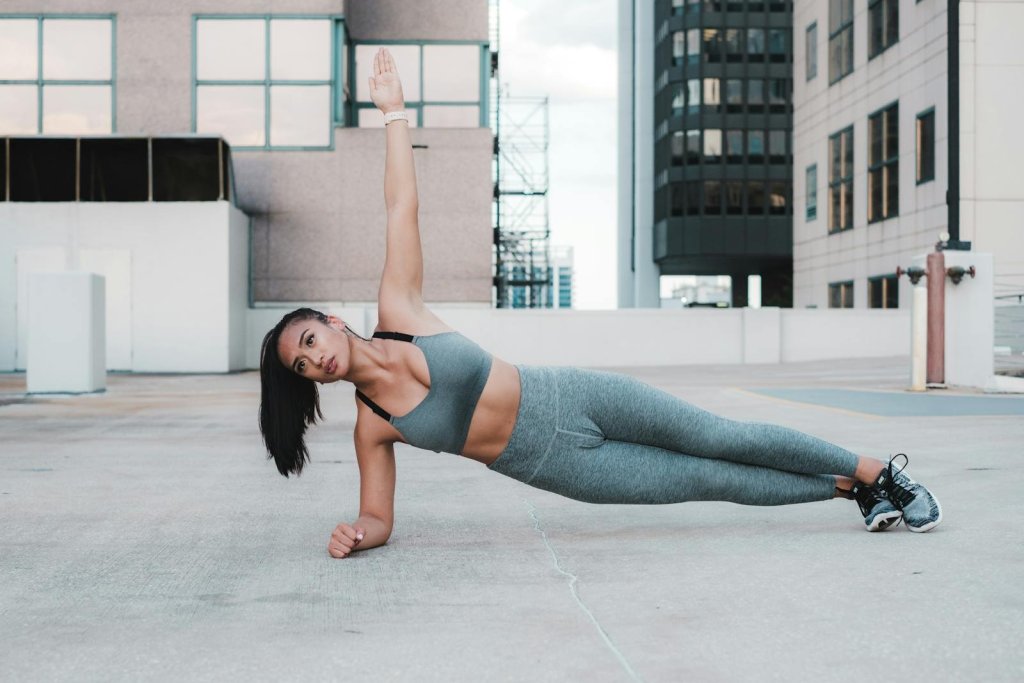
Your obliques are part of the larger abdominal muscle group (including the rectus abdominis and transversus abdominis), and they work best when you train them for stability plus controlled rotation, not endless side bends—Cleveland Clinic has a clear overview of how the abdominal muscles work together.
What obliques do and what “defined waist” really means
“Defined” usually comes from a mix of:
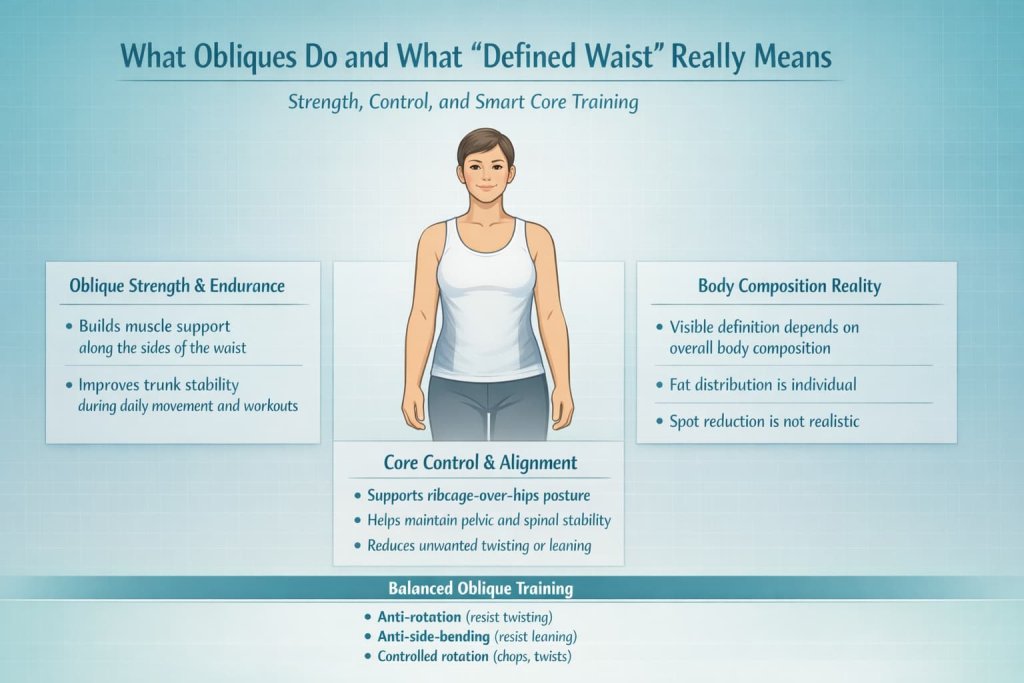
- Building oblique strength and endurance (muscle)
- Improving core control (posture and ribcage/pelvis alignment)
- Managing overall body composition (fat distribution is individual and can’t be spot-reduced)
The most effective approach is a balanced plan that trains the obliques to resist motion (anti-rotation and anti-side-bending) and to rotate under control.
Quick safety checklist before you start
Keep your training joint-friendly and effective:
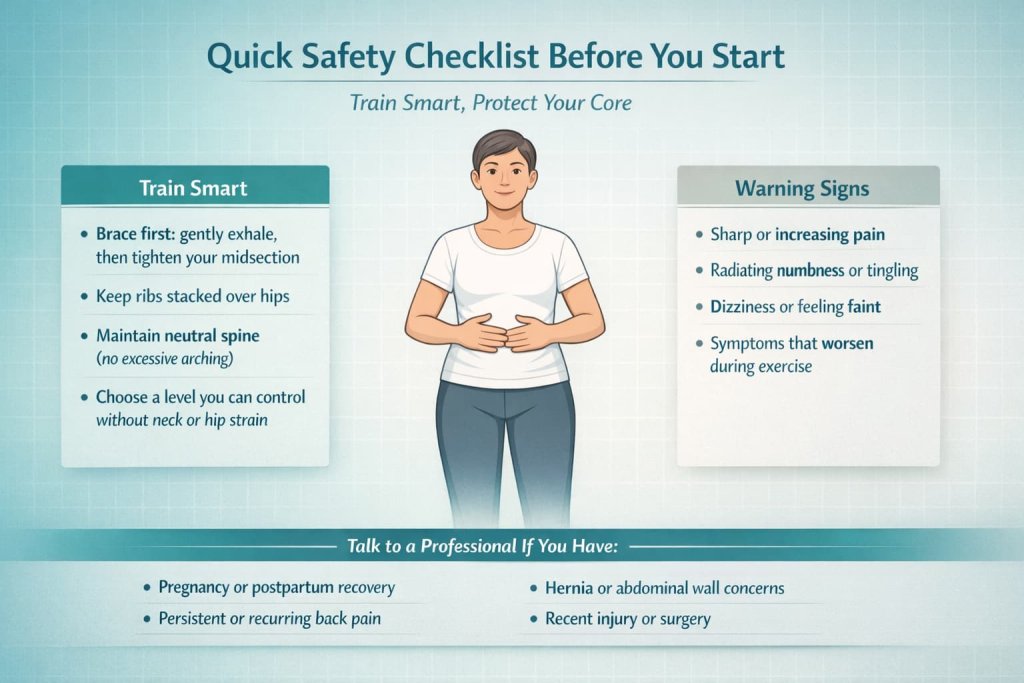
- Brace first: exhale gently, then “tighten” around your midsection like you’re preparing for a light poke
- Keep ribs stacked over hips (avoid flaring ribs or overarching your low back)
- Choose a level where you can hold good form without neck tension or hip shifting
- Stop if you feel sharp pain, radiating numbness/tingling, dizziness, or symptoms that worsen
If you’re pregnant/postpartum, have a hernia/diastasis concerns, or have persistent back pain, get cleared by a qualified clinician before pushing intensity.
12 best oblique exercises for women
Build a stronger, more defined waist with these 12 best oblique exercises for women designed to improve core stability and posture. From side planks to Pallof presses and carries, each move targets your side core safely and effectively.
1. Side plank (knees down)
How to do it:
- Lie on your side with knees bent and stacked
- Place your elbow under your shoulder
- Lift hips so shoulders–hips–knees form a straight line
- Hold while breathing slowly through the brace
- Switch sides
Why it works:
This is one of the best “anti-side-bending” drills. Your obliques stay on to keep your torso from collapsing toward the floor, building the side-core endurance that supports posture and waistline control.
Muscles worked:
External obliques, internal obliques, transverse abdominis, glute medius, shoulder stabilizers.
Trainer Tip:
Start with 15–25 second holds. When it feels solid, increase time before adding harder variations—ACE’s step-by-step cues in the ACE Fitness modified side plank match this setup well.
2. Side plank (full)
How to do it:
- Lie on your side with legs straight and feet stacked
- Place your elbow under your shoulder, forearm flat
- Lift hips into a straight line from head to heels
- Hold without letting hips rotate forward or back
- Switch sides
Why it works:
A longer lever (straight legs) increases demand on the obliques and hip stabilizers. This helps build a stronger “corset” effect through the waist and improves control of your pelvis during daily movement and training.
Muscles worked:
External obliques, internal obliques, transverse abdominis, glute medius, lats, shoulder stabilizers.
Trainer Tip:
If your top hip keeps rolling forward, stagger your feet (top foot slightly in front) until you can hold a clean, square position.
3. Side plank hip dips
How to do it:
- Set up in a side plank (knees down or full)
- Lower hips a few inches toward the floor under control
- Lift back to plank height using your side core
- Repeat reps, then switch sides
Why it works:
You add movement while still forcing the obliques to stabilize the spine and pelvis. The up-and-down motion increases time under tension without relying on fast twisting.
Muscles worked:
External obliques, internal obliques, transverse abdominis, glute medius.
Trainer Tip:
Keep the range small and smooth. If your shoulders shrug or your torso twists, reduce the dip depth.
4. Pallof press (anti-rotation hold)
How to do it:
- Anchor a band at chest height to your side
- Stand tall with feet hip-width and a soft knee bend
- Hold the band at your chest, then press straight out
- Hold 2–5 seconds while resisting rotation
- Bring hands back in and repeat, then switch sides
Why it works:
This trains anti-rotation, one of the most functional oblique jobs. Your side core resists twisting so your trunk stays steady when force tries to pull you off-center.
Muscles worked:
External obliques, internal obliques, transverse abdominis, deep spinal stabilizers, glutes.
Trainer Tip:
If you rotate, move closer to the anchor or use a lighter band until you can keep your chest square—progressions that change stance/surface and increase challenge are discussed in research hosted on PubMed Central.
5. Pallof press walkout
How to do it:
- Set up like a Pallof press with the band at chest height
- Press arms straight out and keep them there
- Take 2–4 small steps away from the anchor
- Take 2–4 steps back in while resisting twist
- Switch sides
Why it works:
As band tension changes, your obliques must constantly adjust to keep you stable. This builds real-world core control for lifting, running, and daily movement.
Muscles worked:
Obliques, transverse abdominis, glutes, upper-back stabilizers.
Trainer Tip:
Tiny steps are the secret. If your ribs flare or shoulders rise, shorten the walkout or reduce band tension.
6. Standing wood chop (band or cable)
How to do it:
- Stand sideways to the anchor with a staggered stance
- Start hands high on the outside shoulder line
- Brace, then pull down and across your body
- Control the return and repeat, then switch directions/sides
Why it works:
This trains controlled rotation plus bracing. Your obliques learn to produce and manage rotational force without dumping stress into the low back.
Muscles worked:
External obliques, internal obliques, rectus abdominis (assist), hips, shoulders.
Trainer Tip:
Rotate through your upper back and hips together, not just your low back—ACE’s coaching cues for the ACE Fitness standing wood chop are a solid reference for clean form.
7. Reverse wood chop (low-to-high)
How to do it:
- Anchor the band low and stand sideways to it
- Start hands near the outside hip
- Brace and pull up and across toward the opposite shoulder
- Control back down and repeat, then switch sides
Why it works:
The upward diagonal pattern trains the obliques to coordinate the trunk with the hips and shoulders. This helps build a strong, athletic core that transfers to sport and everyday lifting.
Muscles worked:
Obliques, serratus anterior (assist), hips, shoulders.
Trainer Tip:
Avoid leaning back as you lift. Stay tall with ribs stacked over hips so the core—not momentum—does the work.
8. Suitcase carry (single dumbbell carry)
How to do it:
- Hold one dumbbell at your side like a suitcase
- Stand tall with shoulders level and ribs stacked
- Walk 20–40 steps without leaning
- Switch sides
Why it works:
This is anti-side-bending under load. Your obliques fire to keep you upright, which supports posture, pelvic stability, and a strong “tight” waist feel.
Muscles worked:
Obliques, quadratus lumborum (assist), glutes, grip, upper back.
Trainer Tip:
If you tilt, lighten the weight. Perfect upright posture is the goal—heavier is only better if form stays clean.
9. Dead bug with cross-body reach
How to do it:
- Lie on your back with hips and knees at 90 degrees
- Brace and keep ribs down (no flaring)
- Reach one arm back while extending the opposite leg
- Return slowly and alternate sides
Why it works:
Cross-body movement forces the obliques to stabilize your trunk while your limbs move. This builds control that carries over to running mechanics, lifting, and daily movement.
Muscles worked:
Obliques, transverse abdominis, hip flexors (controlled), deep spinal stabilizers.
Trainer Tip:
Only extend the leg as far as you can while keeping your low back from arching. Smaller range with perfect control beats bigger range with compensation.
10. Heel taps (braced)
How to do it:
- Lie on your back with hips and knees at 90 degrees
- Brace and keep ribs down
- Tap one heel to the floor lightly
- Return and alternate sides
Why it works:
This builds low-impact core endurance and reinforces bracing mechanics. The obliques assist by helping keep the pelvis steady while the legs move.
Muscles worked:
Transverse abdominis, obliques (stabilizing), rectus abdominis (assist).
Trainer Tip:
Slow tempo makes it effective. If your low back arches, shorten the leg reach and focus on ribs-down control.
11. Mountain climber (slow, controlled)
How to do it:
- Start in a high plank with hands under shoulders
- Brace hard and keep hips level
- Drive one knee toward your chest slowly
- Switch sides without bouncing
Why it works:
When you remove speed, the challenge becomes stability. Your obliques work to prevent twisting and to keep the pelvis steady while your legs drive.
Muscles worked:
Obliques, transverse abdominis, shoulders, hip flexors.
Trainer Tip:
If hips sway side-to-side, slow down even more or elevate your hands on a bench to keep the movement controlled.
12. Russian twist (controlled, feet down)
How to do it:
- Sit tall with knees bent and feet on the floor
- Lean back slightly with a neutral spine
- Brace and rotate your ribs to one side
- Rotate to the other side slowly
Why it works:
This is direct rotational work for the obliques. Done with control, it builds rotational strength and endurance without relying on momentum.
Muscles worked:
External obliques, internal obliques, rectus abdominis (assist), hip flexors (assist).
Trainer Tip:
Keep feet down and rotate from the ribcage, not by swinging the arms. If your low back feels irritated, swap this for Pallof presses or wood chops.
Best weekly plan for oblique exercises for women
A simple, effective schedule:
- 2–4 days per week (alternate days if you’re sore)
- Pick 4–6 exercises per session
- Use a mix:
- 2 anti-rotation moves (Pallof press variations)
- 2 side stability moves (side plank/carry)
- 1–2 controlled rotation moves (chops/twists)
Suggested sets and reps:
- Holds (planks, Pallof hold): 2–4 sets of 15–40 seconds
- Reps (chops, dead bugs): 2–4 sets of 8–12 reps per side
- Carries: 2–4 rounds of 20–40 steps per side
Benefits of Oblique Exercises for Women
Oblique exercises strengthen the sides of your core to support a stable waist, better posture, and stronger movement control.
- Improves bracing and core stability
- Supports posture (ribs stacked over hips)
- Helps balance and reduces unwanted twisting
- Builds a firmer, more “toned” side-core look over time
When to Avoid Oblique Exercises and Talk to a Professional
Pause oblique training and get guidance if you notice warning signs, especially if symptoms worsen.
- Sharp or increasing back/hip/abdominal pain
- Numbness, tingling, or weakness
- Pain that radiates down a leg
- Dizziness or feeling faint during exercise
- Pregnancy/postpartum and unsure what’s safe
- Abdominal doming/bulging during core work
- Recent injury or surgery not cleared for exercise
Common mistakes that ruin results
- Twisting through the low back instead of rotating through ribs/hips together
- Letting hips hike up or sag during side planks
- Going too heavy so you compensate with momentum
- Holding your breath the whole set (brace, but keep breathing)
Do oblique exercises make your waist “wider”
For most women, no. Oblique training typically improves posture and core tone. Visible changes depend more on total training, nutrition, and genetics than on avoiding oblique work. If you’re worried about “blocky” looks, prioritize anti-rotation and carries over heavy, high-volume side bends.
FAQ: Oblique exercises for women
How often should women train obliques?
Most people do best with 2–4 sessions per week, using a mix of anti-rotation, side stability, and controlled rotation.
Are side bends bad for your waist?
Not automatically. Light, controlled side bends can be fine, but many people do them too heavy and compensate through the low back. Carries and side planks are usually more joint-friendly.
What’s the best oblique exercise for beginners?
Knees-down side planks and Pallof press holds are excellent because they build stability with low spinal stress.
Can I do oblique exercises every day?
You can do light bracing work daily, but strength-focused sessions (hard planks, carries, heavy chops) usually need rest days.
Which oblique exercises help posture most?
Side planks and suitcase carries are top choices because they train your body to resist collapsing or leaning.
Do I need equipment to train obliques effectively?
No. Side plank variations and dead bug patterns are enough to start. Bands or a single dumbbell simply make progression easier.
Conclusion
Oblique exercises for women work best when you train your side core for stability first, then add controlled rotation. Start with side planks, Pallof presses, and carries, then layer in chops and slower dynamic core moves as you get stronger. If you want, tell me your equipment (none, band, dumbbells, gym) and your level (beginner/intermediate), and I’ll turn this into a simple 4-week plan.
References
- Kenhub. “External Abdominal Oblique Muscle.” Kenhub
- American Council on Exercise (ACE). “Standing Wood Chop.” ACE Fitness
- Sports (MDPI). “Stable vs. Unstable Surfaces and Muscle Activity (Systematic Review/Meta-Analysis).” MDPI
- PubMed. “EMG Study on Internal and External Oblique Activation During Lateral Core Tasks.” PubMed
- PubMed Central (PMC). “Loaded Carry Variations and Muscle Activation Patterns.” PubMed Central
- Journal of Orthopaedic & Sports Physical Therapy (JOSPT). “Clinical Practice Guidelines: Low Back Pain.” JOSPT