
Hip internal rotation exercises are targeted movements that help improve how your thigh rotates inward at the hip joint, which can support smoother walking, squatting, and everyday movement while reducing unnecessary joint stress. Understanding and training hip internal rotation is important because limited motion in this area is commonly linked with compensations at the knees, pelvis, and lower back.
When performed correctly and consistently, hip internal rotation exercises may help support joint mobility, muscular balance, and long-term hip health.
What Are Hip Internal Rotation Exercises?
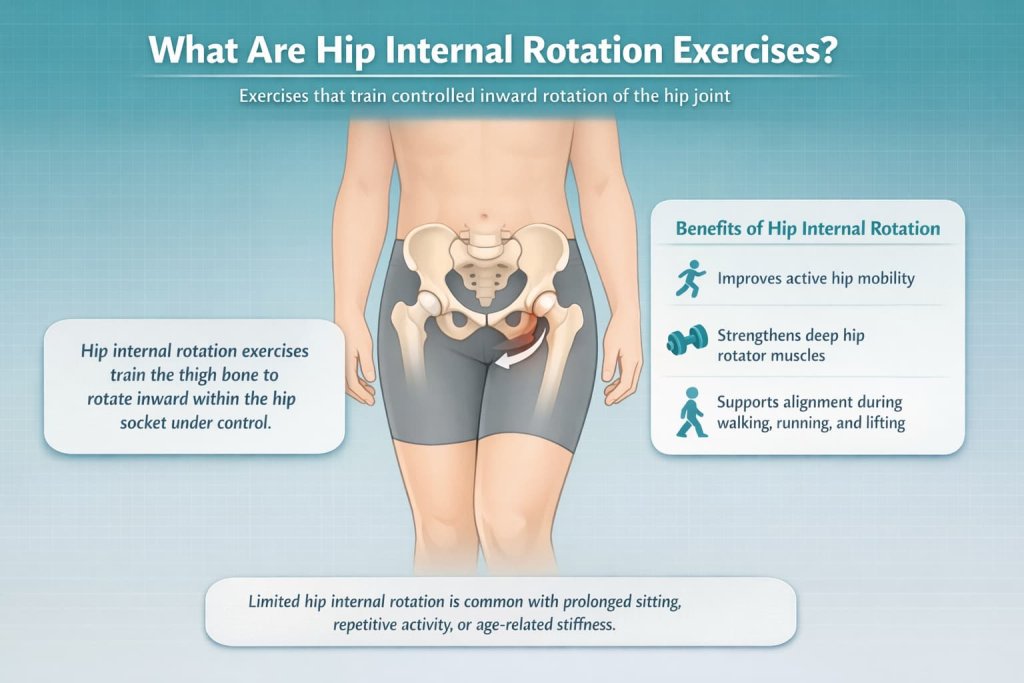
Hip internal rotation exercises are movements that train the femur (thigh bone) to rotate inward within the hip socket under control. These exercises focus on:
- Improving active hip mobility
- Strengthening the deep hip rotator muscles
- Supporting better alignment during walking, running, and lifting
Limited hip internal rotation is commonly observed in people with prolonged sitting habits, athletic overuse, or age-related joint stiffness.
5 Best Hip Internal Rotation Exercises
These hip internal rotation exercises focus on improving controlled movement at the hip joint to support better mobility and joint alignment. When performed consistently, they may help reduce stiffness and support smoother, more efficient lower-body movement.
1. 90/90 Hip Internal Rotation
How to do it:
- Sit on the floor with one leg in front and one leg behind, both knees bent at about 90 degrees
- Keep your chest tall and pelvis neutral
- Slowly rotate the back leg inward by lifting the foot while keeping the knee down
- Move only through a controlled, pain-free range
- Return to the start and repeat before switching sides
Why it works:
The 90/90 position locks the pelvis in place, which reduces compensation from the lower back. This allows true hip internal rotation to occur at the joint, improving both mobility and neuromuscular control.
Muscles worked:
Deep hip internal rotators, gluteus medius, adductors, hip stabilizers
Trainer Tip:
If your torso leans or you feel the movement in your lower back, reduce the range and focus on staying upright.
2. Side-Lying Hip Internal Rotation Lift
How to do it:
- Lie on your side with hips and knees bent, feet stacked
- Keep your hips steady and spine neutral
- Slowly lift the top foot while keeping the knees together
- Lower with control and repeat before switching sides
Why it works:
This exercise isolates the internal rotators by removing bodyweight load and minimizing spinal involvement, making it ideal for beginners or rehab-focused programs.
Muscles worked:
Tensor fasciae latae, anterior gluteus medius, deep hip rotators
Trainer Tip:
Avoid rocking your hips backward—place your top hand on your hip to monitor movement.
3. Seated Hip Internal Rotation
How to do it:
- Sit upright on a chair or bench with knees bent and feet flat
- Place your hands on your thighs to stabilize the legs
- Rotate one foot outward, allowing the thigh to rotate inward
- Move slowly through the available range, then switch sides
Why it works:
Seated positioning limits pelvic movement, making this a clean way to train hip internal rotation similar to how clinicians assess hip range of motion.
Muscles worked:
Deep hip internal rotators, adductors, stabilizing hip musculature
Trainer Tip:
Think “rotate from the hip, not the foot” to avoid ankle or knee dominance.
4. Prone Hip Internal Rotation
How to do it:
- Lie face down with knees bent to about 90 degrees
- Keep your hips pressed gently into the floor
- Slowly move one foot outward to internally rotate the hip
- Return to center with control and repeat on the other side
Why it works:
The prone position minimizes compensation from the pelvis and spine, encouraging deliberate motor control of the hip joint.
Muscles worked:
Deep hip rotators, gluteus medius, stabilizing pelvic muscles
Trainer Tip:
Move slowly—speed often leads to momentum and reduced muscle engagement.
5. Band-Assisted Hip Internal Rotation
How to do it:
- Attach a light resistance band to a stable anchor
- Loop the band around your ankle while seated or lying down
- Start with the leg neutral, then rotate the hip inward against resistance
- Return slowly and repeat before switching sides
Why it works:
External resistance challenges the internal rotators through the full range of motion, helping build strength and active control rather than passive flexibility.
Muscles worked:
Hip internal rotators, adductors, gluteus medius
Trainer Tip:
Use light resistance first—control and alignment matter more than band tension.
How Often Should You Do Hip Internal Rotation Exercises?
Most orthopedic and rehabilitation programs suggest:
- 2–4 sessions per week for mobility and control
- 2–3 sets per exercise, performed slowly
- Emphasis on control, not forcing range
Programs like those outlined by the American Physical Therapy Association stress gradual progression rather than aggressive stretching.
Common Causes of Limited Hip Internal Rotation
Limited hip internal rotation often develops gradually and is commonly linked to daily habits and movement patterns rather than injury.
Common causes include:
- Prolonged sitting or low movement variety
- Muscle stiffness or imbalance around the hips
- Reduced neuromuscular control of hip rotation
- Age-related changes in joint and soft tissue mobility
- Repetitive activities that favor limited hip rotation
Limited internal rotation is not always a problem, but ongoing stiffness or pain may warrant professional guidance.
Why Hip Internal Rotation Matters for Mobility and Joint Health
Adequate hip internal rotation plays a key role in how forces are distributed through the lower body. When this motion is restricted, the body may compensate elsewhere.
Research and clinical guidance from sources such as the Mayo Clinic and the Cleveland Clinic highlight that balanced hip mobility supports:
- More efficient walking and stair climbing
- Reduced strain on the knees and lower back
- Better squat and hinge mechanics
- Improved athletic movement control
Normal Hip Internal Rotation Range
While individual anatomy varies, many clinical references describe normal adult hip internal rotation as approximately 30–45 degrees, depending on testing position and age. Values below this range do not automatically indicate a problem but may signal the need for mobility and strength work—especially if stiffness or discomfort is present.
Common Mistakes to Avoid
- Forcing the hip into painful ranges
- Allowing the pelvis or lower back to twist excessively
- Moving too quickly without muscular control
- Ignoring discomfort that worsens after exercise
Who Should Be Cautious with Hip Internal Rotation Exercises?
You should consider professional guidance if you experience:
- Sharp or persistent groin pain
- Catching or locking sensations in the hip
- Pain that worsens with deep hip flexion and rotation
- Known hip conditions such as femoroacetabular impingement or advanced osteoarthritis
Healthcare guidance from the National Institute on Aging emphasizes individualized progression, especially for older adults.
When to Seek Professional Guidance
If hip stiffness or pain does not improve after several weeks of consistent, controlled exercise, consult a qualified healthcare professional such as a physical therapist or orthopedic specialist. Early assessment may help identify movement restrictions that need targeted care.
Frequently Asked Questions
Can hip internal rotation exercises reduce pain?
They may help support movement efficiency and reduce compensatory stress, which can contribute to improved comfort over time.
Are hip internal rotation exercises safe for beginners?
Yes, when performed slowly and within a comfortable range, they are generally considered low risk.
How long does it take to see improvement?
Many people notice mobility or control changes within 4–6 weeks of consistent practice.
Should I stretch or strengthen for hip internal rotation?
A combination of controlled mobility and strengthening tends to be more effective than stretching alone.
Can athletes benefit from hip internal rotation exercises?
Yes. Adequate hip rotation supports running mechanics, change of direction, and load transfer.
Is limited hip internal rotation always a problem?
Not necessarily. It becomes more relevant when paired with pain, stiffness, or movement limitations.
Conclusion
Hip internal rotation exercises play an important role in supporting healthy hip mechanics, balanced movement, and long-term joint function. By practicing controlled, well-structured exercises consistently, many people can improve mobility and reduce unnecessary strain on surrounding joints. If symptoms persist or worsen, seeking professional guidance is always the safest next step.
This content is for informational purposes only and not medical advice.
References
- American Academy of Orthopaedic Surgeons (AAOS) – Hip Conditioning Program
- Cleveland Clinic – 90/90 Stretch for Hip Mobility
- American Physical Therapy Association (APTA) – Hip Pain and Mobility Deficits: Hip Osteoarthritis CPG (2017)
- Journal of Orthopaedic & Sports Physical Therapy (JOSPT) – Hip OA Clinical Practice Guideline (2017)
- NHS Inform – Exercises for Hip Problems
- National Institute on Aging – Tips for Getting and Staying Active as You Age
- CDC – Physical Activity Guidelines for Older Adults