
Somatic Pilates exercises are slow, mindful Pilates-based movements that prioritize how your body feels (breath, control, and sensation) to help you release perceived tension and improve body awareness. In other words, you’re not chasing “perfect form” or intensity, you’re using gentle movement to reset how you move.
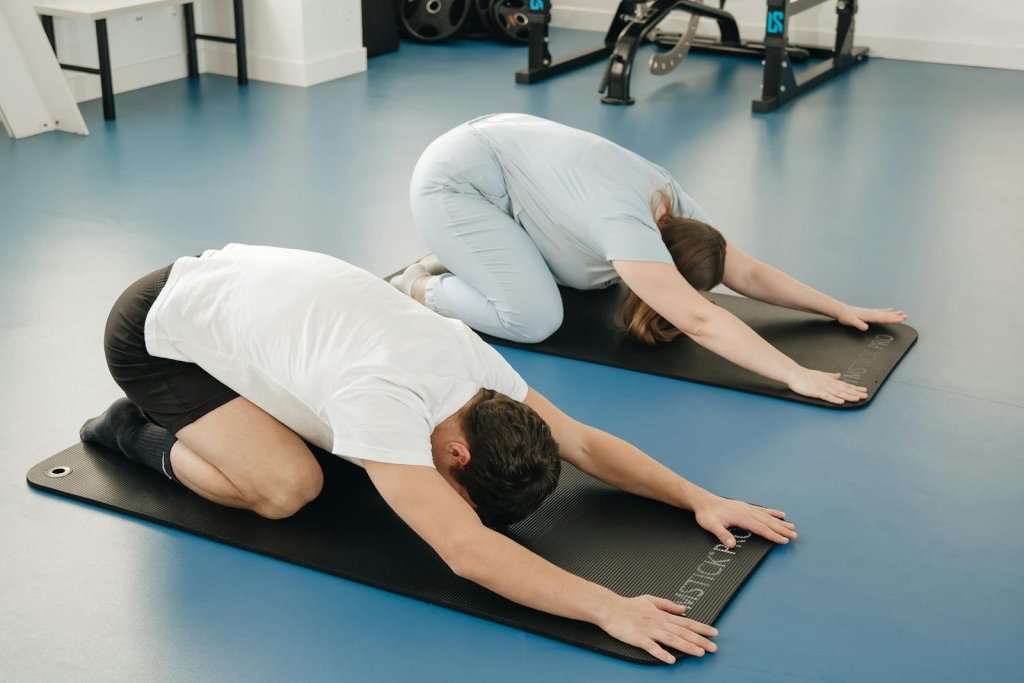
This matters because many people carry stiffness from stress, long sitting, and repetitive daily positions. A somatic Pilates approach can be an accessible way to move more comfortably, improve mobility, and build calm, controlled strength without high impact.
What are somatic Pilates exercises?
Somatic movement is generally defined as movement that emphasizes internal awareness (how your body feels during motion), not performance or competition. Harvard Health describes somatic workouts as movement guided by internal sensations and mindful attention to what your body is doing.
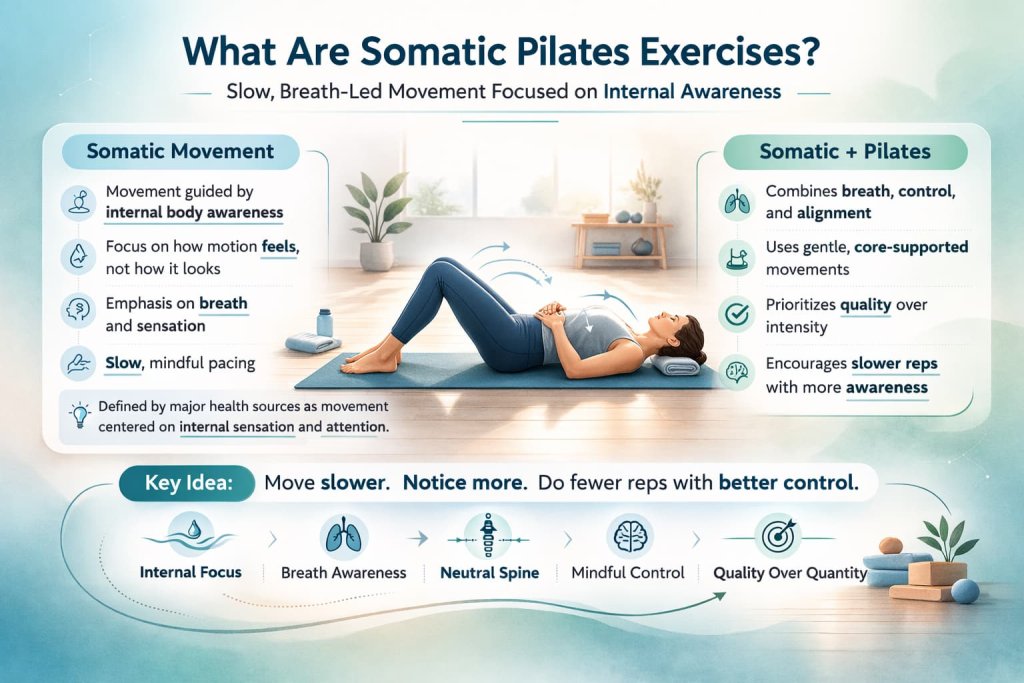
Somatic Pilates combines that “body-first” focus with classic Pilates principles like breath, control, and core-supported movement. A practical way to think about it is: you move slower, notice more, and do fewer reps, but with better quality.
What somatic Pilates may help with
Somatic Pilates may help you:
- Feel less stiff after sitting or stress-heavy days
- Improve posture awareness (ribcage, pelvis, head position)
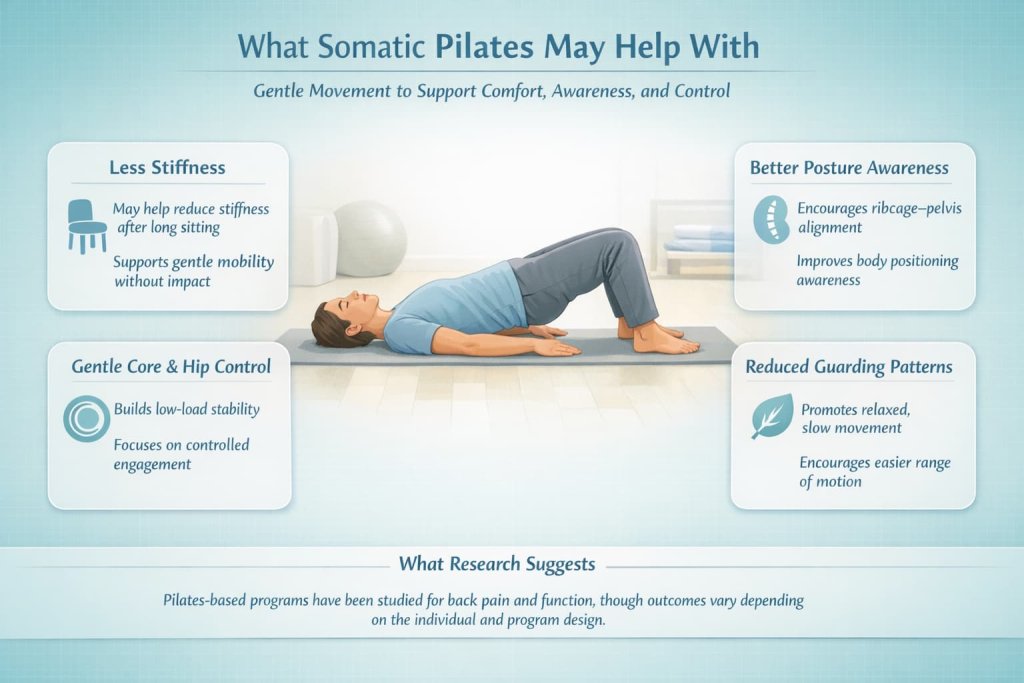
- Build gentle core and hip control without high-impact training
- Reduce “guarding” patterns by practicing slow, easy ranges of motion
It’s important to keep claims realistic. Pilates research overall suggests Pilates-based programs can improve pain and function for some people, but outcomes vary by program and person. A 2025 overview available through PubMed Central discusses Pilates in the context of back pain prevention and management.
8 best somatic Pilates exercises
Below are beginner-friendly options that match the “somatic” goal: slow, sensation-led, and tension-reducing.
1) Supine 360 Breathing (Ribcage Expansion)
How to do it:
- Lie on your back, knees bent, feet flat
- Place one hand on your chest, one on your lower ribs
- Inhale through your nose and feel ribs expand outward (not just belly up)
- Exhale slowly and feel ribs soften down
- Repeat 5–8 slow breaths
Why it works:
This helps you shift out of “braced” breathing and reconnect breath with rib and core movement.
Trainer Tip:
Aim for “wide” breaths into the sides/back of the ribs, not shoulder shrugging.
2) Pelvic Clock (Gentle Pelvis Awareness)
How to do it:
- Stay on your back with knees bent
- Imagine a clock on your pelvis: 12 o’clock toward your head, 6 toward your feet
- Slowly tilt pelvis to 12 (flatten low back slightly), then to 6 (small arch)
- Add tiny shifts toward 3 and 9 (side-to-side)
- Move smoothly for 45–60 seconds
Why it works:
Small, controlled pelvic motion can reduce stiffness and improve awareness of how you hold your lower back
Trainer Tip:
Keep the movement tiny. If you feel gripping in hips or abs, reduce the range.
3) Knee Folds (Marching Prep)
How to do it:
- On your back, knees bent, neutral spine
- Exhale, gently brace as if tightening a belt one notch
- Lift one foot 1–2 inches, then set it down softly
- Alternate sides for 6–10 total reps
Why it works:
Builds calm core control without forcing you into hard abdominal work.
Trainer Tip:
If your pelvis shifts or low back arches, lift less.
4) Pelvic Curl (Slow Bridge Articulation)
How to do it:
- On your back, knees bent, feet hip-width
- Exhale and slowly tilt pelvis to flatten low back
- Roll up one vertebra at a time into a small bridge
- Inhale at the top, exhale and roll down slowly
- Do 5–8 reps
Why it works:
Gentle spinal articulation plus glute engagement can reduce the feeling of “stuck” hips and low back.
Trainer Tip:
Keep ribs down. Think “long spine,” not “high bridge.”
5) Supine Windshield Wipers (Easy Rotation)
How to do it:
- On your back, knees bent, feet slightly wider than hips
- Let knees drop slowly to one side (only as far as comfortable)
- Pause for one breath, return to center
- Repeat to the other side for 6–10 total reps
Why it works:
Adds gentle rotation to the spine and hips, which many people lose with long sitting.
Trainer Tip:
Keep shoulders relaxed on the floor. Reduce range if you feel pinching.
6) Cat-Cow (Segmental Spine Focus)
How to do it:
- Start on hands and knees, hands under shoulders, knees under hips
- Inhale: gently extend through upper back and pelvis (cow)
- Exhale: slowly round spine, letting ribs soften (cat)
- Do 6–10 slow cycles
Why it works:
A classic way to explore spinal motion and release “held” tension patterns.
Trainer Tip:
Move one section at a time (pelvis, mid-back, upper back) instead of one big swing.
7) Child’s Pose Side Reach (Lateral Line Release)
How to do it:
- From hands and knees, sit hips back toward heels (use a pillow if needed)
- Walk hands slightly to the right to feel a gentle left-side stretch
- Breathe for 2–3 slow breaths, then switch sides
- Repeat 2 rounds
Why it works:
Targets the side body (lats/QL area) that often feels tight with desk posture.
Trainer Tip:
If knees don’t like child’s pose, do this at a table or countertop instead.
8) Wall Roll Down (Standing Nervous-System Reset)
How to do it:
- Stand with your back near a wall, feet 6–12 inches away
- Exhale and slowly nod chin, rolling down one vertebra at a time
- Let arms hang; bend knees slightly if hamstrings pull
- Inhale at the bottom, exhale and roll back up slowly
- Do 3–5 reps
Why it works:
Brings the “somatic” feel into standing posture and teaches controlled spinal movement.
Trainer Tip:
Go slow enough that you can feel each part of your spine moving, not just “folding.”
Quick safety checklist before you start
Somatic Pilates should feel gentle and controlled. Use these guardrails:
- Stay in a pain-free range (mild stretching is OK, sharp pain is not)
- Move slowly enough that you can breathe normally
- Stop if you feel dizziness, numbness/tingling, or symptoms that worsen
- If you’re pregnant, recently postpartum, or managing an injury/surgery, consider getting personalized guidance first
How to use these somatic Pilates exercises (sets, reps, and pacing)
A simple structure that works for most beginners:
- Do 1–2 rounds of all 8 exercises
- Spend 45–90 seconds per exercise
- Keep effort around 4–6 out of 10 (you should feel calmer after, not drained)
- Practice 3–5 days per week for consistency
Pro tip: treat this like “movement hygiene.” Small daily sessions are often more helpful than one intense workout.
How to Do Somatic Pilates Safely (Form and Breathing Basics)
Use these basics to keep the practice safe and truly somatic:
- Stay in a pain-free range
- Move slowly enough to notice what’s happening
- Breathe continuously (no breath-holding)
- Exhale to soften tension and support gentle core engagement
- Keep ribs stacked over pelvis (avoid rib flare or low-back arching)
- Relax shoulders, neck, and jaw
- Do fewer reps with more control
- Use props as needed (pillow, towel, chair support)
For a clear overview of how somatic movement emphasizes internal awareness and breath-led pacing, see Harvard Health.
Common mistakes to avoid with somatic Pilates exercises
- Moving too fast (you lose the somatic benefit)
- Forcing range of motion to “stretch deeper”
- Holding your breath or bracing hard the whole time
- Doing too many reps and turning it into a workout grind
When to Avoid Somatic Pilates Exercises and Talk to a Professional
Somatic Pilates should feel gentle and steady. Stop and get professional guidance if you notice:
- Sharp or worsening pain
- Numbness, tingling, or weakness
- Pain that shoots into an arm or leg
- Dizziness or vertigo with position changes
- Recent surgery, fracture, or significant injury
- Severe osteoporosis or any condition with movement restrictions
- Symptoms that feel unusual, unexplained, or keep getting worse
- Pregnancy or postpartum concerns that need individualized clearance
People also ask about somatic Pilates exercises
Is somatic Pilates good for beginners?
Yes, it’s typically beginner-friendly because movements are low-impact and slow. Start with breathing, pelvic clock, and gentle spinal mobility.
How often should I do somatic Pilates?
Most people do well with 10–20 minutes, 3–5 times per week. Daily short sessions can work well if intensity stays low.
Can somatic Pilates help with stress?
It may help support relaxation because it emphasizes slow breathing and body awareness, a focus also discussed by Harvard Health.
FAQ: Somatic Pilates Exercises
1) What is the difference between Pilates and somatic Pilates?
Traditional Pilates often emphasizes form precision and progressive challenge. Somatic Pilates keeps Pilates fundamentals, but prioritizes sensation, ease, and slower pacing.
2) Do I need equipment?
No. A yoga mat and a pillow (for knees/hips) is enough. A wall is useful for wall roll downs.
3) How long should a session be?
A helpful range is 10–30 minutes. If you’re very tight or stressed, shorter sessions done more often tend to feel better.
4) Should I feel sore after somatic Pilates?
Usually not. Mild muscle warmth is fine, but soreness can be a sign you went too hard or too fast.
5) Can I do somatic Pilates if I have back pain?
Some people find gentle Pilates-based movement helpful, but back pain has many causes. Keep movement pain-free and consider professional guidance if symptoms persist or worsen.
6) What should I do if a movement hurts?
Stop that movement, reduce range, or swap it for breathing or pelvic clock. Pain is not a requirement for progress.
7) When is it better to talk to a professional first?
If you have recent surgery, unexplained numbness/weakness, severe osteoporosis, significant dizziness, or ongoing symptoms that are getting worse, get individualized advice.
Conclusion
Somatic Pilates exercises are a practical way to move slower, feel more, and build gentle strength while helping your body let go of “held” tension. Start with the breathing and pelvic work, keep ranges comfortable, and practice consistently for the best results.
References
- NHS — Pilates for Beginners (Safety Basics)
- Cleveland Clinic — Diaphragmatic Breathing: How to Do It and Benefits
- American Council on Exercise (ACE) — Stabilize From the Inside Out: Core Strength With Diaphragmatic Training (Oct 2024)
- PubMed — 2025 Systematic Review: Pilates for Musculoskeletal Conditions in the Extremities