
Scapular mobility exercises can help improve shoulder movement by training your shoulder blades to move more smoothly, stay better controlled, and support overhead motion more comfortably. In practice, the best results usually come from combining mobility drills with light stability and control work, not from stretching alone.

That matters because the scapula, or shoulder blade, is a key part of healthy shoulder motion. If it does not move well with the rib cage and arm, reaching, lifting, pressing, and even posture can feel limited or awkward. Clinical guidance from the American Academy of Orthopaedic Surgeons, Cambridge University Hospitals, and recent 2024 systematic reviews supports using scapular-focused exercise to improve shoulder function, especially when the program is followed consistently for at least several weeks.
Why scapular mobility exercises matter
Your scapula is not supposed to stay fixed. It should glide upward, downward, inward, outward, and rotate as your arm moves. That coordinated motion helps keep the shoulder joint working efficiently. The American Academy of Orthopaedic Surgeons notes that treatment for scapular disorders often focuses on restoring the proper position and motion of the scapula while strengthening the muscles around it.
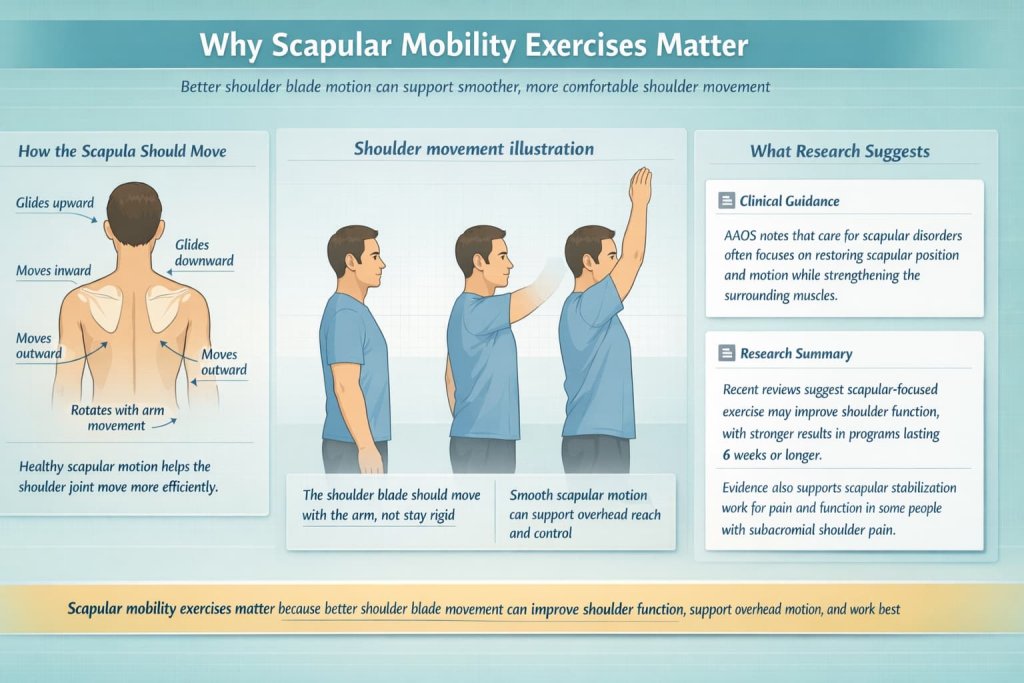
Recent research also supports a practical point: scapular exercise seems to help shoulder function more reliably than range of motion alone. A 2024 meta-analysis published in PubMed Central found that adding specific scapular therapeutic exercises improved shoulder function, with better results in programs lasting 6 weeks or longer. Another 2024 review in PubMed Central found moderate support for scapular stabilization exercises in people with subacromial shoulder pain, especially for pain and function.
Who may benefit most from scapular mobility exercises
These exercises may be useful for people who have:
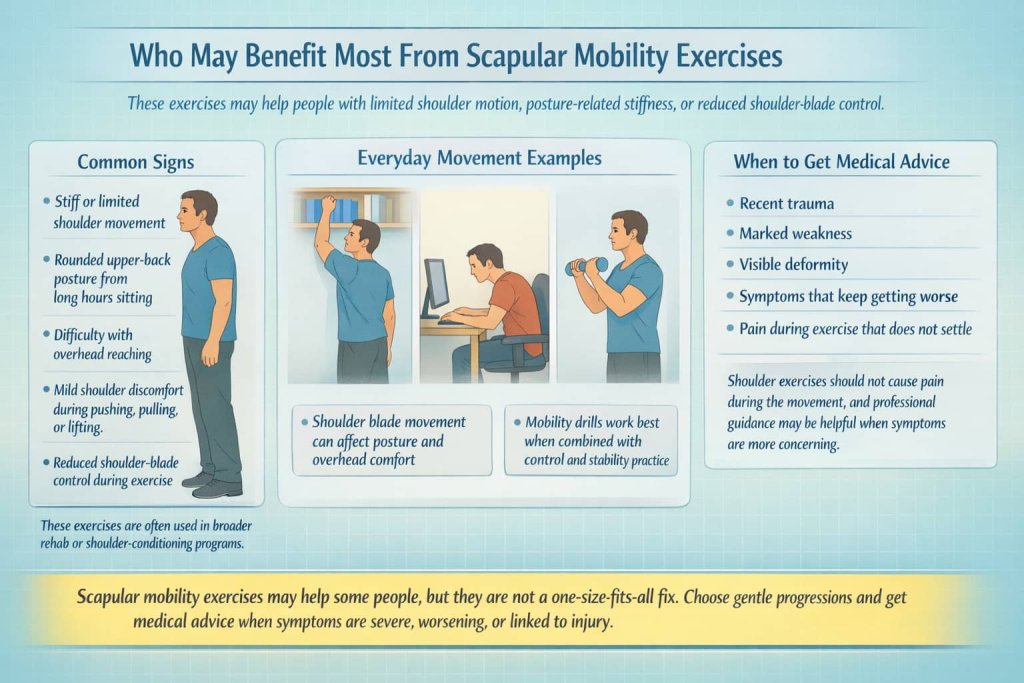
- stiff or limited shoulder movement
- rounded upper-back posture from long hours sitting
- difficulty with overhead reaching
- mild shoulder discomfort during pushing, pulling, or lifting
- reduced shoulder-blade control during exercise
They are often used in broader rehab or conditioning programs, but they are not a one-size-fits-all fix. If you have recent trauma, marked weakness, visible deformity, or symptoms that keep getting worse, get medical advice before trying to self-manage. The American Academy of Orthopaedic Surgeons notes that shoulder exercises should not cause pain during the movement and may be best done with professional guidance when needed.
13 best scapular mobility exercises
Improve shoulder movement, posture, and control with these 13 best scapular mobility exercises. These simple drills can help your shoulder blades move better and support healthier, smoother upper-body motion.
1. Scapular clocks
How to do it:
- Stand tall facing a wall with one forearm lightly supported.
- Imagine your shoulder blade moving like a clock.
- Gently glide it up to 12, down to 6, toward the spine to 3, and away from the spine to 9.
- Move slowly without twisting your torso.
- Repeat on both sides.
Why it works: This drill teaches awareness of basic scapular directions without loading the shoulder heavily. It is a good starting point for people who struggle to feel shoulder-blade motion.
Muscles worked: Serratus anterior, middle and lower trapezius, rhomboids, and the small stabilizers around the shoulder girdle.
Trainer Tip: Keep your neck relaxed. If your upper traps take over, reduce the range.
2. Scapula setting
How to do it:
- Stand or sit upright.
- Gently draw the shoulder blades back and slightly down.
- Hold for a brief pause without arching your low back.
- Relax and repeat.
- Keep the movement subtle.
Why it works: Cambridge University Hospitals uses scapula positioning as an early foundation before harder stability drills. It helps you find a more efficient shoulder-blade starting position.
Muscles worked: Middle trapezius, lower trapezius, rhomboids.
Trainer Tip: Think “long neck, broad collarbones,” not “pinch as hard as possible.”
3. Wall slides
How to do it:
- Stand with your forearms on a wall.
- Keep your ribs stacked and wrists relaxed.
- Slide the arms upward as far as you can without shrugging.
- Pause briefly, then slide back down.
- Repeat with control.
Why it works: Wall slides combine upward rotation, light mobility, and scapular control. They are useful for overhead patterning and posture.
Muscles worked: Serratus anterior, lower trapezius, rotator cuff, deltoids.
Trainer Tip: A slight reach at the top can help you feel the shoulder blades wrap around the rib cage.
4. Serratus wall reach
How to do it:
- Stand facing a wall with both forearms on it.
- Press lightly into the wall.
- Reach your upper back away from the wall by letting the shoulder blades glide forward.
- Return to neutral without collapsing.
- Repeat smoothly.
Why it works: This movement targets protraction control and helps improve the serratus contribution that supports healthy overhead mechanics.
Muscles worked: Serratus anterior, upper and lower trapezius.
Trainer Tip: Do not turn it into a shrug. The movement should feel broad across the upper ribs, not cramped in the neck.
5. Cat-cow with scapular focus
How to do it:
- Start on all fours.
- As you round your upper back, gently spread the shoulder blades apart.
- As you move into extension, let the shoulder blades come closer together naturally.
- Keep the motion slow and coordinated with breathing.
- Repeat for several reps.
Why it works: This adds thoracic mobility to scapular motion. That matters because the shoulder blade and upper back work together during reaching and overhead movement.
Muscles worked: Serratus anterior, trapezius, spinal extensors, abdominals.
Trainer Tip: Move through the upper back, not just the lower back.
6. Thread the needle
How to do it:
- Begin on all fours.
- Slide one arm underneath the body, rotating through the upper back.
- Pause briefly in the comfortable range.
- Return and open the same arm upward if tolerated.
- Repeat before switching sides.
Why it works: This drill improves thoracic rotation and scapular motion together, which can make reaching and shoulder rotation feel smoother.
Muscles worked: Posterior shoulder muscles, rotator cuff, thoracic stabilizers, serratus anterior.
Trainer Tip: Keep the hips as still as you can so the upper back does the work.
7. Scapular circles
How to do it:
- Stand tall with arms relaxed at your sides.
- Roll the shoulder blades up, back, down, and forward in a slow circle.
- Then reverse the direction.
- Keep the movement smooth and controlled.
- Perform equal reps each way.
Why it works: Scapular circles gently explore the full available shoulder-blade path and can reduce stiffness from prolonged sitting.
Muscles worked: Trapezius, rhomboids, serratus anterior, levator scapulae.
Trainer Tip: Make the circles smaller than you think. Smooth control matters more than a big range.
8. Quadruped weight shifts
How to do it:
- Start on all fours with hands under shoulders.
- Shift your body weight gently forward, backward, and side to side.
- Keep the elbows soft but mostly straight.
- Let the shoulder blades adapt to each shift.
- Stay controlled and breathe normally.
Why it works: Cambridge University Hospitals includes weight shifting on all fours as a scapular stabilisation drill. It builds confidence with light closed-chain loading.
Muscles worked: Serratus anterior, rotator cuff, lower trapezius, core.
Trainer Tip: Start with tiny shifts. More is not better if you lose control.
9. Wall press-up
How to do it:
- Stand facing a wall with hands at chest height.
- Lower into a gentle press-up.
- Push back to the start while keeping your body straight.
- At the top, let the shoulder blades glide naturally.
- Repeat with steady tempo.
Why it works: Cambridge University Hospitals uses wall press-ups as part of scapular stabilisation progressions. It is a simple way to add load while keeping the exercise beginner-friendly.
Muscles worked: Serratus anterior, pectorals, triceps, anterior deltoids.
Trainer Tip: Do not let your shoulders roll forward at the bottom.
10. Push-up plus on wall or bench
How to do it:
- Set up for a wall or incline push-up.
- Perform the push-up portion first.
- At the top, gently push a little farther so the shoulder blades move forward around the rib cage.
- Return to neutral.
- Repeat without rushing.
Why it works: The “plus” adds active scapular protraction, which can improve serratus function and shoulder-blade control.
Muscles worked: Serratus anterior, triceps, chest, anterior deltoids.
Trainer Tip: Use a wall first. Progress to a bench or floor only when control is solid.
11. Ball circles on wall
How to do it:
- Place a small ball between your hand and a wall.
- Lean lightly into the ball.
- Make slow circles in one direction, then the other.
- Keep your trunk steady.
- Switch arms after each set.
Why it works: Cambridge University Hospitals includes ball circles on wall to challenge shoulder stability and controlled scapular motion.
Muscles worked: Serratus anterior, rotator cuff, trapezius, deltoids.
Trainer Tip: Use a very small circle first. The goal is control, not speed.
12. Resistance-band scapular retraction
How to do it:
- Hold a light resistance band with arms in front.
- Pull the band apart by drawing the shoulder blades back gently.
- Pause without flaring the ribs.
- Return slowly.
- Repeat for clean reps.
Why it works: This exercise builds active retraction strength, which can balance out long periods of rounded posture.
Muscles worked: Rhomboids, middle trapezius, rear deltoids.
Trainer Tip: Keep your shoulders down and away from your ears.
13. Prone Y raise
How to do it:
- Lie face down on a bench, bed, or mat.
- Raise the arms into a Y shape with thumbs pointing up.
- Lift only as high as you can without shrugging.
- Pause briefly, then lower slowly.
- Repeat for controlled reps.
Why it works: The prone Y helps train upward rotation support and lower-trap function, both important for overhead movement.
Muscles worked: Lower trapezius, posterior deltoids, rotator cuff.
Trainer Tip: Use bodyweight first. This is harder than it looks.
How to build a simple scapular mobility routine
A simple routine does not need all 13 exercises at once. For most people, 4 to 6 movements per session is enough.
A good beginner sequence could look like this:
- Scapula setting
- Wall slides
- Cat-cow with scapular focus
- Quadruped weight shifts
- Wall press-up
- Ball circles on wall
Do 1 to 3 sets of each exercise with controlled reps. Based on a 2024 review in PubMed Central, function-related benefits were stronger when scapular exercise programs lasted at least 6 weeks, and extremely high repetition totals were not necessary.
Before you start
Start gently. Use slow, controlled reps and stop forcing the range. A common rehab timeline from the American Academy of Orthopaedic Surgeons is 4 to 6 weeks, followed by maintenance work 2 to 3 days per week once symptoms and function improve.
Use these simple rules:
- stay in a comfortable range
- stop if pain becomes sharp or clearly worsens
- avoid shrugging through every rep
- focus on smooth shoulder-blade movement, not speed
- choose quality over fatigue
Common mistakes that limit progress
Doing only stretching
Scapular mobility usually improves best when you also train control and light stability.
Shrugging through every rep
If your neck feels overworked, your upper traps may be dominating the movement.
Forcing range
A painful or exaggerated range can make shoulder motion feel worse, not better.
Ignoring the upper back
Thoracic mobility often affects how freely the scapula can move.
Progressing too fast
Closed-chain drills like wall work and quadruped shifts are often better first steps than jumping into heavy overhead lifting.
When to stop and get medical advice
Stop and get assessed if you notice:
- sharp pain that keeps worsening
- major loss of strength
- shoulder instability or repeated giving way
- numbness or tingling that does not settle
- pain after a fall or direct injury
- visible winging or deformity that is getting worse
The American Academy of Orthopaedic Surgeons notes that scapular disorders can make overhead movement difficult and may require targeted physical therapy to restore proper position and motion.
Do scapular mobility exercises really work?
They can, especially when the issue is poor shoulder-blade movement, deconditioning, posture-related stiffness, or reduced control. The best evidence supports them as part of a broader shoulder program. A 2024 systematic review in PubMed Central found improved shoulder function when specific scapular exercises were added to rehab, and another 2024 review in PubMed Central found moderate support for scapular stabilization exercise in subacromial shoulder pain.
That does not mean every exercise fits every shoulder. The best exercise is the one that improves movement quality without increasing symptoms.
FAQs about scapular mobility exercises
1. How often should I do scapular mobility exercises?
Many people do well with 3 to 5 sessions per week at first. The American Academy of Orthopaedic Surgeons notes that conditioning programs are often continued for 4 to 6 weeks, then maintained 2 to 3 days per week.
2. Should scapular mobility exercises hurt?
No. Mild effort is fine, but the exercise should not cause pain during the movement according to the American Academy of Orthopaedic Surgeons.
3. Are scapular mobility and scapular stability the same thing?
Not exactly. Mobility is about how the shoulder blade moves. Stability is about how well it stays controlled during movement. Most good programs train both.
4. Can scapular mobility exercises help posture?
They may help support better posture by improving shoulder-blade control and upper-back movement, especially if you spend long hours sitting. They work best when paired with general strength and workstation changes.
5. How long does it take to notice improvement?
That varies, but rehab-style programs commonly run 4 to 6 weeks, and one 2024 review in PubMed Central found stronger functional results in programs lasting at least 6 weeks.
6. Which scapular mobility exercise is best for beginners?
Scapula setting, wall slides, quadruped weight shifts, and wall press-ups are usually among the most approachable starting points.
7. Can I do scapular mobility exercises every day?
Some light drills can be done daily if they feel good, but harder loading work often does not need to be daily. Quality and recovery still matter.
Conclusion
Scapular mobility exercises can be a smart way to improve shoulder movement, but the biggest payoff usually comes when you train mobility, control, and stability together. Start with simple drills, move slowly, and stay consistent for several weeks. That approach is more realistic, safer, and better supported by current evidence than chasing aggressive stretching alone.
If you are building a shoulder routine, begin with 4 to 6 of the exercises above and progress only when the movements feel smoother and more comfortable.
References
- American Academy of Orthopaedic Surgeons (AAOS) — Rotator Cuff and Shoulder Conditioning Program
- PubMed Central — Shoulder-Specific Exercise Therapy Is Effective in Reducing Chronic Shoulder Pain: A Systematic Review and Meta-Analysis With Meta-Regression
- PubMed Central — Effects of Scapular Treatment on Chronic Neck Pain: A Systematic Review and Meta-Analysis of Randomized Controlled Trials