
Stretch exercises for hip pain may help reduce stiffness, improve range of motion, and make everyday movement feel easier when they are done gently and matched to the area that feels tight. They are not a one-size-fits-all fix, though, and sharp or worsening pain should not be pushed through. The American Academy of Orthopaedic Surgeons advises warming up first, stretching gently, and stopping if an exercise causes pain.
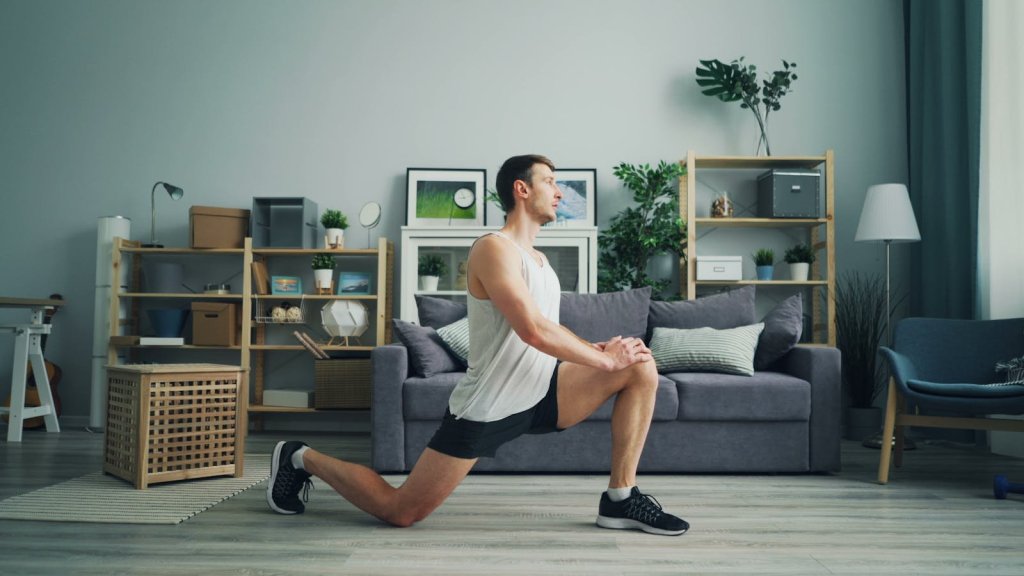
Understanding which stretches target the front of the hip, the buttock area, the inner thigh, or the back of the thigh can help you choose better options and avoid wasting time on movements that do not fit your symptoms. Hospital-based hip rehab handouts from Cambridge University Hospitals and the Royal Orthopaedic Hospital also emphasize slow, controlled exercise and good technique.
Before You Start Stretch Exercises for Hip Pain
A brief warm-up usually works better than stretching cold muscles. The American Academy of Orthopaedic Surgeons recommends 5 to 10 minutes of low-impact activity such as walking or a stationary bike before you start, and its hip program notes that you should not feel pain during an exercise.
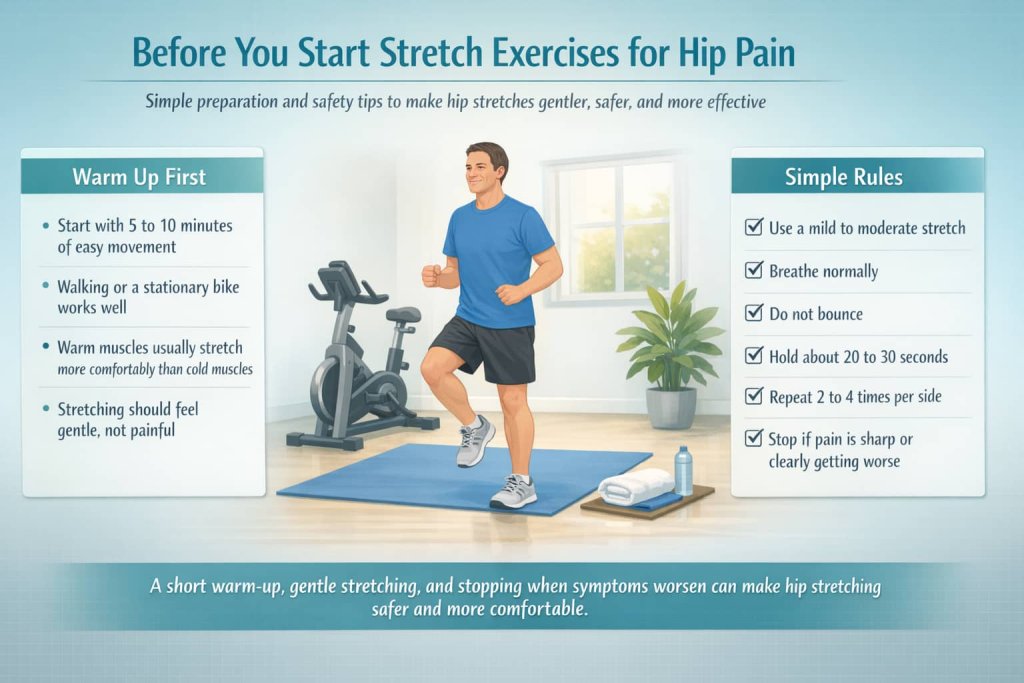
Use these simple rules:
- Move into a mild to moderate stretch, not a painful one.
- Breathe normally and avoid bouncing.
- Hold each stretch about 20 to 30 seconds unless a clinician has given you a different plan.
- Repeat 2 to 4 times per side for most stretches.
- Stop if you feel sharp pain, catching, giving way, numbness, or symptoms that clearly worsen after the stretch. Guidance from the Royal Orthopaedic Hospital notes that exercises should be done gently and slowly, and the American Academy of Orthopaedic Surgeons says pain during exercise should not be ignored.
What Stretch Exercises for Hip Pain Can Actually Help With
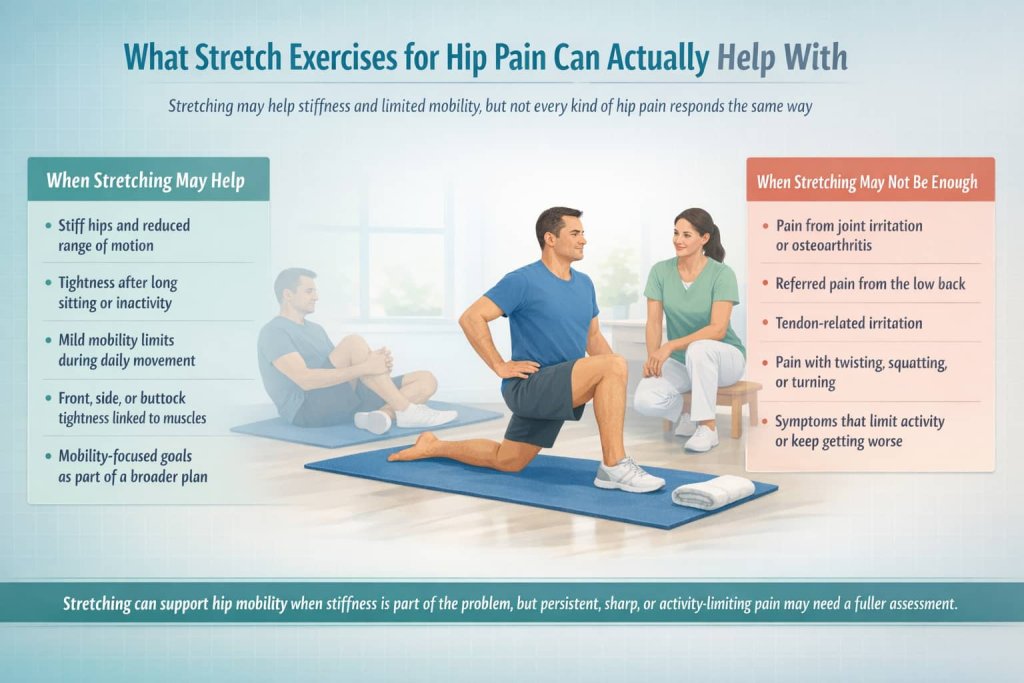
Stretching is most useful when stiffness and reduced mobility are part of the problem. In the hip conditioning program from the American Academy of Orthopaedic Surgeons, flexibility work is described as important for restoring range of motion and preventing injury. A systematic review available through PMC also found that hip flexor stretching can improve hip extension range of motion, which supports using stretching for mobility-focused goals.
That said, hip pain can come from several sources, including muscle tightness, tendon irritation, osteoarthritis, referred pain, or joint issues such as femoroacetabular impingement. The American Academy of Orthopaedic Surgeons notes that femoroacetabular impingement can cause pain, stiffness, and activity limits, especially with turning, twisting, and squatting.
12 Best Stretch Exercises for Hip Pain
Loosen tight hips and move with less stiffness using these 12 gentle stretch exercises for hip pain. This list covers simple at-home stretches that may help improve mobility, ease tension, and support more comfortable daily movement.
1. Knee-to-Chest Stretch
This is one of the simplest options for general buttock and back-of-hip tightness. The American Academy of Orthopaedic Surgeons includes knee to chest in its hip conditioning program and notes that you should feel it in the buttocks.
How to do it:
- Lie on your back with both legs straight or one knee bent.
- Bring one knee toward your chest.
- Hold your shin gently and pull only until you feel a comfortable stretch.
- Hold for 20 to 30 seconds.
- Switch sides, then repeat 2 to 4 times.
Why it works:
It can gently stretch the glute area and improve comfort when the back of the hip feels tight after sitting or walking.
Muscles worked:
Gluteus maximus and gluteus medius, with some relief for the back-of-hip tissues.
Trainer Tip:
Keep your lower back relaxed against the floor rather than yanking the knee in.
2. Supine Hamstring Stretch
If the back of the thigh feels tight and that tightness seems to pull on the hip or pelvis, this is a strong choice. Both the American Academy of Orthopaedic Surgeons and the Royal Orthopaedic Hospital include hamstring stretching in hip rehab materials.
How to do it:
- Lie on your back with one knee bent.
- Lift the other leg and hold behind the thigh.
- Slowly straighten the raised leg until you feel a stretch along the back of the thigh.
- Hold for 20 to 30 seconds.
- Repeat 2 to 4 times per side.
Why it works:
Hamstring tightness can limit hip motion and make bending, walking, or standing up feel stiffer.
Muscles worked:
Hamstrings.
Trainer Tip:
Do not pull directly on the knee joint. The American Academy of Orthopaedic Surgeons specifically cautions against that.
3. Hip Flexor Stretch
This stretch is useful when the front of the hip feels tight, especially after long periods of sitting. Research summarized in PMC found that hip flexor stretching can increase hip extension range of motion.
How to do it:
- Kneel on one knee with the other foot in front.
- Keep your torso upright.
- Gently shift your hips forward until you feel a stretch at the front of the kneeling hip.
- Hold for 20 to 30 seconds.
- Repeat 2 to 4 times per side.
Why it works:
It targets the front-of-hip tissues that often feel shortened in people who sit a lot.
Muscles worked:
Hip flexors, especially the iliopsoas and rectus femoris region.
Trainer Tip:
A slight glute squeeze on the kneeling side often makes the stretch feel cleaner and prevents over-arching the low back.
4. Quadriceps Stretch
The front of the thigh can contribute to front-of-hip tightness too. Cambridge University Hospitals includes a quadriceps stretch in its hip stretching handout.
How to do it:
- Stand holding a wall or chair for balance, or lie face down.
- Bend one knee and hold your ankle.
- Pull the heel gently toward your glutes until you feel a stretch in the front of the thigh.
- Hold for 20 to 30 seconds.
- Repeat 2 to 4 times per side.
Why it works:
It can ease tension in the quadriceps and front of the hip, especially if walking or stairs feel stiff.
Muscles worked:
Quadriceps, especially rectus femoris.
Trainer Tip:
Keep your knees close together and avoid flaring the ribs.
5. Piriformis Stretch
This is commonly used when the discomfort sits deep in the buttock area. Cambridge University Hospitals includes a piriformis stretch in its hip stretching guide, and the American Academy of Orthopaedic Surgeons includes a similar seated rotation stretch that targets the piriformis region.
How to do it:
- Sit on the floor or a chair.
- Cross one leg over the other.
- Bring the knee gently toward the opposite shoulder, or rotate toward the bent leg if seated on the floor.
- Hold for 20 to 30 seconds.
- Repeat 2 to 4 times per side.
Why it works:
It can reduce the tight, deep buttock feeling that sometimes shows up after sitting or twisting.
Muscles worked:
Piriformis and nearby deep gluteal muscles.
Trainer Tip:
Think gentle rotation, not a forced twist.
6. Figure-4 Glute Stretch
This is one of the most practical at-home options because it is easy to scale up or down.
How to do it:
- Lie on your back with knees bent.
- Cross one ankle over the opposite thigh.
- Reach through and draw the uncrossed leg toward you.
- Hold for 20 to 30 seconds.
- Repeat 2 to 4 times per side.
Why it works:
It stretches the glutes and deep external rotators without needing a lot of mobility.
Muscles worked:
Gluteus maximus, gluteus medius, piriformis, and other deep rotators.
Trainer Tip:
If reaching through is hard, stay with the crossed-leg position and lightly press the knee away.
7. Seated Glute Stretch
Cambridge University Hospitals includes a sitting glute stretch variation that brings the knee toward the opposite shoulder.
How to do it:
- Sit tall on the floor or a sturdy chair.
- Cross one leg over the other.
- Hug the crossed knee toward the opposite shoulder.
- Hold for 20 to 30 seconds.
- Repeat 2 to 4 times per side.
Why it works:
It is a good alternative for people who do not want to get down on the floor.
Muscles worked:
Glutes and deep hip rotators.
Trainer Tip:
Sit tall instead of collapsing through the low back.
8. Butterfly Stretch
This classic stretch can help when the inner thigh feels tight and hip opening feels limited.
How to do it:
- Sit on the floor with the soles of your feet together.
- Let your knees fall outward.
- Hold your feet and gently lean forward from the hips.
- Hold for 20 to 30 seconds.
- Repeat 2 to 4 times.
Why it works:
It targets the inner thigh muscles that can limit hip motion and make wide-stance movements feel restricted.
Muscles worked:
Adductors and groin muscles.
Trainer Tip:
Do not force your knees down. Let gravity do most of the work.
9. Standing IT Band and Outer-Hip Stretch
The American Academy of Orthopaedic Surgeons includes a standing iliotibial band stretch, and Cambridge University Hospitals also includes an IT band stretch for the outside of the hip and thigh.
How to do it:
- Stand next to a wall for support.
- Cross the leg you want to stretch behind the other leg.
- Lean your hips sideways toward the wall until you feel a stretch along the outside of the hip and thigh.
- Hold for 20 to 30 seconds.
- Repeat 2 to 4 times per side.
Why it works:
It can help with outer-hip tightness and the feeling of tension along the side of the leg.
Muscles worked:
Tensor fasciae latae and outer-hip tissues.
Trainer Tip:
Do not twist at the waist. The American Academy of Orthopaedic Surgeons specifically gives that cue.
10. Adductor Side-Lunge Stretch
This is a simple way to stretch the inner thigh without sitting on the floor.
How to do it:
- Stand with your feet wide.
- Shift your weight to one side while keeping the other leg straighter.
- Stop when you feel a stretch in the inner thigh of the straight leg.
- Hold for 20 to 30 seconds.
- Repeat 2 to 4 times per side.
Why it works:
The adductors can become tight in people who spend long hours sitting or who feel stiff when changing direction.
Muscles worked:
Adductors and groin muscles.
Trainer Tip:
Keep your chest lifted and move slowly into the stretch.
11. Child’s Pose With Slight Hip Bias
This can feel good when the hips and low back are both stiff, especially after a long day.
How to do it:
- Start on hands and knees.
- Sit your hips back toward your heels.
- Reach your arms forward.
- To bias one side slightly more, walk both hands a little to the opposite side.
- Hold for 20 to 30 seconds.
- Repeat 2 to 4 times.
Why it works:
It provides a gentle global stretch across the hips, glutes, and low back.
Muscles worked:
Glutes, hip capsule area, lower back, and lats secondarily.
Trainer Tip:
Place a pillow under your hips or chest if the floor position feels cramped.
12. Supine Hip Rotation Stretch
This is a gentle mobility option when the hip feels stiff with turning and rotation.
How to do it:
- Lie on your back with knees bent and feet flat.
- Let both knees slowly fall to one side within a comfortable range.
- Return to center and repeat to the other side.
- Hold briefly or move slowly for 5 to 8 reps per side.
Why it works:
It adds controlled hip rotation without forcing end range.
Muscles worked:
Deep hip rotators, glutes, and surrounding joint-support tissues.
Trainer Tip:
Keep the motion small if rotation is uncomfortable.
How to Choose the Right Hip Pain Stretch for Your Symptoms
The best stretch usually depends on where the discomfort is:
- Front of the hip: hip flexor stretch, quadriceps stretch
- Buttock or back of the hip: figure-4 stretch, piriformis stretch, knee-to-chest
- Back of the thigh with hip stiffness: hamstring stretch
- Outer hip or side-of-thigh tightness: standing IT band and outer-hip stretch
- Inner thigh tightness: butterfly stretch, adductor side-lunge stretch
This location-based approach lines up well with hospital handouts from Cambridge University Hospitals that separate quad, hamstring, glute, piriformis, and IT band-focused stretches instead of treating all hip pain the same way.
How Often Should You Do Stretch Exercises for Hip Pain
A practical starting point is 1 to 2 short sessions per day using 3 to 5 stretches that match your symptoms. The Royal Orthopaedic Hospital advises choosing 3 to 4 exercises per session and notes that exercises should be done gently, slowly, and ideally three times a day in its osteoarthritis hip exercise guidance. The American Academy of Orthopaedic Surgeons says its broader hip conditioning program is commonly continued for 4 to 6 weeks and then maintained two to three days per week afterward.
A simple beginner plan looks like this:
- Warm up for 5 minutes
- Pick 3 stretches that match where you feel tight
- Hold each for 20 to 30 seconds
- Repeat each 2 to 4 times
- Reassess after 1 to 2 weeks
Common Mistakes to Avoid
Stretching Too Hard
More intensity is not better. The American Academy of Orthopaedic Surgeons explicitly says you should not feel pain during an exercise.
Skipping the Warm-Up
Cold stretching often feels worse and may be less productive. The American Academy of Orthopaedic Surgeons recommends 5 to 10 minutes of low-impact movement first.
Using Stretches for Every Type of Hip Pain
Hip pain can come from arthritis, tendon problems, referred back pain, or joint conditions. For example, the American Academy of Orthopaedic Surgeons notes that femoroacetabular impingement can cause groin pain, stiffness, and sharp pain with twisting or squatting. If that pattern sounds familiar, generic stretching alone may not be enough.
Ignoring Symptoms That Need Medical Care
The NHS advises seeing a GP if hip pain is stopping normal activities, affecting sleep, getting worse, or not improving after home treatment for 2 weeks. Urgent assessment is more important after a major fall, when you cannot bear weight, or if the joint is hot, swollen, or associated with fever.
Who Should Be Extra Careful
Get medical guidance before starting a new stretching plan if:
- Your hip pain started after a fall or injury
- You cannot bear weight
- You have fever, redness, heat, or major swelling
- Pain is severe at night or keeps getting worse
- You have numbness, major weakness, or bowel or bladder symptoms
- You have a recent hip replacement or a known hip joint condition
These caution points are consistent with guidance from the NHS and MedlinePlus for hip-related red-flag symptoms.
Do Stretch Exercises for Hip Pain Work on Their Own
Sometimes, but not always. Stretching is often one useful piece of the plan, especially for stiffness and reduced range of motion. The American Academy of Orthopaedic Surgeons also emphasizes strengthening the muscles that support the hip, and the Royal Orthopaedic Hospital recommends a mix of mobility and strengthening work in hip rehabilitation materials.
A good next step after the pain settles is often to pair stretching with basic glute and hip-strengthening work so the area feels not just looser, but more supported.
FAQ
What are the best stretch exercises for hip pain at home?
The best at-home options are usually knee-to-chest, figure-4 stretch, hip flexor stretch, hamstring stretch, piriformis stretch, and a standing outer-hip stretch. The right choice depends on whether your tightness is in the front, side, buttock area, or back of the thigh. Cambridge University Hospitals outlines several of these practical options in its hip stretching guidance.
Should I stretch a painful hip every day?
Often yes, if the stretching feels gentle and the symptoms are mostly stiffness-related. Hospital guidance commonly uses daily or frequent gentle practice, but pain during stretching is a sign to stop and reassess. The American Academy of Orthopaedic Surgeons makes that point clearly in its exercise guidance.
Can stretching make hip pain worse?
Yes, especially if you stretch aggressively, force painful positions, or the pain is coming from a condition that needs more than flexibility work. The American Academy of Orthopaedic Surgeons says you should not ignore pain during exercise.
How long should I hold hip stretches?
A common starting point is 20 to 30 seconds. Some guidance from the American Academy of Orthopaedic Surgeons uses 30 to 60 seconds for hamstring work, while hospital handouts often use similar short holds for other stretches.
Is walking better than stretching for hip pain?
They do different jobs. Walking can warm the tissues and keep you moving, while stretching may help specific areas feel less stiff. The American Academy of Orthopaedic Surgeons recommends low-impact movement as a warm-up before hip exercises.
When should I stop stretching and see a doctor?
Stop and get assessed if the pain is severe, follows an injury, makes weight-bearing difficult, keeps getting worse, wakes you at night, or is linked with fever, redness, swelling, numbness, or bladder or bowel changes. The NHS highlights these as warning signs that need medical attention.
Conclusion
The best stretch exercises for hip pain are the ones that match where you feel tight, feel gentle while you do them, and help you move a little more comfortably over time. Start with a short warm-up, choose 3 to 5 stretches from this list, and stay consistent for a couple of weeks instead of forcing deep positions on day one. If your pain is sharp, worsening, or linked to injury or weight-bearing trouble, get medical advice before continuing.
This content is for informational purposes only and not medical advice.