
A practical water intake chart by age and weight starts with official age-based targets, then adjusts for body size, exercise, heat, pregnancy, breastfeeding, and medical needs. There is no single official rule that tells every person exactly how many cups to drink based on weight alone. In the U.S., the strongest baseline comes from age- and life-stage targets for total water, while the Centers for Disease Control and Prevention explains that activity, hot climates, fever, vomiting, diarrhea, pregnancy, and breastfeeding can all change your real-world needs.
That matters because many people look for a water intake chart by age and weight when what they really need is a simple starting point plus a safe way to adjust it. The age chart below gives that starting point. Then you can fine-tune it for body size, sweat loss, climate, and health conditions. CDC data also show that plain-water intake is often lower than people expect: during 2015–2018, U.S. children and teens drank an average of 23 ounces of plain water per day, while adults drank 44 ounces.
What this water intake chart by age and weight really means
The first thing to know is that official recommendations are usually for total water, not just plain drinking water. Total water includes drinking water, other beverages, and water naturally found in foods. So if you eat fruit, vegetables, soup, yogurt, or other high-water foods, those count toward your daily total too.
That is why two people of the same weight can need different amounts of plain water. One may eat more high-water foods, sweat less, stay indoors, and drink milk or tea. Another may work outside in humidity, exercise hard, and lose far more fluid through sweat.
Official daily water intake chart by age
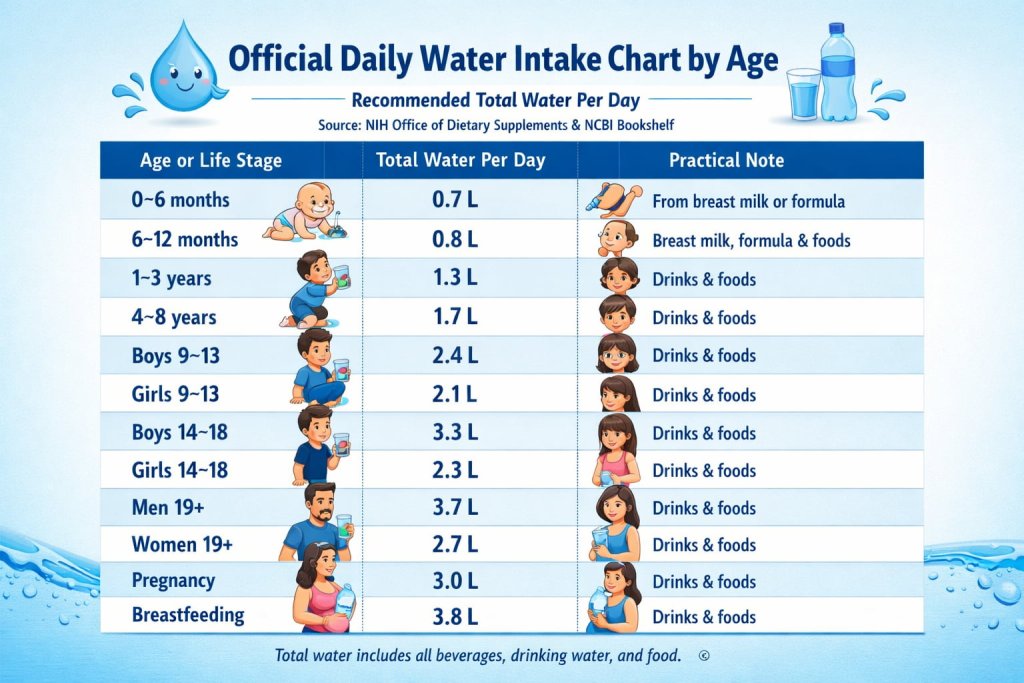
The chart below uses the National Academies’ Dietary Reference Intake values for total water per day. These are the best official baseline for healthy people.
| Age or life stage | Total water per day | Practical note |
|---|---|---|
| 0–6 months | 0.7 L | Usually comes from breast milk or formula |
| 6–12 months | 0.8 L | Mostly from breast milk, formula, and foods |
| 1–3 years | 1.3 L | Total from drinks and food |
| 4–8 years | 1.7 L | Total from drinks and food |
| Boys 9–13 | 2.4 L | Total from drinks and food |
| Girls 9–13 | 2.1 L | Total from drinks and food |
| Boys 14–18 | 3.3 L | Total from drinks and food |
| Girls 14–18 | 2.3 L | Total from drinks and food |
| Men 19+ | 3.7 L | Total from drinks and food |
| Women 19+ | 2.7 L | Total from drinks and food |
| Pregnancy | 3.0 L | Total from drinks and food |
| Breastfeeding | 3.8 L | Total from drinks and food |
Source: NIH Office of Dietary Supplements / NCBI Bookshelf. Total water includes food, beverages, and drinking water.
Quick cups conversion for adults
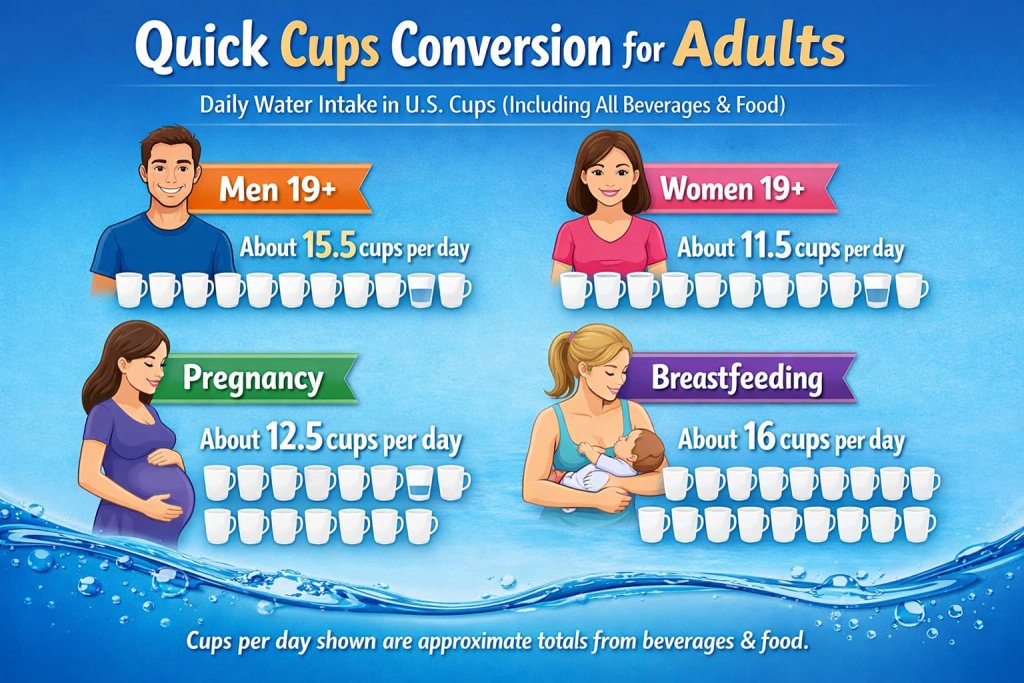
If liters feel abstract, here is the same official total water guidance in approximate U.S. cups:
- Men 19+: about 15.5 cups per day
- Women 19+: about 11.5 cups per day
- Pregnancy: about 12.5 cups per day
- Breastfeeding: about 16 cups per day
These are approximate conversions of the official total-water intake values. They still include water from beverages and food, not just plain drinking water.
Plain-water guidance for babies and young children
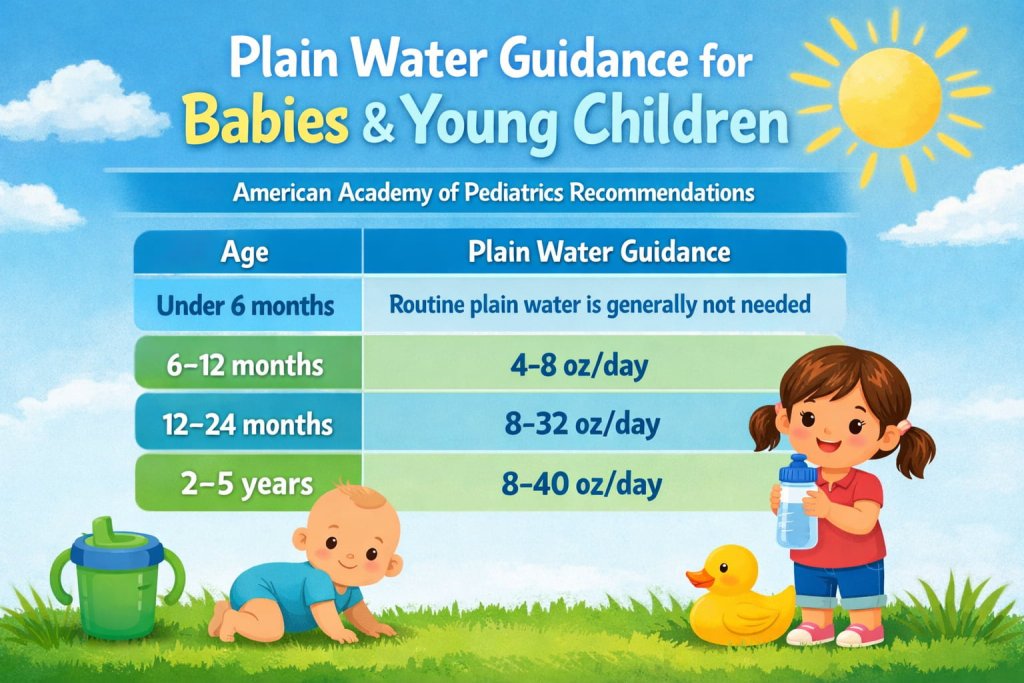
This is the part many charts get wrong. Babies and young children should not simply be put on adult-style “drink more water” rules. The American Academy of Pediatrics gives more specific guidance for children age 5 and younger.
| Age | Plain water guidance |
|---|---|
| Under 6 months | Routine plain water is generally not needed |
| 6–12 months | 4–8 oz/day |
| 12–24 months | 8–32 oz/day |
| 2–5 years | 8–40 oz/day |
AAP also says that water and plain milk are the best beverage choices for young children. Around 6 months, you can begin offering small amounts of water, but hydration for younger infants is still mainly coming from breast milk or formula.
How weight changes your hydration needs
Weight matters, but not in the way many online charts suggest. Official U.S. guidance does not use one simple ounces-per-pound rule for everyone. Instead, it starts with age and life stage, then adjusts for factors like climate, activity, sweat loss, clothing, medications, and health conditions. The American Heart Association makes this especially clear in its hydration guidance.
In practical terms, a larger body often needs more fluid than a smaller body, especially during exercise or heat exposure. But sweat rate can vary a lot from person to person, so the safest way to use weight is to track how much fluid you actually lose. The American Heart Association recommends weighing yourself before and after exercise. For every pound lost through sweat, you need about 1 pint of water to replace it.
That makes this a better approach than copying a generic “drink X ounces for your weight” chart:
- Start with the age-based baseline.
- Add more if you are larger, more active, or sweating heavily.
- Use workout weight change to personalize your plan.
- Recheck in hotter weather, during travel, or when your routine changes.
Activity and climate can raise your water needs fast
Your body needs more water when you are in a hot climate, more physically active, running a fever, or dealing with diarrhea or vomiting. These are some of the biggest reasons a baseline chart stops being enough.
If you exercise in the heat, CDC advises drinking more water than usual and not waiting until you feel thirsty. Thirst can lag behind fluid loss, and muscle cramping can be an early sign of heat-related illness.
For heavy outdoor work or strenuous activity in high heat, the numbers can rise sharply. OSHA advises workers in the heat to drink 1 cup (8 ounces) every 15 to 20 minutes, which is about 32 ounces per hour, and not to exceed 48 ounces per hour because drinking too much too quickly can become dangerous. That is not a normal everyday target. It is a heat-stress rule for demanding conditions.
When plain water may not be enough
If you are losing fluid from vomiting or diarrhea, plain water alone may not be the best replacement. The National Institute of Diabetes and Digestive and Kidney Diseases says you need to replace both fluids and electrolytes, and notes that oral rehydration solutions contain glucose and electrolytes that can help prevent or treat dehydration. CDC’s norovirus guidance also says over-the-counter oral rehydration fluids are especially helpful for mild dehydration.
For children, the American Academy of Pediatrics says oral rehydration therapy is an effective and safe way to help prevent dehydration at home. This is one of the few situations where a simple “drink more water” message is not enough.
Older adults may need extra attention
Hydration can get trickier with age. The CDC heat guidance for older adults says adults 65 and older do not adjust as well to sudden temperature changes, are more likely to have chronic conditions, and are more likely to take medicines that affect sweating or body temperature control. On hot days, CDC tells older adults to drink more water than usual and not wait until they feel thirsty.
This does not mean every older adult should automatically force down large amounts of fluid. It means seniors should be more intentional about hydration, especially during hot weather, illness, or medication changes. If a doctor has already limited fluids or prescribed water pills, individual advice matters more than any general chart.
How much of your daily total should come from plain water?
For most people, plain water should be the main drink because it hydrates without sugar or calories. Plain drinking water counts toward your daily total water intake, and fruits and vegetables with high water content help too.
That means you do not need every liter in the chart to come from plain water alone. But it also does not mean sugary drinks are a good substitute. For children, the American Academy of Pediatrics says plain water and plain milk are the best beverage choices. For adults, CDC lists plain coffee, tea, sparkling water, and similar low- or no-calorie drinks as options that can fit into a healthy pattern, while plain water remains the simplest default.
Signs you are probably hydrated enough
Hydration is not only about counting cups. The American Heart Association says pale, clear urine is a practical sign that you are well hydrated, while dark urine is a sign to drink more fluids. It also notes that thirst is not the best early warning sign, because by the time you feel thirsty, you may already be behind.
A simple day-to-day check looks like this:
- Your urine is usually pale, not consistently dark.
- You are not relying on thirst alone.
- You do not feel washed out, lightheaded, or headachy in the heat.
- Your exercise weight is fairly stable instead of dropping sharply.
Who should be careful with generic water charts?
Some people should not follow a general water intake chart without checking with a clinician first.
People with chronic kidney disease may need to limit liquids because damaged kidneys may not remove extra fluid well, according to NIDDK guidance for adults with CKD.
People with heart failure may also be told to track or limit fluid intake. The American Heart Association’s heart failure guidance says the care team may recommend limiting liquid intake and discussing exactly how much to drink each day.
Babies under 6 months are another special case. They should not be placed on general water charts because their fluid needs are handled very differently from older children and adults.
Can you drink too much water?
Yes. Overhydration is real, especially when someone drinks large amounts quickly during heavy sweating or endurance activity. OSHA warns not to exceed 48 ounces per hour in hot work conditions, and MedlinePlus explains that low blood sodium can happen when the balance of water to sodium gets too diluted.
This is one reason “more is always better” is not good hydration advice. The goal is enough fluid for your body, your weather, and your workload, not nonstop drinking.
When dehydration needs medical attention
A daily water chart is useful for routine hydration, but it should not delay medical care when dehydration is becoming serious. NIDDK lists warning signs such as very dark urine or urinating less than usual, dry mouth, light-headedness, dizziness, fainting, unusual tiredness, and sunken eyes or cheeks. The CDC guidance on E. coli symptoms and dehydration also notes that dehydration can happen quickly in young children and that warning signs can include little or no peeing, very dark urine, crying without tears, and marked sleepiness.
Adults should also seek medical care if they cannot keep liquids or oral rehydration solution down, or if vomiting or diarrhea is frequent, severe, or not improving, as NIDDK explains. This helps readers know when a hydration problem has moved beyond a normal daily-water question.
A simple way to use a water intake chart by age and weight
Use this practical method:
- Start with the official age-based chart above.
- Treat those numbers as total water, not plain water only.
- Increase intake in hot weather, during hard workouts, or when you are losing fluid from illness.
- Use your exercise weight change to personalize your plan.
- If you have kidney disease, heart failure, or a doctor-ordered fluid limit, follow that guidance instead of a general chart.
FAQs
Is 8 glasses of water a day enough?
Sometimes, but not always. Official needs vary by age, sex, pregnancy, breastfeeding, activity, and climate. For many adults, 8 cups may be too low in hot weather or during hard exercise, while others may meet their needs with a mix of water, other drinks, and water-rich foods.
Does coffee or tea count toward hydration?
Yes. CDC lists plain coffee and tea among low- or no-calorie beverage choices that can be part of a healthy diet for most adults. But plain water is still the easiest everyday base, especially when you are trying to build a clear hydration habit.
Should kids use the same water chart as adults?
No. Infants and young children have different guidance. AAP uses child-specific beverage recommendations, and babies under 6 months should not follow adult-style water goals.
What is the best weight-based hydration method for exercise?
The best practical method is to weigh yourself before and after exercise. The American Heart Association says each pound lost through sweat equals about 1 pint of fluid to replace.
Conclusion
A good water intake chart by age and weight is not just a list of cups. It is a baseline plus adjustments. Start with the official age-based total water targets, then raise or lower your intake based on body size, sweat loss, exercise, heat, illness, pregnancy, breastfeeding, and any medical limits. That approach is safer and more accurate than copying a one-size-fits-all weight formula.
If you are building a daily hydration routine, begin with the chart above, make water your default drink, and pay extra attention during workouts, heat waves, and illness. If a health condition affects your fluids, use your clinician’s advice as the real target.
This content is for informational purposes only and not medical advice.
Sources/References
- National Institutes of Health Office of Dietary Supplements / NCBI Bookshelf — Dietary Reference Intakes: Recommended Dietary Allowances and Adequate Intakes, Total Water and Macronutrients
- Centers for Disease Control and Prevention — About Water and Healthier Drinks
- American Academy of Pediatrics — Recommended Drinks for Children Age 5 & Younger