
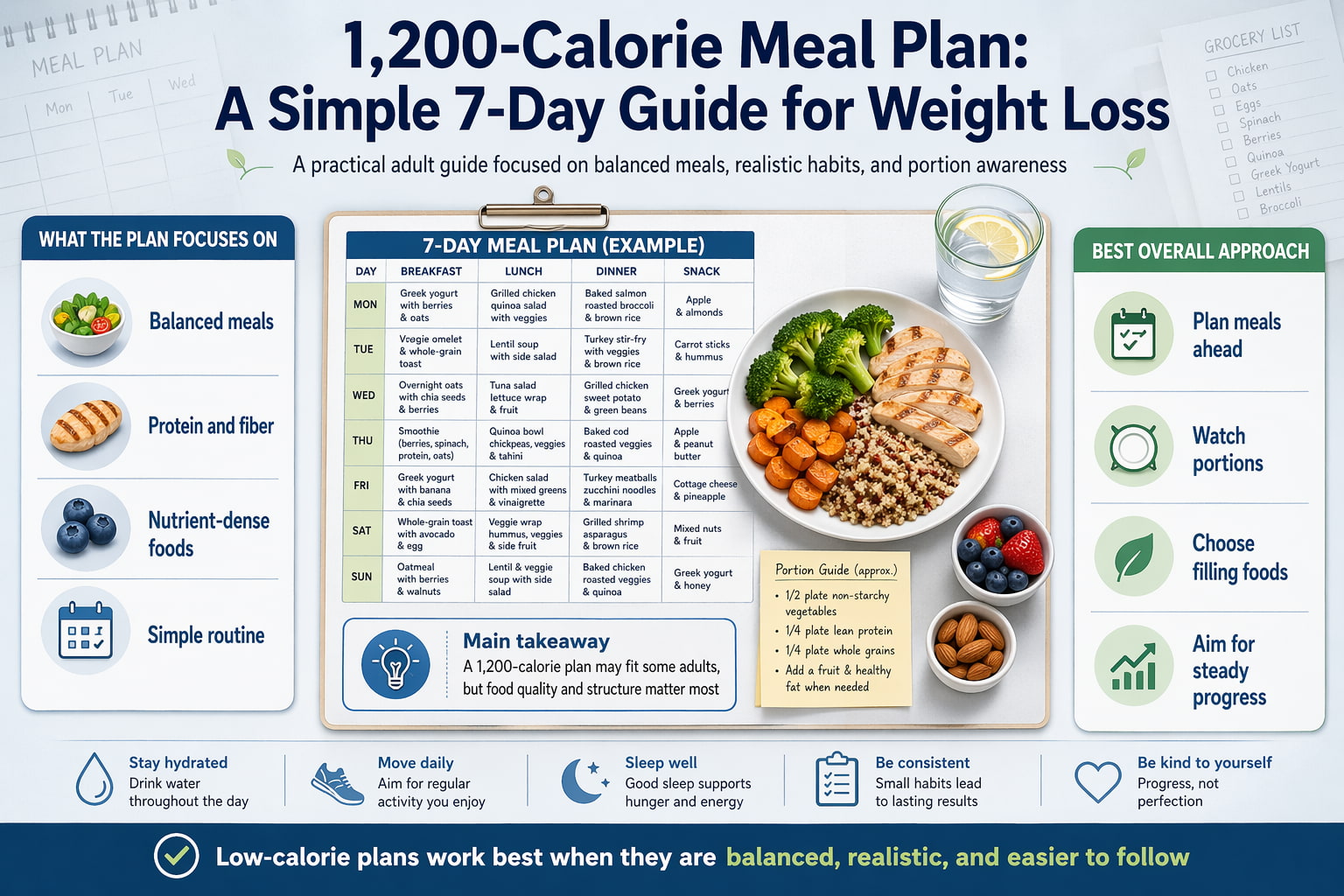
A 1,200-calorie meal plan can help some adults lose weight, but it is a low-calorie approach, not a universal target. A better starting point is the official NIDDK Body Weight Planner, because calorie needs vary by body size, activity, and goal. This article is written for adults only. Teens are still growing, and current federal guidance says adolescence comes with increased needs for energy and key nutrients.
What a 1,200-Calorie Meal Plan Really Means
A 1,200-calorie meal plan is near the low end of adult weight-loss plans. The National Institute of Diabetes and Digestive and Kidney Diseases says eating less than 1,200 calories a day is not advised, so 1,200 should be viewed as a lower boundary for some adults, not a default target for everyone.
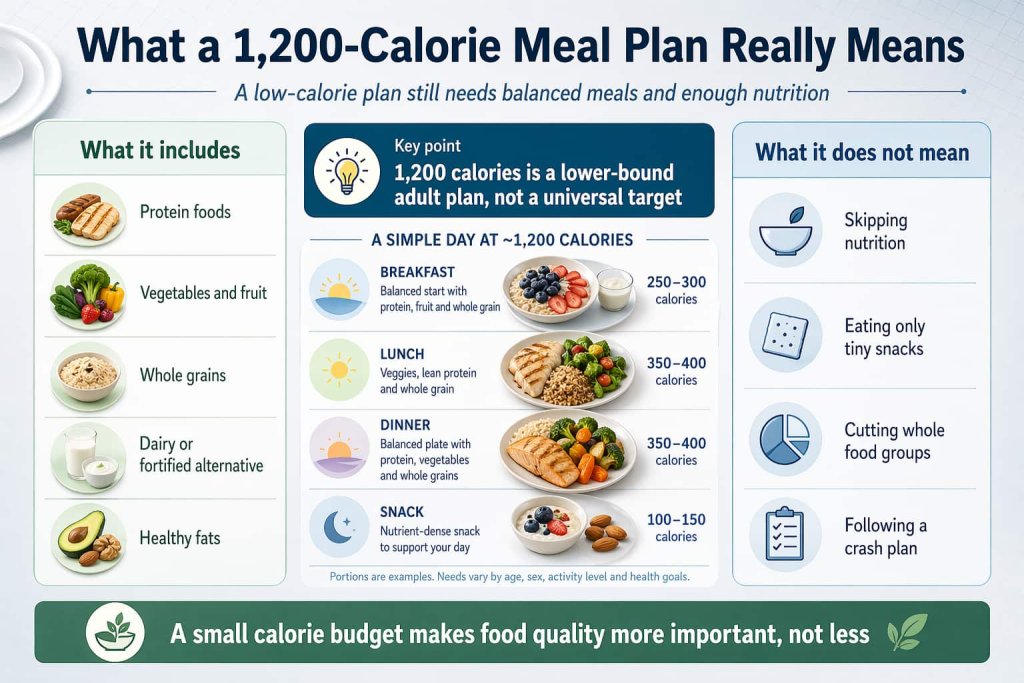
Because the calorie budget is small, food quality matters a lot. The current federal Daily Servings by Calorie Level guide shows that even at 1,200 calories, the pattern still includes protein foods, dairy, vegetables, fruit, whole grains, and healthy fats. In other words, a low-calorie plan still has to be balanced.
One important clarification belongs here: the Dietary Guidelines food-pattern modeling report says the 1,000-, 1,200-, and 1,400-calorie patterns were designed for children ages 2 through 8. Patterns from 1,600 to 3,200 calories are the ones intended for children 9 and older and adults. That does not mean no adult will ever use a 1,200-calorie plan for weight loss, but it does mean this level should be treated as a special-case, lower-calorie option rather than a standard adult template.
Using that federal framework, a 1,200-calorie day roughly looks like this for adults:
| Food group | Approximate daily amount |
|---|---|
| Protein foods | 1.5 to 2 servings |
| Dairy | 2.5 servings |
| Vegetables | 1.75 servings |
| Fruits | 1 serving |
| Whole grains | 1.5 to 2.75 servings |
| Healthy fats | 2.5 teaspoons |
These are serving ranges, not exact meal prescriptions, and actual calories still depend on the foods and portions you choose.
Who a 1,200-Calorie Meal Plan May Fit
For some adults with lower calorie needs, a 1,200-calorie plan may be used as a short-term, structured weight-loss tool. NIDDK recommends choosing plans that are science-based, low in calories, and tailored to your health, preferences, and long-term habits rather than copied from social media or followed as a crash diet.
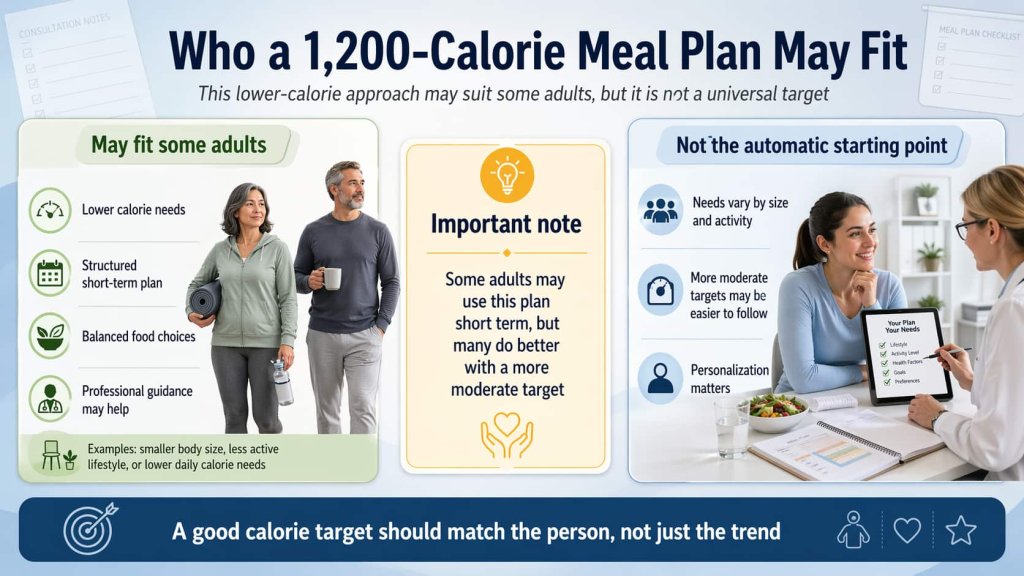
It is also worth saying plainly that you do not need to drop straight to 1,200 calories just because you want to lose weight. NHLBI advises reducing daily calories gradually and talking with your provider before beginning any diet or eating plan. For many adults, a more moderate calorie target is easier to follow, more satisfying, and more realistic for steady progress.
Who Should Be Careful Before Trying It
A 1,200-calorie meal plan is not a good starting point for teens, because adolescence is a rapid growth period with increased needs for energy, protein, calcium, and iron. It also may not fit pregnant or breastfeeding women, highly active adults, or adults whose medicines or medical issues affect weight or blood sugar. NIDDK advises talking with a health care professional, who may review your health factors, medicines, and whether a lower-calorie plan is appropriate for you.
Adults with diabetes need extra caution with a low-calorie plan. NIDDK says some diabetes medicines, including sulfonylureas or insulin, may make blood glucose drop too low during exercise or if you skip or delay a meal. Its guidance on low blood glucose also says your regular eating plan should include enough carbohydrates to help keep blood glucose in your target range. If you use glucose-lowering medicine, this kind of meal plan should be reviewed with your care team before you try it.
How to Build a Balanced 1,200-Calorie Meal Plan
The safest way to think about a 1,200-calorie meal plan is not as “eat tiny portions of anything,” but as “fit the most nutrition into a small calorie budget.” The current Dietary Guidelines for Americans, 2025–2030 emphasizes whole, nutrient-dense foods to meet nutrient needs and support health.
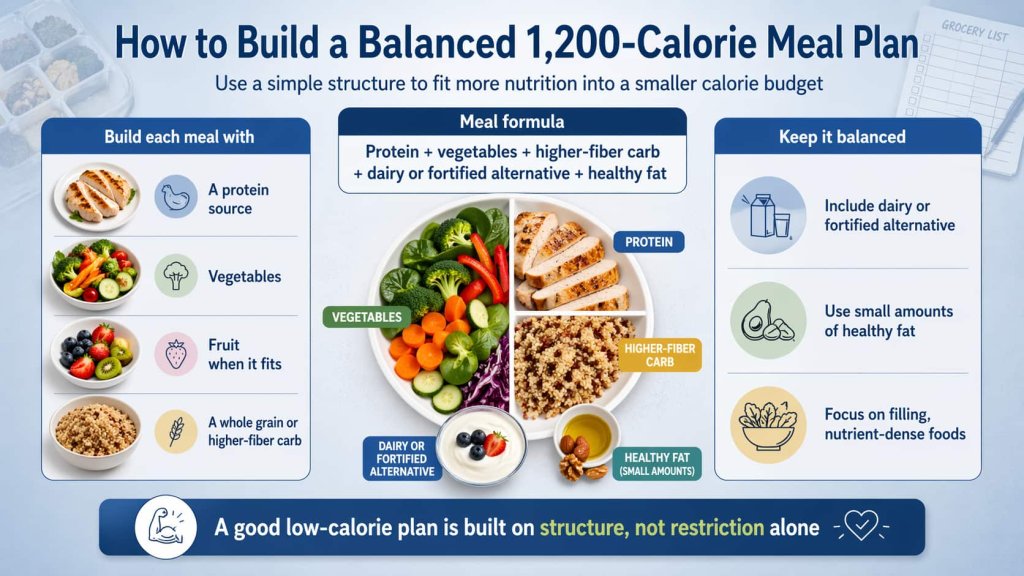
A simple meal-building formula works well:
- Build each meal around a protein source.
- Add vegetables and, when it fits, fruit.
- Choose a whole-grain or other higher-fiber carb.
- Include dairy or a fortified alternative.
- Use small amounts of healthy fat for flavor and satisfaction.
NIDDK’s plate method is a practical shortcut: fill half your plate with fruits and vegetables, one quarter with lean protein or beans, and one quarter with a whole grain such as brown rice or whole-wheat pasta.
What to Prioritize Most
On a lower-calorie plan, the foods that usually make the biggest difference are:
- lean proteins such as eggs, fish, yogurt, tofu, beans, chicken, or cottage cheese
- vegetables, especially non-starchy ones
- fruit instead of calorie-dense sweets
- whole grains instead of refined grains
- mostly water, unsweetened tea, or other low-calorie drinks
That general approach lines up with current federal guidance to focus on whole, nutrient-dense foods and reduce highly processed foods.
How to Read Labels Without Overcomplicating It
The FDA Nutrition Facts Label guide is useful when you are trying to make a 1,200-calorie plan more filling and balanced. Check serving size first, then compare calories, saturated fat, sodium, added sugars, and fiber. FDA notes that Daily Values on the label are based on a 2,000-calorie diet, so use them as comparison tools rather than exact personal targets for a 1,200-calorie plan.
A Simple 7-Day Guide for Weight Loss
A rigid copy-and-paste menu is not the safest approach for a calorie level this low. A better 7-day guide is to use one focused step each day and build a routine you can actually keep.
Day 1: Find Your Real Starting Point
Use the Body Weight Planner to estimate your calorie needs and compare them with what you are eating now. This helps you see whether 1,200 calories is even realistic for your body size and activity level before you try to force it.
Day 2: Put Protein in Every Meal
Build breakfast, lunch, and dinner around a clear protein source. Protein helps a low-calorie plan feel more structured and helps prevent meals from turning into mostly refined carbs. Current federal serving guidance also keeps protein foods in the plan even at 1,200 calories.
Day 3: Make Produce the Easiest Thing to Eat
Keep washed fruit, salad greens, cut vegetables, and frozen vegetables easy to reach. A low-calorie plan becomes much more practical when high-volume foods are the default rather than an afterthought.
Day 4: Upgrade Your Carbs
Choose oats, brown rice, beans, lentils, quinoa, or whole-grain bread instead of pastries, sugary cereal, or white bread most of the time. Whole grains and legumes usually give you more fiber and better staying power for the same calorie budget.
Day 5: Plan One Smart Snack
Skipping snacks is not always the answer. MedlinePlus notes that snacks with a protein source or a whole grain tend to have more staying power, which is why a small planned snack often works better than getting overly hungry and overeating later.
Day 6: Audit Drinks, Sauces, and “Little Extras”
Liquid calories and small add-ons can quietly break a low-calorie plan. NIDDK recommends water instead of sugary drinks, and calorie awareness becomes especially important when the daily target is low.
Day 7: Review Hunger, Energy, and Progress
The goal is not to white-knuckle your way through the week. CDC says healthy weight loss is usually gradual, about 1 to 2 pounds per week, and NIDDK recommends realistic early goals such as 5% to 10% of starting body weight within 6 months. If the plan feels impossible to sustain, it is probably the wrong calorie level for you.
Common Mistakes That Make a 1,200-Calorie Meal Plan Harder
A 1,200-calorie meal plan usually goes wrong when people do one of four things:
- drink a lot of their calories
- let protein and fiber get too low
- rely too heavily on highly processed convenience foods
- expect exercise alone to “cancel out” overeating
CDC notes that most weight loss comes from lowering calorie intake, while physical activity adds health benefits and helps with weight maintenance over time.
What to Do Instead of Chasing Fast Results
A safer target is steady progress. CDC says people who lose weight gradually are more likely to keep it off, and NIDDK advises choosing programs built around healthy behaviors you can maintain. That usually means realistic calories, routine movement, enough sleep, and meals you can repeat without feeling deprived.
FAQ
Is 1,200 calories enough for everyone?
No. Calorie needs vary, and NIDDK’s Body Weight Planner exists because your target should depend on your body size, activity, and goal. A fixed 1,200-calorie plan is only appropriate for some adults.
How much weight can you lose on a 1,200-calorie meal plan?
There is no single number that fits everyone. CDC says a healthy pace is usually about 1 to 2 pounds per week, while NIDDK recommends a realistic first goal of losing 5% to 10% of your starting weight within 6 months.
Can you use a 1,200-calorie meal plan if you exercise a lot?
Often, no. More activity usually means higher calorie needs, and CDC says adults may need more activity and an eating plan that matches their needs to lose weight and keep it off. Personalized planning works better than forcing the same calorie goal on everyone.
What foods help you stay full on a lower-calorie plan?
Protein-rich foods, vegetables, fruit, whole grains, and a planned snack with protein or a whole grain usually help the most. MedlinePlus specifically notes that protein sources and whole grains can make snacks more satisfying.
Conclusion
A 1,200-calorie meal plan can work for some adults, but it is best treated as a careful, individualized tool, not a magic number. The most effective version is built around whole foods, realistic expectations, and a plan you can actually sustain. Before you commit to 1,200 calories, check your needs with the Body Weight Planner or review the plan with a registered dietitian or clinician.
This content is for informational purposes only and not medical advice.
References
- Office of Disease Prevention and Health Promotion — Current Dietary Guidelines
- Dietary Guidelines for Americans — Food Pattern Modeling Report for Ages 2 Years and Older
- RealFood.gov — Daily Servings by Calorie Level
- NIDDK — Healthy Living with Diabetes
- NIDDK — Low Blood Glucose (Hypoglycemia)
- NHLBI — Overweight and Obesity Treatment
- CDC — Physical Activity and Your Weight and Health
- FDA — How to Understand and Use the Nutrition Facts Label
- MedlinePlus — 12 healthy snacks with 200 calories or less