
Creatine for seniors may help support muscle strength, lean mass, and some everyday physical function, especially when it is combined with resistance training. It is not a cure for age-related muscle loss, and it is not a substitute for exercise, but it may be a useful add-on for some older adults who want to stay stronger and more independent as they age, according to a 2024 systematic review and meta-analysis.
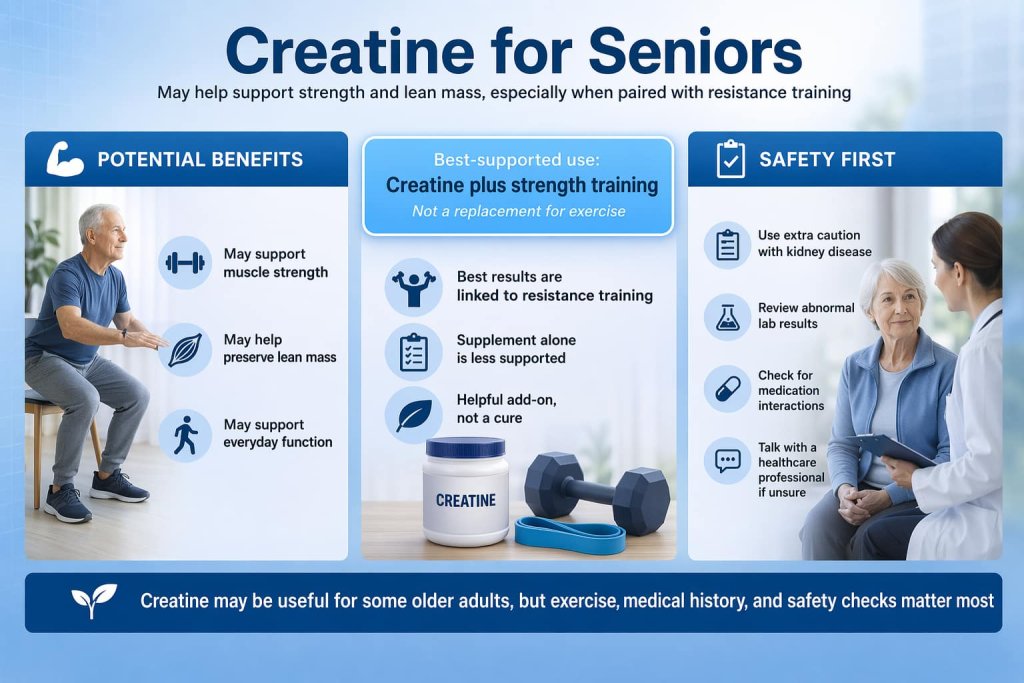
The most important thing to know is this: the best evidence for creatine in older adults is tied to strength training, not to taking the supplement by itself. Safety also matters more in this age group, particularly for people with kidney disease, abnormal lab results, or regular medication use. The NIH Office of Dietary Supplements and current reviews both support that more careful, practical view.
What Is Creatine for Seniors, Exactly?
Creatine is a natural compound stored in muscle and used to help produce quick energy during short, intense efforts. The form used most often in research and supplements is creatine monohydrate, and that is the form with the strongest evidence behind it. The NIH Office of Dietary Supplements notes that creatine is most helpful for repeated short bursts of high-intensity activity and that creatine monohydrate is the most widely used and studied form.
For older adults, that matters because activities like resistance training, getting out of a chair, climbing stairs, and maintaining muscle strength all depend on muscle function. Creatine does not “reverse aging,” but it may help support the muscle side of healthy aging when paired with a good exercise plan, as seen in the 2024 review of older adults at risk of functional decline.
Benefits of Creatine for Seniors
1) It may help improve strength and lean muscle mass
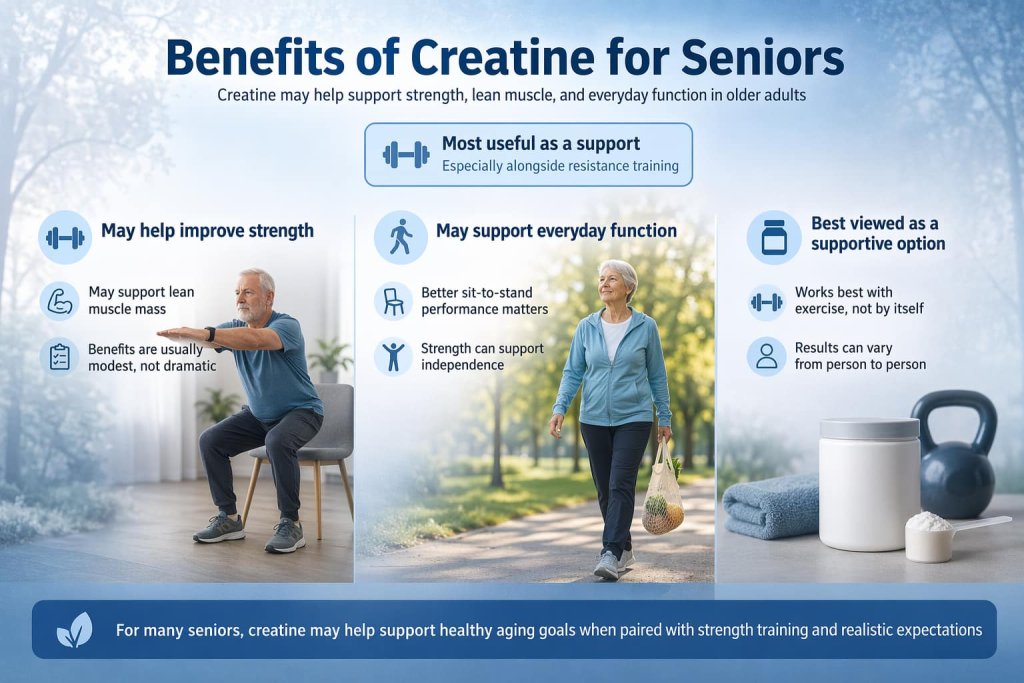
The strongest evidence for creatine in seniors is in muscle-related outcomes. A 2024 systematic review and meta-analysis on creatine and physical function found improvements in sit-to-stand performance, muscle function, and lean tissue mass. A newer 2025 meta-analysis on creatine plus resistance training in older adults also found significant improvements in muscle strength and lean tissue mass.
One important nuance: the 2024 review rated the overall certainty of the evidence as low or very low because many trials had a high risk of bias. That does not erase the positive findings, but it does mean creatine should be viewed as a supportive option with realistic expectations, not a guaranteed fix.
That does not mean every older adult will notice a dramatic change. The benefits tend to be modest, and some people respond better than others. Still, for seniors trying to maintain strength, muscle, and independence, even modest gains can be meaningful.
2) It may support everyday function
This is where creatine becomes more relevant to healthy aging. The 2024 review found better sit-to-stand performance, which matters because getting up from a chair is a real-world marker of lower-body function and independence. That makes creatine more than a “gym supplement” in this context.
In practical terms, creatine may be most useful for older adults who are already working on strength, mobility, or recovery and want a supplement with evidence that goes beyond marketing claims.
Why Creatine Works Better With Exercise
Creatine is not a stand-alone fix. The evidence is strongest when it is used alongside resistance training. That fits with what the National Institute on Aging recommends for older adults: at least 150 minutes of moderate-intensity aerobic activity each week, muscle-strengthening activities at least 2 days a week, and balance work as part of a healthy routine.
For many seniors, the better question is not “Should I take creatine?” but “Am I also doing the kind of training that gives creatine a chance to help?” If you are not doing strength work in some form, creatine is much less likely to deliver noticeable results.
Best Type of Creatine for Seniors
The best-supported option is creatine monohydrate. It is the form used most often in studies, and it is the form specifically identified by NIH ODS as the most widely used and studied. Other forms may be marketed as newer or better, but older adults do not need an exotic version to match the evidence.
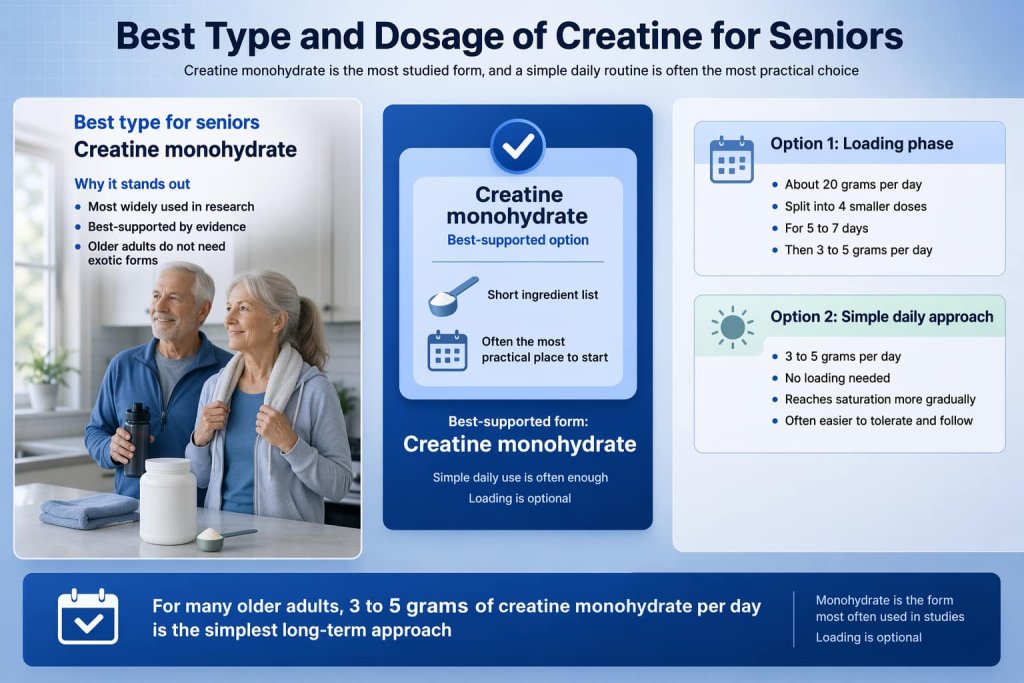
A simple creatine monohydrate product with a short ingredient list is usually the most practical place to start. For many people, fewer ingredients also means fewer things to question.
Creatine Dosage for Seniors
Research and official guidance often point to one of two common approaches:
- A loading phase of about 20 grams per day, split into 4 smaller doses, for 5 to 7 days, followed by 3 to 5 grams per day
- Or a simpler 3 to 5 grams per day approach without loading, which reaches muscle saturation more gradually, according to NIH ODS
For many older adults, the simpler daily approach is easier to tolerate and easier to stick with. A loading phase is optional, not required. In practice, a daily 3 to 5 gram dose of creatine monohydrate is the most common maintenance range discussed in the literature.
How long does creatine take to work?
A loading phase fills muscle stores faster, while a steady 3 to 5 grams per day works more gradually. For most seniors using the simpler daily approach, it makes more sense to judge creatine over several weeks rather than a few days. Consistency with resistance training still matters more than supplement timing.
A practical way to use it
A simple, evidence-aligned routine for many seniors looks like this:
- Choose creatine monohydrate
- Take 3 to 5 grams daily
- Use it consistently rather than sporadically
- Pair it with resistance training and adequate protein intake from food or a clinician-approved plan
Is Creatine Safe for Seniors?
For healthy adults, creatine has a strong safety record in studied amounts. NIH ODS says it appears safe for several weeks or months and also seems safe for longer-term use over several years. The most common side effect is weight gain from water retention. Less common side effects include GI distress, muscle stiffness, and cramps.
That said, “generally safe” does not mean “automatically right for everyone.” Older adults are more likely to have lab abnormalities, chronic conditions, or prescription medications in the mix, so it is smart to be more careful up front. The FDA’s dietary supplement guidance advises consumers to consult a health care professional before taking a dietary supplement and reminds buyers that FDA does not approve dietary supplements before they are marketed.
Safety box: Who should be careful
Talk with a clinician or pharmacist before using creatine if any of these apply to you:
- You have kidney disease
- You have abnormal kidney labs or a history of kidney problems
- You take regular prescription medicines and want to check for supplement fit
- You have been told to limit supplements or closely monitor fluid balance
- You are trying to interpret rising serum creatinine on lab work
A 2025 systematic review and meta-analysis on kidney function found that creatine was associated with a modest, transient increase in serum creatinine but no significant change in GFR, suggesting that a creatinine bump does not automatically mean kidney damage. Even so, that is exactly why older adults should review creatine use with a clinician when kidney questions are already on the table.
What Creatine for Seniors Probably Will Not Do
Creatine is often marketed as if it helps everything. The evidence does not support that.
Bone health: still not convincing
A 2024 review on creatine, muscle, bone, and brain health in older adults concluded that most research suggests creatine is more “hype” than hope for improving bone mass. That means creatine should not be presented as a reliable bone-building supplement or a replacement for proven bone-health strategies.
Brain health: promising, but not proven
A 2025 systematic review on creatine and cognition in aging found that creatine may have cognitive benefits in older adults, but the evidence is still limited and not strong enough to treat creatine as a proven brain-health intervention. For now, that possible benefit should be described cautiously.
How to Choose a Creatine Supplement
Not all supplements are equal. FDA says dietary supplements are regulated differently from drugs and are not approved by FDA before sale, so product quality matters. That is one reason it helps to choose a straightforward creatine monohydrate product from a reputable company and read the label carefully.
Before buying, keep the label simple. Many performance supplements combine multiple ingredients, but older adults do not need a complicated formula to match the evidence. A plain creatine monohydrate product is usually the better fit. It is also smart to bring a full list of your prescription drugs, over-the-counter medicines, and supplements to your next appointment and ask whether creatine makes sense for you. The National Institute on Aging’s guidance on dietary supplements for older adults also advises older adults to buy wisely and look for independent quality marks such as USP when shopping.
NIH ODS also notes that some performance supplements may contain inappropriate or unlabeled ingredients and points to certification programs such as NSF Certified for Sport, Informed-Choice, and the Banned Substances Control Group. While those programs are often discussed in sports settings, the bigger takeaway for seniors is simple: buy from a brand that takes quality control seriously.
Who May Benefit Most From Creatine for Seniors
Based on current evidence, creatine may be most helpful for older adults who:
- Are doing resistance training consistently
- Want to support strength and lean mass
- Care about preserving physical function as they age
- Understand that the benefit is supportive, not magical
It may be less useful for older adults looking for a stand-alone supplement for endurance, bone density, or broad anti-aging claims. Those expectations do not match the best current evidence.
FAQ About Creatine for Seniors
Is creatine safe for seniors over 60 or 70?
It can be appropriate for many healthy older adults, but safety is not one-size-fits-all. NIH ODS describes creatine as generally safe for healthy adults at studied doses, while FDA advises checking with a health professional before starting a supplement. That matters even more if you have kidney concerns or complicated medication use.
Do seniors need a loading phase?
No. A loading phase can fill muscle stores faster, but it is optional. Many people use a steady 3 to 5 grams per day instead.
What is the best creatine for seniors?
Creatine monohydrate is the best-supported option because it is the most studied form.
Can creatine replace exercise or protein?
No. Creatine may support results, but it does not replace resistance training, movement, or a nutritionally adequate diet.
Bottom Line on Creatine for Seniors
Creatine for seniors is worth considering when the goal is strength, lean mass, and physical function, especially if it is paired with resistance training. The best-supported form is creatine monohydrate, and a simple 3 to 5 gram daily approach is often enough for maintenance. The most common downside is water-weight gain, while kidney concerns deserve a more individualized conversation with a clinician.
If you are an older adult trying to stay strong, mobile, and independent, creatine may be a useful tool—but it works best as part of a bigger plan that includes strength training, protein, and medical common sense.
This content is for informational purposes only and not medical advice.
References
- FDA — Questions and Answers on Dietary Supplements
- PubMed — Creatine supplementation for optimization of physical function in the patient at risk of functional disability: A systematic review and meta-analysis
- PMC — Effect of creatine supplementation on kidney function: a systematic review and meta-analysis
- PubMed — Effects of Creatine Monohydrate Supplementation on Muscle, Bone and Brain Health and Function in Older Adults
- PubMed — Creatine and Cognition in Aging: A Systematic Review of Evidence in Older Adults
- PMC — The impact of creatine supplementation associated with resistance training on body composition and physical performance in older adults: a systematic review and meta-analysis