
Kettlebell swings are a powerful hip-hinge exercise that trains your glutes, hamstrings, core, grip, and conditioning at the same time. The key is to drive the movement from your hips, not your arms or lower back.
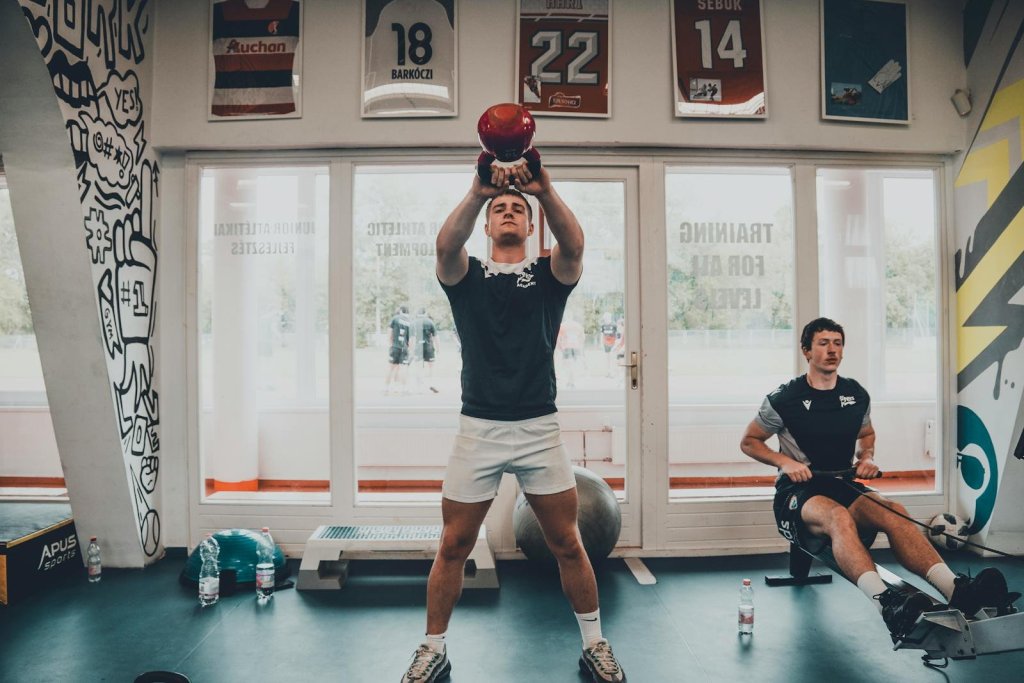
When done well, kettlebell swings can build explosive hip power, improve full-body coordination, and add a strong conditioning effect to your workout. But because the movement is fast and dynamic, proper form matters. Start light, learn the hinge, and progress gradually.
Kettlebell Swings: The Quick Answer
Kettlebell swings are best used as a strength and conditioning exercise. They are not a squat, shoulder raise, or arm workout. The kettlebell moves because your hips snap forward, not because you lift it with your arms.
A safe beginner approach is:
| Goal | Starting Point |
|---|---|
| Learn the movement | Practice hip hinges first |
| Beginner sets | 2 to 3 sets of 8 to 12 reps |
| Conditioning | Short rounds of 15 to 30 seconds |
| Frequency | 1 to 3 times per week |
| Best cue | Hinge back, drive hips forward |
The American Council on Exercise explains that the power for the swing should come from the legs and hips, not the shoulders.
What Are Kettlebell Swings?
Kettlebell swings are a dynamic exercise where you swing a kettlebell from between your legs to about chest height using a strong hip hinge.
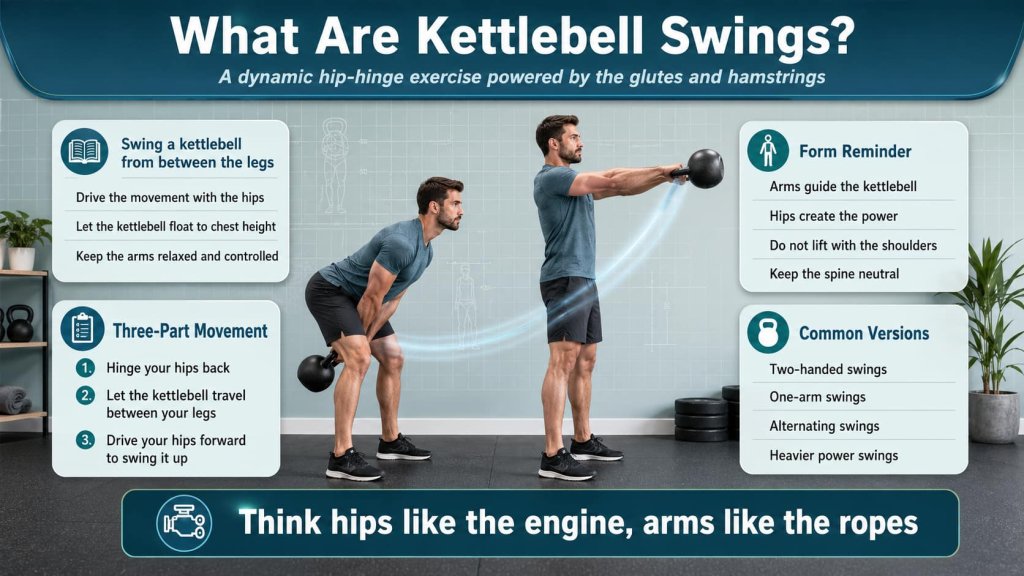
The movement has three main parts:
- Hinge your hips back.
- Let the kettlebell travel between your legs.
- Drive your hips forward to swing the kettlebell up.
Your arms guide the kettlebell, but they should not do most of the work. Think of your arms like ropes and your hips like the engine.
Kettlebell swings are usually performed with two hands, but more advanced versions include one-arm swings, alternating swings, and heavier power-focused swings.
Kettlebell Swings Muscles Worked
Kettlebell swings mainly train the posterior chain, which includes the muscles on the back side of your body.
Primary Muscles Worked
The main muscles used during kettlebell swings are:
- Gluteus maximus: Helps extend the hips powerfully.
- Hamstrings: Help control the hinge and assist hip extension.
- Adductor magnus: Assists hip extension and lower-body power.
- Erector spinae: Helps maintain a strong, neutral spine position.
- Forearms and grip muscles: Help you hold the kettlebell securely.
The American Council on Exercise lists the hamstrings, gluteus maximus, adductor magnus, and forearm flexors as major muscles involved in the two-handed kettlebell swing.
Secondary Muscles Worked
Kettlebell swings also involve:
- Core muscles
- Lats
- Upper back
- Calves
- Shoulders as stabilizers
Your shoulders should stay packed and controlled, but they should not actively lift the kettlebell like a front raise.
Benefits of Kettlebell Swings
Kettlebell swings are popular because they combine strength, power, and conditioning in one movement.
Builds Hip Power
Kettlebell swings train fast hip extension. This is useful for athletic movements like jumping, sprinting, climbing stairs, and many sports actions.
A study indexed in PubMed found that kettlebell swings create a hip-hinge pattern with rapid muscle activation and relaxation cycles.
Strengthens the Glutes and Hamstrings
Because kettlebell swings are hip-driven, they can help strengthen the glutes and hamstrings when performed with proper form.
This makes them a useful addition to lower-body workouts, especially when paired with slower strength exercises like deadlifts, squats, bridges, and lunges.
Improves Conditioning
Kettlebell swings can raise your heart rate quickly because they use large muscle groups and repeated full-body effort.
They can be used in short conditioning rounds, finishers, or circuit workouts. However, beginners should focus on technique before turning swings into high-rep cardio.
Trains Core Stability
Your core works to keep your ribs, pelvis, and spine organized while the kettlebell moves.
This does not mean you should feel swings mainly in your abs. Instead, your core should help you stay stable while your hips create the movement.
Improves Grip Strength
Holding the kettlebell securely challenges your hands, wrists, and forearms.
This can carry over to other strength exercises such as rows, deadlifts, farmer carries, and pull-based movements.
Saves Time
Kettlebell swings are efficient because they train multiple qualities at once:
- Lower-body power
- Posterior-chain strength
- Grip
- Core control
- Cardio-style conditioning
That makes them useful for short workouts when you want a high-value exercise without using many pieces of equipment.
How to Do Kettlebell Swings With Proper Form
Start with the basic two-handed kettlebell swing before trying advanced variations.
How to do it:
- Stand with your feet about shoulder-width apart.
- Place the kettlebell slightly in front of you on the floor.
- Hinge at your hips and keep your back neutral.
- Grip the handle with both hands.
- Pull the kettlebell back between your legs like hiking a football.
- Keep your shoulders packed and your arms relaxed.
- Drive your hips forward strongly.
- Let the kettlebell float up to about chest height.
- Keep your ribs stacked over your pelvis at the top.
- Let the kettlebell fall naturally, then hinge back again.
- Repeat with control.
Trainer Tip: Think “hips snap, bell floats.” You should not be muscling the kettlebell up with your shoulders.
Kettlebell Swing Form Checklist
Use this quick checklist before every set:
- Feet planted firmly
- Spine neutral
- Hips hinge back
- Knees bend slightly, not deeply
- Shoulders stay down and back
- Arms stay long and relaxed
- Bell travels close to the body on the backswing
- Glutes squeeze at the top
- No leaning back at lockout
- Breathing stays controlled
A good kettlebell swing should feel powerful, crisp, and controlled. It should not feel like a lower-back exercise.
Common Kettlebell Swing Mistakes
Kettlebell swings can go wrong when people turn them into a squat, shoulder raise, or lower-back movement.
| Mistake | What Happens | Simple Fix |
|---|---|---|
| Squatting too much | The swing becomes slow and quad-dominant | Push hips back more than knees down |
| Lifting with the arms | Shoulders fatigue too fast | Let the hips drive the bell |
| Rounding the back | More stress on the spine | Brace and keep a neutral spine |
| Leaning back at the top | Lower back may feel overloaded | Finish tall with glutes tight |
| Bell drops too low | Pulls the body out of position | Keep the bell high between the thighs |
| Starting too heavy | Form breaks quickly | Use a lighter kettlebell |
| Doing too many reps too soon | Fatigue causes sloppy technique | Use shorter sets and rest |
Kettlebell Swing Variations
Once your two-handed swing feels consistent, you can try variations based on your goal.
1. Dead-Stop Kettlebell Swing
A dead-stop swing starts each rep from the floor. This helps beginners reset their position and avoid rushing.
How to do it:
- Place the kettlebell in front of you.
- Hinge down and grip the handle.
- Hike the bell back between your legs.
- Drive your hips forward to swing.
- Let the kettlebell return to the floor after each rep.
- Reset your stance and repeat.
Why it works: It teaches clean setup, better bracing, and more control between reps.
Muscles worked: Glutes, hamstrings, core, grip, and upper-back stabilizers.
Trainer Tip: Use this version if your regular swings feel messy or rushed.
2. Russian Kettlebell Swing
The Russian swing usually stops around chest height. This is the best standard version for most beginners and general fitness workouts.
How to do it:
- Set up in a strong hip-hinge position.
- Hike the kettlebell back.
- Drive your hips forward.
- Let the kettlebell float to chest height.
- Guide it back down into the next hinge.
Why it works: It trains power and conditioning without requiring overhead mobility.
Muscles worked: Glutes, hamstrings, core, lats, grip, and upper back.
Trainer Tip: Chest height is enough. Higher is not automatically better.
3. One-Arm Kettlebell Swing
The one-arm swing increases core and shoulder stability demands because the weight is held on one side.
How to do it:
- Start with a lighter kettlebell than your two-hand swing.
- Grip the handle with one hand.
- Keep your shoulders square.
- Hinge back and hike the bell between your legs.
- Drive your hips forward.
- Let the bell float up while keeping your torso stable.
- Switch sides after the set.
Why it works: It adds an anti-rotation challenge and improves side-to-side control.
Muscles worked: Glutes, hamstrings, core, grip, lats, and shoulder stabilizers.
Trainer Tip: Your torso should not twist with the kettlebell.
How Many Kettlebell Swings Should You Do?
The right number depends on your experience, goal, and conditioning level.
Beginner Starting Point
Start with:
- 2 to 3 sets
- 8 to 12 reps per set
- 60 to 90 seconds of rest
- 1 to 2 days per week
This gives you enough practice without turning every set into a fatigue test.
Strength and Power Focus
Use:
- 3 to 5 sets
- 5 to 10 strong reps
- Full rest between sets
- Moderate to heavy kettlebell
- Perfect technique on every rep
For power, stop the set before your reps slow down.
Conditioning Focus
Use:
- 15 to 30 seconds of swings
- 30 to 60 seconds of rest
- 4 to 8 rounds
- Light to moderate kettlebell
Conditioning swings should still look clean. Do not chase speed if your form breaks down.
The CDC recommends adults do muscle-strengthening activity at least 2 days per week, along with regular aerobic activity. Kettlebell swings can fit into that plan, but they should not replace a balanced full-body program.
What Weight Should You Use for Kettlebell Swings?
Choose a kettlebell you can control without pulling from your back or shoulders.
A good beginner weight should feel:
- Heavy enough to encourage a real hip drive
- Light enough to keep your spine neutral
- Manageable for clean sets of 8 to 12 reps
- Easy to stop safely when you are done
The Mayo Clinic recommends choosing a weight you can lift comfortably for 12 to 15 repetitions when learning strength training movements, then increasing gradually as you get stronger.
For swings, form matters more than the exact number on the kettlebell. If your lower back takes over, the weight is probably too heavy or your hinge needs more practice.
Kettlebell Swings for Beginners
Beginners should not rush into fast, high-rep swings. Learn the hinge first.
Step 1: Learn the Hip Hinge
Before swinging, practice a bodyweight hinge:
- Stand tall.
- Place your hands on your hips.
- Push your hips back.
- Keep your back neutral.
- Feel tension in your hamstrings.
- Stand tall by squeezing your glutes.
Step 2: Practice the Kettlebell Deadlift
A kettlebell deadlift teaches you how to lift from the hips without swinging.
Do this before swings if you are new to kettlebells.
Step 3: Try Dead-Stop Swings
Dead-stop swings help you reset every rep.
This is safer and cleaner than doing continuous swings before you understand the rhythm.
Step 4: Build Volume Slowly
Add reps only when your form stays consistent.
Do not jump from 10 controlled swings to 100 swings in one workout.
Where Kettlebell Swings Fit in a Workout
Kettlebell swings work well in several places.
As a Power Exercise
Do them near the beginning of your workout after a warm-up.
Example:
- Warm-up
- Kettlebell swings
- Squats
- Rows
- Core work
As a Conditioning Finisher
Do them at the end of a workout with lighter weight and shorter rounds.
Example:
- 20 seconds swings
- 40 seconds rest
- Repeat 6 rounds
As Part of a Full-Body Circuit
Pair swings with non-competing movements.
Example:
- Kettlebell swings
- Push-ups
- Split squats
- Plank
- Rest and repeat
Who Should Be Careful With Kettlebell Swings?
Kettlebell swings are useful, but they are not the best first exercise for everyone.
Be careful or get professional guidance first if you have:
- Current back, hip, knee, or shoulder pain
- A recent injury or surgery
- Difficulty hinging without rounding your back
- Balance problems
- Poor grip control
- A medical condition that affects exercise safety
- Pain that gets sharper or worse during the movement
The Cleveland Clinic notes that kettlebell training may be safe for some people with proper form and modifications, but individual conditions matter.
Stop the set if you feel sharp pain, dizziness, numbness, or loss of control. Choose a simpler exercise such as glute bridges, hip hinges, or kettlebell deadlifts until your technique improves.
Kettlebell Swings vs Squats
Kettlebell swings and squats are both lower-body exercises, but they are not the same movement.
| Exercise | Main Pattern | Main Focus |
|---|---|---|
| Kettlebell swing | Hip hinge | Glutes, hamstrings, power, conditioning |
| Squat | Knee and hip bend | Quads, glutes, lower-body strength |
A squat moves more up and down. A swing moves more back and forward through the hips.
You can use both in the same program, but do not perform swings like squats.
Kettlebell Swings vs Deadlifts
Kettlebell swings and deadlifts are both hip-hinge movements.
The difference is speed.
| Exercise | Speed | Best For |
|---|---|---|
| Deadlift | Slower and controlled | Strength |
| Kettlebell swing | Fast and explosive | Power and conditioning |
If your swing form is not ready, kettlebell deadlifts are a smart stepping-stone.
Sample Kettlebell Swing Workouts
Here are simple ways to use kettlebell swings safely.
Beginner Technique Workout
- Kettlebell deadlift: 2 sets of 8 reps
- Dead-stop swing: 3 sets of 6 to 8 reps
- Glute bridge: 2 sets of 10 reps
- Side plank: 2 short holds per side
Rest as needed and focus on clean reps.
Strength and Power Workout
- Kettlebell swing: 5 sets of 8 reps
- Goblet squat: 3 sets of 8 to 10 reps
- One-arm row: 3 sets of 10 reps per side
- Farmer carry: 3 short walks
Use full rest between swing sets.
Conditioning Finisher
- 20 seconds kettlebell swings
- 40 seconds rest
- Repeat 6 to 8 rounds
Use a weight that lets every rep stay sharp.
FAQs About Kettlebell Swings
Are kettlebell swings good for beginners?
Yes, but beginners should learn the hip hinge first. Start with bodyweight hinges and kettlebell deadlifts before doing fast swings.
Do kettlebell swings build muscle?
Kettlebell swings can help strengthen the glutes, hamstrings, grip, and core. For maximum muscle growth, pair them with slower strength exercises like squats, deadlifts, rows, presses, and lunges.
Are kettlebell swings cardio or strength?
They can be both. Heavy, low-rep swings focus more on power and strength. Lighter timed sets feel more like conditioning.
Should kettlebell swings hurt my lower back?
No. Your lower back may work as a stabilizer, but it should not feel like the main muscle doing the exercise. If your back hurts, stop and check your hinge, weight choice, and bracing.
How high should the kettlebell swing?
For most people, chest height is enough. The kettlebell should float up from hip power, not shoulder lifting.
Can I do kettlebell swings every day?
Most people do better with rest days, especially when learning. Start with 1 to 3 sessions per week and increase only if your form, recovery, and overall training plan support it.
What is the biggest mistake in kettlebell swings?
The biggest mistake is using the arms or lower back instead of the hips. A proper swing is powered by a strong hip hinge and glute drive.
Conclusion
Kettlebell swings are one of the most efficient exercises for building hip power, posterior-chain strength, grip, core stability, and conditioning. The key is to treat them as a hip-hinge movement, not a squat or shoulder raise.
Start with a light kettlebell, learn the hinge, keep your reps crisp, and progress slowly. When your technique is solid, kettlebell swings can become a powerful part of your strength and conditioning routine.
References
- American Council on Exercise: Best for supporting kettlebell swing setup, hip-drive technique, proper form, and beginner-friendly exercise instructions.
- American Council on Exercise: Best for supporting muscles worked, including the glutes, hamstrings, adductor magnus, and forearm flexors.
- PubMed: Best for supporting research on kettlebell swings as a hip-hinge movement with rapid muscle activation and relaxation cycles.
- PubMed Central: Best for supporting kettlebell swing mechanics, swing style, kettlebell mass, and hip extension demands.
- Cleveland Clinic: Best for supporting kettlebell training safety, beginner progression, and the importance of proper form.
- CDC: Best for supporting adult physical activity guidance, including aerobic activity and muscle-strengthening recommendations.
- Mayo Clinic: Best for supporting safe weight selection, beginner strength-training principles, and gradual progression.
- PubMed Central: Best for supporting broader kettlebell-training effects on fitness and performance-related measures.