
The standing cable fly is the best overall pec deck alternative because it closely reproduces the machine’s chest-fly motion while giving you more control over the pulley height, arm path, and range of motion. Other effective pec deck alternatives include dumbbell flyes, resistance-band flyes, suspension-trainer flyes, and slider flyes.
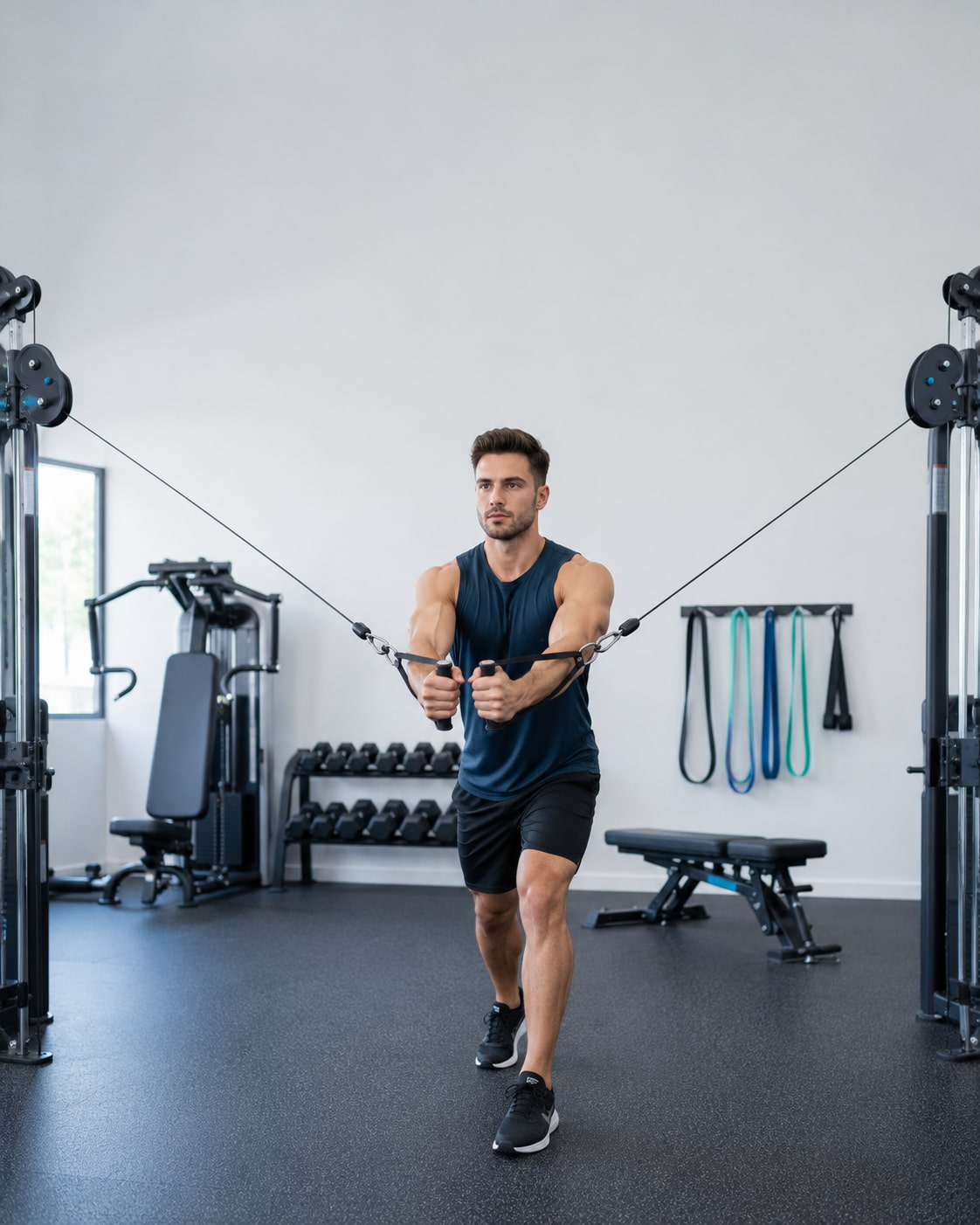
The right option depends on your equipment, experience, and shoulder comfort. Cable exercises provide the closest movement match, while dumbbell and band variations are more practical for home workouts.
This guide covers alternatives to the forward-facing pec deck chest fly—not the reverse pec deck exercise used primarily for the rear shoulders and upper back.
What Is the Best Alternative to the Pec Deck?
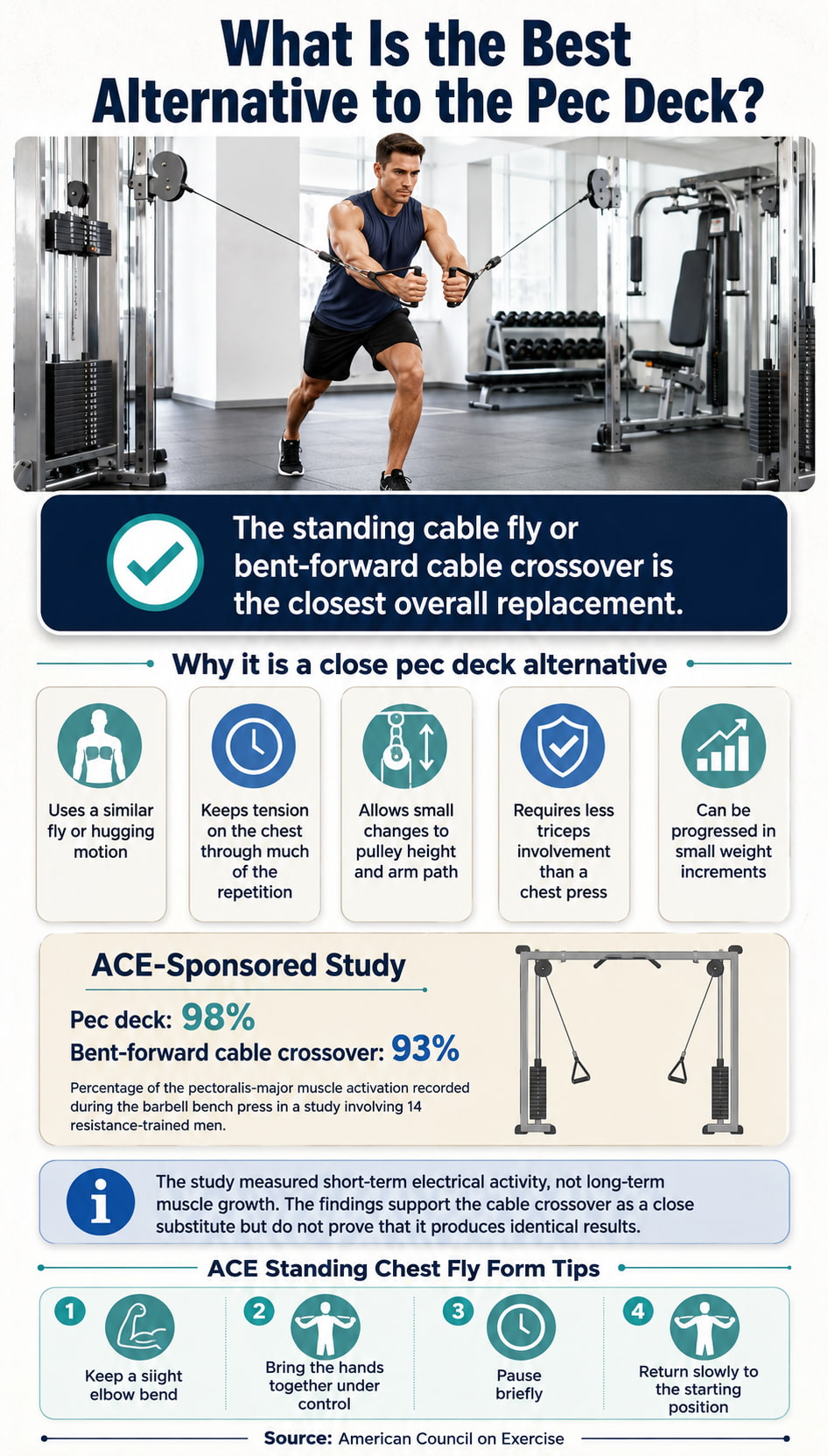
The standing cable fly or bent-forward cable crossover is the closest overall replacement.
Both exercises:
- Use a similar fly or hugging motion.
- Keep tension on the chest through much of the repetition.
- Allow small changes to pulley height and arm path.
- Require less triceps involvement than a chest press.
- Can be progressed in small weight increments.
In a small American Council on Exercise-sponsored study involving 14 resistance-trained men, the pec deck produced 98% and the bent-forward cable crossover produced 93% of the pectoralis-major muscle activation recorded during the barbell bench press. The study measured short-term electrical activity rather than long-term muscle growth, but it supports the cable crossover as a close substitute.
The ACE standing chest fly guide recommends keeping a slight elbow bend, bringing the hands together under control, pausing briefly, and slowly returning to the starting position.
Pec Deck Alternatives Compared
| Exercise | Equipment | Movement match | Best for |
|---|---|---|---|
| Standing cable fly | Dual cable station | Very high | Best overall replacement |
| Single-arm cable fly | Cable station | Very high | Unilateral chest training |
| Lying cable fly | Cable station and bench | Very high | Supported cable isolation |
| Flat dumbbell fly | Dumbbells and bench | High | Common free-weight substitute |
| Incline dumbbell fly | Dumbbells and incline bench | High | Inclined chest-fly training |
| Dumbbell floor fly | Dumbbells | Moderate to high | Limited equipment and controlled depth |
| Resistance-band chest fly | Resistance band and anchor | High | Home and travel workouts |
| Suspension-trainer chest fly | Suspension trainer | High | Bodyweight chest and core training |
| Slider push-up fly | Sliders or towels | Moderate | Advanced home training |
| Dumbbell squeeze press | Dumbbells and bench | Moderate | A more stable fly-free option |
10 Best Pec Deck Alternatives
These 10 pec deck alternatives help isolate your chest using cables, dumbbells, resistance bands, or bodyweight when the machine is unavailable. Choose the exercise that suits your equipment, experience, and shoulder comfort while maintaining controlled form.
1. Standing Cable Fly
Why it works: The standing cable fly is the closest overall pec deck alternative because it uses the same basic arm-adduction pattern while maintaining cable resistance throughout the repetition. You can position the pulleys around shoulder height for a straightforward horizontal fly or adjust them slightly to find a comfortable path.
Muscles worked: The pectoralis major performs most of the work. The front deltoids, serratus anterior, rotator-cuff muscles, abdominals, and other trunk stabilizers assist.
How to do it:
- Set two cable pulleys around shoulder height and attach single handles.
- Hold one handle in each hand and step forward into a stable staggered stance.
- Begin with your arms open and your elbows slightly bent.
- Bring your hands together in a wide hugging motion without changing the elbow angle significantly.
- Pause briefly, then return until you feel a controlled chest stretch.
Trainer Tip: Keep your torso still rather than leaning farther forward as the handles move inward. Use 2–4 sets of 8–15 controlled repetitions.
2. Single-Arm Cable Fly
Why it works: This variation lets you train one side at a time and adjust your body position more freely than with a two-arm fly. It can help you concentrate on a smooth arm path and reduce the tendency of one side to dominate the movement.
Muscles worked: The pectoralis major is the primary muscle. The front deltoid, serratus anterior, obliques, and deep core muscles assist with shoulder movement and torso control.
How to do it:
- Position one cable pulley around shoulder height.
- Stand sideways or slightly in front of the machine and hold the handle with the outside hand.
- Open your working arm with a soft bend in the elbow.
- Sweep the arm inward across the front of your chest.
- Return slowly without allowing the weight stack to pull your shoulder backward.
Trainer Tip: Use a split stance and keep your ribs facing forward. Reduce the weight if your torso rotates toward the cable.
3. Lying Cable Fly
Why it works: The lying cable fly combines the continuous resistance of cables with the stability of a bench. It is a strong choice for people who want less balance demand than a standing fly but more consistent tension than a dumbbell fly.
Muscles worked: The exercise mainly trains the pectoralis major. The front deltoids, biceps, serratus anterior, and shoulder stabilizers provide assistance.
How to do it:
- Place a flat bench between two low cable pulleys.
- Hold the handles and lie on the bench with your feet planted.
- Start with your arms open and your elbows slightly bent.
- Bring the handles together above the center of your chest.
- Lower your arms under control until you reach a comfortable stretch.
Trainer Tip: Set the bench evenly between the pulleys so the resistance feels balanced. Ask for assistance getting into position when using challenging loads.
4. Flat Dumbbell Fly
Why it works: The flat dumbbell fly is one of the most accessible pec deck alternatives when you have dumbbells and a bench. It trains the chest through a wide arc, although tension decreases near the top when the weights are stacked over your shoulders.
Muscles worked: The pectoralis major does most of the work. The front deltoids, biceps, serratus anterior, and rotator-cuff muscles help control the dumbbells.
How to do it:
- Lie on a flat bench with a dumbbell in each hand.
- Hold the dumbbells above your chest with your palms facing each other.
- Maintain a soft, fixed bend in your elbows.
- Lower your arms out to the sides until you feel a comfortable chest stretch.
- Bring the dumbbells back together along the same curved path.
Trainer Tip: Think about moving your upper arms rather than your hands. ACE’s lying chest fly instructions emphasize stable foot placement and a neutral spine.
5. Incline Dumbbell Fly
Why it works: Raising the bench changes the direction of the fly and increases the involvement of the clavicular portion of the pectoralis major. It is useful when you want an inclined chest movement without turning the exercise into a press.
Muscles worked: The clavicular and sternocostal portions of the pectoralis major work together. The front deltoids, biceps, and shoulder stabilizers assist.
How to do it:
- Set an adjustable bench to a low or moderate incline.
- Lie back with a dumbbell in each hand and your feet planted.
- Hold the dumbbells above your upper chest with slightly bent elbows.
- Open your arms in a controlled arc.
- Bring the dumbbells together above your upper chest.
Trainer Tip: A modest incline is usually sufficient. A very steep bench can shift more of the workload toward the shoulders.
6. Dumbbell Floor Fly
Why it works: The floor stops your upper arms before they move far behind your torso, creating a shorter and more controlled range of motion. This makes it practical for home workouts and for people who do not own a bench.
Muscles worked: The pectoralis major is the main target. The front deltoids, biceps, triceps, and shoulder stabilizers assist.
How to do it:
- Lie on the floor with your knees bent and a dumbbell in each hand.
- Press the dumbbells above your chest with your palms facing each other.
- Lower your arms outward while maintaining a soft elbow bend.
- Lightly touch your upper arms to the floor.
- Bring the dumbbells back together without bouncing your arms off the ground.
Trainer Tip: The floor limits depth, but it does not automatically make heavy weights safe. Use a load you can stop gently on every repetition.
7. Resistance-Band Chest Fly
Why it works: A resistance-band fly reproduces the chest-fly pattern without a machine, cable station, or heavy dumbbells. The band becomes more challenging as your hands move together, creating strong resistance near the shortened position.
Muscles worked: The pectoralis major performs most of the movement. The front deltoids, serratus anterior, arms, and trunk stabilizers assist.
How to do it:
- Secure a resistance band to a stable anchor around chest height.
- Face away from the anchor and hold one end in each hand.
- Step forward until the band has light tension at the starting position.
- Bring your hands together while keeping a slight elbow bend.
- Return slowly without allowing the band to snap your arms backward.
Trainer Tip: Check the band and anchor before every set. Stand closer to the anchor or use a lighter band when you cannot maintain a smooth return.
8. Suspension-Trainer Chest Fly
Why it works: A suspension chest fly uses your body weight as resistance while reproducing a wide fly motion. It also demands more abdominal, shoulder, and full-body stability than a machine or cable variation.
Muscles worked: The pectoralis major is the primary mover. The front deltoids, triceps, serratus anterior, abdominals, glutes, and shoulder stabilizers help maintain position.
How to do it:
- Hold the suspension handles and face away from the anchor.
- Lean forward with your arms extended and your body in a straight line.
- Open your arms gradually while keeping your elbows slightly bent.
- Stop before your shoulders move into an uncomfortable position.
- Pull the handles back together by squeezing your chest.
Trainer Tip: Make the exercise easier by standing more upright. Do not begin with a steep body angle unless you can control the entire lowering phase.
9. Slider Push-Up Fly
Why it works: The slider push-up fly combines a fly motion with the stability demands of a push-up. It requires little equipment, but it is substantially harder than it appears and is best suited to experienced exercisers.
Muscles worked: The chest performs the inward pulling action. The shoulders, triceps, serratus anterior, abdominals, hip stabilizers, and glutes work to maintain body position.
How to do it:
- Place each hand on a slider or folded towel on a smooth floor.
- Begin in a high plank or modified kneeling-plank position.
- Slide your hands apart while lowering your chest under control.
- Stop before you lose trunk or shoulder control.
- Pull your hands inward as you return to the starting position.
Trainer Tip: Learn the movement from your knees before attempting it from your toes. Use a small range initially and increase it only when you can keep your hips and shoulders aligned.
10. Dumbbell Squeeze Press
Why it works: The squeeze press is not a direct fly-pattern replacement, but it is a more stable option for people who dislike opening their arms into a deep fly position. Pressing the dumbbells together creates inward force while you perform a conventional press.
Muscles worked: The pectoralis major is the main target. The triceps and front deltoids contribute more than they do during most fly variations.
How to do it:
- Lie on a flat bench with a dumbbell in each hand.
- Press the inner sides of the dumbbells firmly together above your chest.
- Lower the joined dumbbells toward the center of your chest.
- Keep pressing the weights together throughout the movement.
- Extend your arms without allowing the dumbbells to separate.
Trainer Tip: Use hexagonal dumbbells when possible because they are easier to hold together. This exercise should feel like a controlled press, not an attempt to crush the weights together with maximum force.
How to Choose the Right Pec Deck Alternative
Choose the exercise that best fits your equipment and current ability.
- Best overall: Standing cable fly
- Best unilateral option: Single-arm cable fly
- Best supported cable option: Lying cable fly
- Best dumbbell option: Flat dumbbell fly
- Best without a bench: Dumbbell floor fly
- Best at home: Resistance-band chest fly
- Best bodyweight option: Suspension-trainer chest fly
- Best advanced home option: Slider push-up fly
- Best when flyes feel uncomfortable: Dumbbell squeeze press
Cable flyes provide the closest overall replacement. Dumbbells are easier to access but provide less resistance near the top. Bands are portable and inexpensive, while suspension trainers and sliders add much more stabilization demand.
Pec Deck vs. Cable Fly vs. Dumbbell Fly
| Feature | Pec deck | Cable fly | Dumbbell fly |
|---|---|---|---|
| Torso support | High | Low to moderate | High |
| Movement path | Guided | Freely adjustable | Freely adjustable |
| Tension near the top | High | High | Low |
| Core demand | Low | Moderate | Low |
| Setup flexibility | Low | High | Moderate |
| Home-gym practicality | Low | Low unless you own cables | High |
| Learning difficulty | Low | Moderate | Moderate |
The pec deck is usually the most stable. The cable fly provides the greatest freedom to modify your stance, pulley height, and arm path. The dumbbell fly is the most widely available free-weight option but has a less consistent resistance profile.
None is automatically best for everyone. Select the exercise you can perform consistently, comfortably, and progressively.
How Many Sets and Reps Should You Do?
A practical starting point is:
- Beginners: 2–3 sets of 10–15 repetitions
- Intermediate lifters: 3–4 sets of 8–15 repetitions
- Rest: Approximately 60–120 seconds between sets
- Frequency: Include chest training around twice per week when recovery and your overall program allow
Stop most sets when you feel you could complete approximately one to three more controlled repetitions. You do not need to reach complete muscular failure during every set.
Updated resistance-training guidance published by the American College of Sports Medicine in March 2026 emphasizes consistency and individualized programming. For muscle growth, ACSM identifies approximately 10 weekly sets per muscle group as a useful general target, but that total includes presses and other chest exercises—not just flyes.
Most people only need one pec deck alternative in a single workout.
Where to Place Pec Deck Alternatives in Your Workout
Place a pec deck alternative:
- After your main chest press when strength is the priority.
- Near the beginning when chest isolation is the main goal.
- At the end of the workout when using lighter resistance and higher repetitions.
- In a home circuit when equipment is limited.
A simple chest workout could look like this:
- Dumbbell or barbell bench press: 3 sets
- Incline press: 3 sets
- Standing cable fly: 2–3 sets
- Optional triceps exercise: 2–3 sets
Avoid adding several fly variations simply because they appear in this guide. Choose one that fits your program and improve it gradually.
Common Pec Deck Alternative Mistakes
Using Too Much Weight
Heavy resistance often turns a fly into a poorly controlled press. Reduce the load if you must bend your elbows more during the repetition or use momentum to bring your arms together.
Opening the Arms Too Far
A deeper stretch is not automatically better. Stop when your upper arms are around the level of your torso or sooner if that position feels uncomfortable.
Changing the Elbow Angle
Keep a soft but reasonably consistent bend in your elbows. Excessive bending and straightening shifts the exercise toward a pressing movement.
Letting the Shoulders Roll Forward
Maintain a controlled shoulder position as your hands meet. Do not force them together by rounding your upper back or pushing your shoulders forward.
Moving Too Quickly
Control both phases of the exercise. Allowing cables, bands, or dumbbells to pull your arms backward reduces control and can place unnecessary stress on the shoulders.
Ignoring Joint Pain
Muscle effort and a mild stretching sensation are different from sharp, pinching, or worsening joint pain. Reduce the range, change the variation, or stop the exercise if it causes pain.
Hospital for Special Surgery explains that pectoralis-major injuries can occur while the muscle is contracting and lengthening, especially with the arm extended and externally rotated. This supports using controlled resistance and avoiding a forced bottom position. Review the HSS guide to pectoralis-major injuries for additional information.
Frequently Asked Questions
What is the closest exercise to a pec deck?
The standing cable fly is the closest widely available alternative. It uses a similar chest-fly motion and keeps resistance on the chest as the hands come together.
Can dumbbell flyes replace the pec deck?
Yes. Dumbbell flyes can replace the pec deck when cables or machines are unavailable. However, dumbbell resistance is strongest near the lower and middle portions of the repetition and becomes much lighter near the top.
What pec deck alternative can I do at home?
Resistance-band chest flyes, dumbbell floor flyes, suspension-trainer flyes, and slider push-up flyes can all be performed at home. The band fly is usually the simplest direct replacement.
Is the cable fly better than the pec deck?
Neither exercise is universally better. The pec deck offers more stability, while the cable fly allows greater control over the pulley height, stance, arm path, and range. Choose the one you can perform comfortably and progress consistently.
Can push-ups replace the pec deck?
Push-ups train the chest, shoulders, triceps, and core, but they do not closely reproduce the pec deck’s fly pattern. They are an effective compound chest exercise rather than a direct isolation substitute.
Do pec deck alternatives work the inner chest?
They train the pectoralis major as your upper arms move inward. There is no separate inner-chest muscle, so no exercise can isolate it as an independent muscle. Cable and band flyes may create strong tension when the hands move together, which some lifters feel near the center of the chest.
Should I do pec deck alternatives before or after bench presses?
Perform them after bench presses when pressing strength is your priority. Place them earlier when learning the movement or emphasizing controlled chest isolation. Avoid exhausting your chest before heavy presses unless that is an intentional part of your program.
Conclusion
The standing cable fly is the best overall pec deck alternative because it closely matches the machine’s movement while allowing more freedom to adjust your setup. Single-arm and lying cable flyes are also excellent gym options.
For home workouts, choose resistance-band flyes, dumbbell flyes, or dumbbell floor flyes. More advanced exercisers can use suspension-trainer or slider flyes, while the dumbbell squeeze press provides a more stable option for anyone who prefers to avoid a deep fly position.
Choose one exercise you can perform with a comfortable range of motion, controlled form, and gradual progression. Consistent training matters more than using every variation.
This content is for informational purposes only and not medical advice.
References
- American College of Sports Medicine: Updated Resistance Training Guidelines, March 2026
- American Council on Exercise: ACE-Sponsored Chest Exercise Research
- American Council on Exercise: Standing Chest Fly
- American Council on Exercise: Lying Chest Fly
- NCBI Bookshelf: Anatomy of the Pectoralis Major
- Hospital for Special Surgery: Pectoralis Major Injuries