
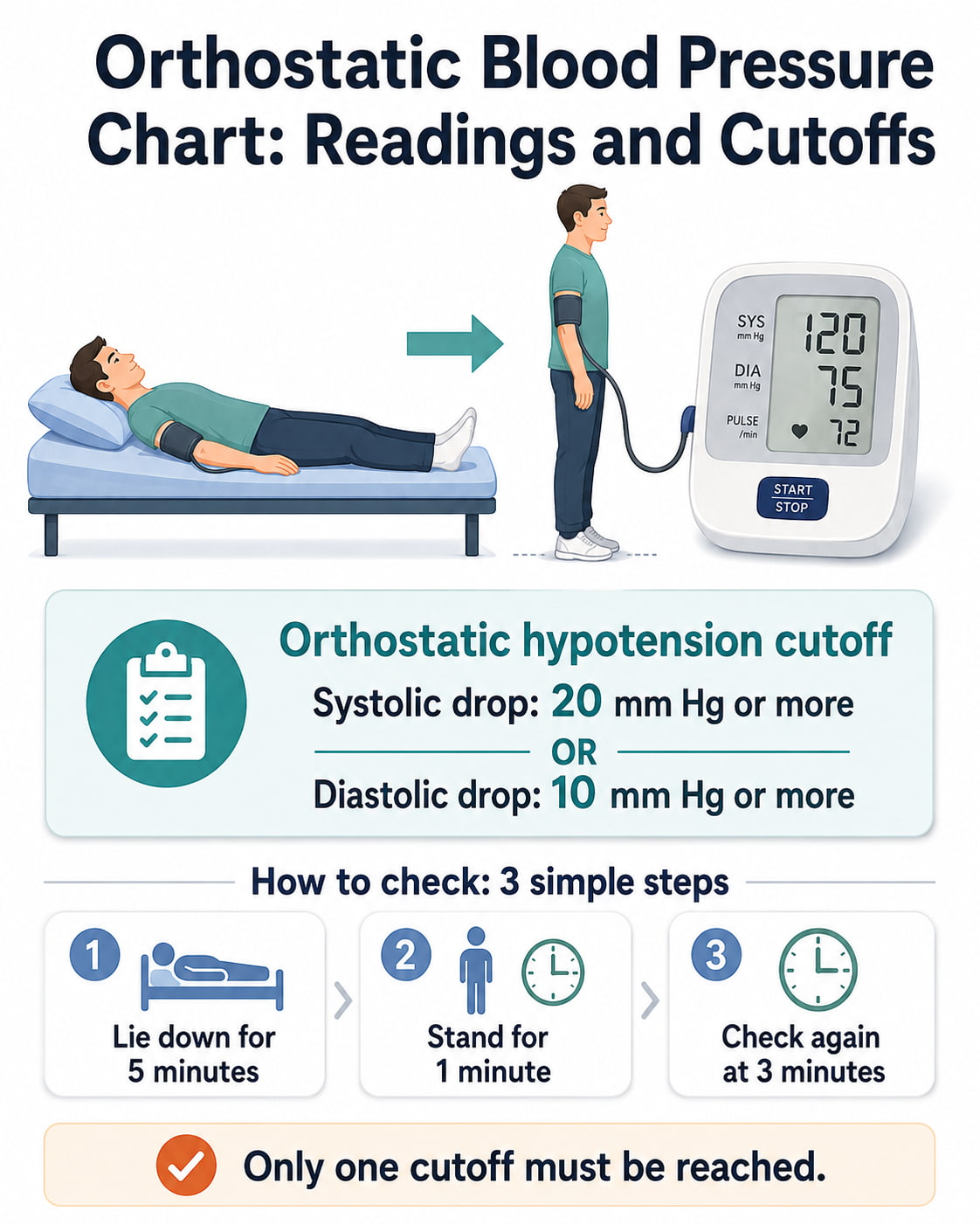
An orthostatic blood pressure reading meets the standard cutoff when systolic pressure falls by at least 20 mm Hg or diastolic pressure falls by at least 10 mm Hg within three minutes of standing. Only one number must reach the cutoff; both do not need to decrease.
To check accurately, rest while lying flat for five minutes, record blood pressure and pulse, then repeat the measurements after standing for one minute and three minutes. Symptoms such as dizziness, blurred vision, weakness, or fainting also matter, even when the numerical decrease is smaller.
The standard cutoff is supported by the American Heart Association’s guidance on orthostatic hypotension.
Orthostatic Blood Pressure Chart
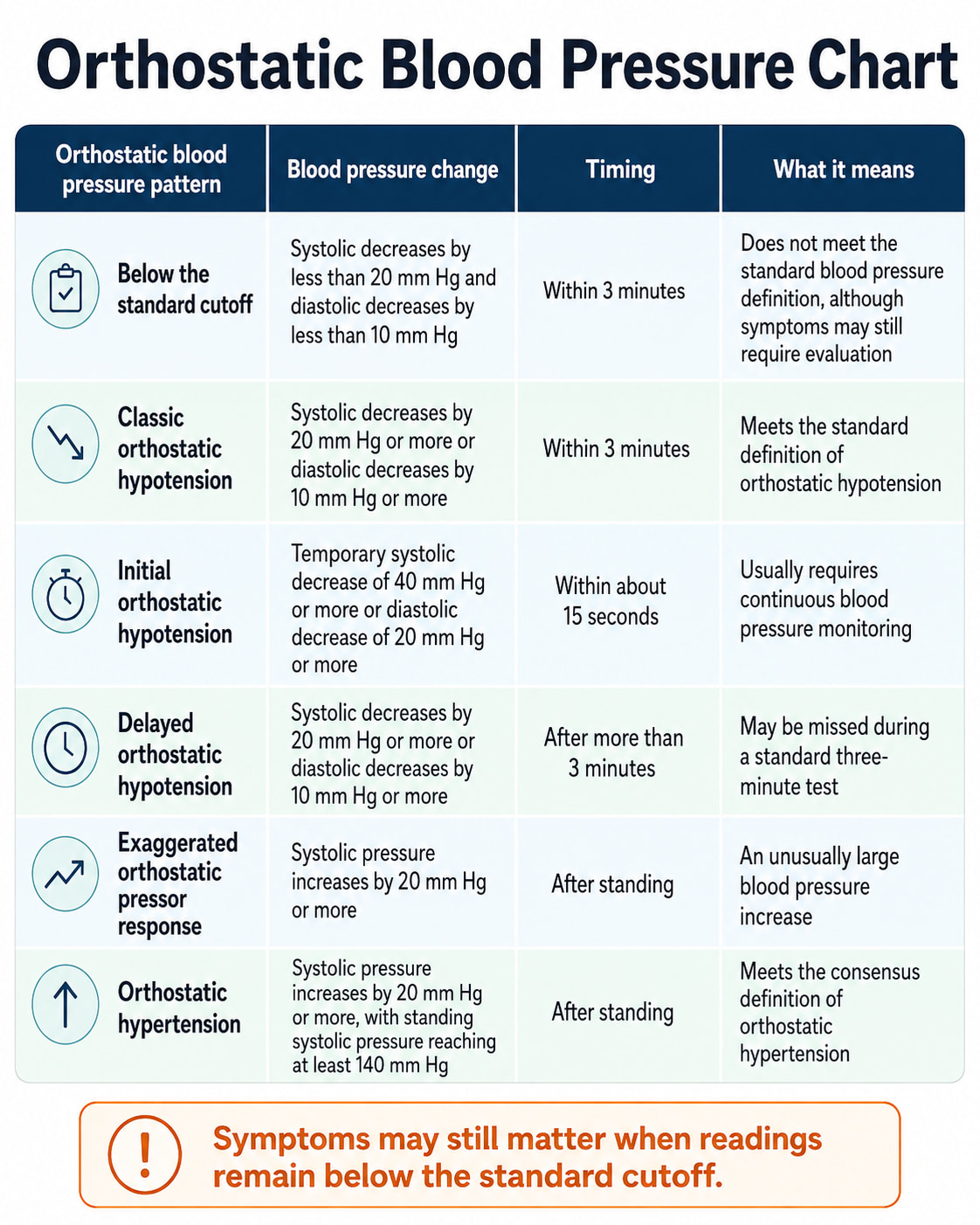
Compare each standing reading with the blood pressure measured after lying flat for five minutes.
| Orthostatic blood pressure pattern | Blood pressure change | Timing | What it means |
|---|---|---|---|
| Below the standard cutoff | Systolic decreases by less than 20 mm Hg and diastolic decreases by less than 10 mm Hg | Within 3 minutes | Does not meet the standard blood pressure definition, although symptoms may still require evaluation |
| Classic orthostatic hypotension | Systolic decreases by 20 mm Hg or more or diastolic decreases by 10 mm Hg or more | Within 3 minutes | Meets the standard definition of orthostatic hypotension |
| Initial orthostatic hypotension | Temporary systolic decrease of 40 mm Hg or more or diastolic decrease of 20 mm Hg or more | Within about 15 seconds | A very rapid decrease that usually requires continuous blood pressure monitoring |
| Delayed orthostatic hypotension | Systolic decreases by 20 mm Hg or more or diastolic decreases by 10 mm Hg or more | After more than 3 minutes | May be missed during a standard three-minute test |
| Exaggerated orthostatic pressor response | Systolic pressure increases by 20 mm Hg or more | After standing | An unusually large blood pressure increase |
| Orthostatic hypertension | Systolic pressure increases by 20 mm Hg or more, with standing systolic pressure reaching at least 140 mm Hg | After standing | Meets the consensus definition of orthostatic hypertension |
Classic orthostatic hypotension is the main result assessed during an ordinary lying-to-standing blood pressure test. Initial orthostatic hypotension occurs too quickly for most automatic home cuffs to capture, while delayed orthostatic hypotension may require measurements beyond three minutes or formal tilt-table testing.
The orthostatic hypertension values come from a consensus statement indexed by PubMed. An increase of at least 20 mm Hg is called an exaggerated pressor response; it becomes orthostatic hypertension when standing systolic pressure is also at least 140 mm Hg.
What Is a Positive Orthostatic Blood Pressure Reading?
A positive result for classic orthostatic hypotension is:
- A systolic decrease of 20 mm Hg or more, or
- A diastolic decrease of 10 mm Hg or more
- Occurring within three minutes of standing
The word “or” is important. A person meets the cutoff when either number decreases enough.
For example, a change from 130/80 mm Hg while lying down to 108/76 mm Hg while standing represents:
- Systolic decrease: 22 mm Hg
- Diastolic decrease: 4 mm Hg
This result meets the cutoff because the systolic decrease is at least 20 mm Hg, even though the diastolic decrease is smaller than 10 mm Hg.
Does a Positive Reading Diagnose a Disease?
A positive orthostatic blood pressure test identifies an abnormal blood pressure response. It does not, by itself, explain why the decrease occurred.
Clinicians interpret the reading alongside symptoms, pulse response, medications, hydration status, recent illness, medical history, and repeated measurements. A single home result can also be affected by movement, an incorrectly positioned arm, the wrong cuff size, or insufficient rest.
How to Measure Orthostatic Blood Pressure Correctly
The CDC STEADI orthostatic blood pressure protocol uses a five-minute lying baseline followed by measurements at one and three minutes after standing. It also recommends recording pulse and associated symptoms.
Step 1: Prepare for the Test
Use an automatic, validated upper-arm monitor with a cuff that fits correctly. Wrist and finger monitors are generally less reliable.
Whenever possible:
- Avoid smoking, caffeine, and exercise for 30 minutes beforehand.
- Empty your bladder.
- Use the same arm for every reading.
- Place the cuff on bare skin.
- Keep the arm supported at heart level.
- Do not talk during the measurements.
The American Heart Association recommends a validated upper-arm cuff and advises having a healthcare professional confirm that the device and cuff fit are appropriate.
Step 2: Measure While Lying Down
Lie flat and rest quietly for at least five minutes.
Record:
- Systolic blood pressure
- Diastolic blood pressure
- Pulse rate
- Any symptoms already present
This becomes the baseline measurement.
Step 3: Stand Safely
Stand up without unnecessary delay, but use a stable surface or another person for support when needed.
Someone with a history of fainting, serious balance problems, or frequent falls should not perform the test alone. Sit or lie down immediately if severe dizziness, weakness, dimmed vision, or near-fainting develops.
Step 4: Measure After One Minute
After standing for one minute, record:
- Blood pressure
- Pulse
- Dizziness or lightheadedness
- Blurred or dimmed vision
- Weakness, nausea, or unsteadiness
Step 5: Measure After Three Minutes
Repeat the same measurements after three minutes of standing. Compare both standing readings with the original lying measurement.
A qualifying decrease at either the one-minute or three-minute reading can meet the standard cutoff when the change is sustained and the measurement is reliable.
How to Calculate an Orthostatic Blood Pressure Drop
Use the five-minute lying reading as the baseline.
Systolic Calculation
Lying systolic pressure − standing systolic pressure = systolic decrease
Example:
134 − 111 = 23 mm Hg decrease
A 23 mm Hg systolic decrease meets the standard systolic cutoff.
Diastolic Calculation
Lying diastolic pressure − standing diastolic pressure = diastolic decrease
Example:
82 − 72 = 10 mm Hg decrease
A 10 mm Hg diastolic decrease meets the standard diastolic cutoff.
If the standing number is higher than the lying number, the result is an increase rather than a decrease.
Example Orthostatic Blood Pressure Readings
| Lying blood pressure | Standing blood pressure | Calculated change | Interpretation |
|---|---|---|---|
| 132/82 mm Hg | 110/76 mm Hg | Systolic decreases 22; diastolic decreases 6 | Meets the cutoff because systolic pressure decreases by at least 20 |
| 126/84 mm Hg | 114/74 mm Hg | Systolic decreases 12; diastolic decreases 10 | Meets the cutoff because diastolic pressure decreases by at least 10 |
| 120/76 mm Hg | 112/72 mm Hg | Systolic decreases 8; diastolic decreases 4 | Below the standard cutoff |
| 148/88 mm Hg | 126/80 mm Hg | Systolic decreases 22; diastolic decreases 8 | Meets the standard systolic cutoff |
| 118/72 mm Hg | 142/80 mm Hg | Systolic increases 24; standing systolic is 142 | Meets the consensus orthostatic hypertension definition |
A result below the 20/10 cutoff should not automatically be labeled normal. Symptoms, repeated patterns, pulse changes, and the person’s overall health still need to be considered.
What If Symptoms Occur Without a 20/10 Drop?
A person may experience dizziness, weakness, blurred vision, or near-fainting without reaching the standard numerical threshold.
The CDC assessment considers lightheadedness or dizziness during the test abnormal, even when the measured decrease is smaller. This does not automatically establish orthostatic hypotension, but it is a reason to stop the test safely and discuss the symptoms with a healthcare professional, especially when they recur.
Possible explanations include:
- A brief decrease that occurred before the cuff completed its reading
- Initial orthostatic hypotension
- Abnormal heart-rate response
- Balance or inner-ear problems
- Medication effects
- Anemia, dehydration, or another medical condition
- Measurement variability
A clinician may repeat the test, extend the standing period, use continuous blood pressure monitoring, or recommend a tilt-table evaluation when symptoms strongly suggest an orthostatic problem.
Classic, Initial, and Delayed Orthostatic Hypotension
1. Classic Orthostatic Hypotension
Classic orthostatic hypotension is the standard type shown on most charts. The qualifying decrease develops and remains present within three minutes of standing.
This is the type that can usually be detected with an ordinary upper-arm cuff.
2. Initial Orthostatic Hypotension
Initial orthostatic hypotension is a much faster, temporary decrease immediately after standing. It is commonly defined as a systolic decrease of at least 40 mm Hg or a diastolic decrease of at least 20 mm Hg within approximately 15 seconds.
Because ordinary cuffs take time to inflate and calculate a result, they usually cannot capture this brief event. Continuous beat-to-beat monitoring is generally needed.
3. Delayed Orthostatic Hypotension
Delayed orthostatic hypotension develops after more than three minutes upright. A standard three-minute test may therefore appear negative.
People whose symptoms begin after prolonged standing may need longer standing measurements or formal autonomic testing.
What Does It Mean When Blood Pressure Rises After Standing?
Blood pressure does not always decrease. Some people experience a substantial systolic increase after standing.
Current consensus terminology distinguishes between:
- Exaggerated orthostatic pressor response: systolic pressure increases by at least 20 mm Hg.
- Orthostatic hypertension: systolic pressure increases by at least 20 mm Hg and the standing systolic reading is at least 140 mm Hg.
For example, an increase from 120 mm Hg lying down to 142 mm Hg standing is a 22 mm Hg rise and reaches a standing pressure above 140 mm Hg. It meets both parts of the consensus definition.
One reading should not be used to make a diagnosis. The result should be confirmed with properly performed repeat measurements and reviewed in the context of the person’s usual blood pressure.
Why Pulse Should Be Recorded
Pulse helps show how the cardiovascular system responds to standing. A heart-rate increase may be a normal attempt to maintain circulation, particularly when blood volume is low.
However, pulse change alone is not part of the standard 20/10 orthostatic hypotension definition. Clinicians may use the relationship between blood pressure and heart-rate changes to help distinguish dehydration, medication effects, and autonomic nervous system disorders.
Orthostatic Hypotension vs. POTS
Orthostatic hypotension and postural orthostatic tachycardia syndrome, or POTS, are not the same condition.
| Feature | Orthostatic hypotension | POTS |
|---|---|---|
| Main change | Blood pressure decreases | Heart rate rises excessively |
| Typical adult cutoff | Systolic decrease of 20 mm Hg or diastolic decrease of 10 mm Hg | Sustained heart-rate increase of at least 30 beats per minute |
| Timing | Within 3 minutes for classic orthostatic hypotension | Within 10 minutes upright |
| Blood pressure requirement | A qualifying decrease is present | Orthostatic hypotension must be absent |
| Other requirements | Cause and symptoms vary | Chronic upright symptoms and exclusion of other causes are required |
For adolescents, a heart-rate increase of at least 40 beats per minute is commonly used in POTS criteria. A fast pulse during a home test does not diagnose POTS; the diagnosis requires a complete clinical assessment.
Common Symptoms of Orthostatic Blood Pressure Changes
Symptoms often begin after standing and improve after sitting or lying down. They may include:
- Dizziness or lightheadedness
- Blurred, dimmed, or tunnel-like vision
- Weakness
- Unsteadiness
- Difficulty concentrating
- Nausea
- Fatigue
- Neck or shoulder discomfort
- Near-fainting
- Fainting
Some people meet the blood pressure cutoff without noticing symptoms. Others have significant symptoms without meeting it during a single test. Both the measurements and the person’s experience are important.
Common Causes and Contributing Factors
Orthostatic hypotension is a blood pressure response, not a single disease. Potential causes and contributors include:
Reduced Blood or Fluid Volume
- Dehydration
- Vomiting or diarrhea
- Fever or heavy sweating
- Blood loss
- Anemia
- Poor fluid intake
Medication and Substance Effects
- Diuretics
- Some blood pressure medications
- Vasodilators
- Alpha blockers
- Certain antidepressants or anti-anxiety medicines
- Some pain medicines
- Alcohol
Nervous System Conditions
- Diabetes-related autonomic nerve damage
- Parkinson disease
- Other disorders affecting autonomic blood pressure control
Heart and Circulation Problems
- Abnormal heart rhythms
- Heart failure
- Reduced cardiac pumping ability
- Blood vessel stiffness
Prolonged bed rest, physical deconditioning, hot environments, and standing after a meal may also contribute. The MedlinePlus low blood pressure resource lists dehydration, heart failure, abnormal rhythms, diabetes-related nerve damage, alcohol, diuretics, and several other medications among possible causes.
Do not stop a prescription medicine based only on an orthostatic reading. A healthcare professional may need to review the dose, timing, drug combination, and reason the medicine was prescribed.
Important Update for People With Hypertension
Orthostatic symptoms are sometimes assumed to mean that blood pressure treatment is too intensive. That is not always the case.
The 2025 AHA/ACC high blood pressure guideline states that improved blood pressure control is recommended in adults with hypertension to reduce the risk of orthostatic hypotension. Treatment decisions should consider symptoms, repeated measurements, medications, cardiovascular risk, and the underlying cause rather than automatically reducing therapy after one reading.
The American Heart Association also advises people not to stop blood pressure medication because of home readings without first consulting their healthcare professional.
What to Do After an Abnormal Reading
If dizziness develops during the test, sit or lie down immediately. Do not continue standing to complete the three-minute measurement when doing so feels unsafe.
After a non-emergency abnormal result:
- Record the lying, one-minute, and three-minute readings.
- Record pulse at each stage.
- Note the time of day and recent meals.
- List symptoms and when they started.
- Note recent illness, vomiting, diarrhea, heat exposure, or poor fluid intake.
- Review the record with a healthcare professional.
- Bring the home monitor to an appointment so its accuracy and cuff fit can be checked.
Do not deliberately increase salt or fluid intake without individualized advice if you have heart failure, kidney disease, high blood pressure, swelling, low sodium, or a prescribed fluid restriction.
When to Contact a Healthcare Professional
Arrange a medical assessment for:
- Repeated decreases that meet the 20/10 cutoff
- Recurrent dizziness after standing
- Near-fainting or fainting
- Unexplained falls
- New exercise intolerance
- Persistent weakness or blurred vision
- Symptoms after starting or changing medication
- Significant blood pressure increases after standing
A clinician may evaluate blood counts, hydration, electrolytes, heart rhythm, medication effects, and autonomic nervous system function depending on the situation.
When to Seek Emergency Help
Seek immediate medical care when fainting or an abnormal blood pressure reading occurs with:
- Chest pain
- Shortness of breath
- New weakness or numbness
- Difficulty speaking
- Major vision changes
- Severe or irregular palpitations
- Black or maroon stools
- Serious injury from a fall
- Ongoing loss of consciousness
The American Heart Association advises calling emergency services when blood pressure is above 180/120 mm Hg and symptoms such as chest pain, shortness of breath, weakness, numbness, vision changes, or difficulty speaking are present.
Frequently Asked Questions
What blood pressure drop is considered orthostatic hypotension?
A sustained systolic decrease of at least 20 mm Hg or a diastolic decrease of at least 10 mm Hg within three minutes of standing meets the standard definition.
Do both systolic and diastolic pressure need to decrease?
No. A qualifying decrease in either the systolic or diastolic number is sufficient. The criterion uses “or,” not “and.”
Should orthostatic blood pressure be checked at one minute or three minutes?
Check at both times when possible. The CDC protocol records blood pressure and pulse after one minute and again after three minutes of standing.
Is a small decrease in blood pressure after standing normal?
A small change can occur as the body adjusts to standing. A decrease below 20 mm Hg systolic and below 10 mm Hg diastolic does not meet the standard definition, but repeated symptoms or unusual patterns still deserve attention.
Can you have orthostatic symptoms without meeting the cutoff?
Yes. A rapid decrease may occur before an ordinary cuff captures it, or symptoms may have another cause. Recurrent lightheadedness, weakness, blurred vision, or near-fainting should be discussed with a healthcare professional.
What does it mean if blood pressure increases after standing?
A systolic increase of at least 20 mm Hg is considered an exaggerated pressor response. When standing systolic pressure is also at least 140 mm Hg, the result meets the consensus definition of orthostatic hypertension.
Can I perform an orthostatic blood pressure test at home?
A home test can provide useful information when performed with a validated upper-arm monitor and proper technique. However, someone with fainting, severe unsteadiness, or a high fall risk should not perform the standing test alone, and home measurements do not replace a professional evaluation.
Conclusion
An orthostatic blood pressure chart is most useful when the readings are taken in the correct order: after five minutes lying down, then after one and three minutes standing. A decrease of at least 20 mm Hg systolic or 10 mm Hg diastolic meets the standard cutoff, but symptoms, pulse changes, medication use, and repeated patterns also matter.
Record abnormal readings carefully and share them with a healthcare professional rather than changing medication, salt, or fluid intake on your own.
This content is for informational purposes only and not medical advice.