
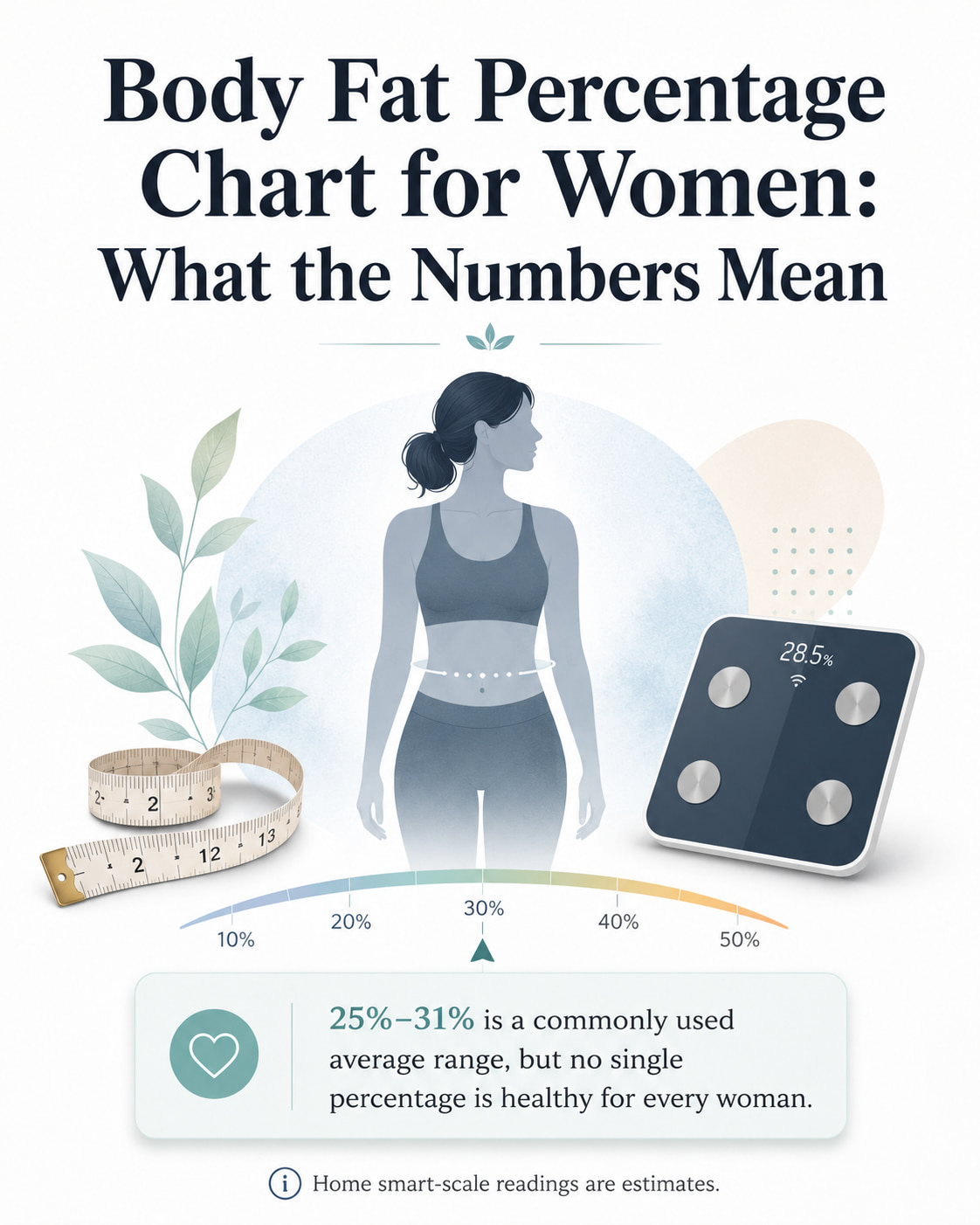
A commonly used body fat percentage chart for women places 25% to 31% in the average range for adult women. However, no single body fat percentage is healthy or unhealthy for every woman.
Age, muscle mass, activity level, fat distribution, menstrual health, medical history, and the measurement method can all affect what your number means. A home smart-scale result should therefore be treated as an estimate—not a diagnosis or a grade of your health.
Body Fat Percentage Chart for Women
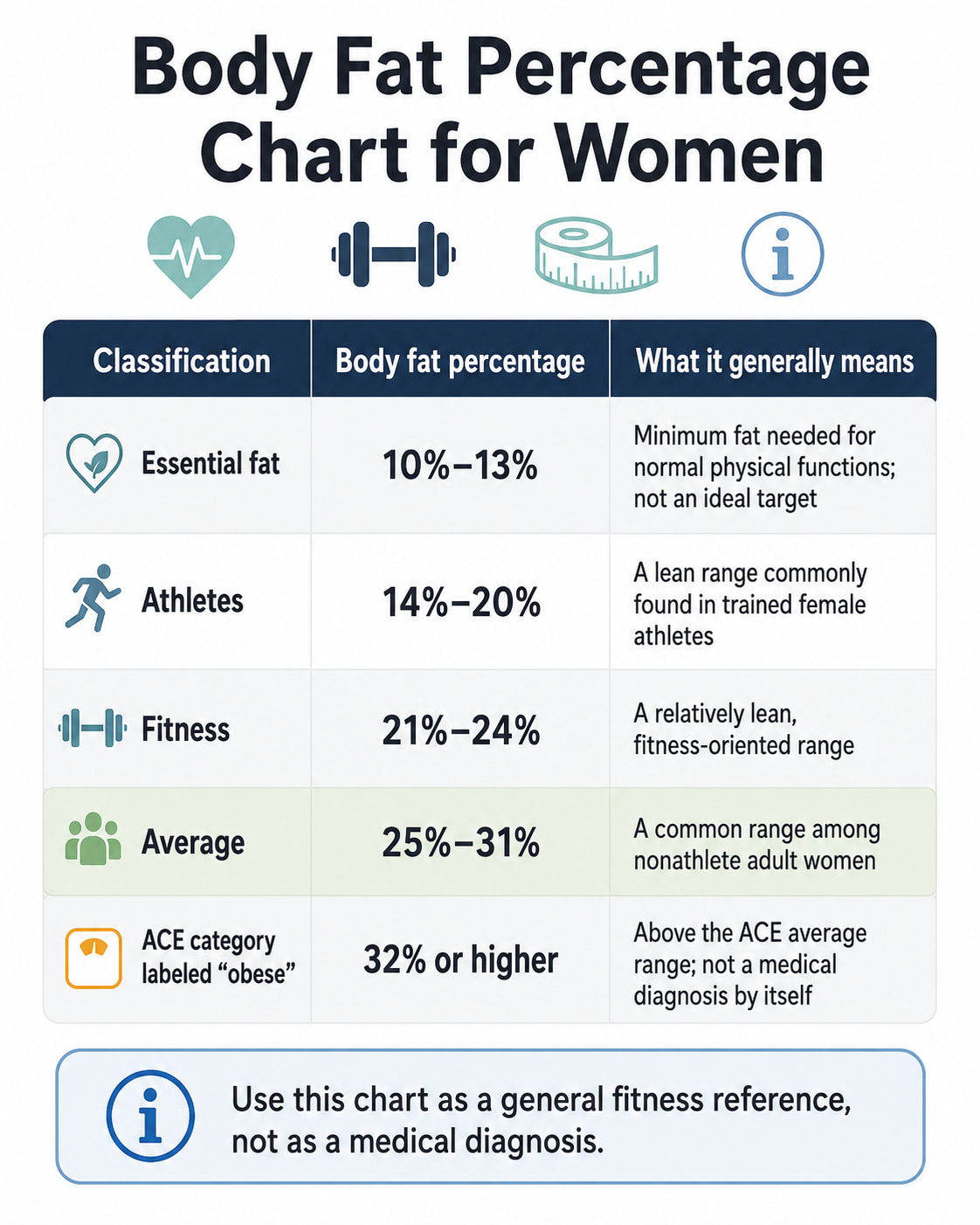
The following chart shows widely used fitness categories for adult women. The categories are commonly associated with the American Council on Exercise, which describes 25% to 31% as typical for an average nonathlete woman.
| Classification | Body fat percentage | What it generally means |
|---|---|---|
| Essential fat | 10%–13% | The minimum fat needed for normal physical functions; not an ideal target |
| Athletes | 14%–20% | A lean range commonly found in trained female athletes |
| Fitness | 21%–24% | A relatively lean, fitness-oriented range |
| Average | 25%–31% | A common range among nonathlete adult women |
| ACE category labeled “obese” | 32% or higher | Above the ACE average range; not a medical diagnosis by itself |
The American Council on Exercise also notes that body fat below 14% may be unusually low for many women. These categories are general fitness references, not universally accepted clinical cutoffs.
How to Use This Chart Correctly
Use the chart as a starting point rather than a strict rule.
For example, a result of 32% falls just above the chart’s average range. That does not automatically mean the person has a disease or needs to lose weight. A healthcare professional may also consider waist circumference, blood pressure, cholesterol, blood glucose, muscle mass, physical function, and medical history.
The word “obese” in the last row is the traditional ACE category label. It should not be used to diagnose clinical obesity from one body fat reading.
Body Fat Percentage Chart for Women by Age
Body composition often changes with age. Women may lose some muscle mass and store a greater proportion of body weight as fat, particularly during and after menopause.
One frequently cited age-based chart comes from research by Gallagher and colleagues. The researchers estimated body fat ranges that corresponded with established BMI categories.
| Age | Lower than the BMI-equivalent range | BMI-equivalent healthy range | Elevated range | Highest category |
|---|---|---|---|---|
| 20–39 years | Below 21% | 21%–32% | 33%–38% | 39% or higher |
| 40–59 years | Below 23% | 23%–33% | 34%–39% | 40% or higher |
| 60–79 years | Below 24% | 24%–35% | 36%–41% | 42% or higher |
These figures should be interpreted cautiously. The original Gallagher body-fat research was designed to explore body fat ranges corresponding to BMI categories. It did not establish universal disease-risk thresholds, and the researchers found differences related to age, sex, and ethnicity.
In practical terms, the chart explains why 33% body fat may be categorized differently for a 25-year-old woman and a 65-year-old woman. It does not mean every woman should intentionally gain body fat as she ages.
What Different Body Fat Percentages Mean for Women
The examples below combine the common fitness chart with important clinical context.
Is 15% Body Fat Healthy for a Woman?
Fifteen percent falls within the common athlete range. It may be appropriate for some well-fueled competitive athletes, but it is very lean for the general population.
A woman at this level should pay attention to energy, recovery, menstrual regularity, bone health and exercise performance. Lower is not automatically better.
Is 20% Body Fat Good for a Woman?
Twenty percent is at the upper end of the athlete range in the traditional chart. It may be compatible with good health when the woman eats enough, has normal physical function and does not experience menstrual or recovery problems.
It is not a necessary target for health or fitness.
Is 25% Body Fat Good for a Woman?
Twenty-five percent marks the beginning of the ACE average range. It is also close to the fitness range and can be a reasonable result for many adult women.
Other health markers still matter more than the percentage alone.
Is 30% Body Fat High for a Woman?
Thirty percent remains within the commonly used 25% to 31% average range for adult women.
It is not automatically high or unhealthy. Interpretation depends on age, waist measurement, muscle mass, metabolic health and the accuracy of the device used.
Is 32% Body Fat High for a Woman?
Thirty-two percent begins the ACE category traditionally labeled “obese,” but that cutoff is not universally accepted as a medical threshold.
For example, 32% also falls within the BMI-equivalent range in the Gallagher chart for women ages 20 to 39 and within the corresponding ranges for older age groups. This difference shows why a chart label should not be treated as a diagnosis.
What Does 35% Body Fat Mean?
Thirty-five percent is above the ACE average range. It may still fall within some age-adjusted reference ranges, particularly for women ages 60 to 79.
A 35% result is best considered alongside waist size, laboratory results, blood pressure, physical activity, strength and family history.
What Does 40% Body Fat Mean?
Forty percent is above the average range in common fitness charts. It also meets the highest age-based category for some younger and middle-aged women.
However, the health implications vary. The location of the fat, the amount of muscle a woman has and whether excess adiposity is affecting her metabolic or physical health are all important.
Why Body Fat Percentage Charts Do Not Always Agree
You may see 32%, 35%, 36%, 39%, 40% or 42% presented as a cutoff. These numbers differ because researchers and organizations developed them for different purposes.
| Reference framework | What it was designed to show |
|---|---|
| ACE fitness chart | General fitness and body-composition categories |
| Gallagher age chart | Body fat values corresponding to BMI categories |
| Newer outcome-based research | Body fat levels associated with metabolic syndrome |
| Clinical obesity frameworks | Excess adiposity plus effects on organs, health or physical function |
A 2025 study in The Journal of Clinical Endocrinology & Metabolism analyzed 16,918 U.S. adults with DXA body-composition measurements from National Health and Nutrition Examination Survey data collected between 1999 and 2018.
The researchers proposed these outcome-based thresholds for women:
| Proposed category | Body fat percentage |
|---|---|
| Overweight | 36% or higher |
| Obesity | 42% or higher |
The Journal of Clinical Endocrinology & Metabolism study developed these cutoffs by comparing body fat percentages with the prevalence of metabolic syndrome. The figures are proposed research thresholds, not universally adopted diagnostic standards.
This research does not mean that every result below 36% is risk-free or that every result above 42% confirms a disease. Individual assessment still matters.
Body Fat Percentage Is Not a Medical Diagnosis
Clinical obesity involves more than crossing a line on a percentage chart.
A 2025 peer-reviewed discussion published by the Centers for Disease Control and Prevention highlighted the limitations of using BMI alone. BMI cannot distinguish fat from muscle, show where fat is stored or reveal whether excess adiposity is affecting organs and physical function. Similar limitations apply when a body fat percentage is viewed without broader health context.
A complete evaluation may include:
- Waist circumference
- Blood pressure
- Blood glucose or A1C
- Cholesterol and triglycerides
- Muscle mass and strength
- Mobility and physical function
- Sleep and breathing symptoms
- Menstrual and reproductive health
- Medical and family history
Body Fat Percentage vs. BMI
Body fat percentage and BMI measure different things.
BMI compares weight with height. It is quick and inexpensive but cannot separate fat, muscle, bone or water weight.
Body fat percentage estimates how much of your total weight consists of fat. It offers more information about body composition, but the result depends heavily on the testing method.
A muscular woman may have a high BMI despite having relatively little body fat. Another woman may have a BMI in the standard healthy category but carry less muscle and more abdominal fat.
Neither measurement gives a complete picture by itself.
Why Waist Circumference Also Matters
Total body fat percentage does not show where fat is stored. Fat concentrated around the abdomen generally has greater cardiometabolic significance than fat around the hips and thighs.
The National Heart, Lung, and Blood Institute states that a waist circumference greater than 35 inches in women is associated with increased risk of heart disease and type 2 diabetes.
To measure your waist:
- Stand upright and relax your abdomen.
- Place a flexible tape around your middle just above the hipbones.
- Keep the tape level without pulling it tightly into your skin.
- Measure just after breathing out normally.
Waist measurements may be less informative during pregnancy or for people with certain medical conditions. Ask a healthcare professional how to interpret the result when standard guidance may not apply.
How Body Fat Percentage Is Measured
No method measures body fat perfectly. Different methods can produce noticeably different results for the same woman.
| Method | Main advantage | Main limitation |
|---|---|---|
| DXA scan | Provides detailed estimates of total and regional fat, lean tissue and bone | More expensive, less accessible and involves a small amount of radiation |
| BIA or smart scale | Quick, convenient and inexpensive | Hydration, meals, exercise and device equations can affect the result |
| BOD POD | Laboratory-based air-displacement measurement | Availability, cost, body size and breathing technique can affect results |
| Skinfold calipers | Affordable and useful for tracking changes | Accuracy depends on the tester and prediction formula |
| Tape-measure formulas | Easy to perform at home | Produces an estimate rather than a direct measurement |
| Waist circumference | Helpful for assessing abdominal fat risk | Does not calculate total body fat percentage |
The American College of Sports Medicine explains that DXA generally provides greater precision than BIA, air-displacement tools and several other commonly used methods. However, DXA is more expensive, requires specialized equipment and training, and uses radiation. ACSM also notes that BIA results can depend on hydration.
How to Get More Consistent Smart-Scale Results
For a more useful trend:
- Use the same scale each time.
- Measure at approximately the same time of day.
- Use the bathroom before measuring.
- Measure before eating, drinking or exercising.
- Place the scale on a hard, level surface.
- Avoid comparing results from unrelated devices.
- Focus on changes over several weeks rather than daily fluctuations.
A sudden one- or two-point change on a smart scale usually does not mean you gained or lost that much body fat overnight. Shifts in water balance can change the estimate.
Can a Woman’s Body Fat Percentage Be Too Low?
Yes. Very low body fat may be a concern when it occurs with inadequate energy intake, menstrual changes, poor recovery or impaired bone health.
The number alone does not determine risk. A trained athlete at 18% may have different nutritional needs and health markers from someone who reached the same percentage through severe food restriction.
The U.S. Office on Women’s Health describes the female athlete triad as a combination of low energy availability, menstrual dysfunction and impaired bone health. Low energy availability can occur when food intake does not provide enough energy to support both exercise and normal physical functions.
Speak with a healthcare professional or registered dietitian if a low or falling body fat reading occurs with:
- Missed or increasingly irregular periods
- Persistent fatigue or feeling cold
- Declining exercise performance
- Recurrent stress injuries or fractures
- Dizziness or weakness
- Restrictive eating or fear of weight gain
- Difficulty recovering from exercise
- Hair loss or other unexplained physical changes
Do not use the essential-fat category as a weight-loss target.
When a Higher Body Fat Percentage May Need Attention
A higher percentage deserves more attention when it appears alongside other cardiometabolic or physical concerns.
Consider discussing the result with a healthcare professional when you also have:
- A waist circumference above 35 inches
- High blood pressure
- Elevated blood glucose or A1C
- Unhealthy cholesterol or triglyceride levels
- Sleep apnea symptoms
- Shortness of breath or reduced mobility
- Rapid or unexplained weight changes
- A strong family history of diabetes or cardiovascular disease
The goal of an assessment should be to understand your health—not to attach judgment to a number.
How to Set a Realistic Body-Composition Goal
A healthy goal is usually based on function and sustainable habits rather than reaching the lowest possible percentage.
Useful goals may include:
- Improving strength
- Maintaining or building muscle
- Supporting regular menstrual cycles
- Improving blood pressure or glucose levels
- Reducing waist circumference when medically appropriate
- Increasing energy and exercise capacity
- Developing eating habits you can maintain
Because body fat tests have measurement error, small differences may not represent real physical change. Look for a clear trend over time and assess progress using more than one marker.
Frequently Asked Questions
What is a healthy body fat percentage for a woman?
A commonly used fitness chart places 25% to 31% in the average range for adult women. However, a healthy percentage varies with age, activity, muscle mass, fat distribution and overall health. There is no universally accepted range that applies to every woman.
Is 30% body fat high for a woman?
Thirty percent falls within the common ACE average range of 25% to 31%. It should still be considered alongside age, waist circumference, metabolic health and the accuracy of the measurement.
Is 35% body fat considered obesity?
The traditional ACE chart places 35% in a category labeled “obese,” but newer outcome-based research proposed 42% as the obesity threshold for women. Neither number should be used alone to make a medical diagnosis.
Does a healthy body fat percentage increase with age?
Body fat percentage often rises with age as muscle mass and hormonal patterns change. Some research charts therefore use higher age-adjusted ranges. This does not mean that body fat must increase or that every increase is beneficial.
Which body fat measurement method is most accurate?
DXA generally provides more detailed and precise body-composition information than consumer scales or tape formulas. However, it costs more, has limited availability and involves a small amount of radiation. Consistent measurements from the same method may be more useful for routine trend tracking.
Why does my smart scale show a different result every day?
Smart scales use bioelectrical impedance, which is affected by hydration, food intake, exercise, skin temperature and testing time. Daily changes often reflect water balance rather than true fat gain or loss.
How often should I measure body fat?
You generally do not need to measure it every day. Checking under similar conditions every few weeks may provide a clearer trend. Frequent testing can create unnecessary concern because normal hydration changes affect many devices.
Conclusion
A body fat percentage chart for women can provide useful context, but it cannot define your health by itself. The commonly used average range is 25% to 31%, while age-based and newer metabolic-risk research use different thresholds.
Use the same measurement method consistently, focus on long-term trends and consider waist size, strength, menstrual health, blood pressure and laboratory results. Discuss unexpected, very low or persistently high readings with a qualified healthcare professional who can interpret them in the context of your overall health.
This content is for informational purposes only and not medical advice.
References
- American Council on Exercise: Body Fat Percentage Categories
- Gallagher et al.: Healthy Percentage Body Fat Ranges
- The Journal of Clinical Endocrinology & Metabolism: Body Fat Threshold Research
- CDC Preventing Chronic Disease: Obesity Staging Systems
- National Heart, Lung, and Blood Institute: Waist Circumference Guidance
- American College of Sports Medicine: Body-Composition Measurement Methods
- U.S. Office on Women’s Health: Female Athlete Triad