
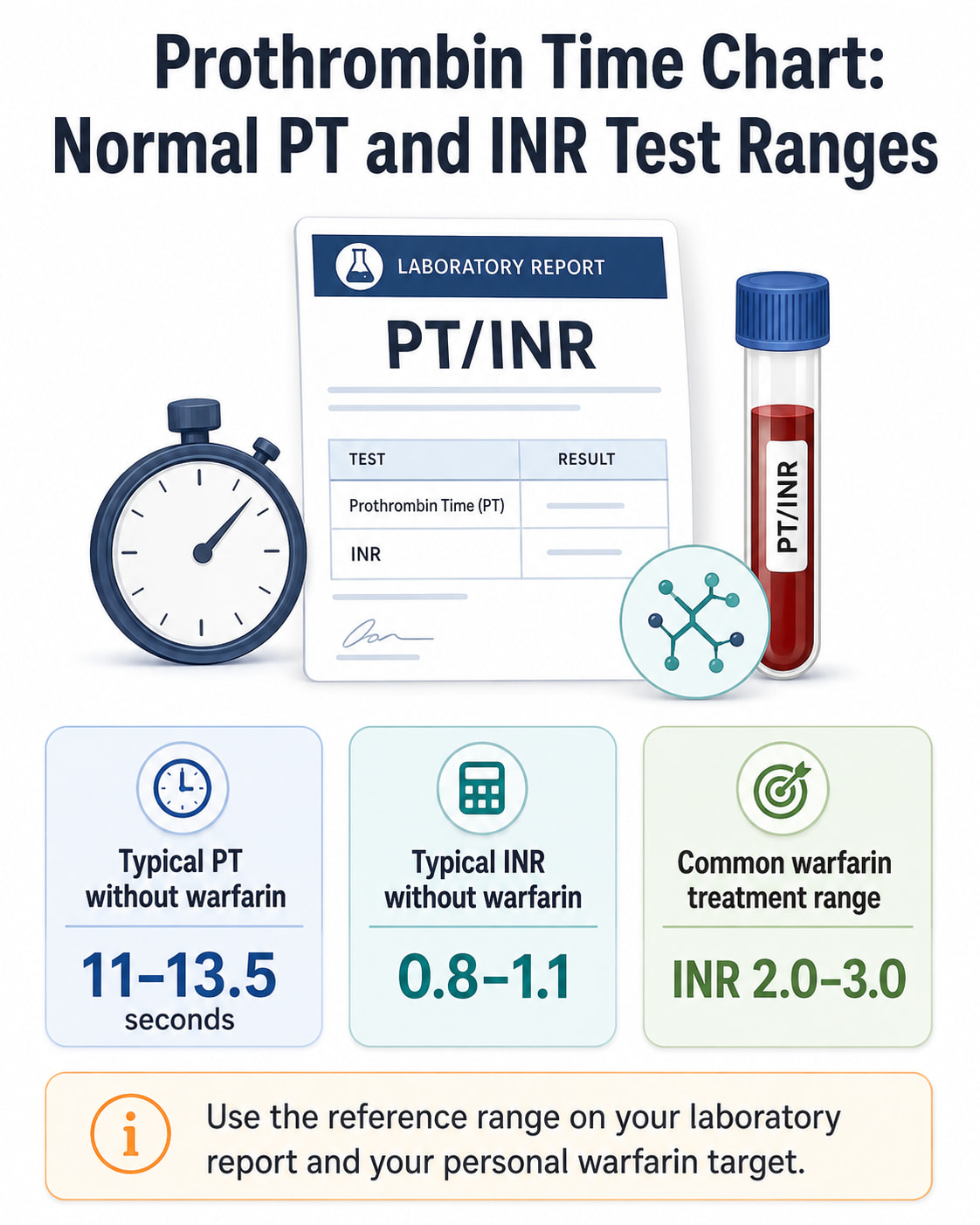
A typical prothrombin time is 11 to 13.5 seconds, while a typical INR is 0.8 to 1.1 for someone who is not taking warfarin. People taking warfarin often have a prescribed INR target of 2.0 to 3.0, although certain heart valve conditions require a different target.
A prothrombin time chart can help you see where your PT and INR results fall. However, laboratory methods, medications, health conditions, and the reason for testing all affect interpretation. Always use the reference range printed on your laboratory report and the target provided by your healthcare professional.
Prothrombin Time Chart
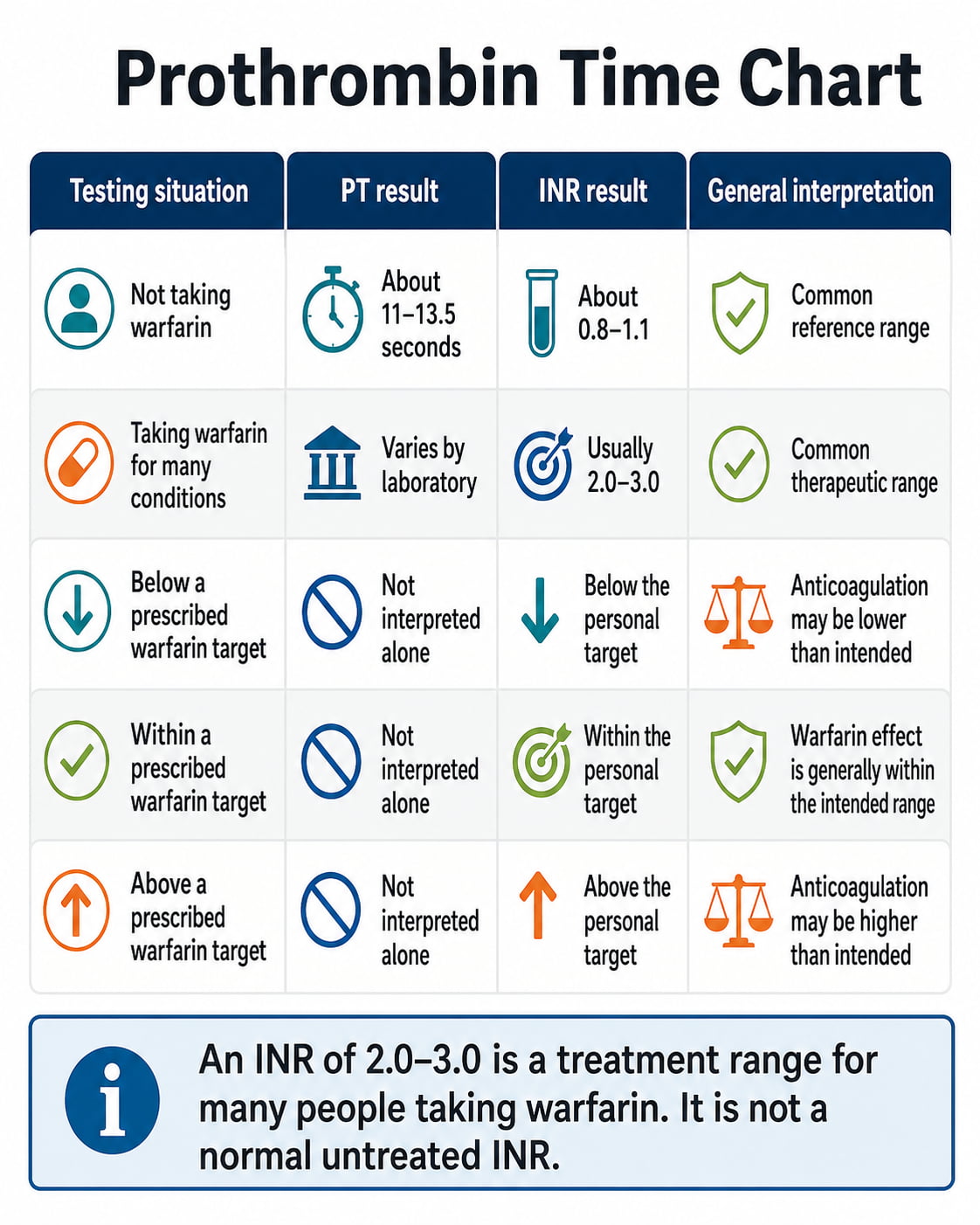
| Testing situation | PT result | INR result | General interpretation |
|---|---|---|---|
| Not taking warfarin | About 11–13.5 seconds | About 0.8–1.1 | Common reference range |
| Taking warfarin for many conditions | Varies by laboratory | Usually 2.0–3.0 | Common therapeutic range |
| Below a prescribed warfarin target | Not interpreted alone | Below the personal target | Anticoagulation may be lower than intended |
| Within a prescribed warfarin target | Not interpreted alone | Within the personal target | Warfarin effect is generally within the intended range |
| Above a prescribed warfarin target | Not interpreted alone | Above the personal target | Anticoagulation may be higher than intended |
These ranges come from commonly used clinical references. According to Cleveland Clinic’s PT/INR guidance, PT of 11 to 13.5 seconds and INR of 0.8 to 1.1 are commonly reported for people who are not taking warfarin. The correct range may still differ between laboratories.
Important: An INR of 2.0 to 3.0 is a treatment range for many people taking warfarin. It is not considered a normal untreated INR.
What Is a Prothrombin Time Test?
A prothrombin time test measures how many seconds it takes a blood sample to form a clot. Blood clotting relies on several proteins called coagulation factors, many of which the liver produces.
Healthcare professionals may order a PT test to:
- Monitor warfarin therapy
- Investigate unusual bleeding or bruising
- Investigate abnormal blood clots
- Check clotting before surgery or another procedure
- Help evaluate liver function
- Check for a possible vitamin K deficiency
- Assess part of the blood-clotting system
The MedlinePlus PT/INR test guide explains that the test can assess whether blood clots normally and whether warfarin is producing the intended anticoagulant effect.
What Is INR?
INR stands for international normalized ratio. It is a standardized calculation based on the prothrombin time.
PT results can differ because laboratories use different equipment, reagents, and testing methods. INR reduces some of this variation, making it easier to compare warfarin-monitoring results from different laboratories.
PT and INR are related, but they are not interchangeable numbers:
- PT reports clotting time in seconds.
- INR reports a standardized ratio.
- There is no single chart that converts every PT result directly into an INR.
- The conversion depends partly on the laboratory reagent used for testing.
For this reason, healthcare professionals usually focus on INR rather than raw PT seconds when monitoring warfarin.
Normal PT and INR Ranges When You Are Not Taking Warfarin
For someone who is not using warfarin, commonly cited results are:
- PT: 11 to 13.5 seconds
- INR: 0.8 to 1.1
A result within these ranges generally means the tested portion of the clotting system is functioning within the laboratory’s expected limits.
However, a normal result does not rule out every bleeding or clotting condition. PT evaluates only part of the coagulation process. A healthcare professional may also order a partial thromboplastin time, platelet count, fibrinogen test, liver tests, or individual clotting-factor tests.
Why Laboratory Reference Ranges Differ
PT reference ranges are method-dependent. One laboratory may use a slightly lower or higher range than another.
Differences may result from:
- The thromboplastin reagent used
- The laboratory instrument
- Calibration methods
- The patient population used to establish the range
- Sample handling and collection
Do not label a result high or low solely by comparing it with a general online chart. Check the range next to the result on your own report.
Therapeutic INR Ranges for Warfarin
Warfarin slows the production of vitamin K-dependent clotting factors. Healthcare professionals adjust the dose carefully because too little anticoagulation may allow a harmful clot to form, while too much may increase bleeding risk.
For many warfarin indications, the common therapeutic range is:
INR 2.0 to 3.0
This range may be prescribed for conditions such as:
- Atrial fibrillation
- Deep vein thrombosis
- Pulmonary embolism
- Prevention of recurrent blood clots
Your prescribed range may differ based on your diagnosis, medical history, bleeding risk, medications, and heart valve type.
INR Targets for Mechanical Heart Valves
Mechanical heart valves require individualized anticoagulation. The target depends on the valve’s type and position and whether the person has additional clotting risk factors.
| Mechanical valve situation | ACC/AHA guideline target |
|---|---|
| Modern bileaflet or current-generation mechanical aortic valve without added thromboembolic risk factors | INR 2.5 |
| Mechanical aortic valve with risk factors or an older-generation valve | INR 3.0 |
| Mechanical mitral valve replacement | INR 3.0 |
| Selected On-X mechanical aortic valve patients, beginning three months after surgery with the specified aspirin plan | INR 1.5–2.0 |
The American College of Cardiology’s heart valve guideline summary emphasizes that valve characteristics and individual risk factors determine the target. The lower On-X range is a device-specific exception and does not apply to other mechanical valves.
Never change your warfarin dose or target based on a general chart.
What Does a High PT or INR Mean?
A high PT or INR means the blood sample took longer to clot than the relevant reference or treatment range.
High PT or INR Without Warfarin
When someone is not taking warfarin, possible reasons for a prolonged PT or elevated INR include:
- Vitamin K deficiency
- Liver dysfunction
- A bleeding disorder
- Low levels or reduced activity of certain clotting factors
- Severe illness
- Disseminated intravascular coagulation
- Medication or supplement effects
An abnormal result does not identify the cause by itself. Healthcare professionals interpret it alongside symptoms, medical history, liver tests, blood counts, aPTT, fibrinogen, and other coagulation studies.
High INR While Taking Warfarin
For a person taking warfarin, an INR above the prescribed target generally means the anticoagulant effect is stronger than intended.
Possible contributors include:
- Taking more warfarin than prescribed
- Starting a medicine that interacts with warfarin
- Antibiotic use
- Illness, fever, vomiting, or diarrhea
- Reduced food intake
- Sudden dietary changes
- Increased alcohol intake
- Liver problems
- Certain supplements or herbal products
A higher INR may increase bleeding risk, but the urgency depends on the value, symptoms, treatment indication, and personal medical history.
Do not skip, reduce, or change a warfarin dose unless the clinician managing your anticoagulation gives you instructions.
What Does a Low PT or INR Mean?
A low result means the sample clotted faster than the relevant reference or treatment range.
Low PT or INR Without Warfarin
Possible reasons include:
- High vitamin K intake
- Vitamin K supplements
- Certain medications
- A blood-clotting disorder
- Normal laboratory variation
A slightly shortened PT does not prove that a person has an abnormal tendency to develop blood clots. Diagnosis requires symptoms, medical history, and additional testing.
Low INR While Taking Warfarin
An INR below the prescribed target may mean warfarin is providing less anticoagulation than intended. This can increase clot risk in some patients.
Possible causes include:
- Missing a warfarin dose
- Taking less warfarin than prescribed
- Increasing vitamin K intake suddenly
- Starting a medication that reduces warfarin’s effect
- Taking certain supplements
- Changes in health or diet
- An inaccurate home-meter result
Do not take an extra warfarin dose to correct a low INR unless your anticoagulation provider specifically tells you to do so.
Foods, Medicines, and Other Factors That Can Affect INR
Warfarin interacts with many medicines, supplements, foods, and health changes. Even a product that seems harmless may change the INR.
Vitamin K and Leafy Green Vegetables
Vitamin K supports the production of clotting factors. Foods rich in vitamin K include kale, spinach, collard greens, broccoli, Brussels sprouts, and other green vegetables.
People taking warfarin usually do not need to avoid these nutritious foods completely. The goal is to keep vitamin K intake reasonably consistent rather than eating a large amount one week and very little the next.
The American Heart Association’s warfarin guide advises patients to discuss major dietary, medication, and supplement changes with their healthcare team.
Medicines and Supplements
Products that may interact with warfarin include certain:
- Antibiotics
- Antifungal medicines
- Pain relievers
- Anti-inflammatory medicines
- Heart medicines
- Seizure medicines
- Antidepressants
- Herbal products
- Multivitamins
- Vitamin K supplements
This does not mean every product will affect every patient. Ask a pharmacist or healthcare professional before starting, stopping, or changing any prescription medicine, over-the-counter product, or supplement.
Health and Lifestyle Changes
INR may also change because of:
- Fever or infection
- Vomiting or diarrhea
- Reduced appetite
- Major weight changes
- Liver dysfunction
- Alcohol use
- Changes in smoking
- Hospitalization
- Changes in physical health
Report meaningful changes to the clinician managing your warfarin.
How the PT/INR Test Is Performed
A PT/INR test may use blood from a vein or fingertip.
For a venous test, a healthcare professional collects a small sample from a vein in the arm. A laboratory then adds a clot-activating substance and measures the clotting time.
A fingertip test uses a small drop of blood placed on a test strip. A portable meter calculates the INR within minutes. Clinics and some patients who need frequent warfarin monitoring use these devices.
Most people need no special preparation. Follow any instructions from the ordering clinician, especially instructions about when to take the daily warfarin dose.
How to Use a Home INR Meter Safely
Home testing can make regular warfarin monitoring more convenient, but correct technique matters.
The U.S. Food and Drug Administration’s home INR meter guidance recommends:
- Washing and drying the hands before testing
- Warming a cold finger to improve blood flow
- Avoiding squeezing or “milking” the fingertip
- Using the correct amount of blood
- Storing test strips as directed
- Testing the meter with quality controls
- Comparing the home meter with laboratory testing periodically
- Contacting the healthcare provider when the result falls outside the assigned target
Home-meter INR results above 4.5 may be less reliable than lower readings. The FDA advises immediate medical attention for a home INR result above 4.5, even without obvious bleeding, and notes that a laboratory blood draw may be needed to confirm the result.
When to Seek Urgent Medical Care
Someone taking warfarin should seek immediate medical attention for:
- Bleeding that does not stop
- Blood in the urine
- Red or black, tarry stool
- Vomiting blood
- Severe or unexplained abdominal pain
- Sudden severe headache
- New confusion
- Trouble speaking
- Sudden weakness or numbness
- Sudden vision loss
- Trouble walking or loss of coordination
- Shortness of breath
- A major fall or head injury
- A home INR result above 4.5
Contact the anticoagulation provider promptly for any INR outside the personal target range, even when no symptoms are present.
PT vs. PTT: What Is the Difference?
PT and PTT both measure clotting time, but they evaluate different parts of the coagulation system.
| Test | Full name | Common uses |
|---|---|---|
| PT/INR | Prothrombin time and international normalized ratio | Warfarin monitoring, liver assessment, vitamin K deficiency, bleeding evaluation |
| PTT or aPTT | Partial thromboplastin time or activated partial thromboplastin time | Evaluation of other clotting factors and monitoring certain forms of heparin |
Healthcare professionals often order both when investigating unexplained bleeding or an abnormal clotting test. One normal test does not guarantee that the other will also be normal.
Frequently Asked Questions
What is a normal prothrombin time?
A commonly cited normal PT is approximately 11 to 13.5 seconds. The exact interval varies by laboratory, so use the reference range printed on your report.
What is a normal INR when you are not taking warfarin?
An INR of approximately 0.8 to 1.1 is commonly considered typical for someone who is not taking warfarin. A slightly different laboratory range may still be appropriate.
Is an INR of 1.2 high?
An INR of 1.2 is slightly above some commonly used untreated reference ranges. It does not identify a specific medical problem by itself. Your clinician will consider the laboratory’s range, medications, symptoms, health history, and other test results.
For someone taking warfarin with a target of 2.0 to 3.0, an INR of 1.2 would be below the usual treatment range.
Is an INR of 2.0 normal?
An INR of 2.0 may be within the prescribed therapeutic range for someone taking warfarin. It would be above the usual reference range for someone who is not using warfarin.
What INR is considered dangerous?
There is no single dangerous INR for every person. Risk depends on whether the person takes warfarin, the prescribed target, symptoms, medical history, and reason for anticoagulation.
The FDA advises immediate medical attention for a home-meter INR above 4.5, even without visible bleeding. Any serious bleeding or stroke-like symptom requires emergency care regardless of the INR number.
Can diet change an INR result?
Yes. Sudden changes in vitamin K intake can affect warfarin response and INR. People taking warfarin should aim for consistent dietary habits and discuss major changes with their healthcare team.
Can I adjust my own warfarin dose based on the chart?
No. A general chart cannot account for your diagnosis, valve type, previous results, medicines, diet, or bleeding and clotting risks. Follow the dose instructions provided by your anticoagulation clinic or prescribing healthcare professional.
Conclusion
A typical prothrombin time is about 11 to 13.5 seconds, and a typical INR is about 0.8 to 1.1 for someone who is not taking warfarin. For many people taking warfarin, the prescribed INR range is 2.0 to 3.0, but mechanical heart valves and other clinical situations may require different targets.
Use the range on your laboratory report, compare warfarin results with your personal target, and contact your healthcare provider before changing medicines, supplements, diet, or warfarin dosage.
This content is for informational purposes only and not medical advice.