
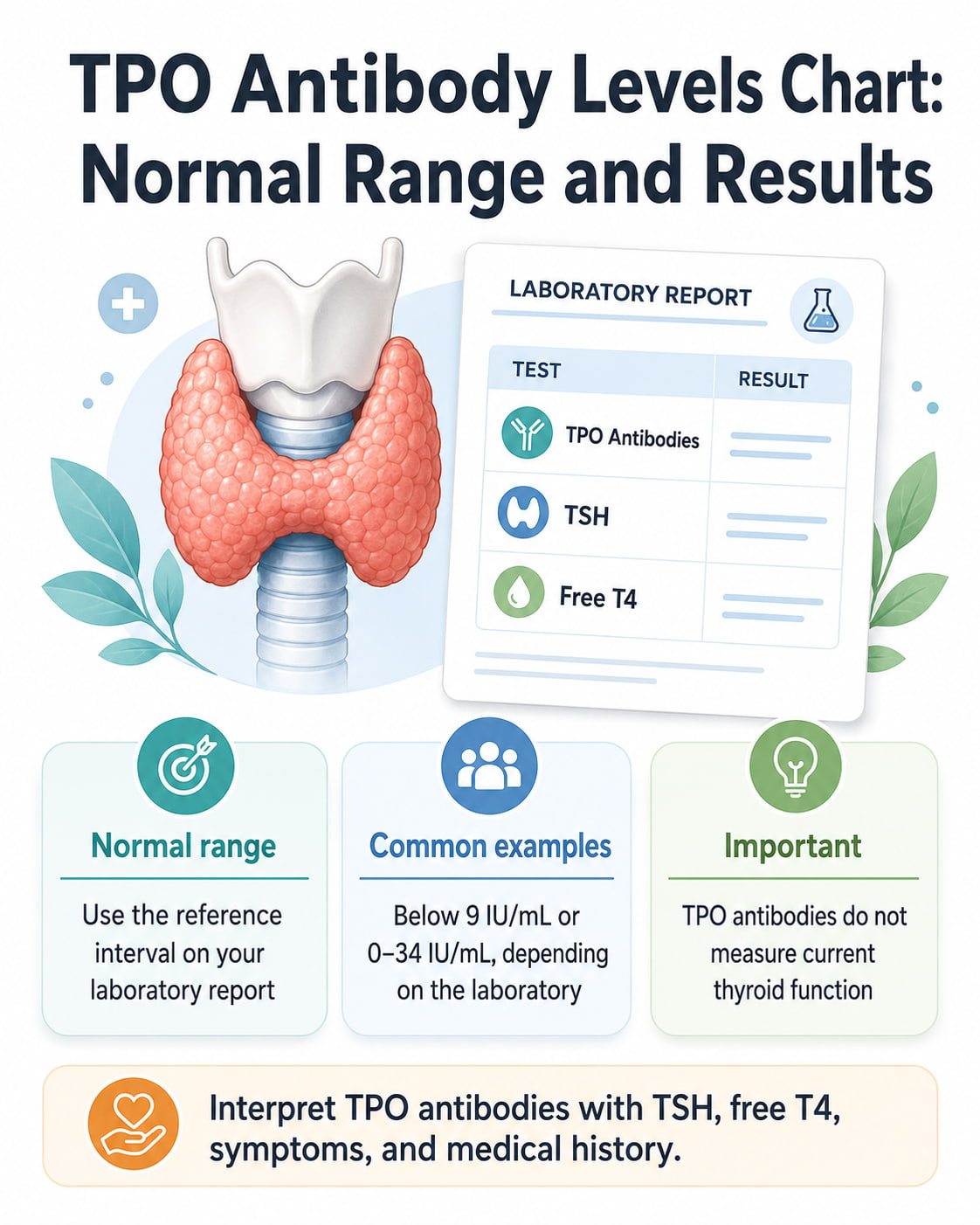
A normal TPO antibody level is a result within the reference range printed on your laboratory report. Common examples include below 9 IU/mL at Mayo Clinic Laboratories and Quest Diagnostics, while Labcorp uses 0–34 IU/mL for adults with its testing method.
These differences matter. A result that one laboratory marks as high may fall within another laboratory’s reference interval. Always compare your number with the range beside it on the same report rather than using a universal cutoff.
An elevated thyroid peroxidase antibody result can support the presence of thyroid autoimmunity, especially Hashimoto’s disease. However, it does not show how well your thyroid currently works. Doctors interpret TPO antibodies alongside thyroid-stimulating hormone (TSH), free T4, symptoms, medical history, and pregnancy status.
TPO Antibody Levels Chart
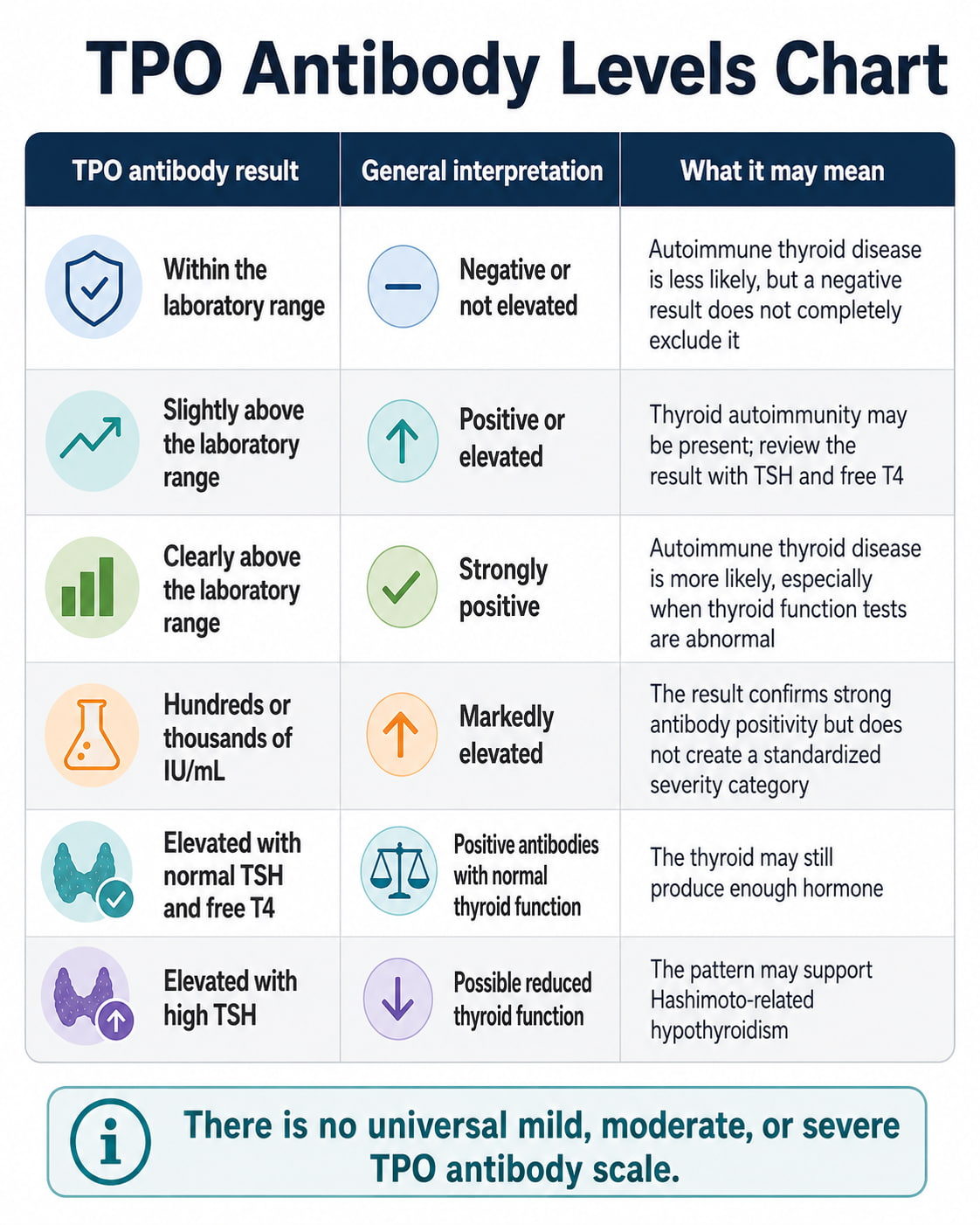
The following TPO antibody levels chart provides a general interpretation based on whether the result falls within or above your laboratory’s range.
| TPO antibody result | General interpretation | What it may mean |
|---|---|---|
| Within the laboratory range | Negative or not elevated | The test did not detect TPO antibodies above the laboratory’s cutoff. Autoimmune thyroid disease is less likely, but a negative result does not completely exclude it. |
| Slightly above the laboratory range | Positive or elevated | Thyroid autoimmunity may be present. The result should be reviewed with TSH and free T4. |
| Clearly above the laboratory range | Strongly positive | Autoimmune thyroid disease is more likely, especially when other thyroid test results are abnormal. |
| Hundreds or thousands of IU/mL | Markedly elevated | The result strongly supports antibody positivity, but the number does not create a standardized mild, moderate, or severe category. |
| Elevated with normal TSH and free T4 | Positive antibodies with normal thyroid function | Autoimmune activity may be present even though the thyroid still produces enough hormone. |
| Elevated with high TSH | Possible reduced thyroid function | This pattern may support Hashimoto-related hypothyroidism, depending on the free T4 result and clinical evaluation. |
There is no medically accepted universal chart that classifies TPO antibodies as mildly, moderately, or severely elevated. Laboratories use different equipment, testing methods, and reference populations. The amount above the cutoff does not directly measure thyroid damage, symptom severity, or the need for medication.
What Is the Normal Range for TPO Antibodies?
The normal TPO antibody range depends on the laboratory that performs the test.
Common TPO Antibody Reference Ranges
| Laboratory | Reference range | Age information |
|---|---|---|
| Mayo Clinic Laboratories | Below 9.0 IU/mL | Applies to all ages |
| Quest Diagnostics | Below 9 IU/mL | General reference range |
| Labcorp | 0–34 IU/mL | Adults older than 19 |
| Labcorp | Age-specific ranges | Children and adolescents |
The Mayo Clinic Laboratories TPO antibody test lists a reference value below 9.0 IU/mL for all ages. The Quest Diagnostics TPO antibody test also lists below 9 IU/mL but specifically tells patients to use the range on their own laboratory report.
In contrast, Labcorp’s TPO antibody test lists an adult range of 0–34 IU/mL.
Labcorp TPO Antibody Ranges by Age
Labcorp currently publishes these age-specific intervals for its assay:
| Age | Labcorp reference interval |
|---|---|
| Birth to 6 days | 0–117 IU/mL |
| 7 days to 3 months | 0–47 IU/mL |
| 4 to 11 months | 0–32 IU/mL |
| 1 to 5 years | 0–13 IU/mL |
| 6 to 10 years | 0–18 IU/mL |
| 11 to 19 years | 0–26 IU/mL |
| Older than 19 years | 0–34 IU/mL |
These ranges apply only to the Labcorp testing method. A different hospital or laboratory may use another interval, including a single cutoff for both children and adults.
Why TPO Antibody Ranges Differ by Laboratory
TPO antibody tests are not fully standardized across all testing platforms. Laboratories may use different immunoassays, calibration systems, equipment, and reference populations.
Because of these differences:
- Use the reference interval on the report containing your result.
- Do not automatically compare a result from one laboratory with a result from another.
- Do not assume that a change in the number represents a real biological change when the tests used different methods.
- Ask your clinician whether repeat testing should use the same laboratory.
For example, a result of 20 IU/mL would exceed the Mayo and Quest cutoff of 9 IU/mL but would remain within Labcorp’s adult interval of 0–34 IU/mL. That does not mean one laboratory is wrong. It means the tests use different assay-specific limits.
What Is a TPO Antibody Test?
Thyroid peroxidase, or TPO, is an enzyme located in thyroid cells. The thyroid uses this enzyme during the production of the hormones thyroxine (T4) and triiodothyronine (T3).
In an autoimmune thyroid condition, the immune system mistakenly produces antibodies directed against thyroid peroxidase. A TPO antibody blood test measures these antibodies.
Other names for the test include:
- TPOAb
- Anti-TPO test
- Thyroid peroxidase antibody
- Antithyroid microsomal antibody
- Thyroid microsomal antibody
The test helps identify an autoimmune cause of a thyroid problem. It does not directly measure whether thyroid hormone levels are currently too high, too low, or normal.
What Does a High TPO Antibody Level Mean?
A high TPO antibody result means that the laboratory detected more thyroid peroxidase antibodies than expected for its testing method.
The result most commonly supports an autoimmune thyroid condition, particularly Hashimoto’s disease. Mayo Clinic Laboratories reports that TPO antibodies are detectable in about 90% of people with Hashimoto’s disease using the information supporting its assay. However, some people with Hashimoto’s disease do not have measurable antibodies in their blood.
Elevated TPO antibodies may occur with:
- Hashimoto’s disease
- Graves’ disease
- Painless thyroiditis
- Postpartum thyroiditis
- Other autoimmune conditions
- Normal thyroid function in some otherwise healthy people
Labcorp notes that small numbers of people without evidence of thyroid disease may also have detectable antibodies. For that reason, a positive TPO test cannot establish a diagnosis by itself.
Does a High TPO Result Confirm Hashimoto’s Disease?
A high TPO antibody result supports Hashimoto’s disease, but it does not always confirm it on its own.
Clinicians may consider:
- TSH
- Free T4
- Symptoms
- Thyroid enlargement or goiter
- Personal and family history
- Other autoimmune conditions
- Thyroid ultrasound findings when needed
According to the NIDDK guide to Hashimoto’s disease, TPO antibodies are present in most people with Hashimoto’s. However, doctors may sometimes use thyroid ultrasound when Hashimoto’s is suspected but blood tests do not detect antithyroid antibodies.
How to Read TPO Antibodies With TSH and Free T4
TPO antibodies help identify a possible autoimmune cause. TSH and free T4 provide more useful information about current thyroid function.
| TPO antibodies | TSH | Free T4 | Possible interpretation |
|---|---|---|---|
| Within range | Normal | Normal | Thyroid function appears normal, and measurable TPO autoimmunity is less likely. |
| Elevated | Normal | Normal | Thyroid autoimmunity may be present, but thyroid function is currently normal. |
| Elevated | High | Normal | Pattern may fit subclinical hypothyroidism. |
| Elevated | High | Low | Pattern supports clinical hypothyroidism, commonly related to Hashimoto’s disease. |
| Elevated | Low | High | May occur with hyperthyroidism or a thyroiditis phase; additional testing may be needed. |
| Within range | High | Low or normal | Hypothyroidism may have a nonautoimmune cause, or antibody-negative Hashimoto’s may be considered. |
The American Thyroid Association explains that TSH is usually the first test used to evaluate thyroid function. A high TSH commonly points toward an underactive thyroid, while a low TSH commonly points toward an overactive thyroid.
Can TPO Antibodies Be High With Normal TSH?
Yes. TPO antibodies can be elevated while TSH and free T4 remain normal.
This pattern suggests that the immune system is producing thyroid antibodies, but the thyroid still makes enough hormone. Some people remain in this stage for years, while others eventually develop hypothyroidism.
The American Thyroid Association’s Hashimoto’s guidance states that people with high antibodies but normal TSH and free T4 do not require thyroid hormone solely because the antibody result is elevated. TSH monitoring is more useful than repeatedly measuring the antibody number.
Your clinician may recommend periodic thyroid function testing based on your TSH, symptoms, age, medical history, pregnancy plans, and other risk factors.
Do Very High TPO Antibodies Mean Severe Thyroid Disease?
Not necessarily. A result of 100, 500, or more than 1,000 IU/mL may be clearly positive under many laboratory ranges, but it does not reliably show:
- How much thyroid damage has occurred
- How severe your symptoms should be
- Whether your thyroid hormone level is low
- How quickly the condition will progress
- What medication dose may be needed
- Whether medication is needed at all
Someone with a very high TPO level may have normal TSH and free T4. Another person with a lower positive result may already have hypothyroidism.
For this reason, the important question is not simply, “How high are the antibodies?” It is, “How is the thyroid functioning?”
Do Positive TPO Antibodies Increase Future Hypothyroidism Risk?
Positive TPO antibodies can indicate a greater risk of developing hypothyroidism, especially when TSH is already mildly elevated.
Mayo Clinic Laboratories reports an estimated annual progression to overt hypothyroidism of 4.3% in antibody-positive people with subclinical hypothyroidism, compared with 2.1% in antibody-negative people. These are population-level estimates and cannot predict exactly what will happen to one person.
Regular TSH monitoring helps detect changes in thyroid function before symptoms become more noticeable.
Symptoms Associated With Abnormal Thyroid Function
TPO antibodies do not produce a unique set of symptoms. Symptoms usually develop when the thyroid begins making too little or too much hormone.
Symptoms of Low Thyroid Function
Possible hypothyroidism symptoms include:
- Fatigue
- Unexplained weight gain
- Increased sensitivity to cold
- Constipation
- Dry skin
- Dry or thinning hair
- Muscle or joint discomfort
- Heavy or irregular menstrual periods
- Fertility problems
- A slower heart rate
- Swelling or fullness in the neck
Many people with early Hashimoto’s disease have no symptoms.
Symptoms of High Thyroid Function
Some forms of thyroiditis may temporarily release excess thyroid hormone. Possible hyperthyroidism symptoms include:
- Unexplained weight loss
- Rapid or irregular heartbeat
- Nervousness or irritability
- Trouble sleeping
- Shaky hands
- Sweating
- Difficulty tolerating heat
- Frequent bowel movements
- Muscle weakness
Symptoms alone cannot determine whether TPO antibodies or thyroid hormone levels are abnormal. Blood testing is necessary.
TPO Antibody Levels During Pregnancy
Pregnancy changes thyroid hormone requirements and may require pregnancy-specific interpretation of TSH and free T4.
TPO antibody positivity can influence how closely thyroid function is monitored before pregnancy, during pregnancy, and after delivery. However, antibody positivity is only one part of the assessment. Clinicians also consider TSH, free T4, gestational stage, previous pregnancy history, thyroid history, and current symptoms.
The American Thyroid Association published updated guidelines for thyroid disease in preconception, pregnancy, and the postpartum period on June, 2026. Pregnant patients should therefore follow current pregnancy-specific guidance rather than applying ranges or recommendations intended for nonpregnant adults.
Contact your obstetric or thyroid clinician promptly when:
- You are pregnant and have a positive TPO antibody result.
- You are planning pregnancy and have abnormal TSH.
- You take levothyroxine and become pregnant.
- You develop new thyroid symptoms during or after pregnancy.
- You have a history of postpartum thyroiditis.
Do not start, stop, or change thyroid medication based only on an antibody result.
Should TPO Antibody Levels Be Repeated?
Routine repeat testing is usually unnecessary after a clearly positive result.
TPO antibodies may remain elevated, fluctuate, or decrease without showing whether thyroid function has improved or worsened. The American Thyroid Association recommends monitoring TSH rather than repeatedly following antibody levels in people with Hashimoto’s disease.
A clinician may repeat the test when:
- The original result was uncertain or inconsistent.
- A different diagnosis is being investigated.
- Previous testing used another assay.
- Pregnancy-related evaluation requires updated information.
- The result does not fit the symptoms or other thyroid tests.
When repeat testing is needed, using the same laboratory can make the comparison more meaningful.
How to Prepare for a TPO Antibody Test
The test requires a blood sample. Fasting is usually not required unless other blood tests ordered at the same time require it.
Preparation instructions may differ by laboratory. Quest Diagnostics currently lists no specific patient preparation for its TPO test. Mayo Clinic Laboratories instructs patients not to take biotin-containing multivitamins or hair, skin, and nail supplements during the 12 hours before specimen collection.
Follow the instructions from your clinician or laboratory. Do not stop prescribed medication or supplements unless a qualified health professional tells you to do so.
What to Do After an Abnormal TPO Antibody Result
An elevated result does not usually require emergency care, but it deserves proper interpretation.
Practical next steps include:
- Check the laboratory range. Confirm whether your result actually exceeds the upper limit printed on the report.
- Review your TSH and free T4. These tests show whether thyroid function is currently normal, low, or high.
- Discuss symptoms and history. Mention fatigue, weight changes, temperature intolerance, menstrual changes, neck swelling, pregnancy plans, and family history.
- Ask when TSH should be repeated. Follow-up timing depends on your complete test pattern and clinical situation.
- Avoid self-prescribing iodine. Large amounts of iodine from supplements or seaweed products may worsen thyroid dysfunction in some people with autoimmune thyroid disease.
- Seek pregnancy-specific advice. Pregnancy and postpartum care require separate thyroid guidance.
Seek prompt medical care for a very rapid or irregular heartbeat, chest pain, fainting, severe weakness, confusion, breathing difficulty, or major neck swelling.
Frequently Asked Questions
What TPO antibody level is considered high?
A result is considered high when it exceeds the upper limit on your laboratory report. That cutoff may be below 9 IU/mL, 34 IU/mL, or another value depending on the assay.
Is a TPO antibody result of 20 IU/mL high?
It depends on the laboratory. A value of 20 IU/mL is above the Mayo and Quest cutoff of 9 IU/mL but within Labcorp’s adult range of 0–34 IU/mL.
Is a TPO antibody result of 100 IU/mL high?
A value of 100 IU/mL exceeds several commonly used reference intervals. It would generally be considered positive, but it does not show thyroid function or establish disease severity.
Can TPO antibodies be over 1,000 IU/mL?
Yes. Some people have results in the hundreds or thousands. A very high result strongly indicates antibody positivity but does not necessarily mean severe hypothyroidism. TSH and free T4 are needed to assess thyroid function.
Can you have Hashimoto’s disease with negative TPO antibodies?
Yes. Most people with Hashimoto’s have measurable TPO antibodies, but antibody-negative cases can occur. A clinician may use medical history, thyroid function tests, examination findings, and sometimes ultrasound when suspicion remains high.
Can TPO antibodies return to normal?
They may decrease or occasionally fall within the laboratory range. However, a lower number does not necessarily mean that autoimmune thyroid disease has disappeared or that thyroid function has improved.
Should I try to lower my TPO antibody number?
The main clinical goal is usually to maintain normal thyroid function rather than target a specific antibody value. Do not start iodine, selenium, thyroid hormone, or another supplement solely to lower antibodies without professional guidance.
Conclusion
A TPO antibody levels chart can help you understand whether your result falls within or above your laboratory’s reference interval. However, there is no universal normal cutoff and no standardized mild, moderate, or severe TPO antibody scale.
Use the range on your own report, then review the result alongside TSH and free T4. A positive result can support thyroid autoimmunity, but it does not automatically mean that you have hypothyroidism, severe disease, or a need for medication.
Discuss an abnormal result with your health care professional, especially if you have thyroid symptoms, an abnormal TSH result, neck swelling, another autoimmune condition, or are pregnant or planning pregnancy.
This content is for informational purposes only and not medical advice.
References
- Mayo Clinic Laboratories: Thyroperoxidase Antibodies, Serum
- Quest Diagnostics: Thyroid Peroxidase Antibodies
- Labcorp: Thyroid Peroxidase Antibodies
- American Thyroid Association: Hashimoto’s Thyroiditis
- NIDDK: Hashimoto’s Disease
- American Thyroid Association: 2026 Pregnancy and Postpartum Guidelines Announcement