
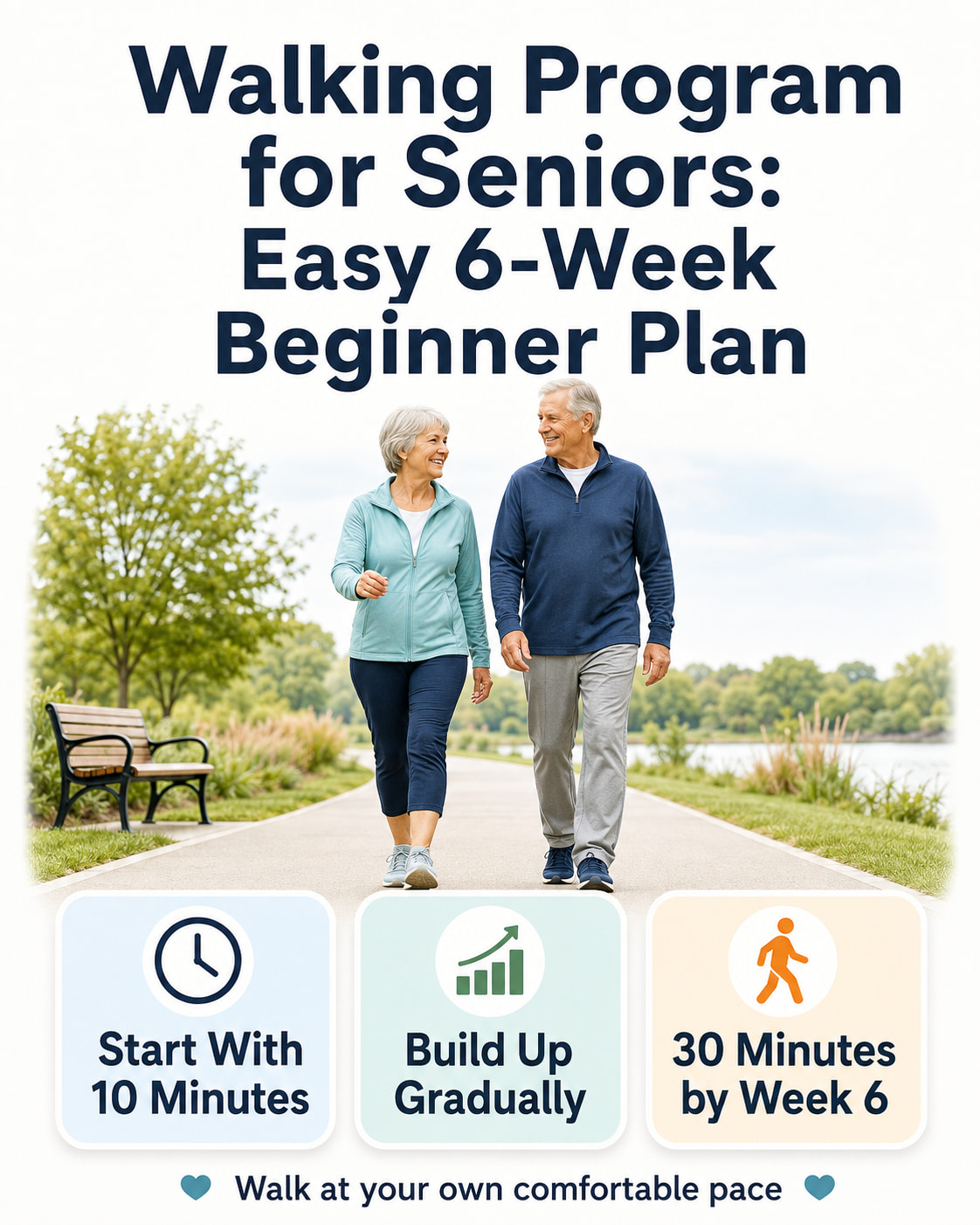
A beginner walking program for seniors can start with 10 minutes of comfortable walking four days a week and gradually build to 30 minutes five days a week by week six. Walk at your own pace, use a cane or walker if prescribed, and repeat any week that feels too difficult.
Current guidance from the Centers for Disease Control and Prevention recommends that adults age 65 and older work toward at least 150 minutes of moderate-intensity aerobic activity each week. Older adults should also include muscle-strengthening activities on at least two days and regular balance activities.
This six-week plan offers a gradual way to become more active without immediately attempting long or brisk walks. By week six, it provides 150 total walking minutes. However, only the minutes completed at a moderate intensity count toward the 150-minute moderate-intensity goal.
Walking Program for Seniors at a Glance
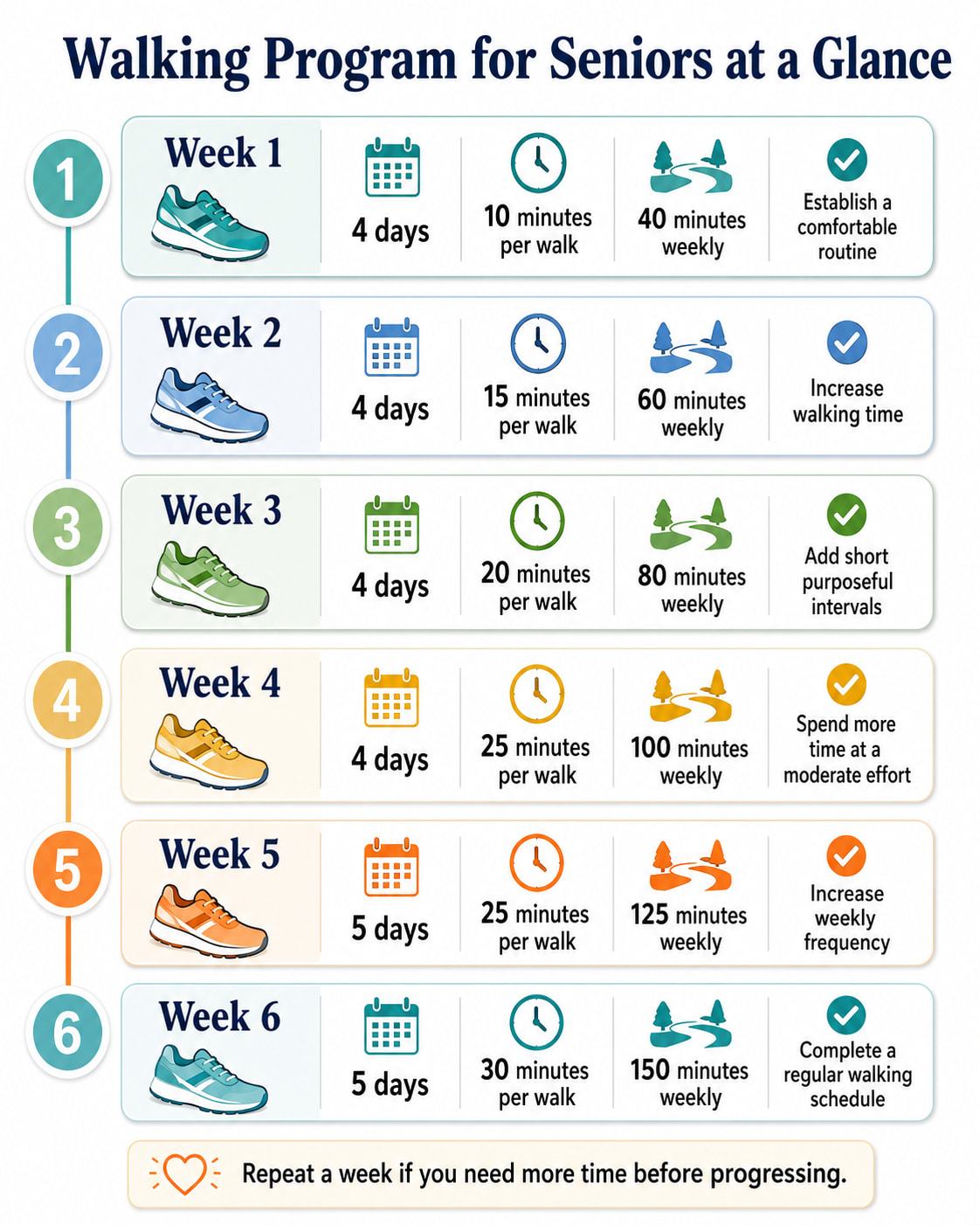
Use this schedule as a flexible starting point rather than a strict requirement.
| Week | Walking Days | Time per Walk | Weekly Total | Main Goal |
|---|---|---|---|---|
| Week 1 | 4 days | 10 minutes | 40 minutes | Establish a comfortable routine |
| Week 2 | 4 days | 15 minutes | 60 minutes | Increase walking time |
| Week 3 | 4 days | 20 minutes | 80 minutes | Add short purposeful intervals |
| Week 4 | 4 days | 25 minutes | 100 minutes | Spend more time at a moderate effort |
| Week 5 | 5 days | 25 minutes | 125 minutes | Increase weekly frequency |
| Week 6 | 5 days | 30 minutes | 150 minutes | Complete a regular walking schedule |
Possible walking days for weeks one through four are Monday, Tuesday, Thursday, and Saturday. In weeks five and six, add Friday or Sunday.
Rest days can include normal daily activities, gentle mobility movements, or appropriate strength and balance exercises. They do not require complete inactivity.
Who Is This Beginner Walking Plan For?
This walking program may be suitable for older adults who:
- Are beginning regular exercise
- Are returning after an inactive period
- Can currently walk for approximately five to ten minutes
- Want a structured but flexible walking schedule
- Walk independently or with a prescribed mobility aid
It is not a personalized rehabilitation plan. Someone recovering from surgery, a serious illness, a fracture, a stroke, or a recent hospitalization may need an individualized program from a physical therapist or other health care professional.
Before Starting a Walking Program
Moderate physical activity is generally safe for most people, including many people with chronic health conditions. Having arthritis, diabetes, high blood pressure, or heart disease does not automatically mean that walking is unsuitable.
Ask a health care professional how to adjust the plan if you have:
- A medical condition that limits your activity
- Chest discomfort or unexplained shortness of breath
- Frequent dizziness, fainting, or falls
- A recent operation, injury, or hospitalization
- New difficulty walking
- Significant foot, hip, knee, or back pain
- Instructions to limit exercise because of a heart or lung condition
The National Institute on Aging advises older adults with chronic conditions to choose activities that match their health, abilities, and medical guidance. Starting slowly is especially important after a period of inactivity.
What You Need
Walking requires little equipment, but a few preparations can make it safer and more comfortable:
- Supportive, properly fitting walking shoes
- Comfortable clothing suitable for the weather
- A watch, phone, or timer
- A level, familiar walking route
- A cane or walker when recommended
- Identification and a phone for outdoor walks
- Water when appropriate
Follow your clinician’s instructions about fluid intake if you have heart failure, kidney disease, or another condition requiring a fluid restriction.
How Hard Should Seniors Walk?
Walking intensity should be based on how the activity feels to you, not on another person’s speed.
Moderate-intensity activity is approximately a five or six on a zero-to-ten effort scale. At that level, your breathing and heart rate increase, but you can still talk. You would not be able to sing comfortably.
| Effort Level | How It Feels | When to Use It |
|---|---|---|
| Very easy | Breathing is relaxed and conversation is effortless | Beginning and end of each walk |
| Easy to comfortable | Breathing is slightly quicker, but talking remains easy | Weeks one and two |
| Moderate | You can talk but probably cannot sing | Purposeful intervals and main walking periods |
| Hard | Speaking requires pauses for breath | Not necessary in this beginner plan |
A pace that is moderate for one person may be easy or difficult for someone else. Hills, heat, medications, health conditions, and current fitness can all change how hard a walk feels.
Use Simple Walking Form
While walking:
- Look several steps ahead rather than down at your feet.
- Keep your shoulders relaxed.
- Let your arms swing naturally.
- Use short, comfortable steps.
- Avoid forcing a longer stride.
- Slow down when your posture or balance begins to change.
- Use your prescribed mobility aid throughout the walk.
Your goal is steady, controlled movement—not speed.
Walking Program for Seniors: The 6-Week Schedule
Week 1: Build the Walking Habit
- Schedule: Four 10-minute walks
- Weekly total: 40 minutes
- Effort: Easy
Keep the entire walk easy. Begin very slowly for two or three minutes, settle into a comfortable pace, and slow down again during the final two minutes.
You should finish feeling that you could have walked a little longer. The first week is about creating a routine, learning how your body responds, and identifying a safe route.
Repeat week one before progressing if ten minutes causes unusual fatigue, worsening joint pain, or difficulty maintaining a steady gait.
Week 2: Increase to 15 Minutes
- Schedule: Four 15-minute walks
- Weekly total: 60 minutes
- Effort: Easy to comfortable
Use this simple structure:
- First 5 minutes: Easy pace
- Middle 5 minutes: Comfortable, slightly more purposeful pace
- Final 5 minutes: Easy pace
It is fine to keep the entire walk easy. Consistency matters more than walking faster.
Your breathing should remain controlled, and you should be able to speak in complete sentences.
Week 3: Add Short Purposeful Intervals
- Schedule: Four 20-minute walks
- Weekly total: 80 minutes
- Effort: Mostly easy with brief moderate periods
Begin with five minutes of easy walking. During the middle of the walk, complete three one-minute intervals at a more purposeful pace. Walk easily for approximately two minutes between the faster intervals.
Finish at an easy pace.
A purposeful pace should make you breathe somewhat harder without causing gasping, dizziness, or loss of balance. Shorten the intervals to 30 seconds when one minute feels too difficult.
Week 4: Spend More Time at a Moderate Effort
- Schedule: Four 25-minute walks
- Weekly total: 100 minutes
- Effort: Easy to moderate
Try the following format:
- 5 minutes of easy walking
- 3 minutes at a purposeful pace
- 2 minutes at an easy pace
- Repeat the purposeful and easy intervals three times
- 5 minutes of easy walking
This gives you nine total minutes at a more purposeful pace. You can shorten those intervals or complete the middle portion entirely at a comfortable pace when needed.
Do not increase both speed and walking time aggressively. Completing the scheduled time safely is the main goal.
Week 5: Add a Fifth Walking Day
- Schedule: Five 25-minute walks
- Weekly total: 125 minutes
- Effort: Easy to moderate
Follow the same general session structure as week four, but add one walking day.
Because the additional day increases your total workload, you do not need to walk faster. Keep at least two of the five walks comfortable if your legs feel tired.
You can also divide a 25-minute session into two shorter walks, such as 10 minutes in the morning and 15 minutes later in the day. Short periods of activity can contribute to your weekly total.
Week 6: Reach 30-Minute Walks
- Schedule: Five 30-minute walks
- Weekly total: 150 minutes
- Effort: Easy to moderate
Use this structure:
- First 5 minutes: Easy warm-up pace
- Middle 20 minutes: Comfortable or moderate walking
- Final 5 minutes: Easy cooldown pace
During the middle portion, you can either maintain one steady, purposeful pace or alternate four minutes of moderate walking with one minute of easy walking.
The week-six schedule reaches 150 total walking minutes. Because the warm-up, recovery, and cooldown portions may be below moderate intensity, it does not necessarily provide 150 minutes of moderate-intensity exercise. Continue gradually increasing the purposeful portion after week six if reaching the full federal target is appropriate for you.
Warm Up and Cool Down Properly
Do not begin at your fastest pace or stop abruptly after a purposeful walk.
The American Heart Association recommends warming up and cooling down for approximately five to ten minutes. Walking slowly is an appropriate way to do both.
For the short walks in weeks one and two, much of the session may serve as a gentle warm-up. That is appropriate for a beginner.
After the walk, you may perform gentle calf or leg stretches while your muscles are warm. Stretch only to mild tension. Do not bounce or force a painful position.
How to Make Walking Safer
Choose a Suitable Route
A good beginner route should be:
- Level or only gently sloped
- Well lit
- Free from loose rugs, cords, ice, gravel, and broken pavement
- Close to benches or places to rest
- Familiar and easy to leave if you become tired
Use sidewalks or walking paths where possible and watch for uneven surfaces that may create tripping hazards.
Use an Indoor Backup Plan
Walk indoors when outdoor conditions are unsafe. Options include:
- A shopping mall
- A community center
- A long hallway
- An indoor track
- A treadmill with appropriate support
- Marching or walking laps at home
Move indoors during extreme heat, severe cold, heavy rain, icy conditions, or poor air quality.
Wear Secure Footwear
Choose shoes that:
- Fit securely at the heel
- Provide enough room for the toes
- Have nonslip soles
- Do not create rubbing or pressure
- Are securely tied or fastened
Backless slippers, smooth soles, and poorly fitting shoes can make walking less stable.
Keep Help Within Reach
Carry a charged phone and identification when walking outside. Walk with another person when you are unsteady, unfamiliar with the route, or concerned about falling.
A prescribed cane or walker should be used during exercise, not left behind in an attempt to make the walk more challenging.
How to Modify the Plan
| Situation | Practical Adjustment |
|---|---|
| Limited endurance | Divide one walk into two shorter sessions |
| Arthritis stiffness | Begin slowly and choose a flat, comfortable surface |
| Knee or hip discomfort | Reduce the duration, pace, or incline |
| Balance concerns | Use a prescribed aid and walk with a companion |
| Excessive fatigue | Repeat the current week or return to the previous week |
| Missed walking days | Resume the schedule without doubling the next walk |
| Bad weather | Walk indoors or march in place near stable support |
| Illness or an extended break | Restart at a lower level and rebuild gradually |
A mild sense of muscle use can be normal. Sharp pain, increasing joint swelling, or pain that changes the way you walk is a reason to stop and reassess.
How to Know When You Are Ready to Progress
Move to the next week when you can:
- Complete the scheduled walks without worsening pain
- Maintain stable posture and balance
- Recover normally after each session
- Speak comfortably at the planned effort
- Finish without feeling exhausted
Repeat the same week when you are not ready. Progressing slowly is not failure; it is part of building a sustainable walking habit.
Avoid adding extra time to make up for missed sessions. A sudden increase in walking volume may create more soreness without providing a meaningful advantage.
Add Strength and Balance Activities
Walking is primarily aerobic activity. It does not fully replace exercises designed to strengthen the major muscle groups or challenge balance.
Current recommendations for older adults include at least two days of muscle-strengthening activity and regular balance activities in addition to aerobic exercise. Examples may include:
- Sit-to-stands from a sturdy chair
- Wall push-ups
- Supported heel raises
- Resistance-band exercises
- Supported single-leg standing
- Heel-to-toe walking near a stable counter
Balance exercises should be performed near reliable support when needed. People with frequent falls, significant weakness, or a neurological condition may benefit from instruction from a physical therapist.
A combination of aerobic, strength, and balance activities may better support physical function and reduce fall risk than walking alone.
Track Your Walking Progress
A basic walking log can help you notice improvement and identify problems early.
| Date | Minutes | Effort | Symptoms | Recovery |
|---|---|---|---|---|
| Monday | 15 | Easy | None | Felt normal afterward |
| Tuesday | 15 | Comfortable | Mild stiffness at first | Improved during walk |
| Thursday | 15 | Easy | None | Good |
| Saturday | 15 | Comfortable | None | Good |
Track more than distance. Minutes, effort, comfort, balance, and recovery provide a more useful picture for beginners.
A step counter is optional. You do not need to reach 10,000 steps per day to benefit from walking. Current federal recommendations are based on weekly activity time and intensity rather than one universal daily step requirement.
When to Stop Walking
Stop the walk immediately if you experience:
- Chest pain, pressure, squeezing, or tightness
- Fainting or feeling as though you may faint
- Severe or unusual dizziness
- Unusual or extreme shortness of breath
- Nausea associated with exertion
- A new rapid, irregular, or pounding heartbeat
- Sudden weakness or loss of coordination
- Sharp pain that changes your walking pattern
Aerobic activity should not cause chest pressure, dizziness, or nausea.
Call 911 or your local emergency number for chest discomfort that is severe, lasts more than a few minutes, or occurs with shortness of breath, sweating, nausea, lightheadedness, or discomfort in the arm, back, neck, jaw, or stomach.
New but nonemergency symptoms should still be discussed with a health care professional before you resume the program.
What to Do After Week 6
After completing the plan, choose the next step that matches your abilities:
- Repeat week six until it feels comfortable.
- Gradually make more of each walk moderately intense.
- Keep one or two walks easy for recovery.
- Add a few minutes to one or two walks rather than increasing every session.
- Continue at a lower level if that is what your health and abilities allow.
- Include strength and balance activities during the week.
The goal is not to complete six weeks as quickly as possible. The goal is to create a routine you can continue safely.
Frequently Asked Questions
How many minutes should a senior walk each day?
Many older adults can work toward 30 minutes of moderate-intensity walking on five days each week. A beginner may need to start with five or ten minutes and build up gradually.
People who cannot reach 30 minutes can still benefit from shorter walks. The appropriate amount depends on health, mobility, symptoms, and current activity level.
Is walking 30 minutes a day enough for seniors?
Thirty minutes of moderate-intensity walking on five days provides 150 weekly aerobic minutes, meeting the general aerobic recommendation.
However, a complete activity routine should also include muscle-strengthening and balance activities. Walking should not be treated as a replacement for every other type of exercise.
What is a safe walking pace for an older adult?
A safe pace is one that allows stable posture, controlled breathing, and confident steps.
At a moderate pace, you should be able to talk but not sing. Slow down when you cannot speak comfortably, begin to lose balance, or develop unusual symptoms.
Can seniors divide one walk into shorter sessions?
Yes. A 30-minute daily total can be divided into shorter sessions, such as three 10-minute walks or two 15-minute walks.
This can be especially helpful for people with limited endurance, arthritis, fatigue, or a busy schedule.
Do seniors need to walk 10,000 steps every day?
No. Ten thousand steps is not a universal requirement.
The official U.S. activity target is based primarily on weekly minutes and intensity. Step counts can help track progress, but a realistic increase from your current level is more useful than pursuing an arbitrary number.
Is walking enough to improve balance?
Walking supports general mobility, leg use, and coordination, but it may not challenge balance in all the ways needed to reduce fall risk.
Include specific balance and strengthening activities appropriate for your ability. Use stable support or professional supervision when balance is limited.
What should I do if my knees or hips hurt while walking?
Slow down, shorten the walk, avoid hills, and choose a level surface. Do not continue through sharp pain or pain that changes your gait.
Persistent pain, swelling, instability, or worsening symptoms should be evaluated by a health care professional. A physical therapist may also help identify suitable walking modifications and strengthening exercises.
Conclusion
A walking program for seniors should begin at a manageable level and progress according to comfort, balance, and recovery. Start with four easy 10-minute walks, record how you feel, and increase the time only when the current week feels comfortable.
Consistency matters more than speed. A short walk completed safely is more valuable than a long walk that leaves you exhausted or in pain.
References
- American Heart Association — Warm Up, Cool Down
- Centers for Disease Control and Prevention — Older Adults: Adding Activity Recommendations
- Centers for Disease Control and Prevention — What Counts as Physical Activity for Older Adults
- National Institute on Aging — Exercising With Chronic Conditions
- National Institute on Aging — Exercising Outdoors: Safety Tips for Older Adults