
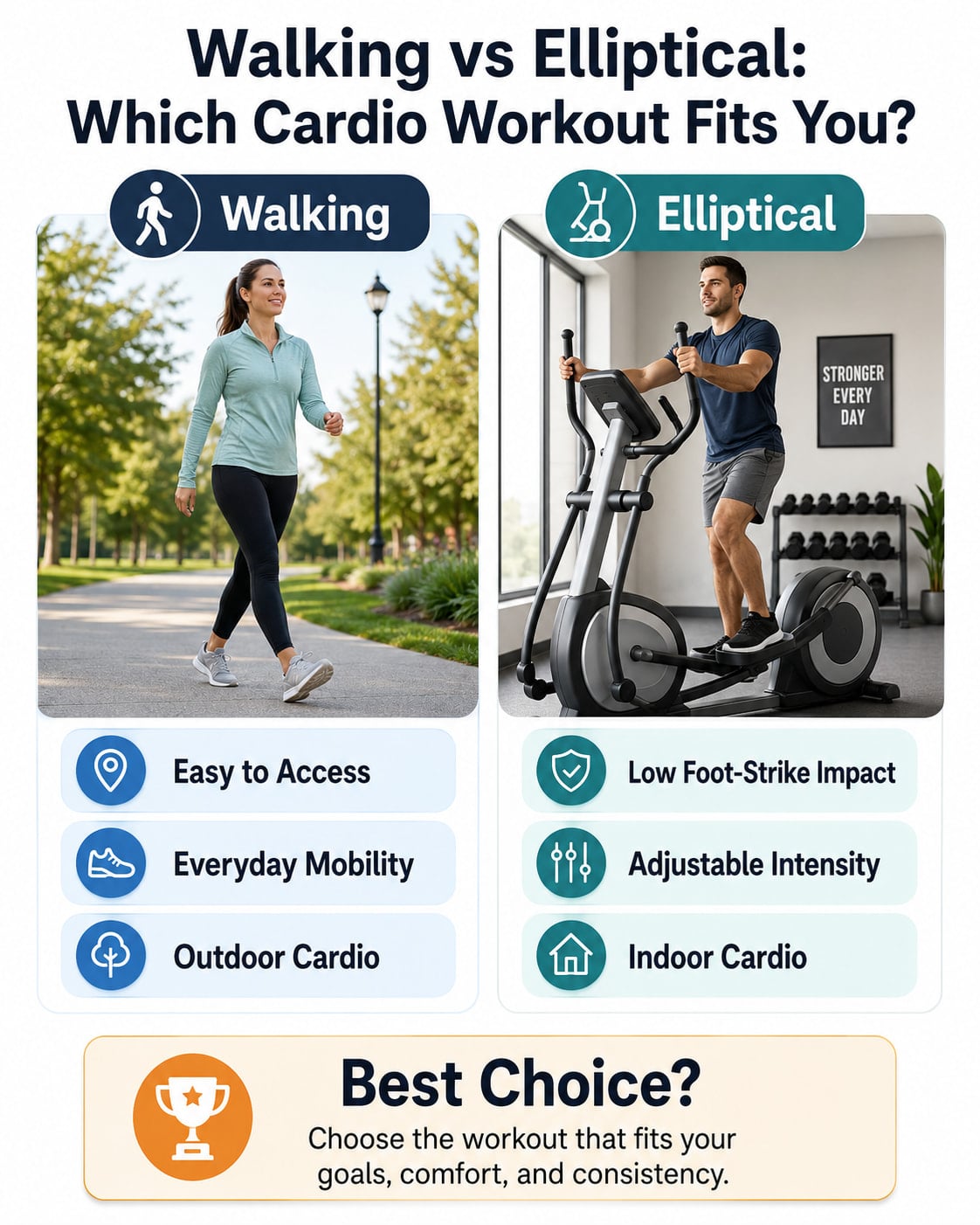
Walking is usually the better choice for convenience, everyday mobility, and outdoor exercise, while the elliptical is often better for a controlled, higher-intensity workout with less impact at foot strike. Both are effective forms of cardio, so the right choice depends on your goals, joint comfort, fitness level, and which activity you can perform consistently.
You do not have to choose one forever. Walking and elliptical workouts can both contribute to the current CDC physical activity recommendation of at least 150 minutes of moderate-intensity aerobic activity per week, along with muscle-strengthening exercise on at least two days.
Walking vs Elliptical at a Glance
| Comparison | Walking | Elliptical | Better Choice |
|---|---|---|---|
| Cost and accessibility | Usually free and available almost anywhere | Requires a machine or gym access | Walking |
| Foot-strike impact | Low impact, but each step contacts the ground | Feet remain supported by the pedals | Elliptical |
| Calorie-burning potential | Depends on speed, hills, and duration | Resistance and speed make vigorous exercise easier | Depends on intensity |
| Everyday mobility | Directly practices natural walking | Uses a guided movement pattern | Walking |
| Indoor convenience | Requires a treadmill during poor weather | Designed for controlled indoor exercise | Elliptical |
| Upper-body involvement | Natural arm swing | Moving handles can involve the arms | Elliptical |
| Cardiovascular fitness | Effective when performed briskly | Effective at moderate or vigorous intensity | Both |
| Bone-loading exercise | Low-impact, weight-bearing activity | Low-impact, weight-bearing activity | Both |
| Joint comfort | May suit people who prefer a natural stride | May suit people bothered by repeated foot strikes | Individual choice |
| Beginner friendliness | Very little learning curve | Requires basic setup and coordination | Walking |
The elliptical reduces repeated ground contact, but that does not make it automatically safer for every knee, hip, or back condition. Elliptical exercise generally involves greater hip and knee flexion than ordinary walking, so personal comfort matters more than the “low-impact” label.
How Walking and Elliptical Workouts Differ
Walking and elliptical training are both upright cardiovascular activities, but their movement patterns are not identical.
How Walking Works
Walking moves your body forward through a natural gait cycle. One foot pushes against the ground while the other swings forward.
You can change the difficulty by adjusting:
- Your walking speed
- The distance or duration
- Hill or treadmill incline
- Surface type
- Step frequency
- Added intervals
Walking also directly supports activities such as hiking, sightseeing, commuting, shopping, and moving around independently.
How an Elliptical Works
An elliptical guides your feet through a smooth, oval-shaped path. Because your feet remain on the pedals, there is no separate heel strike with every stride.
You can usually adjust:
- Pedaling speed
- Resistance
- Ramp incline
- Forward or reverse direction
- Upper-body effort through moving handles
This makes it easy to change intensity without having to walk faster outdoors or find a steep hill.
Walking vs Elliptical Calories: Which Burns More?
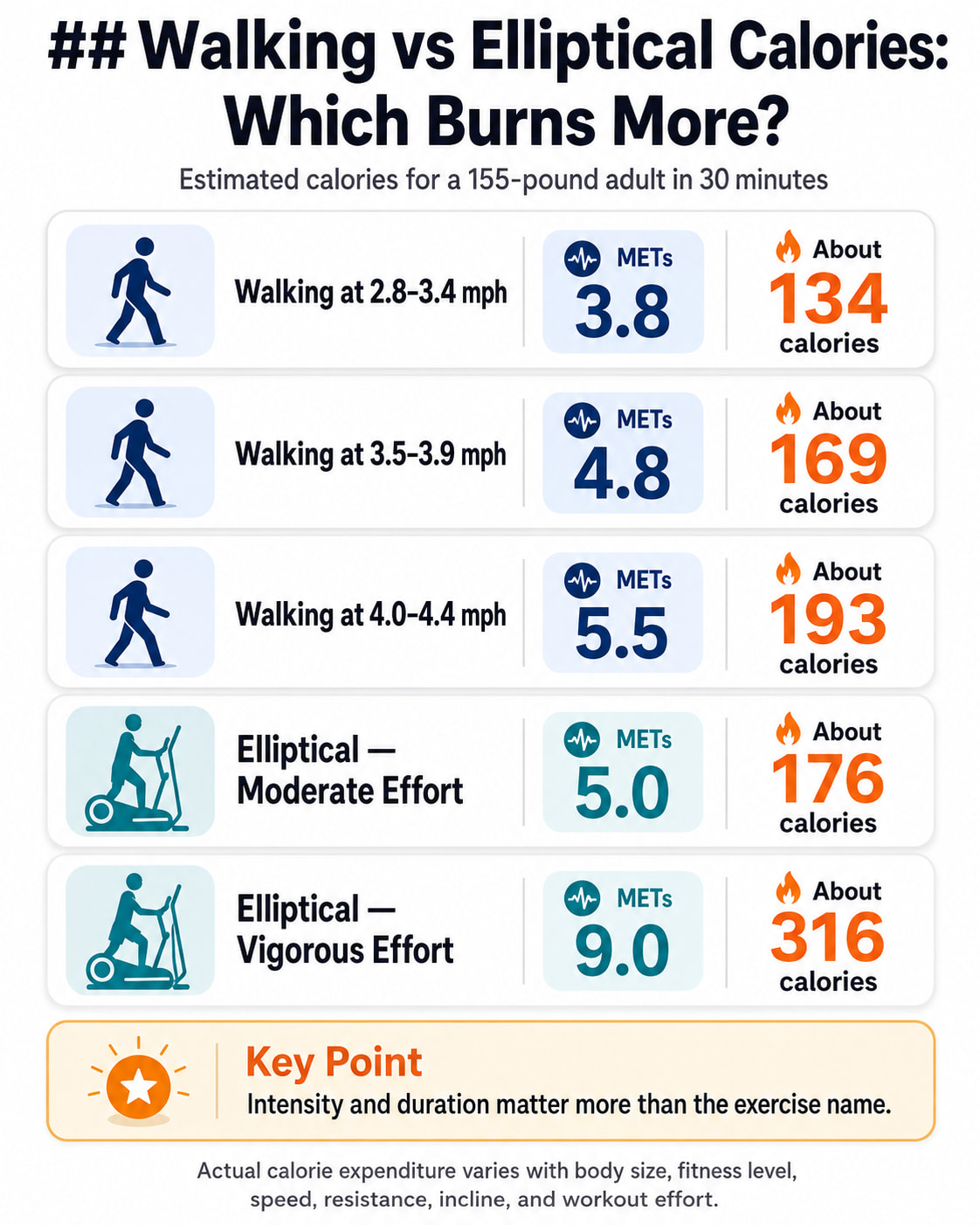
A vigorous elliptical workout will generally burn more calories than a comfortable walk, but brisk walking can closely match a moderate elliptical session.
The important comparison is effort versus effort. Comparing a casual walk with a hard elliptical interval workout will naturally favor the elliptical. Comparing brisk walking with moderate elliptical exercise produces a much smaller difference.
The 2024 Adult Compendium of Physical Activities lists moderate elliptical exercise at 5.0 metabolic equivalents, or METs, and vigorous elliptical exercise at 9.0 METs. Level walking ranges from 3.8 METs at 2.8–3.4 mph to 5.5 METs at 4.0–4.4 mph.
Estimated Calories Burned in 30 Minutes
The following estimates are for a 155-pound adult. They use the Compendium’s approximation that one MET equals about one calorie per kilogram of body weight per hour.
| Activity | MET Value | Estimated Calories in 30 Minutes |
|---|---|---|
| Walking at 2.8–3.4 mph | 3.8 | About 134 |
| Walking at 3.5–3.9 mph | 4.8 | About 169 |
| Walking at 4.0–4.4 mph | 5.5 | About 193 |
| Elliptical at moderate effort | 5.0 | About 176 |
| Elliptical at vigorous effort | 9.0 | About 316 |
These numbers are estimates, not guaranteed results. Your actual calorie expenditure depends on your body size, workout duration, pace, resistance, incline, fitness level, and how actively you use the elliptical handles.
A vigorous rating also means genuinely hard exercise. Simply selecting a high resistance level while moving slowly or leaning heavily on the handles may not produce the same energy expenditure.
Calorie-Burning Verdict
Choose the elliptical when you want to reach a higher intensity in a limited amount of time. Choose walking when you are more likely to exercise longer, go out more frequently, or remain active throughout the day.
A 25-minute elliptical workout does not necessarily burn more weekly calories than five 40-minute walks. Your total activity across the week matters more than which machine you use in one session.
Is Walking or the Elliptical Better for Weight Loss?
Neither activity has a special weight-loss advantage. The better option is the one that helps you complete enough exercise consistently while maintaining an appropriate eating pattern.
A 2024 systematic review and dose-response meta-analysis included 116 randomized clinical trials and 6,880 adults with overweight or obesity. Greater amounts of weekly aerobic exercise were associated with progressively larger reductions in body weight, waist circumference, and body-fat measurements through approximately 300 minutes per week. The researchers concluded that more than 150 minutes of moderate-intensity aerobic exercise per week may be needed for clinically important changes in waist circumference and body fat.
This does not mean everyone must immediately exercise for 300 minutes. Beginners can start with shorter sessions and gradually increase their weekly total.
For practical weight management:
- Build toward at least 150 minutes of moderate-intensity cardio per week.
- Increase your time gradually if your goals and recovery allow.
- Include strength training at least twice per week.
- Choose eating habits you can maintain rather than relying only on exercise.
- Track weekly consistency instead of focusing on one workout’s calorie display.
Does Walking or the Elliptical Burn More Belly Fat?
Neither exercise selectively removes fat from the stomach.
Walking and elliptical workouts may support reductions in total and abdominal fat when they contribute to a sustained energy deficit. The 2024 meta-analysis found that aerobic exercise was associated with reductions in waist circumference and both visceral and subcutaneous fat, but the results were related to overall aerobic exercise volume—not one specific cardio machine.
Is the Elliptical Better Than Walking for Your Knees?
The elliptical usually produces less impact at foot strike, but it is not automatically better for every knee problem.
A biomechanical study comparing elliptical exercise with level walking found lower loading rates during elliptical exercise. However, the elliptical also produced greater hip, knee, and ankle flexion, along with greater hip-flexor and knee-extensor moments. In simple terms, the pedals reduce landing impact, but your knees and hips still have to work throughout the movement.
This distinction matters because different problems respond differently:
| Situation | Option That May Feel Better | Important Consideration |
|---|---|---|
| Foot or heel discomfort from repeated ground contact | Elliptical | Feet remain supported by the pedals |
| Discomfort during deep or repeated knee bending | Level walking | Elliptical motion may involve greater knee flexion |
| Arthritis | Either | Choose an activity that causes little or no additional pain |
| Poor balance | Depends | Elliptical handles may help, but getting on and off can be difficult |
| Recent lower-body injury | Individualized plan | Ask a healthcare professional or physical therapist |
| Pain that worsens during exercise | Neither until assessed | Do not continue forcing the painful movement |
The CDC classifies brisk walking as a joint-friendly activity and recommends choosing exercise that is enjoyable, accessible, causes little or no pain, and can be maintained over time.
Low Impact Does Not Mean No Impact or No Joint Load
An elliptical still places body weight and muscular force through your legs. Increasing resistance or ramp incline can also increase the effort required from your quadriceps, glutes, and other lower-body muscles.
Start with low resistance and a comfortable stride. Stop increasing the difficulty if your movement becomes jerky, your heels repeatedly lift from the pedals, or discomfort builds with each minute.
Muscles Worked by Walking and the Elliptical
Both exercises work the lower body, but they emphasize the muscles differently.
| Muscle Area | Walking | Elliptical |
|---|---|---|
| Quadriceps | Active, especially during hills | Often strongly involved |
| Glutes | Used for hip extension and propulsion | Often emphasized, especially with resistance or incline |
| Hamstrings | Assist with hip movement and knee control | Assist through the guided stride |
| Calves | Important for pushing off the ground | Active, but often less emphasized than during walking |
| Muscles at the front of the shin | Help lift and control the foot | Generally less active because the foot stays supported |
| Core | Supports upright posture | Supports posture and controls body movement |
| Arms and upper back | Natural arm swing | Moving handles can add upper-body involvement |
Research comparing muscle activation found greater gluteus maximus and vastus lateralis activity during elliptical exercise than during walking. Walking produced greater activation in several lower-leg muscles, including the gastrocnemius, soleus, and tibialis anterior. Elliptical training also involved greater flexion through the trunk, hips, and knees.
Another small study found greater rectus femoris activity and greater quadriceps–hamstring coactivation during elliptical training than during overground or treadmill walking. However, the study involved only 10 healthy young adults, so the findings should not be treated as a universal rule for every person or machine.
Does an Elliptical Count as an Upper-Body Workout?
Moving handles can involve your arms, shoulders, chest, and upper back, especially when you actively push and pull instead of allowing your legs to do all the work.
However, elliptical training is still primarily cardiovascular exercise. It does not replace structured strength training for your chest, back, shoulders, and arms.
Which Is Better for Cardiovascular Fitness?
Both walking and elliptical exercise can improve cardiovascular fitness when the workout is long and challenging enough.
The elliptical often makes vigorous exercise more accessible because you can quickly increase resistance, incline, and speed. Walking can also become demanding when you walk briskly, climb hills, use a treadmill incline, or perform intervals.
A simple way to monitor intensity is the talk test:
- Moderate intensity: You can talk but not comfortably sing.
- Vigorous intensity: You can say only a few words before pausing for breath.
The CDC also describes moderate intensity as roughly a 5 or 6 on a 0–10 effort scale and vigorous intensity as approximately a 7 or 8. The same walking pace can feel easy to a trained person and challenging to a beginner, so intensity should be judged relative to your fitness level.
Cardio Fitness Verdict
Choose brisk walking when you enjoy outdoor exercise, want to improve walking endurance, or prefer longer steady sessions.
Choose the elliptical when you want controlled intervals, quick resistance changes, or a vigorous workout without repeated foot strikes.
Which Is Better for Beginners?
Walking is the best starting choice for many beginners because it is familiar, accessible, and easy to adjust.
You can begin with five or ten minutes and increase your time without learning how to operate a machine. Walking can also be divided into several short sessions throughout the day.
The elliptical may be a better starting option when:
- Outdoor conditions are unsafe or uncomfortable.
- Foot strike makes walking uncomfortable.
- You prefer exercising in a controlled indoor environment.
- You want adjustable resistance without moving faster.
- You feel stable and comfortable using the machine.
Beginners using an elliptical should start at low resistance. Spend the first few sessions learning the movement rather than trying to maximize speed or calories.
Walking vs Elliptical for Older Adults
Neither option is automatically best for every older adult.
Walking has strong practical value because it directly supports everyday mobility. It can also be performed socially and does not require gym access.
An elliptical may provide a smoother option for someone who dislikes repeated ground contact. The handles may offer support, but mounting the pedals, starting the machine, and stepping off can be challenging for a person with poor balance or limited mobility.
Adults 65 and older are advised to include aerobic activity, muscle-strengthening exercise, and balance activities during the week. Neither walking nor elliptical exercise alone provides every part of that recommendation.
Older adults should choose the exercise they can perform with controlled posture and little or no additional pain. Anyone with a history of falls, significant balance limitations, osteoporosis-related fractures, or a recent joint replacement may benefit from individualized guidance.
Which Is Better for Bone Health?
Walking and elliptical training are both classified as low-impact, weight-bearing activities because you remain upright and support your weight against gravity.
The Bone Health and Osteoporosis Foundation includes both fast walking and elliptical machines among low-impact weight-bearing options. It also recommends muscle-strengthening activities, such as lifting weights, using resistance bands, or performing body-weight movements.
Neither cardio option should be treated as a complete bone-health program. Resistance exercise provides an additional stimulus to muscles and bones, while balance training can be particularly important for reducing fall risk in older adults.
People with osteoporosis or a history of fractures should ask a qualified healthcare professional which impact levels and movements are appropriate.
Walking vs Elliptical: How to Choose Based on Your Goal
| Your Main Goal | Recommended Choice |
|---|---|
| Increase daily movement | Walking |
| Improve walking endurance | Walking |
| Prepare for hiking or a walking event | Walking |
| Exercise outdoors | Walking |
| Start cardio without a gym | Walking |
| Reduce repeated foot-strike impact | Elliptical |
| Perform controlled indoor intervals | Elliptical |
| Reach vigorous intensity quickly | Elliptical |
| Exercise during extreme weather | Elliptical |
| Support weight management | Either or both |
| Improve cardiovascular fitness | Either or both |
| Find an exercise for joint discomfort | Whichever remains comfortable |
| Avoid boredom | Combine both |
Your answer may also depend on what you enjoy. A theoretically ideal workout provides little benefit if you dislike it enough to skip most sessions.
Can You Combine Walking and Elliptical Workouts?
Yes. Combining the two may be more practical than trying to select one permanent winner.
A mixed routine can:
- Add variety to your week.
- Make indoor and outdoor exercise possible.
- Reduce boredom.
- Change the movement demands placed on your legs.
- Allow both steady cardio and harder intervals.
- Help you continue exercising when weather changes.
Example Balanced Week
| Day | Activity |
|---|---|
| Monday | 30-minute brisk walk |
| Tuesday | Full-body strength training |
| Wednesday | 25-minute elliptical workout |
| Thursday | Rest or an easy 15-minute walk |
| Friday | 30-minute brisk or hill walk |
| Saturday | Strength training and 15–20 minutes of easy cardio |
| Sunday | Rest, mobility work, or a comfortable recreational walk |
This is only an example. Adjust the days, duration, and intensity to match your schedule, current ability, and recovery.
Beginner Walking Workout
25-Minute Steady Walking Session
Warm-up: 5 minutes
Walk at a relaxed pace. Allow your breathing and body temperature to increase gradually.
Main workout: 15 minutes
Walk at a moderate intensity. You should be able to talk, but singing should feel difficult.
Cooldown: 5 minutes
Slow your pace until your breathing begins returning toward normal.
Complete this workout three times per week. When it feels comfortable, add approximately five minutes to one or two sessions.
Beginner Elliptical Workout
25-Minute Steady Elliptical Session
Warm-up: 5 minutes
Use low resistance and a comfortable speed. Focus on smooth, controlled movement.
Main workout: 15 minutes
Increase resistance slightly until your effort feels moderate. Maintain an upright torso and keep your feet in contact with the pedals.
Cooldown: 5 minutes
Reduce resistance and gradually slow your pace.
During your first few sessions, avoid increasing speed and resistance at the same time. Change one variable at a time so you can evaluate how your body responds.
Walking or Elliptical Interval Workout
Once you have established a basic fitness foundation, intervals can make either activity more challenging.
28-Minute Beginner Interval Session
- Warm up for 5 minutes at an easy pace.
- Exercise for 1 minute at a harder but controlled effort.
- Recover for 2 minutes at a comfortable pace.
- Repeat the harder and easier periods six times.
- Cool down for 5 minutes.
For walking, increase your speed or use a gentle hill. On an elliptical, increase resistance, speed, or incline—but not necessarily all three at once.
Form and Safety Tips
Walking Form Tips
- Keep your head up and look ahead.
- Let your shoulders remain relaxed.
- Use a natural stride instead of forcing long steps.
- Allow your arms to swing comfortably.
- Wear supportive footwear appropriate for the surface.
- Begin on a flat, predictable route if you are new to exercise.
- Use reflective clothing or lighting when walking in low visibility.
Elliptical Form Tips
- Place your feet securely and keep them in contact with the pedals.
- Stand tall rather than leaning heavily on the handles.
- Keep a slight, comfortable bend in your knees.
- Use a controlled pace without bouncing.
- Push and pull the moving handles when you want upper-body involvement.
- Start with low resistance and increase it gradually.
- Slow the pedals before getting off the machine.
Stop exercising if you develop pain, extreme shortness of breath, dizziness, or symptoms that feel unusual for you. MedlinePlus also recommends starting slowly and speaking with a healthcare provider when health concerns may affect exercise safety.
Limits of Walking vs Elliptical Research
Direct studies comparing walking and elliptical exercise are limited. Many involved small groups of healthy adults, evaluated only short laboratory sessions, or tested a limited number of elliptical models.
Machine design also matters. Stride length, pedal spacing, ramp angle, resistance, handle position, and speed can change how an elliptical affects your posture and muscles. One elliptical may feel comfortable while another does not.
For that reason, research can identify general differences, but it cannot determine which exercise will be safest or most enjoyable for every individual.
Frequently Asked Questions
Is an elliptical better than walking for weight loss?
Not automatically. An elliptical may help you reach a higher intensity in less time, but walking may be easier to perform more often and for longer periods. Weekly exercise volume, workout intensity, eating patterns, and consistency determine the overall result.
Is 30 minutes on an elliptical equal to 30 minutes of walking?
There is no exact conversion. According to 2024 Compendium estimates, moderate elliptical exercise at 5.0 METs is similar in energy demand to brisk walking at 4.8 METs. Vigorous elliptical exercise at 9.0 METs is considerably more demanding than ordinary level walking.
Which burns more calories, walking or an elliptical?
A hard elliptical workout usually burns more calories per minute than a comfortable walk. However, very brisk or uphill walking can equal or exceed a moderate elliptical workout. Duration and intensity must be considered together.
Is an elliptical better than walking for bad knees?
It may feel better when foot-strike impact causes discomfort, but elliptical exercise requires repeated knee bending and substantial quadriceps involvement. Level walking may feel better for someone who dislikes deeper knee flexion. The safest choice is the activity that can be performed with controlled movement and little or no increased pain.
Does the elliptical burn belly fat?
The elliptical can contribute to overall fat loss when combined with sufficient weekly exercise and an appropriate eating pattern, but it cannot specifically target stomach fat. Walking works in the same general way.
Is walking or the elliptical better for older adults?
Walking may be better for functional mobility and accessibility. The elliptical may be useful for controlled indoor cardio with less foot-strike impact. Balance, joint comfort, machine access, and the ability to get on and off safely should guide the decision.
Can you walk or use an elliptical every day?
Many people can perform easy or moderate cardio frequently if they recover well and remain comfortable. However, every session does not need to be hard. Alternate easier and more challenging days, and reduce your workload if soreness, fatigue, or joint discomfort continues to increase.
Conclusion
In the walking vs elliptical comparison, there is no universal winner. Walking is the stronger all-around option for accessibility, outdoor activity, everyday mobility, and walking-specific endurance. The elliptical is the stronger option for indoor intervals, adjustable resistance, and cardio with less foot-strike impact.
For weight management and cardiovascular fitness, the activity you perform consistently will usually be more valuable than the one that appears better on paper.
Start with a comfortable 20- to 30-minute session, monitor how your body responds, and gradually build toward the recommended weekly activity target. You can also combine walking and elliptical workouts to gain the practical benefits of both.
References
- CDC: Current Physical Activity Recommendations
- CDC: How to Measure Physical Activity Intensity
- CDC: Joint-Friendly Physical Activity for Arthritis
- 2024 Adult Compendium: Conditioning Exercise MET Values
- 2024 Adult Compendium: Walking MET Values
- Aerobic Exercise and Weight Loss in Adults: Systematic Review and Dose-Response Meta-Analysis
- Joint Loading in the Lower Extremities During Elliptical Exercise
- Similarity of Joint Kinematics and Muscle Demands Between Elliptical Training and Walking
- Comparison of Elliptical Training and Walking Muscle Activation Patterns
- Bone Health and Osteoporosis Foundation: Weight-Bearing and Muscle-Strengthening Exercise
- MedlinePlus: Exercise and Physical Fitness