
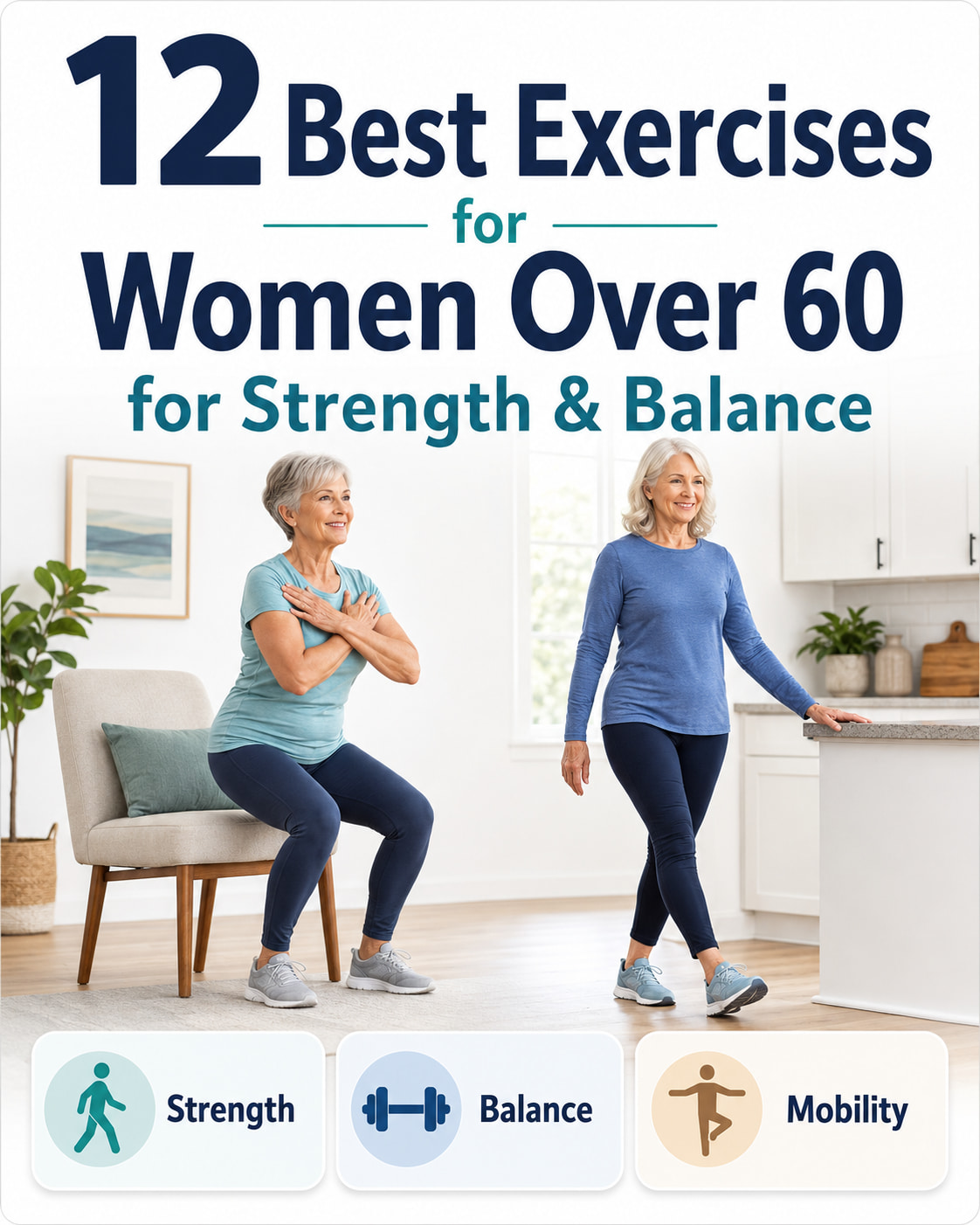
The best exercises for women over 60 combine strength training, balance practice, and moderate aerobic activity. Chair sit-to-stands, wall push-ups, resistance-band rows, step-ups, heel raises, supported balance exercises, and brisk walking create a practical full-body routine without requiring complicated equipment.
Women ages 60–64 can follow the general adult activity guidelines, while adults 65 and older are specifically advised to include balance training. The Centers for Disease Control and Prevention recommends at least 150 minutes of moderate-intensity aerobic activity each week, muscle-strengthening exercise on at least two days, and balance activities for adults 65 and older.
You do not need to complete all 12 exercises in one workout. Choose movements that match your current ability, use support when needed, and build up gradually.
Exercises for Women Over 60 at a Glance
The following targets are general starting points, not rigid requirements. Begin with less if you are new to exercise or returning after a long break.
| Exercise | Best for | Equipment | Beginner target |
|---|---|---|---|
| Brisk walking | Cardiovascular endurance and weight-bearing activity | Supportive shoes | 10–30 minutes |
| Chair sit-to-stand | Leg strength and getting up from chairs | Sturdy chair | 1–2 sets of 6–12 |
| Wall push-up | Chest, shoulder, and arm strength | Wall | 1–2 sets of 8–12 |
| Resistance-band row | Upper-back and arm strength | Resistance band | 1–2 sets of 8–15 |
| Low step-up | Stair climbing and single-leg control | Low step and railing | 1–2 sets of 6–10 per side |
| Standing hip abduction | Side-hip strength and stability | Chair or counter | 1–2 sets of 8–12 per side |
| Supported heel raise | Calf, ankle, and balance training | Chair or counter | 1–2 sets of 10–15 |
| Glute bridge | Glute and hip strength | Mat or firm bed | 1–2 sets of 8–12 |
| Bird dog | Core stability and coordination | Mat or wall | 1–2 sets of 5–8 per side |
| Tandem stance | Supported static balance | Counter or chair | 2 holds of 10–30 seconds |
| Supported single-leg stand | Single-leg balance | Counter or chair | 2 holds of 5–20 seconds |
| Heel-to-toe walk | Dynamic balance and foot control | Wall or counter | 2–4 passes of 5–10 steps |
Why Strength and Balance Matter After 60
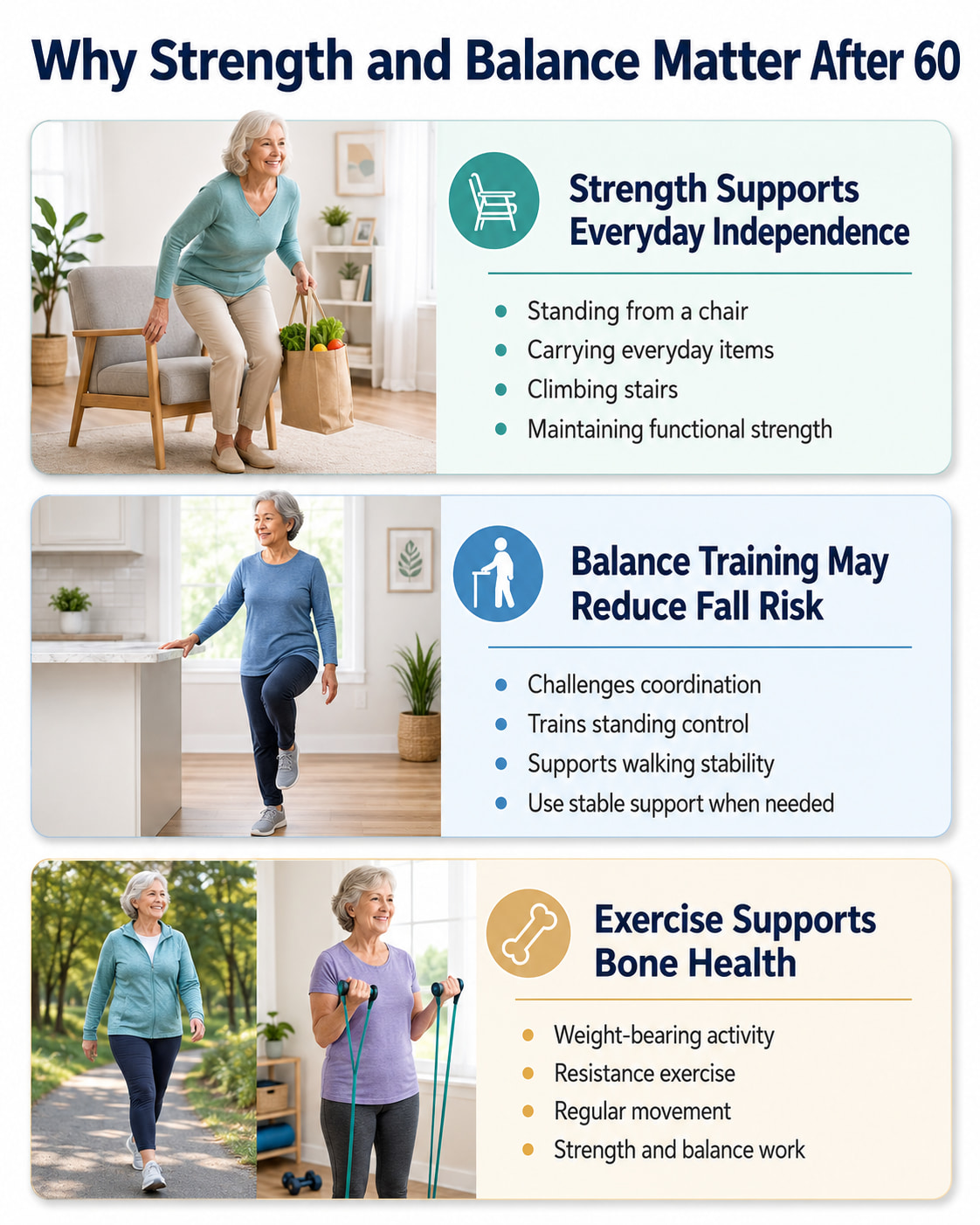
Strength Supports Everyday Independence
Strength is involved in almost every daily task, including standing from a chair, carrying groceries, climbing stairs, opening doors, and getting up from the floor.
The American College of Sports Medicine updated its resistance-training guidance in March 2026. Its central message is that consistency matters more than complicated programming. For generally healthy adults, training the major muscle groups at least twice per week is more important than finding a supposedly perfect routine. Bodyweight exercises, resistance bands, and home workouts can all provide meaningful benefits.
Balance Training May Reduce Fall Risk
Balance involves coordinated work from your legs, hips, trunk, vision, and inner-ear system. It can be challenged while standing still, changing direction, stepping over objects, or walking on uneven ground.
The U.S. Preventive Services Task Force recommends exercise interventions for community-dwelling adults age 65 and older who have an increased risk of falling. The programs studied most often included gait, functional movement, balance, and resistance training.
Anyone with recent falls, severe unsteadiness, or difficulty walking should seek individualized guidance rather than attempting unsupported balance exercises alone.
Exercise Supports Bone Health
Bone loss accelerates after menopause as estrogen levels decline. Weight-bearing activities such as walking and resistance exercises provide useful mechanical loading while strengthening the muscles that support movement.
The Office on Women’s Health identifies regular weight-bearing activity as an important part of maintaining bone health.
A separate January 2025 recommendation from the U.S. Preventive Services Task Force advises osteoporosis screening for all women age 65 and older. It also recommends screening postmenopausal women younger than 65 when a clinical risk assessment identifies increased fracture risk.
Before Starting These Exercises
Use the following precautions to make your routine safer and more manageable:
- Exercise on a dry, uncluttered surface.
- Use a sturdy chair that does not roll or slide.
- Wear supportive shoes for standing exercises.
- Keep a counter, railing, or wall within reach during balance work.
- Begin with a comfortable range of motion.
- Move slowly enough to remain in control.
- Exhale during the difficult part of a strength exercise instead of holding your breath.
- Stop an exercise that causes sharp, increasing, or unfamiliar pain.
Spend a few minutes warming up with easy walking, marching in place, shoulder rolls, ankle movements, and gentle practice repetitions.
Talk with a healthcare professional or physical therapist before beginning when you have a recent operation or fracture, significant balance problems, frequent falls, an unstable medical condition, or osteoporosis with a high fracture risk. The Bone Health & Osteoporosis Foundation recommends starting slowly and using a pain-free range of motion, particularly after a long period without regular exercise.
Stop exercising and seek appropriate help if activity causes chest pain or pressure, dizziness, nausea, faintness, or extreme shortness of breath. These symptoms should not be treated as normal workout discomfort. MedlinePlus provides additional general guidance on exercise and physical fitness safety.
12 Best Exercises for Women Over 60
The exercises below cover aerobic fitness, lower- and upper-body strength, core stability, and balance. Start with four to six movements rather than trying to master everything at once.
1. Brisk Walking
Why it works: Walking develops cardiovascular endurance and provides low-impact, weight-bearing activity. It is also easy to divide into shorter sessions throughout the day.
Muscles worked: Quadriceps, glutes, hamstrings, calves, and muscles around the ankles and feet.
How to do it:
- Stand tall with your eyes looking ahead.
- Walk at a pace that feels purposeful but controlled.
- Let your arms swing naturally without forcing the movement.
- Keep your steps comfortable rather than reaching far in front.
- Slow down gradually at the end of the walk.
Trainer Tip: Begin with 5–10 minutes if 30 minutes feels unrealistic. Add a few minutes as your endurance improves. Indoor hallways, shopping centers, and treadmills with accessible handrails can be useful alternatives during poor weather.
2. Chair Sit-to-Stand
Why it works: This exercise directly trains the movement used to rise from a chair, toilet, or car seat. It strengthens the legs while also practicing controlled sitting.
Muscles worked: Quadriceps, gluteus maximus, hamstrings, calves, and core.
How to do it:
- Place a sturdy chair against a wall.
- Sit near the front with your feet approximately hip-width apart.
- Lean forward slightly from your hips while keeping your back comfortably neutral.
- Press through both feet and stand tall.
- Push your hips back and lower slowly to the chair.
Trainer Tip: Use the armrests or place your hands on your thighs when assistance is needed. Progress by using less hand support, slowing the lowering phase, or holding a light weight near your chest.
3. Wall Push-Up
Why it works: Wall push-ups train upper-body pushing strength with less resistance than floor push-ups. This makes them easier to adjust for beginners.
Muscles worked: Chest, triceps, front shoulders, and core stabilizers.
How to do it:
- Face a wall and place your hands slightly wider than shoulder-width.
- Step back until your arms are straight and your body forms a gentle angle.
- Bend your elbows and bring your chest toward the wall.
- Keep your body aligned without allowing your hips to sag.
- Press through your hands and return to the starting position.
Trainer Tip: Standing closer to the wall makes the exercise easier. Move farther away as you become stronger. A countertop push-up is a harder progression because it places your body at a lower angle.
4. Resistance-Band Row
Why it works: Rows strengthen the upper back and arms, helping balance the pushing work from wall push-ups. They also train the pulling pattern used when opening doors or drawing objects toward you.
Muscles worked: Latissimus dorsi, rhomboids, middle trapezius, rear shoulders, and biceps.
How to do it:
- Attach the band to a secure anchor according to its manufacturer’s instructions.
- Hold one end in each hand with your arms extended.
- Stand or sit tall with your shoulders relaxed.
- Pull your elbows back until your hands approach your ribs.
- Pause briefly, then return slowly without letting the band snap forward.
Trainer Tip: Keep your torso still and avoid shrugging your shoulders. Use a lighter band if you need to lean backward to complete the repetition.
5. Low Step-Up
Why it works: Step-ups train the strength and control needed for curbs, stairs, and changes in elevation. Each leg works separately, which also adds a balance challenge.
Muscles worked: Quadriceps, glutes, hamstrings, calves, and hip stabilizers.
How to do it:
- Stand in front of a low step with a railing or counter nearby.
- Place your entire right foot on the step.
- Press through that foot and stand on the step.
- Bring the other foot up lightly without pushing hard from the floor.
- Step down slowly and repeat before changing sides.
Trainer Tip: Start with the bottom stair or a low aerobic step. Hold the railing as much as necessary. A higher step is not automatically better; choose a height that allows controlled movement without pulling yourself up.
6. Standing Hip Abduction
Why it works: This movement strengthens the side of the hip, which contributes to pelvic control when you stand on one leg or take a step.
Muscles worked: Gluteus medius, gluteus minimus, and other hip stabilizers.
How to do it:
- Stand tall and hold a counter or sturdy chair.
- Keep both feet pointing forward.
- Shift your weight onto one leg without leaning.
- Move the other leg a short distance out to the side.
- Lower it slowly and complete the repetitions before changing sides.
Trainer Tip: A small, controlled movement is enough. If your torso leans or your toes turn upward, reduce the range. Add a light resistance band only after bodyweight repetitions feel stable.
7. Supported Heel Raise
Why it works: Heel raises strengthen the calves and ankles, which contribute to walking, stair climbing, and balance corrections.
Muscles worked: Gastrocnemius, soleus, and smaller foot and ankle muscles.
How to do it:
- Stand behind a counter or chair with your feet approximately hip-width apart.
- Keep your knees straight but not rigidly locked.
- Rise onto the balls of both feet.
- Pause briefly at the top.
- Lower your heels slowly to the floor.
Trainer Tip: Begin with both hands on the support. Progress to one hand or light fingertip contact only when you remain steady. Keep support available even after your balance improves.
8. Glute Bridge
Why it works: Glute bridges train the hips without requiring standing balance. They can be useful for people who need a supported way to strengthen the glutes and posterior chain.
Muscles worked: Glutes, hamstrings, and trunk stabilizers.
How to do it:
- Lie on your back with your knees bent and feet flat.
- Place your feet approximately hip-width apart.
- Gently brace your abdomen.
- Press through your feet and lift your hips.
- Stop before your lower back arches, then lower slowly.
Trainer Tip: Focus on lifting with your hips rather than forcing a high position. When getting to the floor is difficult, use a firm bed if it is safe to access, or replace the bridge with supported standing hip extensions.
9. Bird Dog
Why it works: Bird dogs train trunk stability, hip control, shoulder stability, and coordination between opposite sides of the body.
Muscles worked: Core, spinal stabilizers, glutes, upper back, and shoulder stabilizers.
How to do it:
- Begin on your hands and knees with your back comfortably neutral.
- Brace your trunk without holding your breath.
- Extend one leg behind you.
- Add the opposite arm only when you can keep your hips level.
- Return slowly and repeat on the other side.
Trainer Tip: Start by moving only one arm or one leg. For a standing alternative, place both hands on a wall and extend one leg behind you while reaching the opposite arm upward or forward.
10. Tandem Stance
Why it works: Placing one foot directly or almost directly in front of the other narrows your base of support. This challenges balance without requiring you to stand on one leg.
Muscles worked: Ankle, calf, hip, and core stabilizers.
How to do it:
- Stand beside a counter or behind a sturdy chair.
- Place one foot in front of the other.
- Begin with a small space between the feet if needed.
- Stand tall and hold the position for 10–30 seconds.
- Change which foot is in front.
Trainer Tip: Start with a semi-tandem position, where the front heel is beside rather than directly in front of the back toes. Gradually narrow the position as your control improves.
11. Supported Single-Leg Stand
Why it works: Walking, climbing stairs, and stepping over objects all require brief periods of support on one leg. This exercise practices that skill in a controlled setting.
Muscles worked: Gluteus medius, calves, ankle stabilizers, and core.
How to do it:
- Stand behind a stable counter with both hands available for support.
- Shift your weight onto one leg.
- Lift the other foot slightly from the floor.
- Keep your hips level and your standing knee softly extended.
- Hold briefly, lower the foot, and change sides.
Trainer Tip: The lifted foot only needs to clear the floor. Start with 5-second holds and full hand support. Reduce support gradually, but do not remove it when there is a meaningful risk of falling.
12. Heel-to-Toe Walk
Why it works: Heel-to-toe walking adds movement to a narrow balance position. It trains controlled foot placement and coordination while moving forward.
Muscles worked: Calves, ankles, hips, thighs, and core stabilizers.
How to do it:
- Stand beside a wall or counter.
- Place one foot in front of the other so the front heel approaches the back toes.
- Shift your weight forward carefully.
- Take another controlled heel-to-toe step.
- Continue for 5–10 steps, then turn around safely.
Trainer Tip: Keep your fingertips close to the support. If exact heel-to-toe placement is too difficult, leave a small space between the feet or use a slightly wider line.
How Often Should Women Over 60 Exercise?
A balanced weekly routine includes aerobic activity, strength training, and balance practice.
Aerobic Exercise
Build toward at least 150 minutes of moderate-intensity activity each week. This can be divided into manageable sessions, such as:
- 30 minutes on five days
- 20–25 minutes on most days
- Several shorter walks accumulated throughout the day
A moderate pace should increase your breathing while still allowing you to speak in sentences.
Strength Training
Train the major muscle groups on at least two nonconsecutive days each week. A beginner can start with one set of each exercise and progress toward two or three sets.
You do not need to perform all 12 movements during each strength workout. A session with five or six well-chosen exercises can cover the major areas of the body.
Balance Training
Practice balance exercises at least several times per week. Short sessions are useful because balance work does not need to be exhausting.
Complete balance exercises near a stable support and stop before fatigue causes your control to deteriorate.
Beginner Weekly Strength and Balance Plan
This schedule is an example that can be adjusted around your health, energy, and current activity level.
| Day | Activity |
|---|---|
| Monday | Strength Workout A and 5 minutes of supported balance |
| Tuesday | 10–30-minute walk |
| Wednesday | Rest, easy walking, or gentle mobility |
| Thursday | Strength Workout B and 5 minutes of supported balance |
| Friday | 10–30-minute walk |
| Saturday | Optional walk and short balance practice |
| Sunday | Rest or light daily activity |
Strength Workout A
Perform 1–2 sets of each exercise:
- Chair sit-to-stand
- Wall push-up
- Resistance-band row
- Standing hip abduction
- Supported heel raise
Finish with tandem stance or heel-to-toe walking.
Strength Workout B
Perform 1–2 sets of each exercise:
- Low step-up
- Wall push-up
- Resistance-band row
- Glute bridge
- Bird dog
Finish with supported single-leg stands.
How to Choose the Right Exercise Difficulty
The exercise should feel challenging enough to require effort but not so difficult that your technique changes.
For strength exercises, choose a variation or resistance that allows you to:
- Complete each repetition without rushing
- Keep your joints and trunk controlled
- Finish with approximately two or three good repetitions still possible
- Breathe normally throughout the set
- Repeat the exercise with similar form after resting
A fixed dumbbell weight is not appropriate for every woman over 60. Strength, exercise experience, joint comfort, medical history, and the specific movement all affect how much resistance is suitable.
How to Progress Safely
Progress only one part of the routine at a time.
A sensible order is:
- Improve exercise technique.
- Add a few repetitions.
- Add a second set.
- Increase the range of motion when comfortable.
- Use slightly more resistance.
- Progress to a harder exercise variation.
For balance exercises, progress by narrowing your stance, increasing the hold slightly, or using less hand pressure. Do not progress by moving far away from your support.
Rest long enough to repeat the next set with steady technique. For many beginners, approximately 60–120 seconds between strength sets is reasonable, but additional rest is appropriate when needed.
Exercise Modifications for Common Concerns
| Concern | Practical adjustment |
|---|---|
| Knee discomfort | Use a higher chair, reduce squat depth, choose a lower step, and move slowly |
| Limited balance | Use two hands for support and prioritize seated or lying exercises |
| Difficulty getting on the floor | Use standing bird dogs, standing hip extensions, or a safe firm-bed option |
| Wrist discomfort | Perform wall push-ups more upright or use a comfortable hand position |
| Shoulder discomfort | Reduce push-up depth and use a lighter resistance band for rows |
| Low endurance | Use shorter walks and one set per exercise |
| Unequal leg strength | Begin with the weaker side and use the same controlled volume on both sides |
Exercise should not be used to push through sharp pain. If symptoms repeatedly return, a physical therapist or other qualified healthcare professional can help identify appropriate movements and modifications.
Exercise Considerations for Osteoporosis
Women with osteoporosis can often remain active, but exercise selection may need to account for bone density, previous fractures, posture, and fall risk.
Weight-bearing activities, strength training, balance work, and functional exercises may all be useful. However, people with previous spinal fractures or a high risk of fracture may need to avoid or modify:
- Forceful forward bending from the waist
- Rapid or loaded spinal twisting
- Heavy lifting beyond their current ability
- High-impact movements
- Exercises with a substantial fall risk
These restrictions are not identical for every person. Individual advice from a physical therapist or healthcare professional is preferable to removing all challenging exercise. The Bone Health & Osteoporosis Foundation emphasizes correct positioning and individualized guidance for people with osteoporosis or elevated fracture risk.
FAQs About Exercises for Women Over 60
What are the best exercises for a woman over 60?
A useful routine combines lower-body strength, upper-body strength, balance, core stability, and aerobic activity. Chair sit-to-stands, wall push-ups, band rows, low step-ups, hip abductions, heel raises, supported balance exercises, and walking provide a practical starting point.
The best personal choices are the exercises you can perform consistently without unsafe balance loss or worsening pain.
How often should a woman over 60 strength train?
Most women can aim for at least two strength-training sessions per week, preferably on nonconsecutive days. Each session should cover the major muscle groups.
Beginners can start with one set per exercise and add a second set when recovery and technique remain good.
Can women build muscle after age 60?
Yes. Resistance training can improve strength, muscle function, and physical performance during later adulthood. Progress depends on training consistency, appropriate resistance, recovery, nutrition, health status, and individual response.
Advanced equipment or training methods are not required. Bodyweight exercises, bands, machines, and free weights can all be effective when they provide an appropriate challenge.
Is walking enough exercise for women over 60?
Walking is an excellent form of aerobic and weight-bearing activity, but it does not fully replace strength or balance training.
A complete routine should also include exercises for the legs, hips, chest, back, arms, core, and balance. Adding two short strength sessions and several brief balance practices makes a walking program more complete.
How much weight should a 60-year-old woman lift?
There is no universal starting weight. Use a weight or resistance that allows controlled repetitions without joint pain, breath-holding, or major changes in technique.
The final repetitions should feel challenging, but you should not need to strain to failure. Increase the resistance gradually after you can complete the top of your repetition range comfortably.
What are the safest balance exercises for older women?
Supported tandem stands, heel raises, single-leg stands, and heel-to-toe walking are accessible options because they can be performed beside a counter or sturdy chair.
A balance exercise should feel mildly challenging, not as though a fall is likely. Women with repeated falls, dizziness, or severe unsteadiness should seek professional assessment before practicing independently.
Which exercises should women with osteoporosis avoid?
The answer depends on fracture history and individual risk. Women with osteoporosis—particularly those with spinal fractures—may need to modify high-impact exercise, forceful forward spinal bending, rapid twisting, heavy lifting, and activities with a high chance of falling.
A physical therapist can help preserve the benefits of strength and balance training while adapting unsafe movements.
Conclusion
Exercises for women over 60 do not need to be intense or complicated to be worthwhile. A consistent routine built around walking, basic strength movements, and supported balance practice can help maintain strength, mobility, and confidence in daily activities.
Start with four to six exercises, complete them with controlled technique, and schedule two manageable strength sessions this week. Add repetitions, resistance, or duration gradually as the movements become easier.
References
- Centers for Disease Control and Prevention — Older Adults: Adding Activity Recommendations
- American College of Sports Medicine — 2026 Resistance Training Guidelines
- U.S. Preventive Services Task Force — Falls Prevention in Community-Dwelling Older Adults
- U.S. Preventive Services Task Force — Osteoporosis Screening
- Office on Women’s Health — Osteoporosis
- Bone Health & Osteoporosis Foundation — Exercise and Safe Movement
- National Institute on Aging — Exercise and Physical Activity