
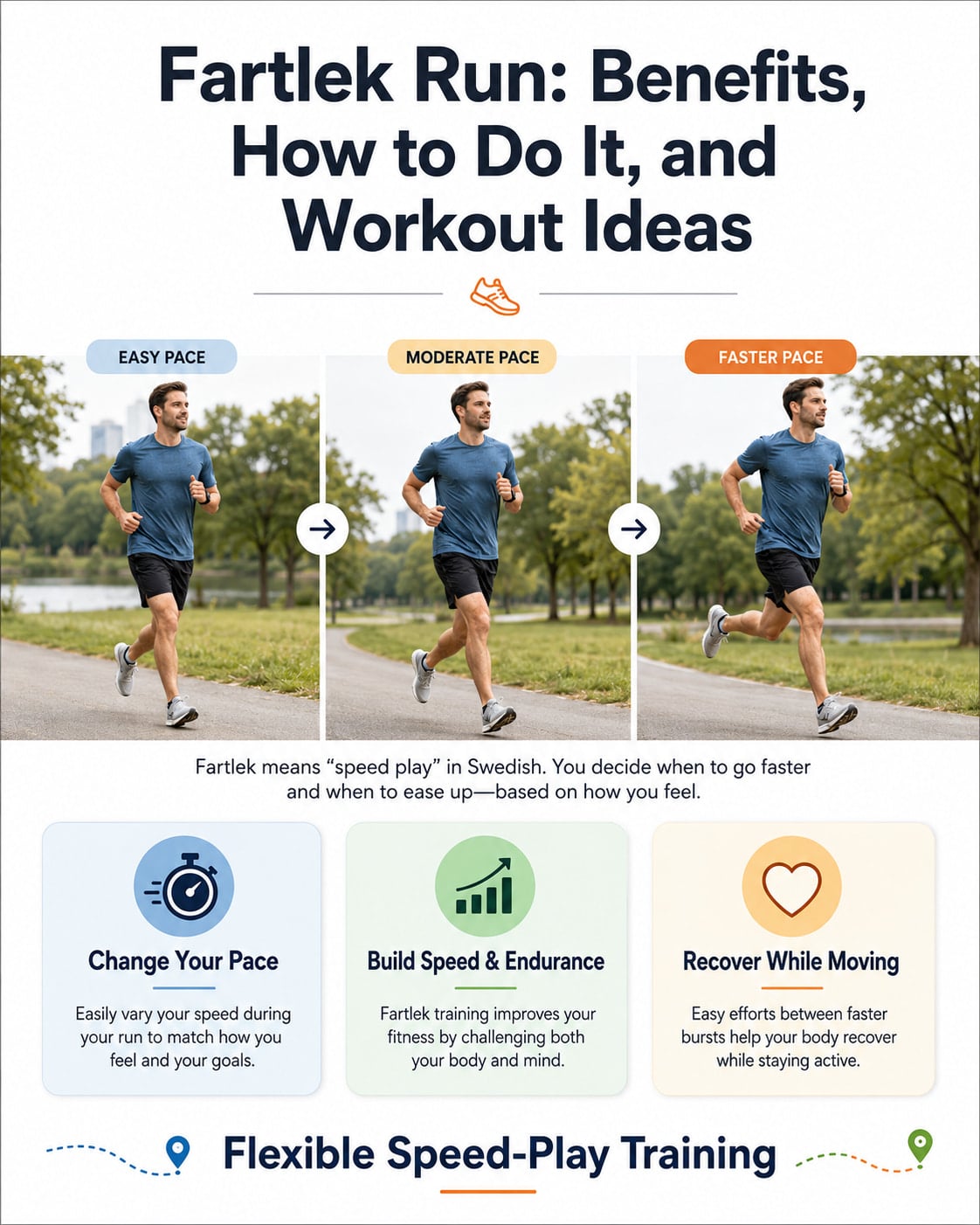
A fartlek run is a continuous running workout that alternates faster efforts with easy jogging or walking. It provides a flexible way to work on speed, endurance, and pace control without following the rigid distances and recovery periods used in traditional interval training.
“Fartlek” is a Swedish term meaning “speed play.” During a fartlek workout, you can change pace according to time, terrain, landmarks, or how you feel. You might run quickly to the next streetlight, jog for two minutes, accelerate up a hill, and then return to an easy pace.
You do not need to sprint during every fast section. For most recreational runners, controlled surges at a challenging but sustainable effort are safer and more useful than repeated all-out sprints.
Fartlek Run at a Glance
| Workout feature | General starting point |
|---|---|
| Main purpose | Speed endurance, pace control, and workout variety |
| Fast-section effort | About 6–8 out of 10 |
| Recovery effort | About 2–4 out of 10 |
| Beginner main set | Approximately 10–15 minutes |
| Starting frequency | Once per week |
| Recovery style | Easy jogging or walking |
| Equipment | Running shoes; a timer is optional |
These are starting ideas rather than fixed rules. Your experience, health, weekly mileage, goals, and recovery should guide the final workout.
What Is a Fartlek Run?
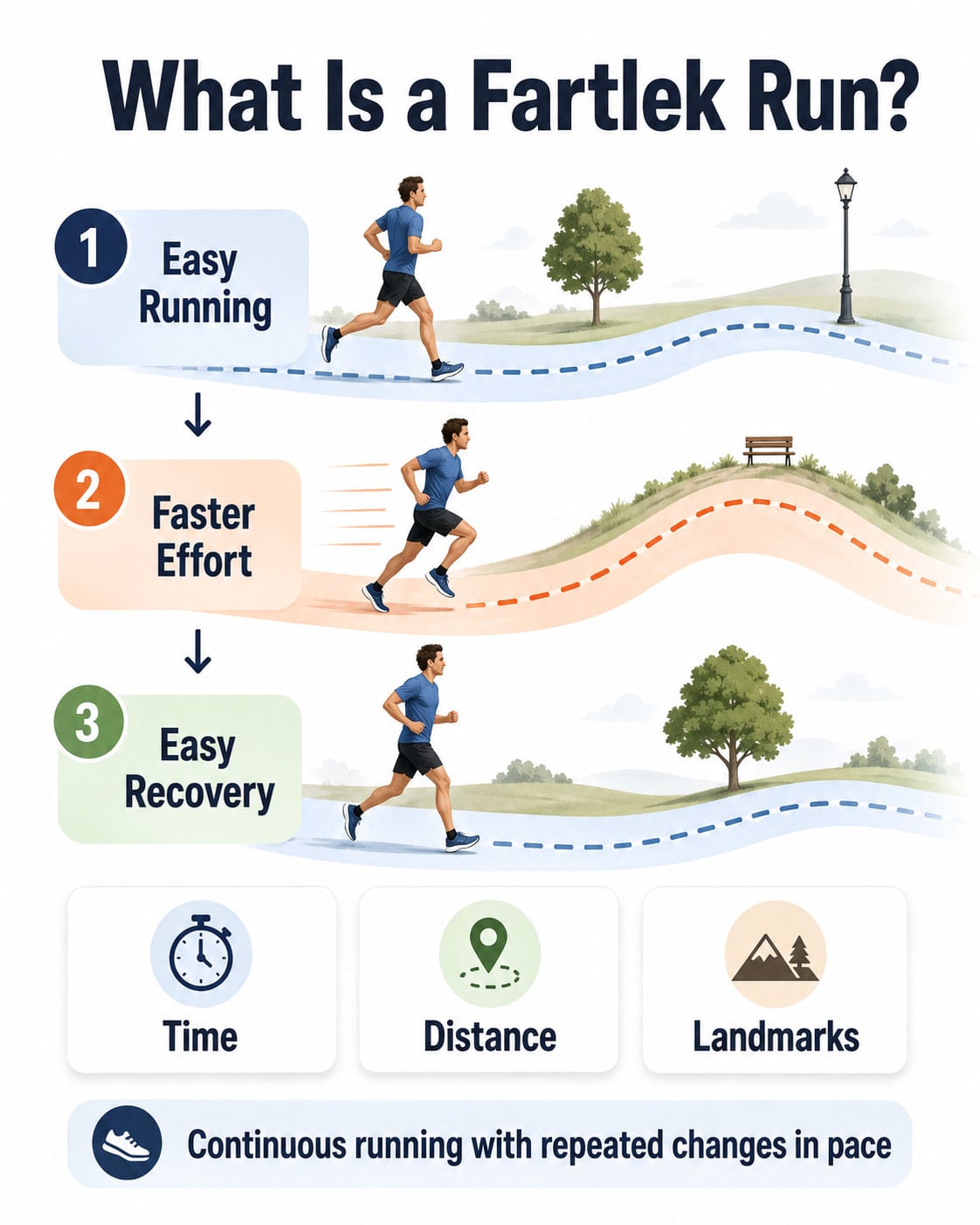
A fartlek run blends continuous running with repeated changes in speed. Instead of stopping completely between faster efforts, you normally continue moving at an easier pace.
The National Strength and Conditioning Association’s fartlek training guide describes fartlek training as variable-paced exercise that alternates faster and slower bouts. The faster sections can be planned, while the pace may also be selected according to how the runner feels.
A fartlek workout can be:
- Unstructured: Run faster to a tree, sign, hilltop, or other landmark.
- Time-based: Alternate one minute fast with two minutes easy.
- Distance-based: Run faster for one block or 400 meters.
- Terrain-based: Increase effort on hills and recover on flatter ground.
- Partly structured: Follow a general plan but adjust the pace or recovery as needed.
Traditional fartlek training uses active recovery, such as easy jogging. Beginners may use brisk walking when necessary. The important feature is the repeated change between harder and easier movement.
Fartlek Run Benefits
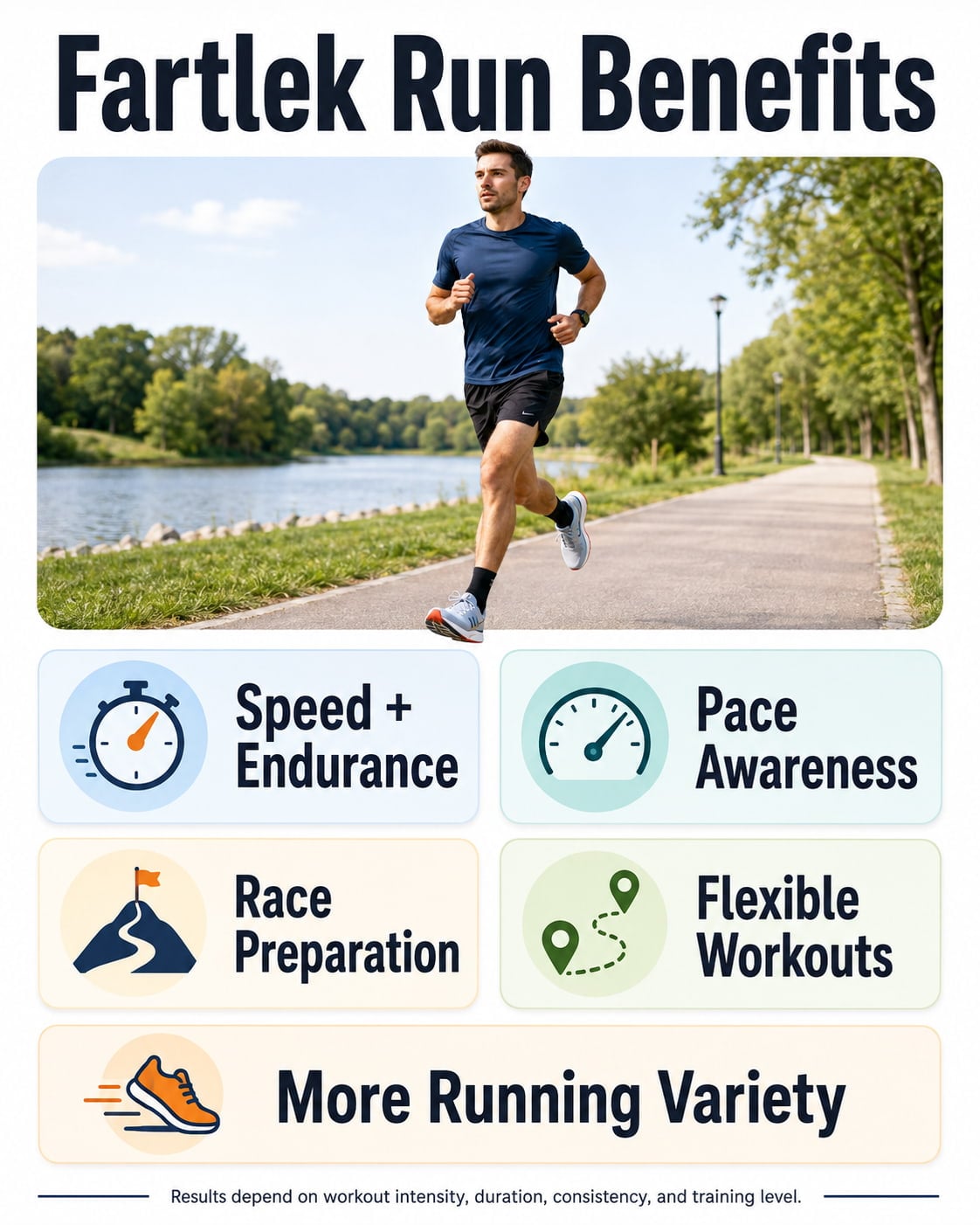
The results of any running workout depend on its intensity, duration, frequency, and how well it fits into the rest of your training. When programmed appropriately, fartlek running may provide several practical benefits.
Trains Speed and Endurance Together
The easier portions of a fartlek keep you moving aerobically, while the faster surges increase the demand on your heart, lungs, and working muscles.
Longer, controlled surges emphasize aerobic endurance. Shorter, harder efforts place more demand on your ability to produce and maintain speed. A single fartlek session can therefore expose you to several effort levels without requiring a track.
The NSCA notes that fartlek programming can be adjusted to emphasize different energy systems by changing the speed, duration, and recovery of each effort.
Improves Pace Awareness
Many runners have difficulty recognizing the difference between an easy pace, a steady pace, and a hard but controlled pace.
Fartlek training gives you repeated opportunities to change effort and notice how each intensity affects your breathing, stride, and fatigue. Over time, this may help you make better pacing decisions during races, hills, and group runs.
Prepares You for Changing Race Conditions
Race pace is not always perfectly steady. Hills, turns, crowds, wind, terrain, and competitors can force you to speed up or slow down.
Fartlek running practices these changes. You learn to increase your effort, recover while continuing to move, and then accelerate again.
This can be particularly useful for:
- 5K and 10K races
- Cross-country running
- Trail running
- Hilly road races
- Team sports with repeated accelerations
Makes Speed Training More Flexible
Traditional interval sessions often require a measured course, track, or carefully programmed watch. A fartlek run can be completed almost anywhere.
You can use:
- Trees
- Mailboxes
- Streetlights
- Hills
- Music
- A simple timer
- Perceived effort
This flexibility also makes it easier to shorten or extend a recovery period when weather, terrain, or fatigue changes during the run.
Adds Variety to a Running Routine
Repeating the same easy route at the same speed can become monotonous. Fartlek training adds decisions and pace changes that may make a familiar route feel different.
Enjoyment is personal, but runners who dislike highly structured track workouts may find speed play more approachable.
May Improve Fitness and Running Performance
A 2026 review published in the Bulletin of Rehabilitation Medicine selected 23 studies from 145 records. The included programs generally lasted four to 12 weeks and used two to four fartlek sessions per week. The review reported positive findings for endurance, speed, agility, and coordination across several athletic populations.
However, the researchers also emphasized important limitations. Study designs, protocols, sample sizes, sports, and participants varied considerably. Most interventions were short, and many participants were athletes rather than new recreational runners. The findings support fartlek as a useful training option, but they do not prove that every fartlek workout produces the same results.
A separate trial examined a structured 10-20-30 speed workout in 18 moderately trained runners. After seven weeks, the training group’s VO₂max was 4% higher, while average 1,500-meter and 5K times improved by 21 and 48 seconds, respectively. Weekly running volume was also reduced by 54%.
That study was small and tested a specific high-intensity protocol. It should not be interpreted as a guarantee that every runner will experience the same improvements.
Fartlek vs. Interval and Tempo Running
Fartlek, interval, and tempo workouts all include faster running, but their structures are different.
| Feature | Fartlek run | Interval workout | Tempo run |
|---|---|---|---|
| Structure | Flexible or partly planned | Usually precisely planned | Mostly continuous and steady |
| Fast efforts | Change by time, distance, terrain, or feel | Follow a target time, distance, or pace | One longer controlled-hard effort |
| Recovery | Usually easy jogging; walking may be used | Jogging, walking, or complete rest | Normally no recovery during the main effort |
| Pace | Can vary throughout the workout | Usually consistent across repetitions | Relatively steady |
| Main advantage | Variety and pace adaptability | Precise speed or performance training | Sustaining a comfortably hard pace |
| Typical setting | Roads, trails, hills, or treadmill | Track, road, hill, or treadmill | Road, track, or treadmill |
Fartlek and high-intensity interval training can overlap, but they are not automatically the same. A fartlek containing moderate surges may not reach HIIT intensity. A session using repeated near-maximal efforts may closely resemble HIIT.
How to Do a Fartlek Run
A basic fartlek session has three parts: an easy warm-up, alternating fast and easy segments, and a cooldown.
1. Choose a Safe Route
Begin on a familiar route with predictable footing. A level road, running path, park loop, or treadmill makes it easier to control your first few sessions.
Avoid planning hard surges across busy intersections, steep downhill sections, broken pavement, or crowded paths.
2. Warm Up at an Easy Pace
Start with at least five to 10 minutes of easy walking or jogging. Extend the warm-up to 10–15 minutes when you need more time to feel loose and comfortable.
You may also add a few controlled dynamic movements, such as:
- Ankle circles
- Leg swings
- Marching
- Walking lunges
- Two or three short relaxed accelerations
The warm-up should gradually raise your breathing rate without creating fatigue. The NSCA recommends beginning fartlek training with a steady warm-up jog and ending with easy movement.
3. Begin Your First Fast Segment
Increase your pace smoothly rather than suddenly sprinting.
For a beginner, a fast section may last:
- 20–30 seconds
- One short block
- The distance between two streetlights
- A short, gentle hill
Aim for a controlled effort. Your posture and stride should remain stable, and you should feel capable of completing the remaining repetitions.
4. Recover at an Easy Pace
Slow to an easy jog or walk after each faster effort.
The recovery should allow your breathing to settle and your running form to feel controlled again. You do not need to wait until you feel completely rested, but you should not begin the next surge while still struggling from the previous one.
5. Repeat the Fast and Easy Sections
Beginners can start with four to six faster efforts. Experienced runners may complete more repetitions or use longer work periods.
Keep the first few efforts conservative. A common mistake is running the first repetition too fast and then slowing dramatically during the rest of the workout.
6. Cool Down
Finish with five to 10 minutes of easy jogging or walking.
Your breathing should gradually return toward normal. Do not end a hard repetition and stop abruptly unless pain, weakness, or another concerning symptom requires you to stop.
How Hard Should a Fartlek Run Feel?
Pace varies between runners, so effort and breathing are often more useful than a fixed speed.
The Physical Activity Guidelines for Americans uses a simple talk test. During moderate activity, you can talk but not sing. During vigorous activity, you generally cannot say more than a few words without pausing for breath.
| Segment | Effort out of 10 | Breathing and talk test |
|---|---|---|
| Warm-up | 2–3 | Easy conversation |
| Easy recovery | 2–4 | Full sentences |
| Steady surge | 5–6 | Short sentences |
| Fast surge | 7–8 | Only a few words |
| All-out sprint | 9–10 | Not normally needed |
Most recreational fartlek sessions should use fast segments around 6–8 out of 10. Save near-maximal sprinting for carefully programmed sessions and runners with an appropriate training background.
Your fastest sustainable effort will also change with:
- Hills
- Heat and humidity
- Wind
- Sleep
- Recent training
- Running surface
- Current fitness
Run by effort when conditions make your normal pace unusually difficult.
6 Fartlek Workout Ideas
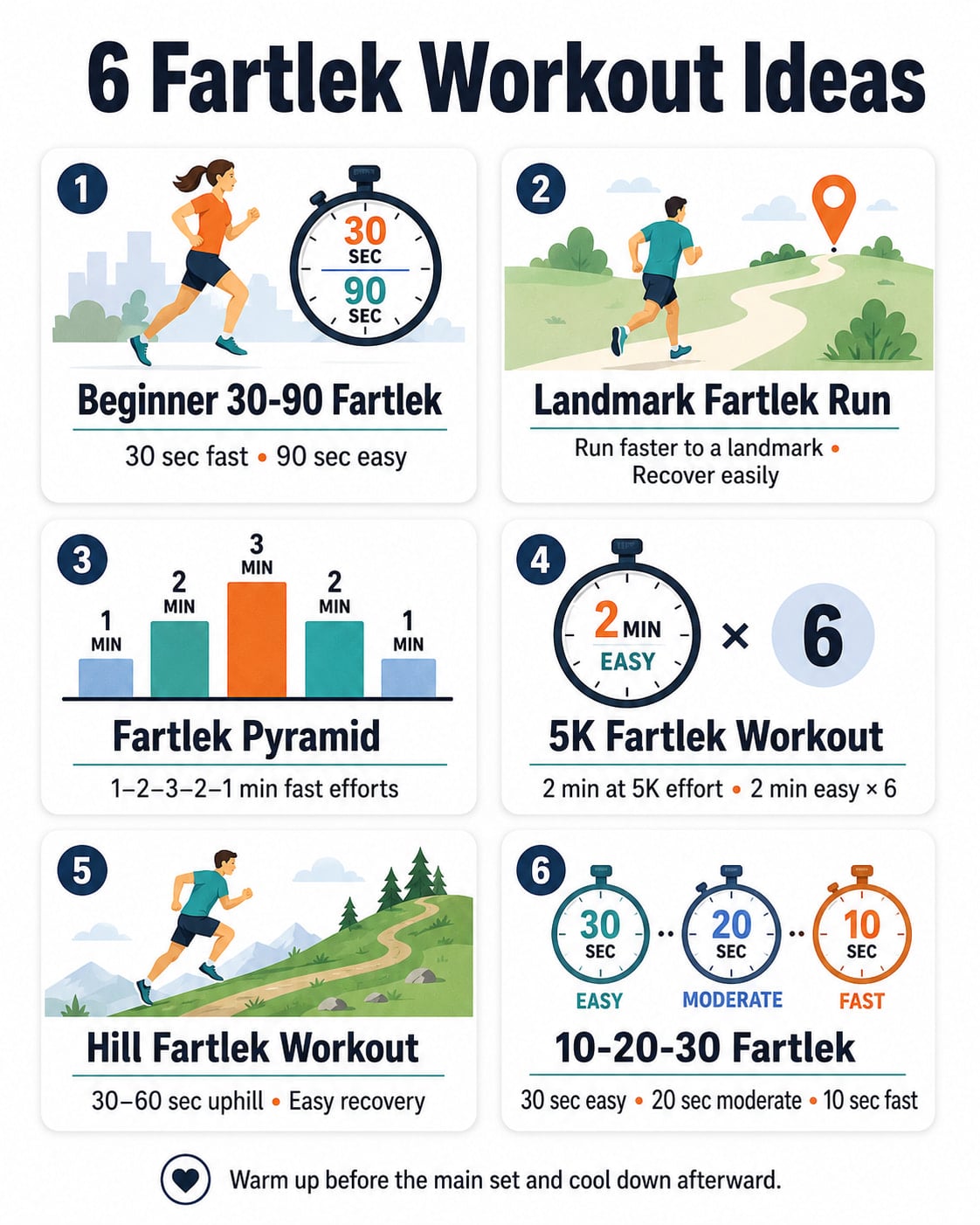
Complete an easy warm-up before each main set and finish with a cooldown. The suggested efforts can be adjusted to match your experience.
1. Beginner 30-90 Fartlek
This predictable workout is a good introduction to pace changes.
Workout:
- Warm up for 10 minutes.
- Run faster for 30 seconds.
- Jog or walk easily for 90 seconds.
- Repeat six times.
- Cool down for 5–10 minutes.
Keep the faster portions around 6–7 out of 10 during your first session. They should feel noticeably quicker than an easy run but not like a sprint.
2. Landmark Fartlek Run
This option captures the flexible “speed play” style of fartlek training.
Workout:
- Warm up for 10 minutes.
- Choose a visible landmark, such as a tree or streetlight.
- Run at a controlled fast pace until you reach it.
- Jog easily until your breathing settles.
- Choose another landmark and repeat.
- Complete six to 10 surges.
- Cool down for 5–10 minutes.
Change the landmark distances. One effort might last 20 seconds, while another lasts one minute.
3. Fartlek Pyramid
A pyramid gradually lengthens the fast efforts before making them shorter again.
Workout:
- Warm up for 10–15 minutes.
- Run fast for 1 minute, then jog easily for 1 minute.
- Run fast for 2 minutes, then jog easily for 2 minutes.
- Run fast for 3 minutes, then jog easily for 3 minutes.
- Run fast for 2 minutes, then jog easily for 2 minutes.
- Run fast for 1 minute, then jog easily for 1 minute.
- Cool down for 10 minutes.
The three-minute segment should not be as fast as the one-minute segments. Adjust your pace so that each effort remains controlled.
4. 5K Fartlek Workout
This workout introduces repeated efforts around your current 5K intensity.
Workout:
- Warm up for 10–15 minutes.
- Run for 2 minutes at approximately 5K effort.
- Jog easily for 2 minutes.
- Repeat six times.
- Cool down for 10 minutes.
Use effort rather than an exact pace on hills or in difficult weather. You should finish feeling challenged but not completely exhausted.
New runners should build a consistent easy-running base before attempting repeated 5K-effort segments.
5. Hill Fartlek Workout
Hills naturally increase intensity without requiring you to chase a specific speed.
Workout:
- Warm up for 10–15 minutes on level ground.
- Run uphill at a strong, controlled effort for 30–60 seconds.
- Jog or walk carefully downhill.
- Repeat four to eight times.
- Cool down for 10 minutes.
Use a moderate hill with safe footing. Keep your steps controlled, avoid leaning excessively from the waist, and do not sprint down the hill.
6. 10-20-30 Fartlek
This is a structured speed-play workout based on repeated one-minute cycles.
One cycle:
- 30 seconds easy
- 20 seconds moderate
- 10 seconds fast
Repeat the cycle five times to complete one five-minute block.
Starter workout:
- Warm up for 10 minutes.
- Complete one five-minute block.
- Jog easily for 2 minutes.
- Complete a second five-minute block.
- Cool down for 10 minutes.
The original research protocol used three or four five-minute blocks and near-maximal 10-second efforts. Beginners should use fewer blocks and controlled fast running instead of trying to copy the research intensity immediately. The original study was conducted in moderately trained runners, not first-time exercisers. (University of Copenhagen research summary)
How Often Should You Do Fartlek Training?
Most beginners can start with one fartlek workout per week. This provides time to learn the pacing and evaluate how your body responds.
Experienced runners may complete one or two challenging running sessions per week, but both do not need to be fartlek workouts. Your other quality session might be a tempo run, hill session, long run, or traditional interval workout.
Avoid placing demanding running workouts on consecutive days. Use an easy run, walking day, cross-training session, or rest day between them when possible.
How to Progress Your Fartlek Workouts
Change one variable at a time.
You can progress by:
- Adding one or two repetitions.
- Extending each fast segment by 10–30 seconds.
- Making the fast pace slightly quicker.
- Shortening the recovery period.
- Adding a hill or more challenging terrain.
Do not increase all five variables during the same week. A small adjustment makes it easier to judge whether you are recovering well.
Reduce the session when your pace drops sharply, your form becomes difficult to control, or soreness continues to affect normal running.
Common Fartlek Mistakes
Treating Every Fast Section Like a Sprint
Faster does not automatically mean maximum effort. Repeated all-out sprinting can make the workout difficult to control and may exceed what your current training supports.
Use a pace you can repeat with consistent form.
Running the Recovery Too Fast
The easy sections should prepare you for the next faster effort. When the recovery pace is too hard, the entire workout becomes one continuous struggle.
Slow down enough to regain control of your breathing.
Skipping the Warm-Up
Moving directly from rest to fast running may leave you feeling stiff and unprepared.
Begin with easy movement and increase speed gradually.
Starting Too Fast
The first repetition should usually feel manageable. Aim to keep the final repetition similar in quality to the first rather than producing one very fast effort followed by several poor ones.
Making Every Run a Hard Run
Fartlek training is only one part of a balanced running plan. Easy runs help you accumulate aerobic training with less fatigue.
Do not turn every routine run into an unplanned speed workout.
Ignoring the Route and Weather
Traffic, darkness, uneven ground, extreme heat, ice, and steep downhills can make pace changes less safe.
Choose a route that allows you to accelerate and slow down without losing awareness of your surroundings.
Fartlek Running Safety Tips
Fartlek running can be adjusted for many fitness levels, but the faster sections still create more demand than easy jogging.
Use these precautions:
- Become comfortable with easy running or run-walking before adding repeated hard efforts.
- Begin with short, controlled surges.
- Increase duration or intensity gradually.
- Wear footwear appropriate for the surface.
- Stay aware of traffic, cyclists, animals, and other runners.
- Use walking recoveries when you cannot regain control while jogging.
- Stop if pain becomes sharp, changes your stride, or continues to worsen.
- Ask a qualified healthcare professional for individualized guidance when you have a health condition or are unsure whether vigorous exercise is appropriate.
Heat can make a normal running pace feel substantially harder. The CDC’s heat-safety guidance for athletes recommends scheduling activity during cooler parts of the day, beginning gradually, drinking water before becoming thirsty, and stopping if you feel faint or weak.
Frequently Asked Questions
What does fartlek mean?
Fartlek is a Swedish term meaning “speed play.” The workout involves playing with different speeds rather than maintaining one pace throughout the run.
Is fartlek running good for beginners?
Yes. Beginners can alternate short periods of faster jogging with easy jogging or walking. The fast pace should be relative to the runner’s current ability, not an all-out sprint.
Start with four to six surges of 20–30 seconds and allow enough recovery to regain comfortable breathing.
How long should a fartlek run be?
A beginner session may last approximately 20–30 minutes, including the warm-up and cooldown. The speed-play portion can begin at 10–15 minutes.
Experienced runners may use a 20–30-minute main set or incorporate pace changes into a longer run. Longer is not automatically better; the workout should fit your training level and goal.
What pace should the fast portions be?
Most fast portions can be completed around 6–8 out of 10 effort. You should feel challenged and unable to hold a normal conversation, but your form should remain controlled.
The correct pace changes with the length of the effort. A 20-second surge can be faster than a three-minute surge.
Should you sprint during a fartlek run?
Not necessarily. Many fartlek workouts use controlled efforts between a steady pace and approximately 5K effort.
Near-maximal sprints may be included in advanced programming, but they are not required for a workout to qualify as fartlek training.
Is fartlek training useful for a 5K?
Fartlek training may be useful for 5K preparation because it practices pace changes, faster running, and active recovery. A workout such as six rounds of two minutes at 5K effort with two minutes of easy jogging can be included as one quality session.
It should complement rather than replace easy running, appropriate weekly mileage, and recovery.
Can you do a fartlek workout on a treadmill?
Yes. Warm up at an easy speed, increase the belt speed for each fast segment, and return to an easy speed for recovery.
Change speeds gradually and use the safety clip. You can keep the incline consistent or add small incline changes after you are comfortable controlling the speed transitions.
Conclusion
A fartlek run is one of the most adaptable ways to introduce faster running into your routine. It combines quicker efforts with active recovery, allowing you to train pace changes without relying on a track or a complicated workout plan.
Start with one beginner fartlek session per week. Keep the surges controlled, recover at a genuinely easy pace, and progress only one part of the workout at a time. Choose the 30-90 workout or landmark fartlek for your first session, then record how the effort felt so you can adjust the next one.
References
- National Strength and Conditioning Association: Fartlek Training with Personal Training Clients.
- Kotadiya and Shah: Fartlek Training as a Dynamic Approach to Improving Skill-Related Fitness in Athletes.
- University of Copenhagen: The 10-20-30 Training Concept Improves Performance and Health Profile in Moderately Trained Runners.
- Office of Disease Prevention and Health Promotion: Physical Activity Guidelines Questions and Answers.
- Centers for Disease Control and Prevention: Heat and Athletes.