

The best time of day to run is the time you can follow consistently without sacrificing sleep, proper fueling, recovery, or safety. Morning running may make it easier to protect your workout from daily interruptions, while late-afternoon or early-evening running may provide a modest performance advantage for some people.
Research does not identify one universally superior time for running. Your schedule, natural energy pattern, sleep response, climate, and training goal matter more than following a specific hour on the clock.
This guide compares morning vs. evening running and explains how to choose the best time for your body and goals.
What Is the Best Time of Day to Run?
There is no single best running time for everyone.
A 2023 systematic review of morning and evening exercise training found limited evidence that one time of day consistently produces better long-term improvements in fitness, health, body composition, or exercise performance.
The review did find some evidence of time-specific adaptation. In other words, regularly training at a particular time may help you perform better when tested at that same time. This can be useful when preparing for a race with a fixed starting time.
For most runners, the best time meets four basic conditions:
- It fits your schedule consistently.
- It allows enough sleep and recovery.
- It gives you enough energy to complete the planned workout.
- It provides reasonably safe weather, visibility, traffic, and air-quality conditions.
Morning vs. Evening Running at a Glance
| Factor | Morning Running | Evening Running |
|---|---|---|
| Consistency | May be easier to complete before other responsibilities begin | May work better for people who dislike waking early |
| Performance | Some runners feel stiff or less energetic immediately after waking | Speed and endurance may feel better later in the day |
| Fueling | Less time to eat and hydrate before running | More time to eat and drink during the day |
| Sleep | Unlikely to interfere with bedtime, but waking too early may reduce sleep | Easy running may be well tolerated, but hard late workouts may affect sleep |
| Race preparation | Useful for races with early starting times | Useful for afternoon or evening events |
| Environment | May offer cooler or quieter conditions in some locations | May offer better visibility than pre-dawn running |
| Schedule risks | Requires an earlier bedtime and reliable wake-up routine | Work, family duties, or fatigue may interfere |
Neither option wins every category. The better choice is the one whose advantages matter most in your daily life.
Benefits of Running in the Morning
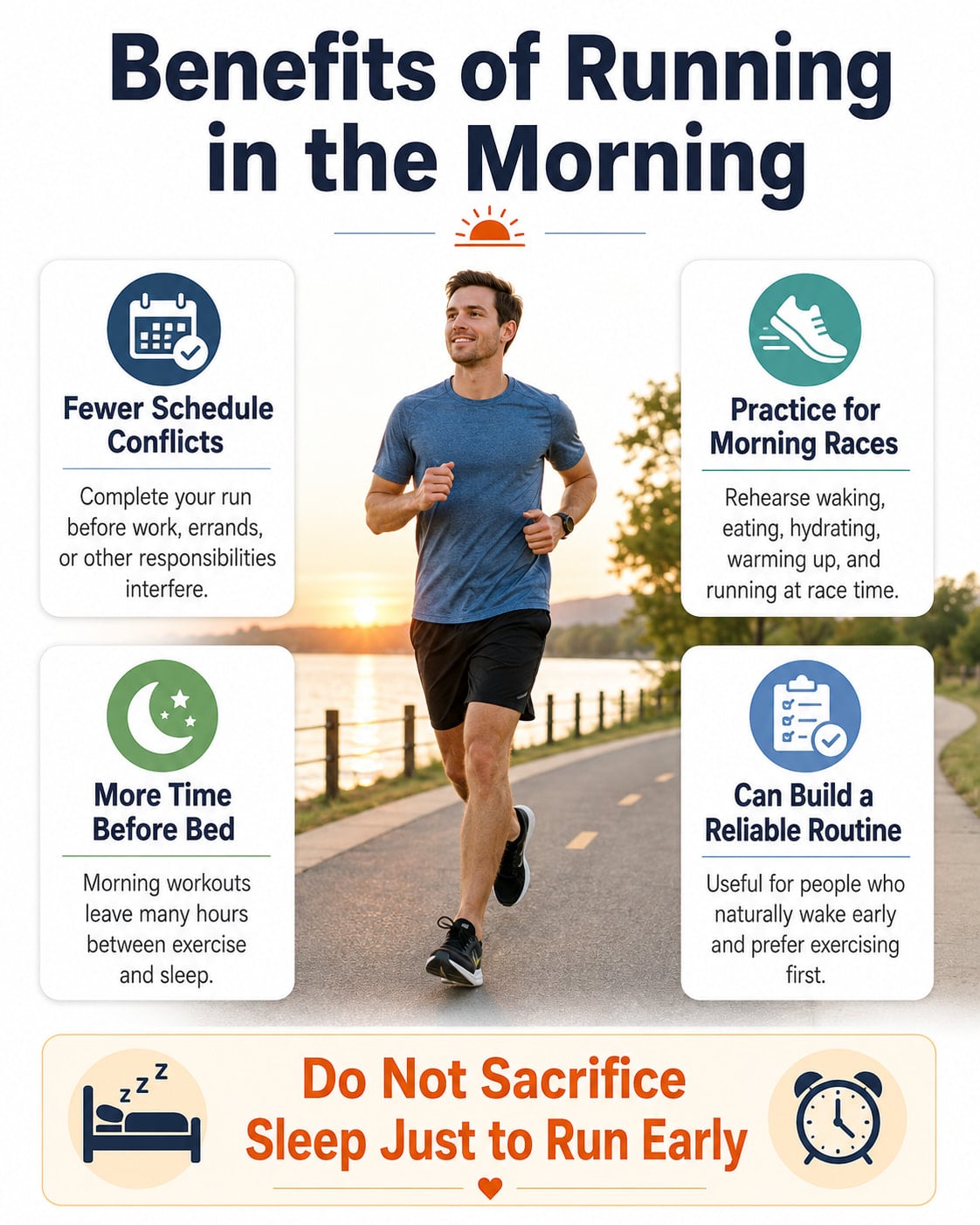
Morning running can be practical, especially when the rest of your day is unpredictable.
Morning Running May Be Easier to Schedule
An early run is less likely to be displaced by late meetings, errands, family responsibilities, or changes in your afternoon schedule.
That does not mean everyone is more disciplined in the morning. Some people repeatedly skip early workouts because they struggle to wake up or go to bed too late. A theoretically convenient workout time is not useful if you rarely follow it.
Morning running may fit you well when you:
- Naturally wake up early
- Can maintain a consistent bedtime
- Have busy afternoons or evenings
- Prefer completing exercise before work
- Feel mentally refreshed after an early run
Consistency matters more than forcing yourself into a routine you dislike.
Morning Training Can Prepare You for Early Races
Many organized races begin in the morning. Training at the expected race time allows you to practice the entire routine, including:
- Waking up
- Eating and drinking
- Using the bathroom
- Warming up
- Managing pre-race nerves
- Pacing in morning conditions
You do not need to perform every run at race time. However, including several morning workouts before an early event can help make race morning feel familiar.
Morning Runs Leave More Recovery Time Before Bed
Running in the morning gives your body many hours to settle before sleep. This may be helpful if hard evening exercise makes you feel alert or restless.
However, morning running only supports recovery when it does not reduce sleep. Waking at 5:00 a.m. after going to bed at midnight is generally a poor trade-off.
Protecting adequate sleep is more important than earning credit for exercising early.
Potential Drawbacks of Morning Running
Morning running may be less suitable when you:
- Regularly go to bed late
- Feel dizzy, weak, or nauseated while running without food
- Need a long warm-up before moving comfortably
- Have little time to hydrate or use the bathroom
- Must run alone in dark or isolated conditions
- Perform noticeably worse during early hard workouts
You can reduce morning discomfort by starting with several minutes of walking or easy jogging before increasing your pace. Prepare your clothing, shoes, water, and breakfast the night before to make the routine easier.
Benefits of Running in the Evening
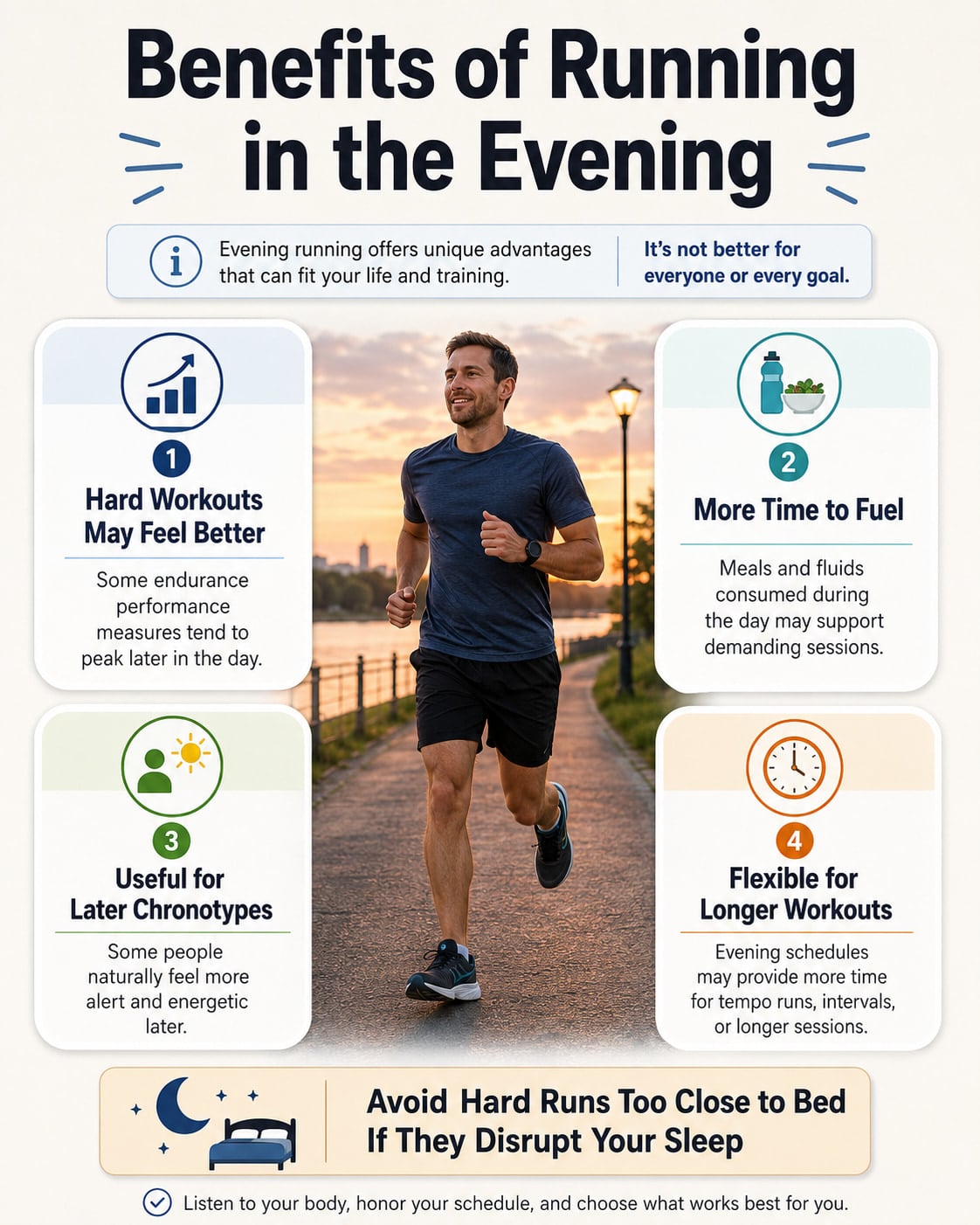
Evening running can work well for people who feel more energetic later in the day or need more time to fuel before exercise.
Running Performance May Be Better Later in the Day
A 2023 meta-analysis of time-of-day effects on endurance exercise found that performance measured through time to exhaustion or total work was generally better in the afternoon or evening than in the morning.
This does not mean every runner will be faster at night. The studies used different exercise tests and included activities beyond outdoor running. The average advantage also does not guarantee a meaningful difference in your training.
Still, late afternoon or early evening may be worth testing for:
- Intervals
- Tempo runs
- Hill repetitions
- Time trials
- Long runs that require substantial fueling
Your personal results matter more than the average research result.
Evening Runs May Allow More Time for Fueling
By the evening, you have usually had several opportunities to eat and hydrate. This can make demanding workouts feel more manageable than running immediately after waking.
Evening running may be especially useful when you need:
- A full meal several hours before training
- More time to hydrate
- A longer warm-up
- Greater flexibility for a long workout
- More energy for faster running
Avoid eating a large meal immediately before running. Use foods and timing that you have already tested rather than experimenting before an important session.
Evening Running Can Create a Transition After Work
An easy run may provide a clear transition between work and personal time. It can also help some people step away from screens and mentally reset.
However, this benefit depends on your schedule. An evening workout can become stressful when it competes with dinner, childcare, social plans, or bedtime.
Potential Drawbacks of Evening Running
Evening running may be difficult when:
- Your workday frequently runs late
- You feel mentally exhausted after work
- A hard workout leaves you alert at bedtime
- You depend on late caffeine to train
- You must run in darkness or heavy traffic
- Exercise causes you to delay dinner or sleep
A shorter completed run is usually more valuable than an ambitious evening session that you regularly cancel.
Can Evening Running Affect Sleep?
Evening running does not automatically damage sleep.
A 2026 systematic review comparing morning and evening exercise found no clear overall sleep advantage for morning exercise. Some nighttime exercise was associated with slightly more wakefulness after initially falling asleep, but the results did not support a universal rule that everyone must avoid evening workouts.
Intensity and proximity to bedtime may be more important than the word “evening.”
A 2025 Nature Communications study analyzed data from 14,689 physically active adults across more than four million nights. Later and more strenuous exercise was associated with later sleep, shorter sleep duration, lower sleep quality, and less favorable overnight recovery measurements. Exercise ending at least four hours before normal sleep onset was not associated with those changes.
The study was observational, so it cannot prove that late exercise directly caused every sleep difference. It does provide a useful starting point for runners who notice problems after hard evening sessions.
Use these practical guidelines:
- Keep late runs easy when possible.
- Try to finish long runs, intervals, or races about four hours before bedtime.
- Avoid using a late dose of caffeine simply to complete the workout.
- Allow time for a cool-down, shower, food, and relaxation.
- Move the run earlier if you repeatedly struggle to fall asleep afterward.
- Track how you sleep instead of assuming that evening running is harmful.
A relaxed 30-minute run may affect you differently from a strenuous 90-minute workout. Personal response should guide the final decision.
How Your Chronotype Affects the Best Time to Run
Your chronotype is your natural tendency to feel alert and sleepy at particular times.
A morning type may wake early without much difficulty and feel most productive before noon. An evening type may become more alert later and prefer a later sleep schedule. Many people fall somewhere between those two patterns.
A 2026 randomized trial of chronotype-aligned exercise studied adults ages 40 to 60 with at least one cardiometabolic risk factor. Participants completed supervised moderate aerobic exercise either at a time that matched their chronotype or at the opposite time.
Both groups improved. However, those exercising at a chronotype-aligned time experienced greater improvements in several measures, including aerobic capacity, blood pressure, metabolic markers, and sleep quality.
The trial involved brisk treadmill walking rather than running, excluded intermediate chronotypes, and included a specific at-risk population. It therefore supports personalized exercise timing but does not prove that every runner must follow a strict chronotype-based schedule.
A simple way to use this information is to notice when you naturally feel:
- Most awake
- Most motivated to exercise
- Physically coordinated
- Comfortable eating before a run
- Able to complete hard efforts
- Least likely to skip training
Your preferred time may already reflect your chronotype.
Best Time to Run for Different Goals
Your goal can help narrow the choice between morning and evening running.
Best Time to Run for General Health
For general health, run whenever you can exercise regularly and recover well.
Current CDC physical activity guidance for adults recommends at least 150 minutes of moderate-intensity activity or 75 minutes of vigorous-intensity activity each week, plus muscle-strengthening activity on at least two days.
The guidance focuses on the amount and intensity of weekly activity, not a required time of day. Running in the morning does not count more than completing the same suitable workout in the evening.
Best Time to Run for Performance
Late afternoon or early evening may provide a modest advantage during demanding endurance workouts. However, performance timing should also match your event.
For example:
- For a 7:00 a.m. race, include some early runs.
- For an evening track meet, practice several hard sessions later in the day.
- For a midday event, test your fueling and warm-up at midday.
Do not move every workout to the evening solely because a study found a group-level advantage. A well-rested morning runner may outperform a tired evening runner.
Best Time to Run for Weight Loss
Morning running is not automatically better for weight loss.
Running before breakfast may increase the amount of fat used as fuel during that particular workout. However, higher fat oxidation during one session does not necessarily produce greater long-term fat loss.
A systematic review found greater fat oxidation during fasted aerobic exercise, while a controlled trial comparing fasted and fed aerobic training found similar body-composition changes when the exercise and calorie deficit were comparable.
For weight management, focus on:
- A schedule you can maintain
- Appropriate weekly activity
- Gradual training progression
- Adequate sleep
- Sustainable eating habits
- Recovery between sessions
Choose morning running only when it makes regular exercise easier—not because fasted exercise is a guaranteed shortcut.
Best Time to Run for Better Sleep
Run at the time that supports both exercise and adequate sleep.
Morning running may be preferable when late workouts repeatedly leave you restless. Evening running may be perfectly suitable when you fall asleep normally afterward.
Move hard sessions earlier when you notice:
- Delayed sleep after running
- An unusually high bedtime heart rate
- Restlessness
- Shorter sleep
- Greater fatigue the following morning
Do not wake up extremely early to run when doing so creates chronic sleep loss.
Best Time to Run Before a Race
The most useful time is often the expected race time.
Complete at least some race-specific workouts under a similar schedule. Practice your pre-run meal, hydration, warm-up, clothing, bathroom routine, and pacing.
You can still complete easy runs at other times. The goal is familiarity, not rigidly performing every session at the exact race hour.
Best Time to Run in Hot Weather
Choose the coolest reasonably safe part of the day rather than chasing a small theoretical performance advantage.
Depending on your location, that may be early morning or after sunset. Check the actual temperature, humidity, air quality, visibility, and route conditions before leaving.
Reduce your pace, shorten the run, choose a shaded route, or move indoors when conditions are unsafe. Weather and air quality should take priority over your preferred schedule.
Should You Run Before or After Breakfast?
You do not have to eat before every morning run, but fasted running is not suitable for everyone.
An easy, short run before breakfast may feel comfortable when you:
- Ate adequately the previous day
- Are well hydrated
- Feel steady without food
- Keep the effort controlled
- Have no medical reason to avoid fasting
Eating first may be more helpful when you:
- Plan a long or high-intensity run
- Feel weak, shaky, dizzy, or nauseated when fasted
- Struggle to maintain your intended pace
- Are increasing your training volume
- Have several workouts close together
A small, familiar snack such as a banana, toast, or another easily digested carbohydrate may provide energy without making you feel overly full. Test food choices during normal training rather than before a race.
People with diabetes, a history of disordered eating, pregnancy-related nutrition needs, or medications that affect blood glucose should discuss fasted exercise with a qualified healthcare professional.
How to Find Your Personal Best Running Time
Test both options instead of guessing.
For one or two weeks, complete similar easy runs in the morning and evening. Keep the route, duration, and effort reasonably consistent. After each run, record:
- Energy before the run: Did starting feel easy or difficult?
- Performance: How did your normal pace feel?
- Comfort: Did you experience hunger, stiffness, or digestive discomfort?
- Mood: Did the run improve or drain your energy?
- Schedule: Was the workout easy to protect from interruptions?
- Sleep: Did the run change your bedtime or sleep quality?
- Recovery: How did you feel the following day?
Choose the time that produces the best overall pattern—not necessarily the single fastest run.
You can also use a mixed schedule. For example, complete easy runs in the morning when your schedule is predictable and save intervals for the late afternoon when you feel stronger.
Safety Factors That May Change When You Run
The safest running time may change by season, location, and route.
Before choosing a time, consider:
- Temperature and humidity
- Air quality
- Sunrise and sunset
- Traffic volume
- Sidewalk and trail conditions
- Wildlife or stray animals
- Access to water
- Personal security
- Availability of a running partner
When running in low light, use reflective clothing and an appropriate light. Carry identification and a phone when practical. Select familiar, populated routes and tell someone where you are going when running alone.
Stop exercising and seek medical help for chest pain, fainting, severe or unusual shortness of breath, or other alarming symptoms. People with cardiovascular, respiratory, metabolic, or other medical conditions may need individualized advice before starting or changing a running program.
Frequently Asked Questions
Is it better to run in the morning or evening?
Neither time is universally better. Morning running may support a reliable routine, while late-afternoon or evening running may feel better for demanding workouts. Choose the time you can maintain without compromising sleep, safety, or recovery.
What is the healthiest time of day to run?
The healthiest time is one that allows regular activity, adequate sleep, proper fueling, recovery, and safe running conditions. Current exercise guidelines do not require running at a particular time.
Is morning running better for weight loss?
Not necessarily. Fasted morning running may increase fat use during the workout, but it has not been shown consistently to produce more long-term fat loss than fed or evening exercise. Weekly activity, eating habits, sleep, and consistency matter more.
Does running at night affect sleep?
It depends on the person, workout, and timing. An easy evening run may not cause a problem. Long or strenuous running close to bedtime is more likely to affect sleep in susceptible runners.
How long before bed should I stop running?
For hard or long runs, finishing about four hours before bedtime is a reasonable starting point. A shorter, easier run may be well tolerated closer to bed. Monitor your own sleep response.
Should I run on an empty stomach in the morning?
You can complete an easy run without breakfast if you feel comfortable and have no medical reason to avoid fasting. Eat first when fasting causes weakness, dizziness, poor performance, or excessive hunger.
Do I need to run at the same time every day?
No. A consistent time may make the habit easier, but a mixed schedule is also effective. It can be useful to complete some sessions at your expected race time and schedule demanding workouts when you usually perform best.
Conclusion
The best time of day to run is personal. Morning running may be easier to protect from daily interruptions and can prepare you for early races. Evening running may allow better fueling and provide a modest performance advantage during harder workouts.
Start with the time that fits your life, then evaluate your energy, performance, sleep, recovery, and consistency. The most effective running schedule is not the one that looks ideal on paper. It is the one you can safely repeat week after week.
References
- Best Time of Day for Strength and Endurance Training to Improve Health and Performance
- Time-of-Day Effects of Exercise on Cardiorespiratory Responses and Endurance Performance
- Diurnal Variation in Maximum Endurance and Maximum Strength Performance
- Effects of Morning Versus Evening Exercise on Sleep
- Dose-Response Relationship Between Evening Exercise and Sleep
- Chronotype-Aligned Exercise Timing in Middle-Aged Adults at Cardiometabolic Risk
- CDC Guidance for Adding Physical Activity as an Adult
- Effects of Aerobic Exercise Performed in a Fasted Versus Fed State
- Body-Composition Changes Associated With Fasted Versus Fed Aerobic Exercise