
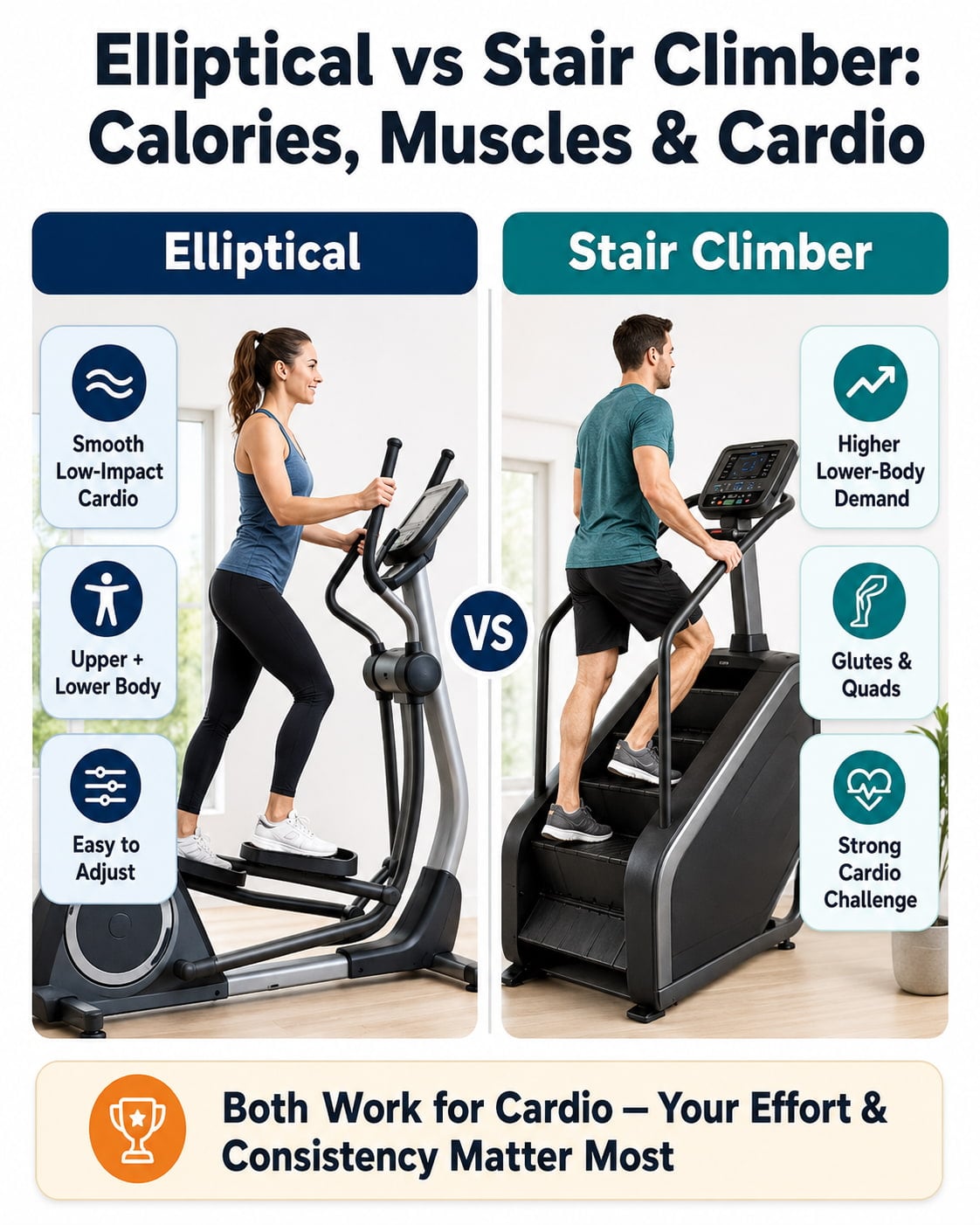
The stair climber usually has a slight advantage for calorie burn and lower-body intensity, while the elliptical is often better for smoother, more stable, full-body cardio. However, both machines can provide an effective cardiovascular workout. Your effort level, workout length, resistance, technique, and consistency matter more than the machine alone.
A 2024 comparison of seven indoor cardio machines found that the stair climber produced slightly higher energy expenditure, heart rate, and oxygen consumption than the elliptical during very hard exercise. However, another study found broadly similar physiological responses when elliptical and stepper workouts were matched by relative intensity.
This elliptical vs stair climber guide compares calories, muscles worked, cardiovascular benefits, joint impact, weight-loss potential, and the best machine for different fitness goals.
Elliptical vs Stair Climber: Quick Comparison
| Feature | Elliptical | Stair climber |
|---|---|---|
| Movement | Smooth oval or gliding stride | Repeated stepping or stair climbing |
| Main muscles | Quadriceps, glutes, hamstrings, and calves | Quadriceps, glutes, calves, and hamstrings |
| Upper-body involvement | Possible with moving handles | Minimal unless the machine includes moving handles |
| Calorie potential | Moderate to high | Generally high at challenging intensities |
| Cardiovascular challenge | Moderate to vigorous | Moderate to vigorous |
| Joint impact | Low impact with feet supported | Low impact but more weight-bearing knee and hip flexion |
| Balance requirement | Usually lower | Usually higher |
| Best for | Longer cardio, beginners, full-body movement, and smooth exercise | Climbing fitness, glute and quad endurance, and higher-intensity sessions |
| Main drawback | May feel less natural to some users | Legs may fatigue before the cardiovascular system does |
Overall winner: There is no universal winner. Choose the stair climber when you want a demanding climbing workout with strong quadriceps and glute involvement. Choose the elliptical when you want smooth, adjustable cardio that may be easier to sustain for longer.
What Does “Stair Climber” Mean?
The term “stair climber” may describe several machines:
- A rotating stair treadmill or stepmill
- A machine with two independent up-and-down pedals
- A compact home stepper
These designs do not produce identical movement or energy expenditure. This article primarily refers to the rotating stair treadmill commonly found in commercial gyms.
Research may use the terms stair climber, stair treadmill, stepper, and stepmill differently. Machine design, step height, speed controls, and handrail use can all affect the workout.
Elliptical vs Stair Climber Calories
The stair climber may burn slightly more calories than the elliptical when both machines are used at a similarly hard effort. The difference is usually smaller than many online calorie comparisons suggest.
In the 2024 head-to-head study, 30 recreationally active men between ages 35 and 49 completed 12-minute workouts on each machine. All participants had more than 10 years of experience using indoor cardio equipment.
The measured energy expenditure was:
| Exercise intensity | Elliptical | Stair climber |
|---|---|---|
| Very hard effort, RPE 17 | 12.82 calories per minute | 13.35 calories per minute |
| Maximum effort | 14.67 calories per minute | 15.16 calories per minute |
At the very hard effort, the stair climber burned approximately 4% more calories per minute. At maximum effort, the difference was approximately 3%.
These were extremely demanding workouts performed by experienced, physically active men. The numbers should not be treated as typical calorie totals for beginners, moderate workouts, women, older adults, or people with different body weights.
Estimated Calories Burned in 30 Minutes
The 2024 Adult Compendium of Physical Activities assigns these standardized intensity values:
- Elliptical at moderate effort: 5.0 METs
- Elliptical at vigorous effort: 9.0 METs
- Stair treadmill at general effort: 9.3 METs
Using the standard MET calorie formula, estimated 30-minute calorie expenditure is:
| Body weight | Elliptical, moderate | Elliptical, vigorous | Stair treadmill, general |
|---|---|---|---|
| 125 pounds | About 149 calories | About 268 calories | About 277 calories |
| 155 pounds | About 185 calories | About 332 calories | About 343 calories |
| 185 pounds | About 220 calories | About 396 calories | About 410 calories |
These estimates are not a perfect machine-to-machine comparison because the stair-treadmill category is not labeled as moderate or vigorous. The values are best used to understand the possible range rather than predict an exact personal result.
What Determines How Many Calories You Burn?
Actual calorie expenditure depends on:
- Your body weight and body composition
- Workout duration
- Resistance level
- Pedaling or stepping speed
- Cardiovascular fitness
- Machine design
- How actively you use the elliptical handles
- How much body weight you support on the stair-climber rails
Leaning heavily on the rails can reduce the amount of body weight your legs must move. It may also allow the machine to display a higher speed without producing the expected workload.
Machine calorie displays should be treated as estimates. They may not accurately account for your individual metabolism, technique, fitness, or the amount of assistance you receive from the handrails.
Calorie-Burning Verdict
The stair climber has a small potential advantage when intensity and workout duration are comparable.
The elliptical may still produce greater total calorie expenditure when it allows you to:
- Exercise longer
- Use a higher sustainable intensity
- Train more frequently
- Avoid stopping because of early leg fatigue
- Actively use both the arms and legs
A 40-minute elliptical workout can burn more total calories than a 15-minute stair-climber workout, even when the stair climber burns more calories per minute.
Elliptical vs Stair Climber Muscles Worked
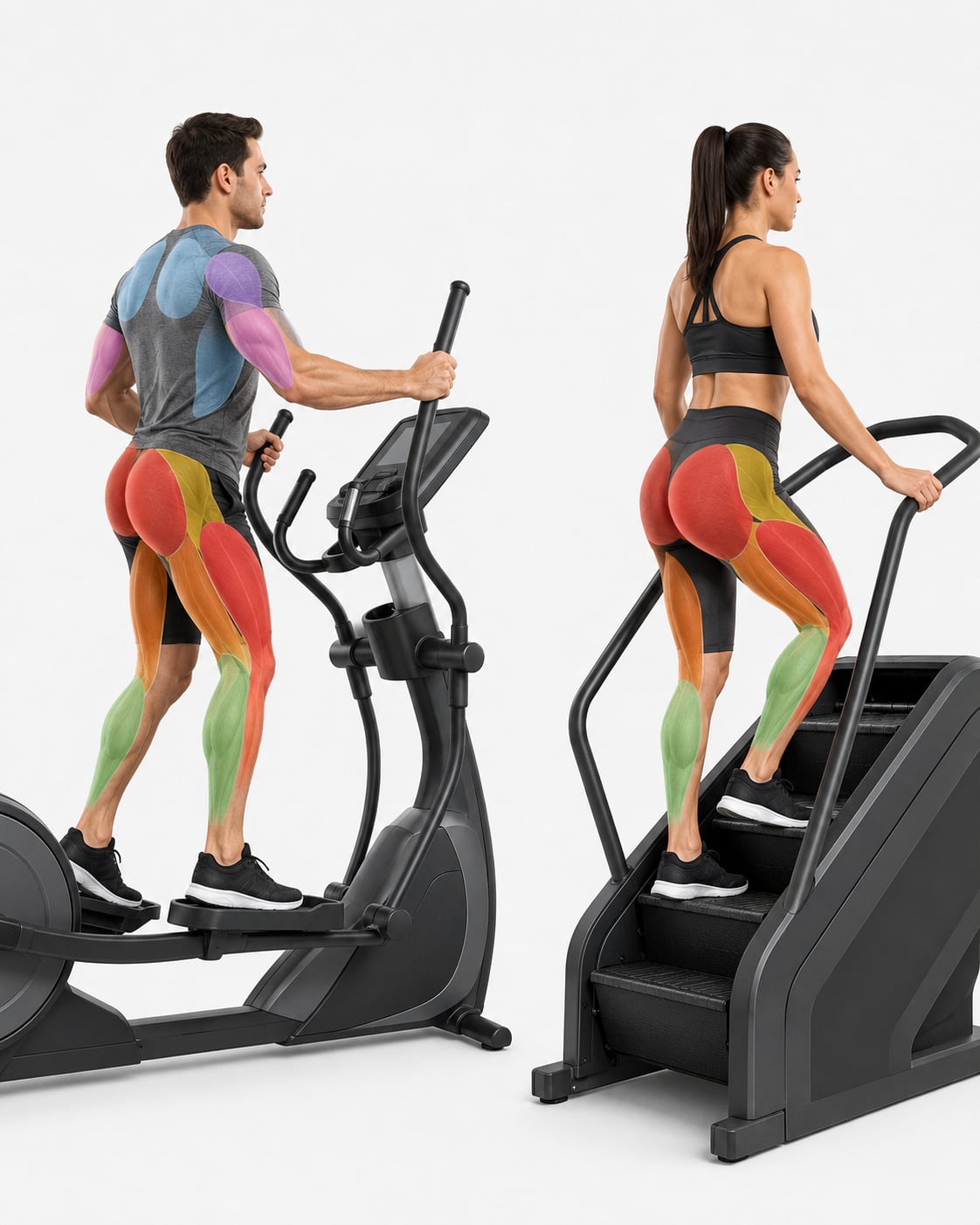
Both machines train the major lower-body muscle groups. The difference is how those muscles are loaded and how much movement occurs at the knees, hips, and ankles.
Elliptical Muscles Worked
The primary muscles used on an elliptical include:
Quadriceps
The quadriceps on the front of your thighs straighten your knees as you push the pedals.
The quadriceps include:
- Vastus lateralis
- Vastus medialis
- Vastus intermedius
- Rectus femoris
Gluteal Muscles
The gluteus maximus contributes to hip extension as you drive the pedal backward and downward.
The gluteus medius and other hip muscles help stabilize the pelvis during the continuous stride.
Hamstrings
The hamstrings assist hip extension and knee movement. Their exact contribution changes with the machine’s incline, resistance, stride design, and direction of movement.
Calves
The gastrocnemius and soleus help stabilize your ankles and transfer force through the pedals.
Upper-Body Muscles
An elliptical with moving handles can also involve the:
- Upper back
- Shoulders
- Chest
- Biceps
- Triceps
Upper-body involvement depends on how actively you push and pull. Simply resting your hands on the handles produces very little additional upper-body work.
Stair Climber Muscles Worked
The stair climber primarily trains the:
Quadriceps
Your quadriceps extend your knees every time you push a step downward and raise your body.
Gluteus Maximus
Your glutes help extend your hips as you climb. Glute demand may increase when you use a controlled step, place your full foot on the step, and avoid pulling your body upward with the rails.
Calves
Your calves assist with ankle movement and help stabilize your feet during each step.
Hamstrings
The hamstrings support hip extension and knee control, although the quadriceps and glutes usually create most of the noticeable effort.
Hip and Trunk Stabilizers
Your hip stabilizers and trunk muscles help maintain balance and an upright position. They are not necessarily working against enough resistance to replace dedicated core or strength exercises.
Which Machine Works More Muscles?
The elliptical can involve more total muscle groups when it has moving handles and you use them actively.
The stair climber usually creates a more concentrated lower-body challenge because you repeatedly move your body upward against gravity.
A study of muscle activation on the stepper and elliptical found broadly similar lower-body muscular effort between the two machines. The stepper produced higher activation in some muscles and exercise conditions, but it did not consistently activate every muscle more than the elliptical. Quadriceps activation was relatively high on both machines.
Is the Stair Climber Better for Glutes?
The stair climber will often feel more glute-focused because each step involves hip extension while supporting your body weight.
However, glute involvement depends on:
- Step height
- Speed
- Range of motion
- Body position
- Individual anatomy
- Handrail use
- Whether your full foot remains supported
Taking excessively large steps, bending far forward, or hanging from the rails is not necessary to work your glutes.
The stair climber may improve lower-body muscular endurance, particularly in beginners. For substantial glute or leg muscle growth, combine cardio with progressive resistance exercises such as squats, split squats, hip hinges, leg presses, and calf raises.
Which Is Better for Cardiovascular Fitness?
Both the elliptical and stair climber can improve cardiovascular fitness when you exercise at an appropriate intensity.
A 2021 laboratory study compared treadmill, elliptical, and stepper exercise in 18 trained runners. Participants worked at 60%, 70%, and 80% of their machine-specific peak workloads. Heart rate, oxygen consumption, and fuel use changed mainly with exercise intensity and were broadly similar between the elliptical and stepper.
The 2024 study found slightly higher heart rate and oxygen consumption on the stair climber during very hard exercise. Together, the research suggests that the stair climber may have a small advantage at certain matched perceived efforts, but either machine can provide vigorous cardio.
How to Measure Your Effort
You do not need to reach maximum intensity to improve your fitness.
A practical 1-to-10 effort scale can help:
| Effort | How it feels | Talk test |
|---|---|---|
| 2–3 | Easy warm-up or recovery | Comfortable conversation |
| 4–6 | Moderate, sustainable effort | Can speak in sentences but not sing |
| 7–8 | Vigorous effort | Can speak only a few words at a time |
| 9–10 | Near-maximum effort | Talking is very difficult |
Most steady-state cardio can be performed around a moderate effort. Short intervals can reach vigorous levels when appropriate for your experience and health.
According to the current CDC physical activity recommendations, adults should aim for at least:
- 150 minutes of moderate-intensity aerobic activity per week, or
- 75 minutes of vigorous-intensity aerobic activity per week, or
- An equivalent combination of moderate and vigorous activity
Adults should also complete muscle-strengthening activities on at least two days per week. Some physical activity is better than none, and the weekly total can be divided into shorter sessions.
Elliptical vs Stair Climber for Weight Loss
Neither machine automatically produces weight loss. Body-weight changes depend on your long-term energy balance, eating pattern, activity level, sleep, adherence, and individual physiology.
Exercise can increase energy expenditure and support weight management, but people vary greatly in the amount of activity they need to lose or maintain weight.
Choose the Stair Climber When:
- You want to maximize calorie expenditure per minute
- You enjoy challenging lower-body workouts
- You tolerate repeated stair climbing comfortably
- You are preparing for stairs, hills, or hiking
- You prefer shorter, more intense sessions
Choose the Elliptical When:
- You can exercise longer on it
- You prefer a smooth, continuous stride
- You want to use your upper and lower body
- The stair climber causes premature leg fatigue
- You want an easier way to control workout intensity
- You are more likely to use it consistently
Which Is Better for Belly Fat?
Neither machine can selectively reduce fat from your abdomen or another specific area.
Both can contribute to overall energy expenditure. Changes in abdominal fat occur as part of broader changes in body composition rather than because one exercise directly targets the stomach.
For weight-management goals, a practical program usually combines:
- Regular cardio
- Full-body resistance training
- An eating pattern that supports your energy needs
- Adequate recovery
- A schedule you can maintain
Which Machine Is Lower Impact?
Both machines are generally considered lower impact than running because they do not involve repeated running-style airborne strides and hard landings.
The elliptical keeps both feet in continuous contact with the pedals. The stair climber requires repeated step contacts and supports your body in a more vertical, weight-bearing position.
Is the Elliptical Easier on the Knees?
The elliptical often feels easier on the knees because its pedals guide your feet through a smooth path and eliminate a distinct landing phase.
Biomechanical research found that elliptical exercise produced lower loading rates around foot contact than walking. However, it also involved greater hip, knee, and ankle flexion, meaning the machine is not free from joint loading. Machine setup, cadence, resistance, stride length, and personal anatomy can affect comfort.
Is the Stair Climber Bad for the Knees?
The stair climber is not inherently bad for healthy knees. However, stair climbing generally places greater demands on the knee than level walking because you support your body weight while the knee is flexed.
Biomechanical modeling has found higher knee contact and shear forces during stair climbing than level walking. That research examined regular stairs rather than every type of stair-climber machine, so it should not be used to predict the exact load produced by a particular gym machine.
The elliptical may be the more comfortable starting choice when you have:
- Limited balance
- Low exercise tolerance
- Discomfort with stairs
- Difficulty controlling a deep knee bend
- A recent lower-body injury
- A rehabilitation plan that calls for smoother movement
Comfort varies. Some people feel better on the stair climber, while others find the elliptical’s fixed stride uncomfortable.
Stop the workout if you experience sharp or increasing pain, joint instability, or unusual swelling. Seek individualized guidance before exercising when you are recovering from surgery or have a condition affecting your heart, lungs, balance, or joints. The CDC also recommends consulting a healthcare professional before vigorous activity when certain health or inactivity concerns are present.
Which Is Better for Beginners?
The elliptical is usually easier for beginners because:
- The movement is smooth and continuous
- The pedals support the feet
- Speed can be reduced without suddenly losing rhythm
- The handles may provide additional stability
- Resistance can start very low
Some beginners initially find the elliptical movement awkward. A few slow minutes are usually enough to learn the basic pattern.
The stair climber can also be beginner-friendly when used at a low speed. However, it may cause rapid quadriceps, glute, or calf fatigue before your heart and lungs reach the intended training level.
Beginners should not copy advanced stair-climber workouts that involve high speeds, sideways stepping, deep crouching, or skipping multiple steps.
Proper Elliptical Form
Use these form cues:
- Stand tall with your head facing forward.
- Keep your shoulders relaxed.
- Place your entire foot on each pedal.
- Maintain a soft bend in your knees.
- Keep your hips level rather than rocking from side to side.
- Hold the handles lightly.
- Push and pull the moving handles when you want upper-body involvement.
- Use enough resistance to maintain control without bouncing.
- Allow the pedals to slow before stepping off.
Avoid leaning your full body weight onto the stationary handles. That position can reduce the workload and encourage rounded posture.
Proper Stair-Climber Form
For a controlled stair-climber workout:
- Begin at a slow speed.
- Stand tall with your chest lifted.
- Use a small, natural forward lean rather than rounding your back.
- Place as much of your foot on the step as the machine allows.
- Keep your knees tracking in the same general direction as your toes.
- Push through each step under control.
- Touch the rails lightly for balance.
- Reduce the speed if you need to hang from the rails.
- Step off only after the machine has stopped or slowed as directed.
A faster displayed speed is not automatically a better workout. Use a pace that lets you maintain posture and control.
Elliptical vs Stair Climber: Which Should You Choose?
| Your main goal | Better starting choice |
|---|---|
| Highest possible calorie burn per minute | Stair climber |
| Smooth full-body cardio | Elliptical |
| Longer steady-state sessions | Elliptical |
| Strong quadriceps and glute challenge | Stair climber |
| Training for stairs or steep hiking | Stair climber |
| Lower balance demand | Elliptical |
| Cardio fitness | Either |
| Beginner-friendly exercise | Usually elliptical |
| Workout variety | Alternate both |
| Sensitive knees | Often elliptical, depending on individual comfort |
The best choice is the machine that lets you reach an appropriate training intensity without losing control, relying heavily on handrails, or aggravating pain.
Can You Use the Elliptical and Stair Climber Together?
Yes. The machines complement each other well.
The elliptical can provide longer, smoother aerobic sessions. The stair climber can add shorter workouts with a concentrated lower-body challenge.
You can combine them by:
- Alternating machines on different days
- Using the elliptical for easier recovery workouts
- Using the stair climber for shorter intervals
- Splitting one cardio session between both machines
- Switching machines when local muscle fatigue limits your workout
Changing machines may also make a program more enjoyable, which can help with long-term consistency.
Sample Elliptical and Stair-Climber Workouts
Adjust the resistance and speed to your ability. The effort rating matters more than the machine’s level number because levels vary between manufacturers.
20-Minute Beginner Elliptical Workout
| Time | Intensity |
|---|---|
| 0–5 minutes | Easy warm-up, RPE 2–3 |
| 5–15 minutes | Moderate steady effort, RPE 4–6 |
| 15–20 minutes | Easy cooldown, RPE 2–3 |
Focus on smooth movement and relaxed posture. Add two to five minutes to the middle section as your endurance improves.
20-Minute Beginner Stair-Climber Workout
| Time | Intensity |
|---|---|
| 0–5 minutes | Very easy pace, RPE 2–3 |
| 5–17 minutes | Alternate 1 minute moderate and 1 minute easy |
| 17–20 minutes | Easy cooldown |
Reduce the speed when your form changes or you begin supporting substantial body weight with the rails.
30-Minute Combined Workout
| Time | Machine and intensity |
|---|---|
| 0–5 minutes | Elliptical, easy warm-up |
| 5–15 minutes | Elliptical, moderate effort |
| 15–25 minutes | Stair climber, easy-to-moderate effort |
| 25–30 minutes | Elliptical, easy cooldown |
Use caution during machine changes, especially when you are fatigued.
Frequently Asked Questions
Does the stair climber burn more calories than the elliptical?
The stair climber may burn slightly more calories per minute at a comparable hard effort. One 2024 study found a difference of approximately 3% to 4% between the machines during very hard and maximum exercise. Your actual result depends on intensity, duration, body weight, technique, and handrail use.
Is the elliptical or stair climber better for glutes?
The stair climber is generally the more glute-focused option because each step requires hip extension while supporting your body weight. The elliptical still trains the glutes, especially when you use meaningful resistance and maintain a controlled stride.
Is the elliptical better than the stair climber for knees?
The elliptical often feels more comfortable because it provides a smooth pedal path without a distinct landing phase. However, neither machine is automatically appropriate for every knee condition. Your symptoms, machine setup, range of motion, resistance, and technique all matter.
Which machine is better for cardiovascular fitness?
Both are effective. Research in trained runners found similar heart-rate and oxygen-consumption responses between elliptical and stepper exercise when workloads were matched relative to each machine’s peak level.
Is 20 minutes on the elliptical or stair climber enough?
A 20-minute workout can provide meaningful aerobic activity, especially when performed at a moderate or vigorous intensity. It can also contribute toward the recommended weekly activity total. You can gradually increase duration, frequency, or intensity as your fitness improves.
Can I use the elliptical and stair climber on the same day?
Yes. You can divide one workout between both machines. Starting on the elliptical may provide a smooth warm-up before the stair climber, while finishing on the elliptical can provide a controlled cooldown.
Should I use the elliptical or stair climber every day?
Daily light or moderate cardio may be manageable for some people, but hard sessions do not need to be performed every day. Beginners should increase training gradually and vary intensity. Include easier days and muscle-strengthening exercise rather than repeating an exhausting lower-body workout without adequate recovery.
Conclusion
The elliptical and stair climber are both valuable cardio machines, but they serve slightly different purposes.
Choose the stair climber when you want a demanding, lower-body-focused workout with a small potential calorie-burning advantage. Choose the elliptical when you want smooth, adjustable, often more comfortable cardio that can involve both your arms and legs.
For cardiovascular fitness and weight management, consistency is more important than choosing a theoretical winner. Start with the machine that feels comfortable, use proper form, and gradually progress your workout duration or intensity.
References
- 2024 Adult Compendium of Physical Activities: Conditioning Exercise
- Energy Expenditure, Oxygen Consumption, and Heart Rate on Seven Indoor Cardio Machines
- Physiological and Metabolic Responses to Treadmill, Elliptical, and Stepper Exercise
- Muscular Activation Patterns During Treadmill, Stepper, and Elliptical Exercise
- Joint Loading in the Lower Extremities During Elliptical Exercise
- Tibiofemoral Loading During Walking and Stair Climbing
- CDC: Adding Physical Activity as an Adult