
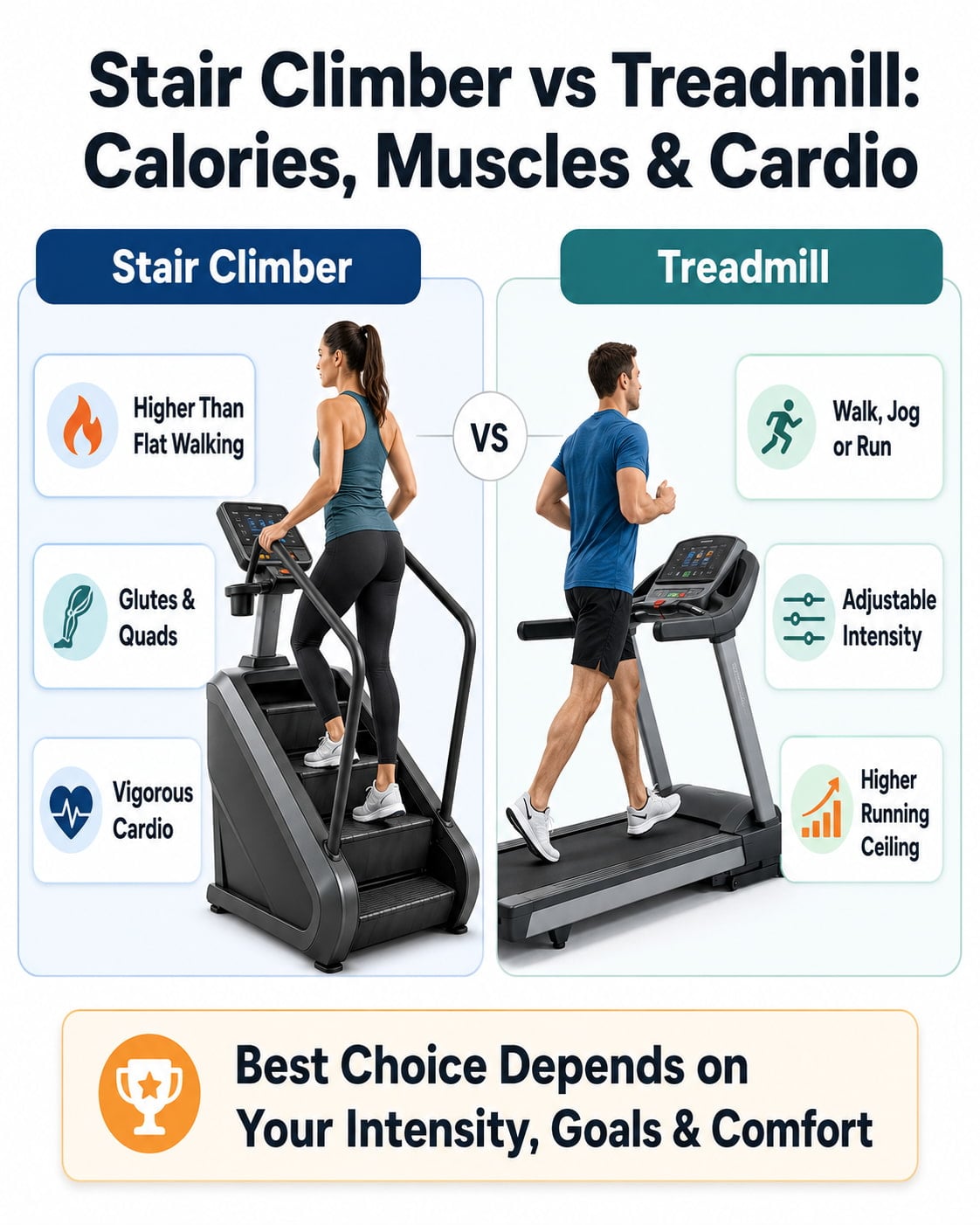
A stair climber generally burns more calories than flat treadmill walking and places greater demand on your glutes and quadriceps, while treadmill running can match or exceed it for calorie burn and cardiovascular intensity. The better option depends on your fitness level, joint comfort, workout duration, and whether your main goal is walking, running, or lower-body conditioning.
Both machines can provide an effective cardio workout. The stair climber delivers a demanding, climbing-focused session, while the treadmill gives you more control over speed, incline, impact, and overall workout style.
In this stair climber vs treadmill comparison, “stair climber” refers primarily to a rotating stepmill or stair treadmill. Compact pedal steppers may produce a different workload.
Stair Climber vs Treadmill: Quick Comparison
| Category | Stair Climber | Treadmill |
|---|---|---|
| Main movement | Continuous stair climbing | Walking, jogging, or running |
| Calorie burn | Usually higher than flat walking | Lower during easy walking but potentially higher during running |
| Main muscles | Glutes, quadriceps, hamstrings, and calves | Glutes, quadriceps, hamstrings, calves, hip flexors, and core |
| Cardio intensity | Reaches vigorous intensity quickly | Ranges from gentle walking to intense running |
| Joint demand | No running-style landing impact, but substantial knee demand | Walking is highly adjustable; running creates more impact |
| Glute emphasis | High | Moderate when flat; higher with incline |
| Versatility | Limited to stepping patterns | Supports walking, hills, running, and intervals |
| Beginner-friendly | Can feel difficult quickly | Walking speed can be increased gradually |
| Best for | Lower-body endurance and time-efficient cardio | General cardio, running, longer workouts, and gradual progression |
The basic conclusion is simple: choose the stair climber when you want intense stepping and greater glute and quadriceps involvement. Choose the treadmill when you want more control, variety, or running-specific training.
What Is the Difference Between a Stair Climber and a Treadmill?
A stair climber uses moving steps that require you to repeatedly lift your body upward. Each step involves hip extension, knee extension, and ankle movement. This creates continuous demand on the large muscles of the lower body.
A treadmill moves a belt underneath you. You can walk, jog, or run while adjusting the speed and incline. That makes it easier to create anything from a gentle recovery walk to an intense running workout.
The stair climber usually feels harder at a slower movement speed because you are continuously working against gravity. The treadmill has a much wider intensity range.
Stair Climber vs Treadmill Calories
Calorie burn depends on more than the machine. Your body weight, pace, incline, step rate, fitness level, workout duration, and handrail use all affect the result.
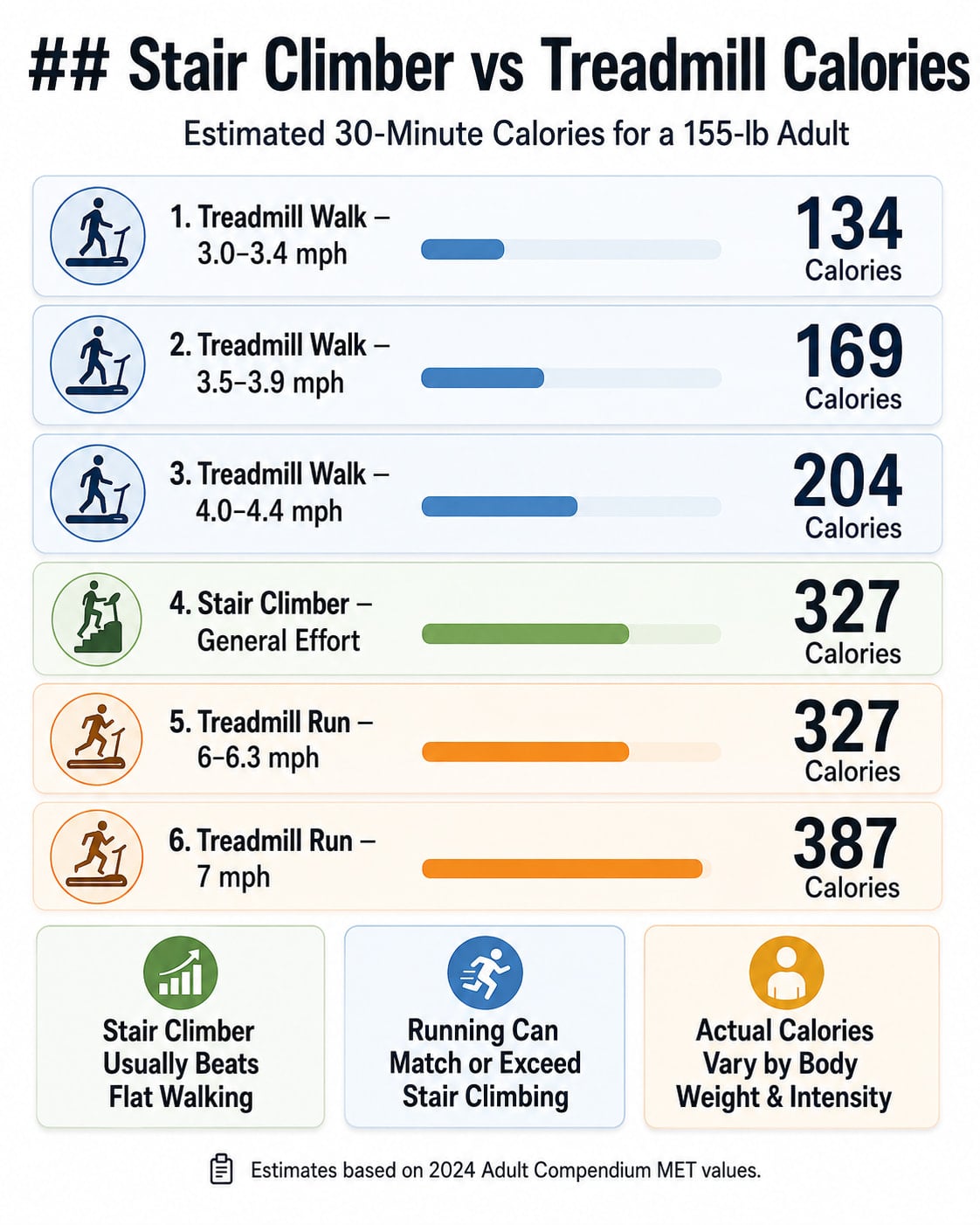
The 2024 Adult Compendium of Physical Activities assigns standardized metabolic equivalent, or MET, values to different activities. It lists general stair-treadmill exercise at 9.3 METs. By comparison, level treadmill walking ranges from approximately 3.8 METs at 3.0–3.4 mph to 5.8 METs at 4.0–4.4 mph. Running at about 6–6.3 mph is also listed at 9.3 METs, while running at 7 mph is listed at 11 METs.
Estimated Calories Burned in 30 Minutes
The following estimates are for a person weighing approximately 155 pounds. They are calculated using the Compendium definition of one MET as roughly one calorie per kilogram of body weight per hour.
| Activity | MET Value | Estimated Calories in 30 Minutes |
|---|---|---|
| Treadmill walking at 3.0–3.4 mph, 0% incline | 3.8 | 134 |
| Treadmill walking at 3.5–3.9 mph, 0% incline | 4.8 | 169 |
| Treadmill walking at 4.0–4.4 mph, 0% incline | 5.8 | 204 |
| Stair treadmill or stepmill, general use | 9.3 | 327 |
| Treadmill running at 6–6.3 mph | 9.3 | 327 |
| Treadmill running at 7 mph | 11.0 | 387 |
These numbers are general estimates, not guaranteed personal results. A slower stair-climber pace may burn less, while a fast pace may burn more. Treadmill incline can also substantially increase the energy cost of walking.
To roughly adjust the table for your body weight, multiply the listed calories by your weight and divide by 155. For example, a person weighing 200 pounds would multiply the estimate by approximately 1.29.
Which Machine Burns More Calories?
The answer depends on what you do on the treadmill:
- Stair climber vs flat treadmill walking: The stair climber generally burns more calories per minute.
- Stair climber vs incline treadmill walking: The result depends on the incline, speed, and stair-climber level.
- Stair climber vs treadmill running: Running can match or exceed stair-climber calorie burn.
- Equal workout intensity: Calorie expenditure may be similar when your actual oxygen consumption and effort are similar.
A 2024 comparison of seven indoor cardio machines found that the treadmill produced the highest energy expenditure, oxygen consumption, and heart rate at very hard and maximal intensities. The stair climber ranked second. However, the study included only 30 experienced, recreationally active men ages 35–49, so the ranking should not be applied to every exerciser or workout.
Calorie winner: The stair climber wins against ordinary treadmill walking, but treadmill running has the higher maximum calorie-burning potential.
Stair Climber vs Treadmill Muscles Worked
Both machines train the lower body, but they emphasize the muscles differently.
Muscles Worked on the Stair Climber
The primary stair climber muscles include:
- Gluteus maximus
- Quadriceps
- Hamstrings
- Calves
- Hip-stabilizing muscles
- Core muscles that help maintain posture
The quadriceps straighten your knee as you rise to the next step. Your glutes and hamstrings help extend the hip, while your calf muscles assist with ankle movement and support.
Your glutes work most effectively when you place enough of your foot on the step, maintain a tall posture, and avoid supporting your body weight heavily on the handrails.
The stair climber primarily develops muscular endurance. Although it may help your legs feel stronger, it does not provide the same progressive resistance or muscle-building potential as exercises such as squats, deadlifts, lunges, and leg presses.
Muscles Worked on the Treadmill
Treadmill walking and running use:
- Quadriceps
- Hamstrings
- Glutes
- Calves
- Hip flexors
- Core and pelvic stabilizers
Flat walking provides a relatively balanced and moderate lower-body workload. Running increases the demand on the calves, hamstrings, glutes, and muscles responsible for absorbing and producing force.
Incline walking changes the emphasis. Research on incline treadmill walking reports increased activity in the quadriceps, hamstrings, and calf muscles compared with level walking. Hip- and knee-extensor demands also rise as the incline increases.
Which Is Better for Glutes and Legs?
The stair climber generally provides the stronger glute and quadriceps challenge, particularly when compared with level treadmill walking.
However, incline treadmill walking can narrow the difference. A sufficiently challenging incline requires your glutes, hamstrings, quadriceps, and calves to work harder without requiring you to run.
Muscle winner: Choose the stair climber for concentrated glute and quadriceps endurance. Choose the incline treadmill for a more adjustable lower-body workout.
Stair Climber vs Treadmill for Cardio
Both machines can improve cardiovascular fitness when used regularly at an appropriate intensity.
The stair climber often raises your breathing and heart rate quickly because every step moves your body upward. It is useful when you want to reach a challenging intensity without running at a high speed.
The treadmill provides a broader range of cardiovascular options. You can use it for:
- Easy recovery walking
- Moderate steady-state cardio
- Brisk incline walking
- Jogging
- Long-distance running
- Sprint intervals
- Hill intervals
Which Produces a Harder Cardio Workout?
The stair climber is usually harder than level treadmill walking at a comparable comfortable pace. Many people reach vigorous intensity within a few minutes of continuous climbing.
Treadmill running, however, has a higher intensity ceiling. The 2024 cardio-machine comparison found that the treadmill produced higher average energy expenditure, oxygen consumption, and heart rate than the stair climber during very hard and maximal efforts.
That does not mean the treadmill always improves fitness more. A randomized 12-week study involving 22 moderately active women found similar cardiorespiratory improvements among treadmill-running, stair-climber, and elliptical groups when training volume and intensity were comparable.
Use the Talk Test to Measure Intensity
You do not need laboratory equipment to estimate your workout intensity.
- Moderate intensity: You can talk, but singing would be difficult.
- Vigorous intensity: You can say only a few words before needing to pause for breath.
Adjust the speed, incline, or stair-climber level until the effort matches your current goal.
Cardio winner: The treadmill offers greater versatility and maximum intensity, while the stair climber offers time-efficient, vigorous cardio without requiring fast running.
Which Is Better for Weight Loss?
Neither machine guarantees weight loss. Exercise supports weight management by increasing energy expenditure, but results depend on your total activity, eating habits, sleep, recovery, and consistency.
The CDC explains that physical activity and reduced calorie intake work together to create the calorie deficit required for weight loss. It also notes that the amount of activity needed for weight management varies among individuals.
The stair climber may help you burn more calories in a short session than flat treadmill walking. However, that advantage can disappear when:
- You can remain on the treadmill much longer.
- You run or use a challenging incline.
- The stair climber causes excessive fatigue.
- You lean heavily on the stair-climber rails.
- You cannot recover well enough to exercise consistently.
For example, a demanding 15-minute stair-climber session may burn fewer total calories than a comfortable 45-minute treadmill walk, even if the stair climber burns more per minute.
Weight-Loss Verdict
Choose the machine that allows you to exercise consistently, progress safely, and accumulate enough weekly activity.
- Choose the stair climber for shorter, more intense sessions.
- Choose the treadmill for longer walks, running, or greater workout variety.
- Use both to prevent boredom and manage fatigue.
Neither machine can selectively burn belly fat. Fat loss occurs throughout the body according to overall energy balance, genetics, and individual physiology.
Which Is Easier on the Knees and Joints?
The stair climber is sometimes described as low-impact because it avoids the repeated airborne landing phase of running. However, low impact does not mean low joint demand.
Stair climbing requires repeated knee flexion and strong quadriceps contractions. Biomechanical research found that stair-climbing loads created more challenging patellofemoral contact mechanics than level walking, particularly at greater knee-flexion angles.
Treadmill Walking
Treadmill walking is generally the easiest option to adjust for beginners or people who do not tolerate running or stair climbing well. You can reduce the speed, remain at a low incline, and stop immediately when needed.
Treadmill Running
Running creates greater repeated landing forces than walking. New runners may need time to adapt their feet, ankles, calves, knees, and hips to that workload.
Stair Climber
The stair climber avoids running-style impact, but it can still irritate knees that are sensitive to stairs, deep knee bending, or repeated loaded flexion. It also requires balance and continuous lower-body control.
Incline Treadmill Walking
Incline walking increases muscular and cardiovascular demand without requiring running. However, steep grades still change joint mechanics and can place greater demand on the calves, Achilles tendons, hips, and knees.
Joint-comfort winner: Treadmill walking is usually the most adjustable starting option. The best individual choice is the movement you can perform without worsening pain or changing your natural form.
Stop exercising and seek appropriate medical guidance if you develop chest pain, unusual shortness of breath, dizziness, faintness, or persistent joint pain. People with cardiovascular conditions, balance problems, recent injuries, or significant joint disease may need personalized exercise guidance.
Is the Stair Climber or Treadmill Better for Beginners?
The treadmill is usually easier for beginners because it allows gradual progression. You can begin with slow, level walking and increase only one variable at a time.
The stair climber can become difficult quickly. Beginners often compensate by leaning heavily on the handrails, taking incomplete steps, or moving faster than they can control.
A sensible starting approach is:
Beginner Treadmill Starting Point
- Walk for 10–20 minutes.
- Choose a pace that feels comfortable but purposeful.
- Keep the incline between 0% and 2% initially.
- Add two to five minutes as your endurance improves.
- Increase speed or incline only after the current workout feels manageable.
Beginner Stair Climber Starting Point
- Begin with 5–10 minutes at a low level.
- Use a slow, controlled step rate.
- Keep your torso tall.
- Touch the handrails lightly for balance.
- Add one or two minutes before making the machine faster.
You do not need to finish an exhausting workout for it to be effective. Starting below your maximum ability makes it easier to recover and exercise regularly.
How to Use Proper Form on Each Machine
Stair Climber Form Tips
- Stand tall rather than folding over the console.
- Place most or all of your foot securely on each step.
- Push through the working leg without bouncing.
- Keep your knees tracking in the same direction as your toes.
- Use the handrails lightly instead of supporting your body weight.
- Reduce the level when you can no longer control each step.
Leaning heavily on the rails reduces lower-body work and can make the machine’s calorie estimate less representative of your actual effort.
Treadmill Form Tips
- Walk or run near the center of the belt.
- Look forward instead of down at your feet.
- Maintain a natural stride rather than reaching far forward.
- Allow your arms to swing naturally.
- Avoid holding the rails during normal walking or running.
- Use the safety clip when one is available.
- Increase speed and incline gradually.
Your posture should remain controlled throughout the workout. A setting is too difficult when you must grip the rails, overstride, or repeatedly lose your position on the machine.
Simple 20-Minute Stair Climber Workout
This beginner-friendly workout alternates controlled steady climbing with brief increases in effort.
| Time | Effort |
|---|---|
| 0–3 minutes | Easy warm-up |
| 3–13 minutes | Steady moderate pace |
| 13–17 minutes | Alternate 30 seconds faster with 30 seconds easy |
| 17–20 minutes | Easy cooldown |
Use a step rate that allows you to maintain upright posture. During the moderate section, you should be able to speak in short sentences.
Simple 20-Minute Treadmill Workout
This workout can be performed as a brisk walk or easy walk-jog session.
| Time | Effort |
|---|---|
| 0–4 minutes | Easy walk |
| 4–12 minutes | Brisk walk at 1%–3% incline |
| 12–16 minutes | Alternate 1 minute faster with 1 minute easy |
| 16–20 minutes | Easy cooldown walk |
The exact speed is not important. Choose a pace that raises your breathing while allowing you to maintain natural form.
Which Machine Should You Choose?
Your goal should guide your decision.
Choose the Stair Climber When You Want To:
- Emphasize your glutes and quadriceps
- Burn more calories than flat walking in the same amount of time
- Reach vigorous intensity quickly
- Improve stair-climbing endurance
- Complete a shorter, demanding workout
- Avoid running while still performing challenging cardio
Choose the Treadmill When You Want To:
- Begin with gentle or moderate walking
- Train specifically for running
- Perform longer steady-state workouts
- Adjust intensity gradually
- Use a wide range of speeds and inclines
- Alternate between walking, jogging, hills, and intervals
- Reduce the difficulty quickly when fatigued
Use Both When You Want To:
- Add variety to your cardio routine
- Reduce overuse from repeating one movement
- Combine longer workouts with shorter intense sessions
- Train both running and climbing fitness
- Keep exercise more interesting
How Much Stair Climber or Treadmill Exercise Should You Do?
The current Physical Activity Guidelines for Americans recommend that adults work toward 150–300 minutes of moderate-intensity aerobic activity or 75–150 minutes of vigorous-intensity activity each week. Adults should also complete muscle-strengthening activity involving the major muscle groups on at least two days per week.
You do not need to reach the full recommendation immediately. Start with an amount you can complete safely, then gradually add time, frequency, speed, or incline.
Because both machines primarily provide aerobic and muscular-endurance training, include separate resistance exercises for complete strength development.
Frequently Asked Questions
Does the stair climber burn more calories than the treadmill?
The stair climber generally burns more calories than flat treadmill walking at common exercise speeds. Treadmill running can match or exceed stair-climber calorie burn, and challenging incline walking may narrow the difference.
Is the stair climber or treadmill better for weight loss?
Either machine can support weight loss. The stair climber may burn more calories per minute than walking, while the treadmill may allow longer workouts and offers running as a higher-intensity option. Consistency and total energy balance matter more than the machine alone.
Which machine is better for losing belly fat?
Neither machine specifically targets belly fat. Both can increase calorie expenditure, but fat loss depends on maintaining an overall calorie deficit. Where your body loses fat first is influenced partly by genetics and physiology.
Does the stair climber build your glutes?
The stair climber strongly engages the glutes and may improve their muscular endurance. It may also support some muscle development in beginners, but progressive resistance exercises such as squats, lunges, step-ups, and hip thrusts are more effective for substantial glute growth.
Is 20 minutes on the stair climber enough?
Twenty minutes can provide a meaningful cardio workout, especially at moderate or vigorous intensity. It can count toward your weekly aerobic activity goal. Beginners may benefit from starting with shorter sessions and increasing the duration gradually.
Is a stair climber or treadmill better for bad knees?
Treadmill walking is often easier to adjust and may be more comfortable than stair climbing. However, knee conditions differ. Stair climbing involves greater knee flexion and quadriceps demand, while running creates greater landing impact. Choose the pain-free option and seek professional guidance for persistent symptoms.
Can incline treadmill walking replace the stair climber?
Incline treadmill walking can provide a similar cardiovascular challenge while increasing glute, hamstring, quadriceps, and calf involvement. It does not exactly reproduce continuous stepping, but it is a practical alternative for people who prefer walking or want more control over the workload.
Conclusion
The stair climber is generally better than flat treadmill walking for calorie burn, glute engagement, and time-efficient lower-body cardio. The treadmill is more versatile and can range from gentle walking to intense running, giving it the higher overall calorie and cardio ceiling.
Choose the stair climber for concentrated stepping and leg endurance. Choose the treadmill for walking, running, gradual progression, or longer workouts. Combining both can give you variety while helping you build a more balanced and sustainable cardio routine.
Start with a manageable pace, use controlled form, and increase only one workout variable at a time.
References
- 2024 Adult Compendium of Physical Activities — Conditioning Exercise
- 2024 Adult Compendium of Physical Activities — Walking
- 2024 Adult Compendium of Physical Activities — Running
- Frontiers in Sports and Active Living — Energy Expenditure Across Seven Cardio Machines
- PubMed — Stair Climber, Elliptical, and Treadmill Training Comparison
- PMC — Incline Walking and Lower-Extremity Mechanics
- PubMed — Stair Climbing Versus Level Walking Patellofemoral Mechanics
- CDC — Physical Activity and Weight Management
- ODPHP — Current Physical Activity Guidelines for Americans