
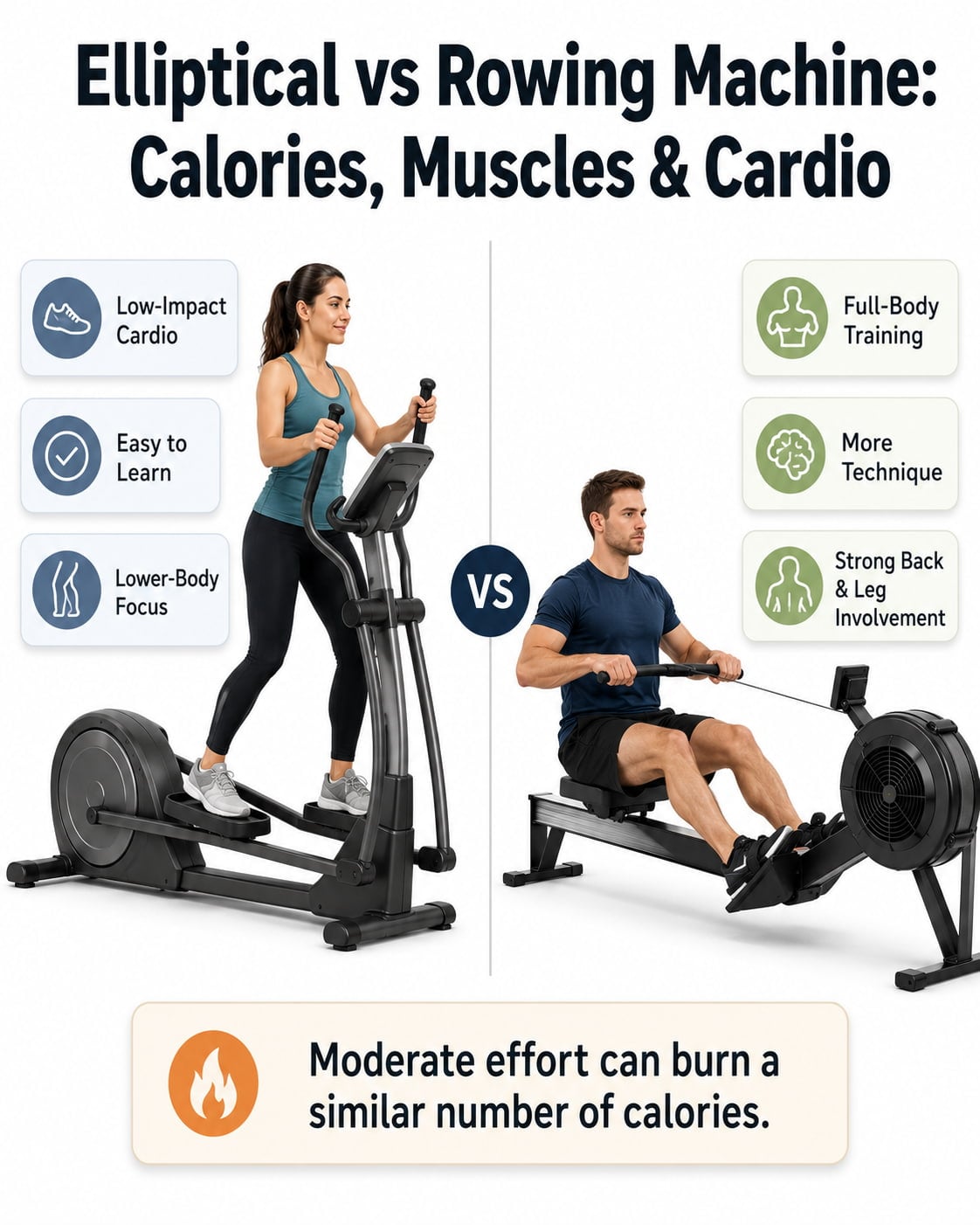
When comparing the elliptical vs rowing machine, the elliptical is usually easier for sustained low-impact cardio, while the rowing machine provides greater total-body muscle involvement. At moderate effort, however, the two machines can burn a similar number of calories.
The better option depends on your workout intensity, technique, joint comfort, balance, and personal preference. Choose the elliptical for simple standing cardio with a lower learning curve. Choose the rower when you want to involve your legs, hips, core, back, arms, and grip in one coordinated movement.
Elliptical vs Rowing Machine: Quick Comparison
| Category | Elliptical | Rowing machine |
|---|---|---|
| Moderate calorie burn | About 185 calories in 30 minutes for a 155-pound adult | About 185 calories below 100 watts for a 155-pound adult |
| Main muscles | Quadriceps, glutes, hamstrings, calves | Quadriceps, glutes, hamstrings, back, core, shoulders, arms, and grip |
| Upper-body involvement | Light to moderate when you actively use the handles | Substantial pulling and trunk involvement |
| Cardio potential | Moderate or vigorous | Moderate or vigorous |
| Impact level | Low impact and weight-bearing | Low impact and seated |
| Learning curve | Relatively simple | Requires more technique and coordination |
| Balance requirement | Requires standing balance | Seated position may feel more stable |
| Best for | Steady cardio, beginners, and lower-body endurance | Full-body conditioning, intervals, and posterior-chain involvement |
The 2024 Adult Compendium of Physical Activities assigns both moderate elliptical exercise and moderate rowing below 100 watts a value of 5.0 metabolic equivalents, or METs. That means their estimated energy costs are similar when the intensity is truly comparable.
Elliptical vs Rowing Machine Calories
Neither machine automatically burns more calories in every workout.
Calorie expenditure depends on:
- Your body weight
- Workout duration
- Resistance or rowing power
- Movement speed
- Technique
- Fitness level
- How consistently you maintain the effort
A casual rowing session may burn fewer calories than a hard elliptical workout. A high-power rowing session may burn considerably more than moderate elliptical exercise.
Estimated Calories Burned in 30 Minutes
The following estimates are for a 155-pound adult. They were calculated from the 2024 Adult Compendium’s MET values using the formula:
Calories per minute = MET × 3.5 × body weight in kilograms ÷ 200
| Exercise and intensity | MET value | Estimated calories in 30 minutes |
|---|---|---|
| Elliptical, moderate effort | 5.0 | About 185 |
| Rowing below 100 watts, moderate effort | 5.0 | About 185 |
| Rowing, general vigorous effort | 7.3 | About 269 |
| Rowing at 100–149 watts | 7.5 | About 277 |
| Elliptical, vigorous effort | 9.0 | About 332 |
| Rowing at 150–199 watts | 11.0 | About 406 |
| Rowing at 200 watts or more | 14.0 | About 517 |
The Compendium classifies rowing at 200 watts or more as very vigorous. Maintaining that output for 30 minutes would be extremely demanding for many recreational exercisers, so the 517-calorie estimate should not be viewed as a typical beginner workout.
These figures are estimates rather than guaranteed results. Your actual calorie expenditure can differ, and the number displayed on a machine’s console may not match a standardized MET calculation.
Does Research Show That One Burns More?
A 2024 study comparing indoor cardio machines found that the elliptical produced a higher average energy expenditure than the rower under the study’s specific conditions.
At a perceived exertion of 17 out of 20, described as very hard:
- Elliptical: 12.82 calories per minute
- Rowing machine: 11.45 calories per minute
At maximum effort:
- Elliptical: 14.67 calories per minute
- Rowing machine: 13.46 calories per minute
However, this does not prove that the elliptical always burns more. The study involved only 30 recreationally active men between ages 35 and 49 who had more than 10 years of indoor cardio experience. They completed short 12-minute bouts at very hard or maximum intensity. The authors also identified the male-only sample and indirect measurement methods as limitations.
The practical conclusion is simple: compare the intensity you can realistically maintain, not just the name of the machine.
Muscles Worked on an Elliptical
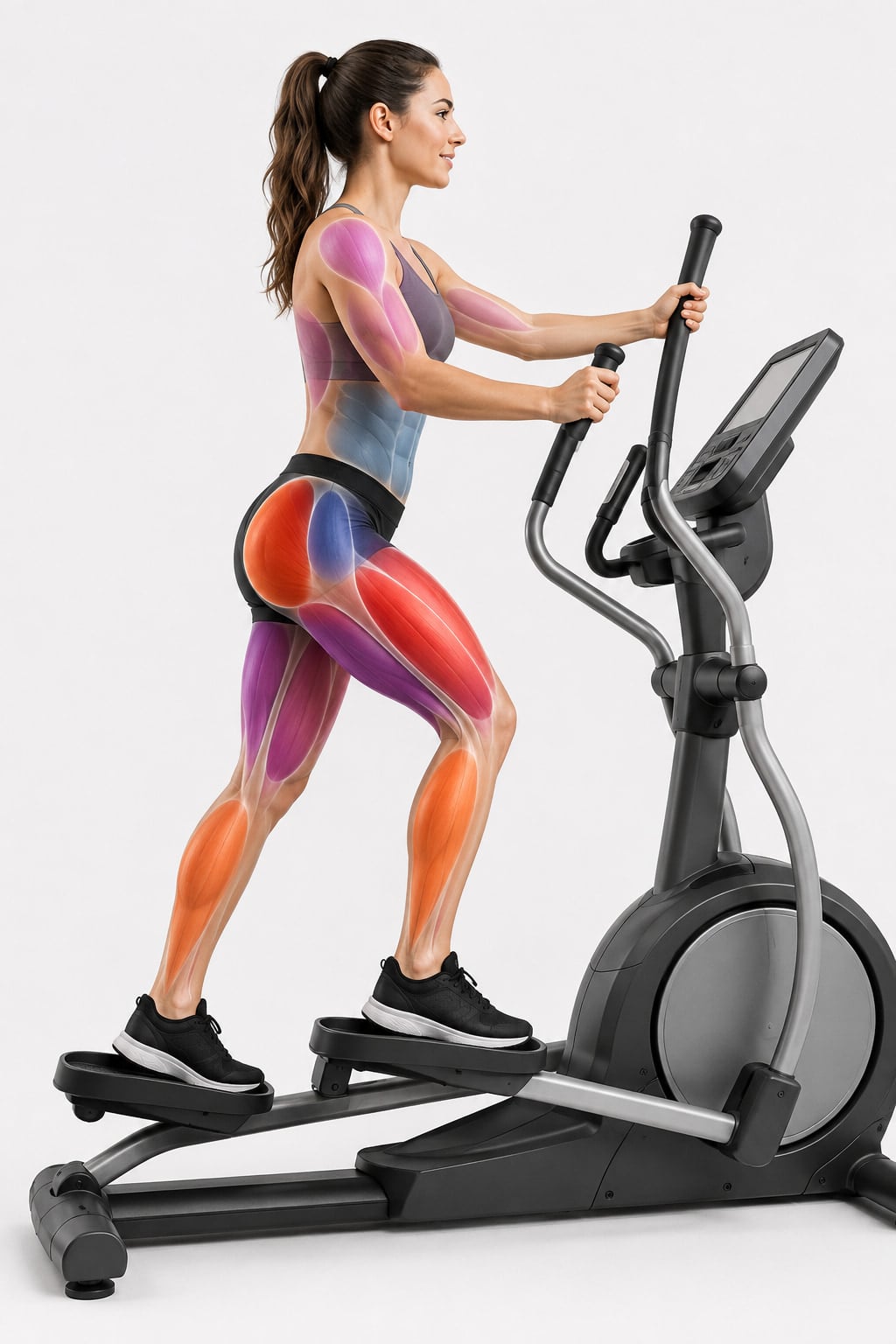
The elliptical is primarily a lower-body cardio machine.
Primary Elliptical Muscles Worked
The main muscles include:
- Quadriceps: Straighten your knees as you press the pedals.
- Gluteus maximus: Helps extend your hips as you drive the pedals backward and downward.
- Hamstrings: Assist with hip extension and controlled pedal movement.
- Calves: Contribute to ankle control and force transfer.
- Hip stabilizers: Help control your pelvis while you remain upright.
The exact muscle demand changes with the machine’s stride path, ramp angle, resistance, speed, and your posture.
An elliptical can also require meaningful work from the hips and knees. One biomechanical study found lower vertical forces and lower heel-strike loading rates than walking, but it also found greater hip-flexor and knee-extensor moments. This is why low impact should not be interpreted as no muscular or joint demand.
Does the Elliptical Work the Upper Body?
Moving handles can involve your:
- Shoulders
- Upper back
- Chest
- Biceps
- Triceps
- Core
You must actively push and pull the handles to create meaningful upper-body effort. Holding them loosely while allowing your legs to do all the work provides much less upper-body training.
Hospital for Special Surgery describes the elliptical as a weight-bearing, low-impact machine and notes that moving handles can involve the arms, chest, and shoulders. The standing position also requires coordination and balance, which may be challenging for some users.
Although the elliptical can involve both the upper and lower body, the legs normally perform most of the work.
Muscles Worked on a Rowing Machine
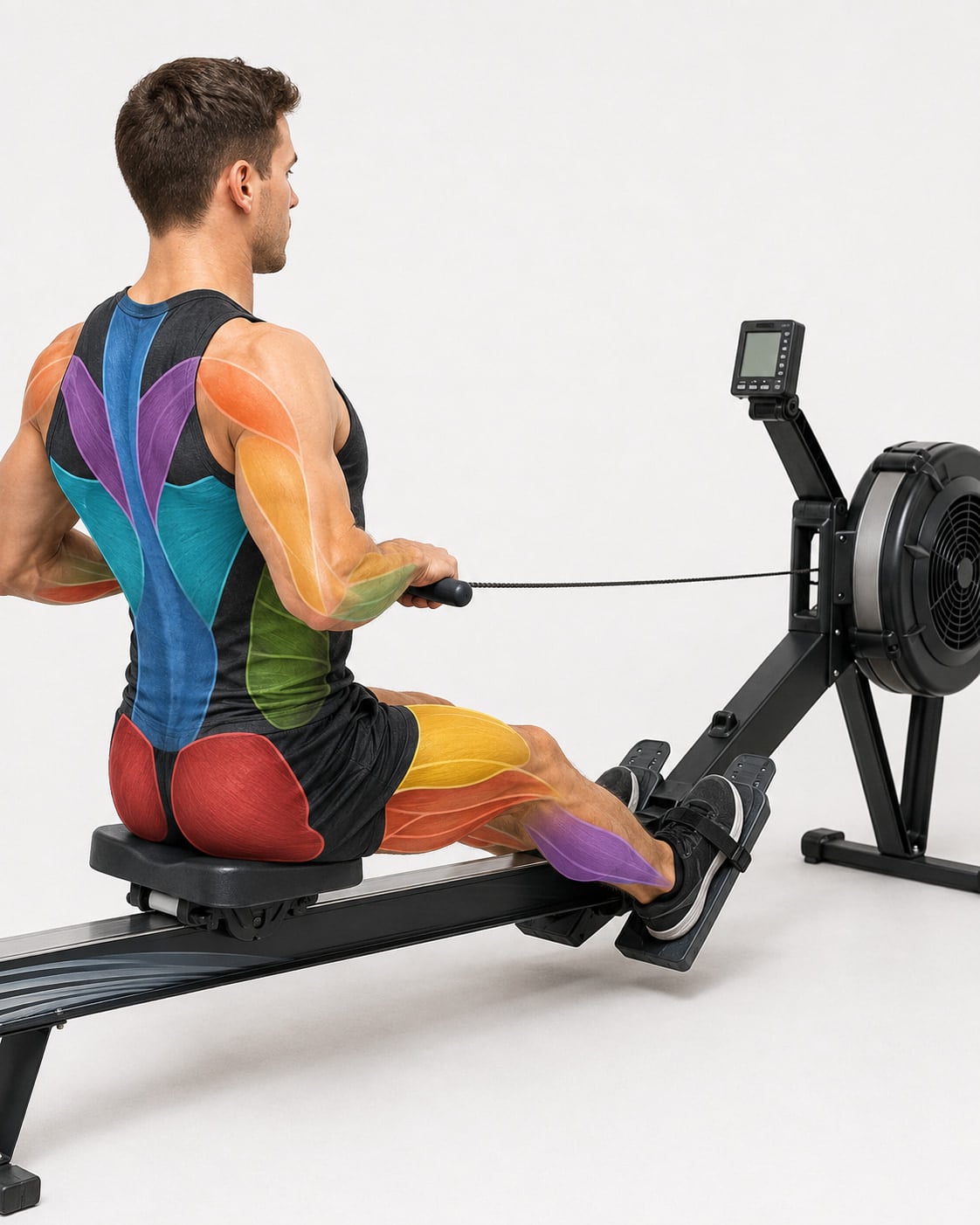
A rowing machine involves a larger combination of lower-body, trunk, back, and arm muscles.
A review of rowing physiology reported that rowing involves almost all major muscles during the stroke and can produce a substantial oxygen demand at higher intensities.
Lower-Body Muscles
Your lower body initiates the rowing drive.
The main muscles include:
- Quadriceps
- Gluteus maximus
- Hamstrings
- Calves
The quadriceps extend your knees as you push away from the front of the machine. Your glutes and hamstrings contribute as your hips open and your body moves toward the finish position.
Back and Shoulder Muscles
As the drive continues, the upper back helps pull the handle toward your body.
The main muscles include:
- Latissimus dorsi
- Rhomboids
- Trapezius
- Rear deltoids
- Spinal erectors
These muscles help move and stabilize the shoulder blades, support the trunk, and complete the pulling portion of the stroke.
Arms, Forearms, and Grip
The final part of the drive uses the:
- Biceps
- Forearms
- Finger and hand muscles
- Grip muscles
Your arms should finish the stroke rather than start it. Pulling early with the arms reduces the contribution from the larger leg and hip muscles.
Core Muscles
Your abdominals, obliques, and spinal stabilizers help transfer force between your lower and upper body.
The core does not remain completely still. It controls the forward hip hinge, supports the body as it opens during the drive, and helps prevent uncontrolled rounding or overextension.
Which Machine Provides the Better Full-Body Workout?
The rowing machine provides the more complete full-body workout.
It combines:
- Leg extension
- Hip extension
- Trunk stabilization
- Upper-back pulling
- Elbow flexion
- Grip endurance
The elliptical can include the arms, but its upper-body resistance is generally less demanding than the pulling and stabilization required during rowing.
Correct rowing technique is also more than pulling a handle back and forth. The British Rowing technique guide recommends this movement sequence during the drive:
Legs → body → arms
The recovery reverses the order:
Arms → body → legs
Starting with the legs allows the larger lower-body muscles to create most of the initial force. It also helps prevent an inefficient, arm-dominant stroke.
Can Either Machine Replace Strength Training?
Neither machine should completely replace resistance training.
Elliptical and rowing workouts can improve muscular endurance, especially when you use appropriate resistance. However, they do not provide the same progressive loading or exercise variety as squats, hinges, presses, rows, and other resistance exercises.
Current CDC guidance recommends that adults perform muscle-strengthening activities that work all major muscle groups on at least two days each week, in addition to aerobic activity.
Elliptical vs Rowing Machine for Cardio
Both machines can provide effective cardiovascular exercise.
The elliptical may be easier for continuous steady-state cardio because its guided movement pattern requires less technical coordination. You can adjust the resistance, ramp, or pace while maintaining a relatively consistent rhythm.
Rowing can also create a substantial cardiovascular demand because the legs, hips, trunk, back, and arms work together. However, beginners may become limited by technique or local muscle fatigue before their cardiovascular system reaches the intended training intensity.
How to Measure Your Workout Intensity
The CDC’s talk test offers a simple way to judge effort:
- Moderate intensity: You can talk but not sing.
- Vigorous intensity: You can say only a few words before pausing for a breath.
You can also use a perceived-exertion scale from 0 to 10:
- Moderate effort: approximately 5 or 6
- Vigorous effort: approximately 7 or 8
- Maximum effort: approximately 10
The CDC recommends at least 150 minutes of moderate-intensity aerobic activity, 75 minutes of vigorous activity, or an equivalent combination each week for most adults. Some activity is better than none, and the total can be divided into smaller sessions.
Which Is Better for Improving Cardio Fitness?
There is no universal winner.
Choose the machine that allows you to:
- Reach an appropriate breathing and heart-rate response
- Maintain good technique
- Complete enough weekly exercise
- Increase the challenge gradually
- Recover without persistent pain
- Stay consistent over time
A technically poor rowing workout is not automatically better than a controlled elliptical session simply because rowing uses more muscles.
Which Machine Is More Joint-Friendly?
Both machines are considered low impact because neither involves the repeated landing forces associated with running. However, they place stress on the body in different ways.
Elliptical Joint Considerations
Your feet remain in contact with the pedals, which reduces heel-strike loading. This can make the elliptical a useful alternative for people who want cardio without repeated running impact.
However, the elliptical still requires:
- Repeated knee and hip movement
- Standing balance
- Control through a fixed machine path
- Enough hip and knee mobility for the stride
- Muscular effort against resistance
Research comparing elliptical exercise with walking found lower vertical reaction forces and loading rates on the elliptical but greater hip-flexor and knee-extensor moments. Someone with knee or hip symptoms may therefore tolerate one machine design better than another.
Rowing Joint and Back Considerations
Rowing is seated and does not involve landing forces. It may feel more comfortable for people who want to avoid standing impact or who feel less secure balancing on an elliptical.
However, rowing involves repeated:
- Knee flexion
- Hip flexion
- Hip extension
- Trunk movement
- Upper-body pulling
Reaching too far at the catch, rounding the lower back, pulling before the legs drive, or continuing after technique deteriorates can make the movement less efficient.
A systematic review found that fatigue increased lumbar-spine flexion at the catch in rowers and that this increase was greater on an ergometer. The review also found biomechanical differences between rowers with and without low-back pain, although most of the available research involved trained rowers rather than casual gym users.
Elliptical or Rower for Bad Knees?
There is no single answer for every knee condition.
The elliptical avoids landing impact, but the knee repeatedly bends and straightens against resistance. Rowing also avoids landing impact but usually requires deeper knee flexion at the front of the stroke.
A shorter rowing slide, lower resistance, or smaller elliptical stride may feel more comfortable, but modifications should match the person’s condition and professional guidance.
Elliptical or Rower for Lower-Back Sensitivity?
The elliptical allows a more upright position, but users should avoid leaning heavily on the handles or allowing the pelvis to shift excessively.
The rower requires good hip movement and trunk control. People who repeatedly round their lower backs or lack comfortable hip flexion may find rowing more challenging.
Stop the workout and seek appropriate medical guidance if either machine causes sharp pain, increasing numbness, weakness, dizziness, chest discomfort, or symptoms that do not settle after exercise.
Elliptical vs Rowing Machine for Weight Loss
Both machines can support a weight-loss program by increasing energy expenditure.
The more useful question is not which machine has the highest theoretical calorie value. It is which one allows you to accumulate enough comfortable, challenging activity week after week.
According to the CDC’s guidance on physical activity and body weight, physical activity increases the number of calories your body uses. Weight loss generally requires a calorie deficit created through a combination of physical activity and changes in food and drink intake. The exact amount of activity needed varies between individuals.
Choose the Elliptical for Weight Loss When:
- You can maintain a steady workout longer.
- You prefer a simple movement pattern.
- Rowing technique limits your workout duration.
- You enjoy standing cardio.
- You want to adjust incline, speed, and resistance easily.
Choose the Rower for Weight Loss When:
- You enjoy full-body workouts.
- You can maintain good technique as you become tired.
- You prefer intervals or performance-based sessions.
- You want measurable targets such as watts, stroke rate, distance, or split time.
- You like combining cardio with muscular endurance.
Neither machine specifically removes abdominal fat. Changes in waist size occur through overall fat loss, not by selecting a machine that works the abdominal muscles more directly.
Which Is Better for Beginners?
The elliptical is usually easier for complete beginners.
The pedals guide your feet through a predictable path, and you can create a useful cardio workout without learning a complex movement sequence.
Start with:
- A comfortable resistance
- A pace that allows controlled breathing
- An upright posture
- Light contact with the handles
- A duration you can complete without losing form
The rowing machine has a greater learning curve, but beginners can still use it effectively. Start slowly and focus on sequencing before speed.
Basic rowing cues include:
- Sit tall with a long spine.
- Lean forward from the hips rather than rounding your back.
- Begin the drive by pressing through your legs.
- Open your hips after the legs have started extending.
- Pull the handle toward the lower ribs only after the leg drive.
- Return the arms before bending the knees.
- Keep the recovery slower and more controlled than the drive.
A high stroke rate does not automatically mean a better rowing workout. Controlled power and repeatable technique are more useful than rushing back and forth on the seat.
Choose the Elliptical If…
The elliptical may fit you better when you:
- Want uncomplicated, low-impact cardio
- Prefer standing exercise
- Enjoy longer steady-state workouts
- Want a lower technical learning curve
- Prefer lower-body-focused conditioning
- Can comfortably balance on the moving pedals
- Want an alternative to running impact
Choose the Rowing Machine If…
The rowing machine may fit you better when you:
- Want greater total-body muscle involvement
- Want to train your back, hips, arms, core, and grip
- Prefer seated cardio
- Enjoy short intervals and performance targets
- Want more posterior-chain involvement
- Are willing to practice proper stroke technique
- Can tolerate repeated hip, knee, and trunk movement
Can You Use Both Machines?
Yes. Alternating the elliptical and rower can add variety and reduce the amount of repetitive work performed on one machine.
A practical approach is to use:
- The elliptical for longer, steady aerobic sessions
- The rower for shorter full-body intervals
- Either machine for moderate cardio, depending on how your body feels that day
Avoid making every session an all-out workout. Easier sessions help you accumulate weekly activity, while harder sessions require more recovery.
Elliptical vs Rowing Machine: Final Verdict
The rowing machine wins for total-body muscle involvement because it directly trains the legs, hips, trunk, back, arms, and grip through a coordinated stroke.
The elliptical wins for simplicity and sustained cardio because its movement is easier to learn and can be maintained without as much technical concentration.
For calorie burn, there is no automatic winner. Moderate elliptical exercise and moderate rowing below 100 watts are both listed at 5.0 METs. Vigorous elliptical exercise may burn more than ordinary vigorous rowing, while high-watt rowing can exceed the elliptical.
Choose the machine that matches your body, goals, and preferences—and that you can use consistently with controlled technique.
Frequently Asked Questions
Does Rowing Burn More Calories Than the Elliptical?
Not always. Moderate elliptical exercise and rowing below 100 watts have the same 5.0-MET value in the 2024 Adult Compendium. High-power rowing can burn more, but a vigorous elliptical workout can burn more than a casual or moderately vigorous rowing session.
Which Machine Works More Muscles?
The rowing machine works more muscle groups. It combines leg drive, hip extension, core stabilization, upper-back pulling, arm work, and grip. The elliptical primarily emphasizes the lower body, although moving handles can add some upper-body involvement.
Is the Elliptical or Rower Better for Losing Belly Fat?
Neither machine can target belly fat directly. Both can increase calorie expenditure and support overall fat loss when combined with an appropriate eating pattern, adequate sleep, and consistent activity.
Is the Elliptical or Rowing Machine Better for Bad Knees?
Both are low impact, but they stress the knees differently. The elliptical avoids landing forces but still creates knee-extensor demand. Rowing is seated but involves repeated and sometimes deep knee flexion. The better choice depends on your symptoms, comfortable range of motion, resistance, and medical guidance.
Can Rowing or Elliptical Exercise Replace Strength Training?
No. Both can improve muscular endurance, but neither replaces a complete resistance-training program. Include separate exercises that progressively train all major muscle groups.
Is 20 or 30 Minutes on Either Machine Enough?
A 20- or 30-minute session can contribute meaningfully to your weekly aerobic activity. The appropriate duration depends on your fitness, intensity, recovery, and total weekly exercise. Beginners can start with shorter sessions and increase gradually.
Can I Use the Elliptical and Rower on the Same Day?
Yes. You can divide one workout between the two machines or use one as a warm-up for the other. Keep the total intensity appropriate and stop if your technique deteriorates or pain develops.
Conclusion
The elliptical and rowing machine are both effective low-impact cardio options, but they serve different strengths. Use the elliptical for accessible, steady cardio and the rower for greater full-body involvement.
Do not choose solely by the highest calorie estimate. Test both machines at a controlled effort, consider which one feels better on your joints, and select the option you are most likely to use consistently.
References
- 2024 Adult Compendium of Physical Activities — Conditioning Exercise
- Compendium of Physical Activities — Unit Conversions
- Energy Expenditure on Seven Indoor Cardio Machines — Frontiers in Sports and Active Living
- CDC Adult Physical Activity Guidelines
- CDC Guide to Measuring Physical Activity Intensity
- CDC Physical Activity and Body Weight Guidance
- The Physiology of Rowing — PubMed
- British Rowing Indoor Rowing Technique
- Joint Loading During Elliptical Exercise — PubMed
- Rowing-Related Low-Back Pain and Biomechanics — PubMed
- Elliptical Benefits — Hospital for Special Surgery