
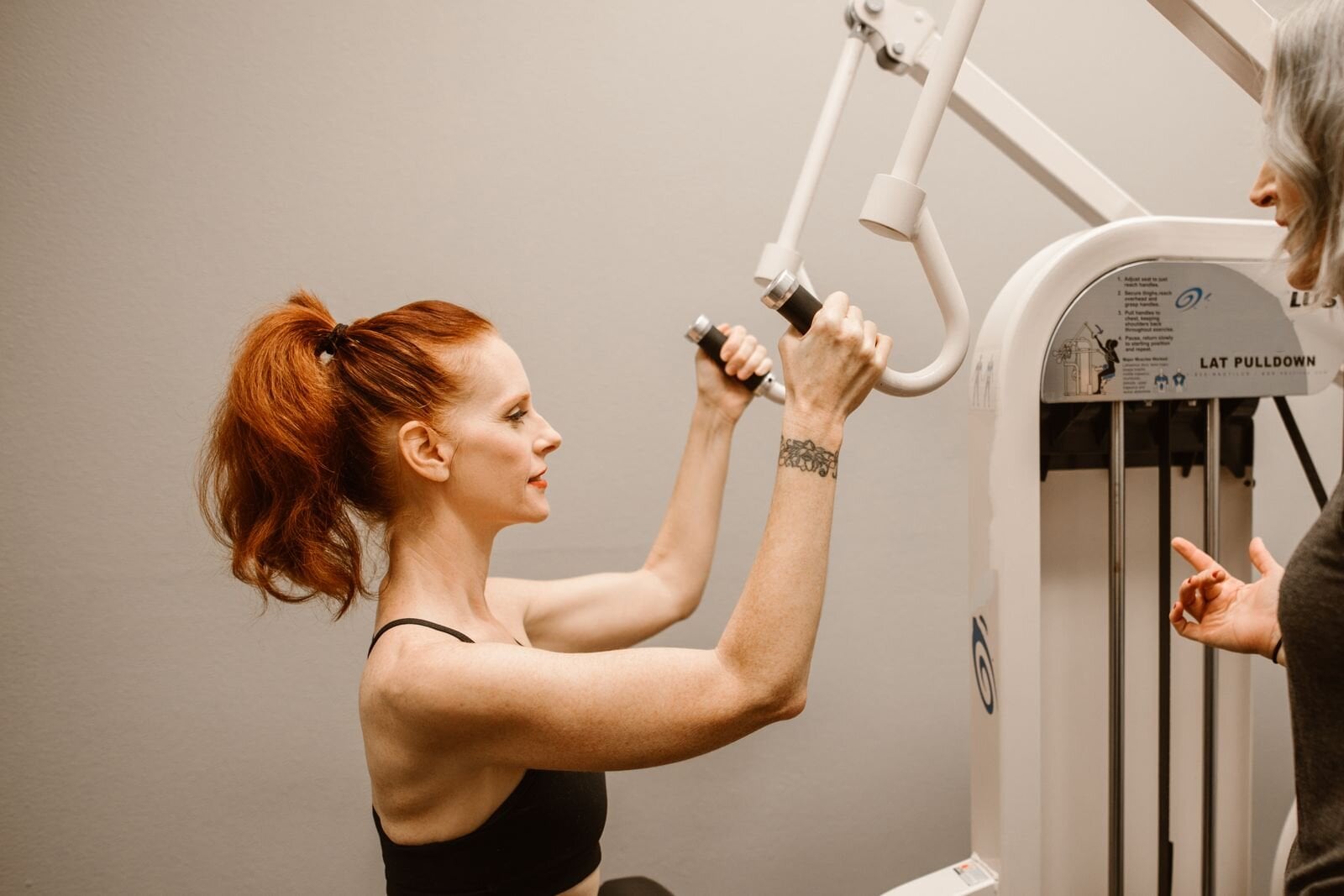
Strength training is exercise that makes your muscles work against resistance, and most adults should train all major muscle groups at least two days per week. You can use your body weight, resistance bands, dumbbells, barbells, kettlebells, cable stations, or weight machines.
For beginners, strength training does not need to be complicated. Start with two full-body workouts per week, learn a few basic movement patterns, and gradually increase the resistance as you become stronger. The current CDC guidance on muscle-strengthening activity recommends working the legs, hips, back, chest, abdomen, shoulders, and arms.
What Is Strength Training?
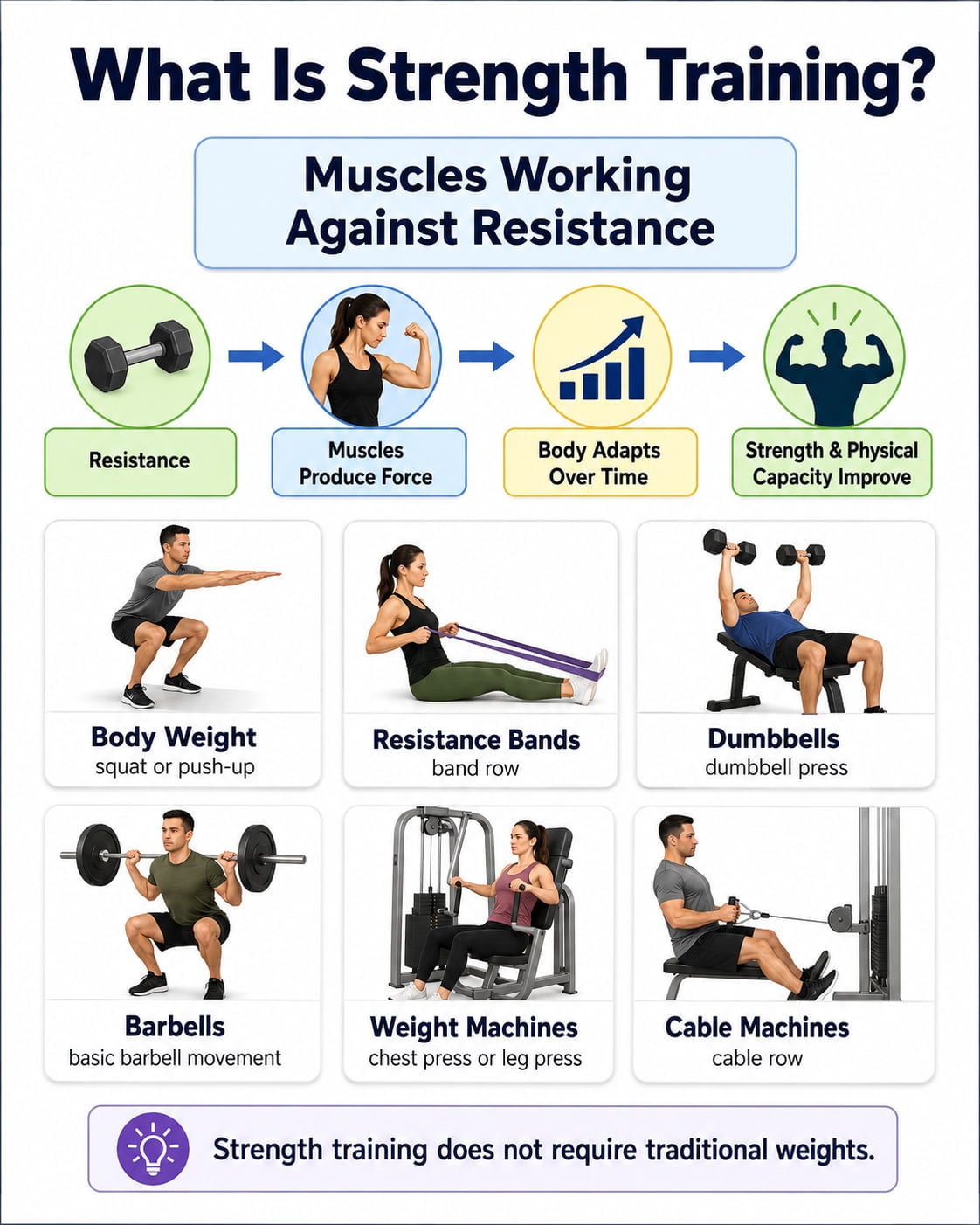
Strength training is a type of physical activity in which your muscles contract against an external force. That force may come from a dumbbell, resistance band, exercise machine, household object, or your own body weight.
The resistance challenges the muscles. Over time, the body adapts by becoming better able to produce force and perform the movement.
Common examples include:
- Squats
- Push-ups
- Rows
- Lunges
- Deadlifts
- Overhead presses
- Resistance-band exercises
- Weight-machine exercises
- Planks and loaded carries
Strength Training vs. Resistance Training
“Strength training” and “resistance training” are often used interchangeably.
Resistance training is the broader term for exercise performed against resistance. Strength training usually describes resistance exercise intended to improve muscular strength, although the same workouts may also improve muscle size, endurance, power, and physical function.
Weight training is one form of strength training that specifically uses weights. You do not need traditional weights to become stronger.
What Counts as Strength Training?
An activity generally counts when it challenges your muscles enough that completing additional repetitions becomes difficult.
Strength training can include:
- Bodyweight exercises: Squats, wall push-ups, step-ups, and planks
- Resistance bands: Rows, presses, pull-aparts, and pulldowns
- Free weights: Dumbbells, barbells, and kettlebells
- Weight machines: Leg presses, chest presses, and lat pulldowns
- Cable machines: Rows, presses, and rotational exercises
- Some physical tasks: Carrying heavy objects or performing demanding yardwork
The resistance method matters less than whether the exercises are safe, challenging, progressive, and performed consistently. The American College of Sports Medicine’s March 2026 update found that bodyweight exercises, bands, free weights, machines, and home-based programs can all be effective.
Benefits of Strength Training
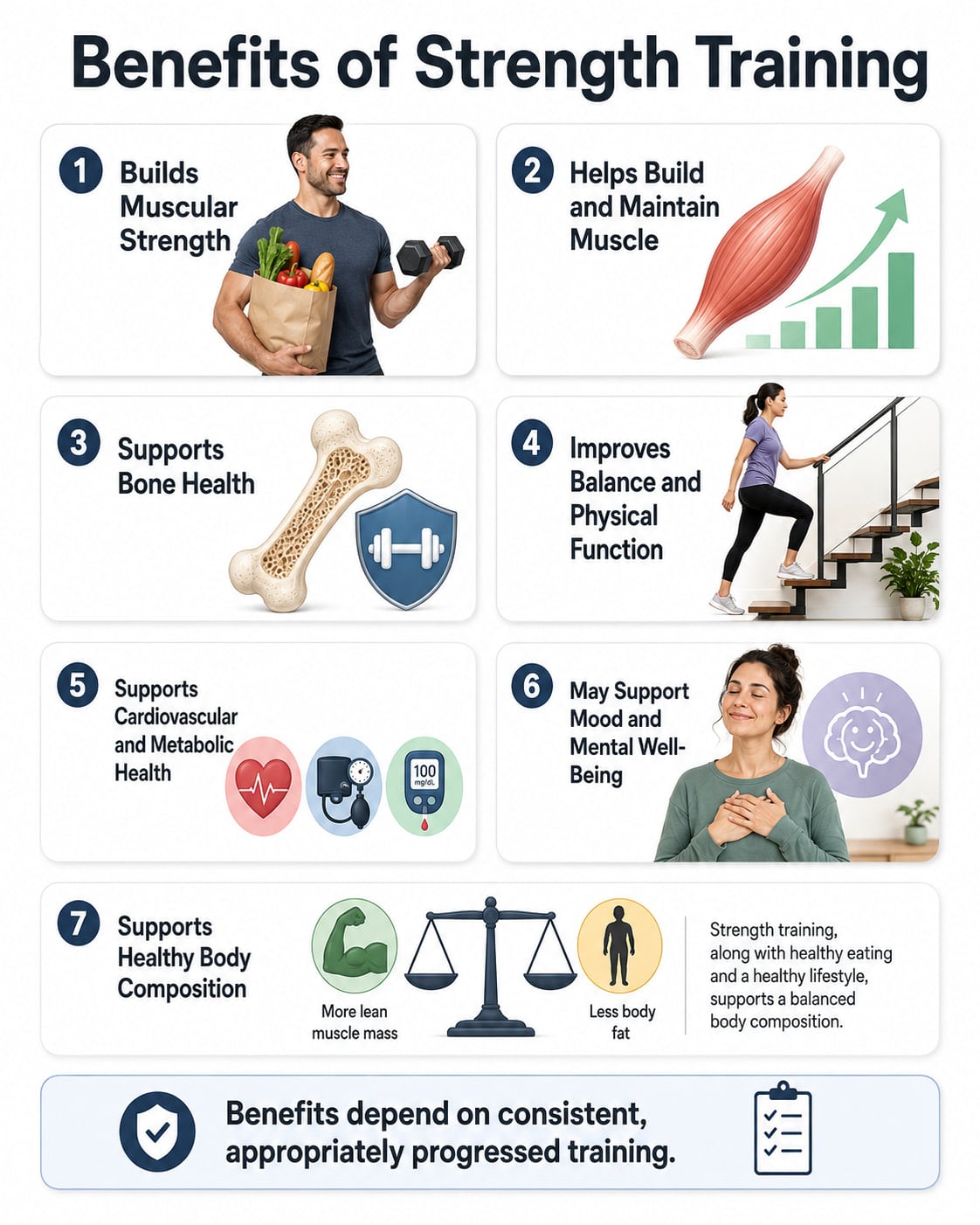
Strength training supports much more than larger muscles. It can improve physical ability, help maintain independence, and complement aerobic exercise as part of a balanced fitness routine.
1. Builds Muscular Strength
Regular resistance exercise improves your muscles’ ability to produce force. This can make everyday activities easier, including:
- Carrying groceries
- Lifting household objects
- Climbing stairs
- Standing up from a chair
- Performing physical work
- Participating in sports and recreation
Beginners often become stronger partly because their nervous system becomes more efficient at coordinating movements. Muscle growth may contribute more as training continues.
2. Helps Build and Maintain Muscle
Strength training provides the stimulus your body needs to build or maintain muscle tissue.
Maintaining muscle becomes increasingly important with age because adults commonly experience gradual losses in muscle mass, strength, and power. These changes can make daily activities more difficult when they become significant.
The National Institute on Aging reports that strength training may help older adults maintain muscle mass, improve mobility, and remain independent.
3. Supports Bone Health
Muscles pull on bones during resistance exercise. This mechanical loading can provide a useful stimulus for maintaining bone strength.
A systematic review of adults age 65 and older found that progressive resistance training improved lower-body strength and produced a modest improvement in femur or hip bone mineral density. However, the evidence was stronger and more consistent for muscular strength than for bone-density changes.
Strength training should not be presented as guaranteed protection against osteoporosis or fractures. People with osteoporosis, previous fractures, or significant spinal problems may need individualized exercise modifications.
4. Improves Balance and Physical Function
Strength training may improve more than maximum lifting ability. Depending on the program, it can support:
- Balance
- Walking speed
- Stair-climbing ability
- Muscular endurance
- Movement speed
- Power
- Coordination
- Ability to perform daily tasks
The 2026 ACSM position stand reviewed evidence covering strength, muscle growth, power, endurance, balance, gait speed, and other measures of physical performance. It emphasized that regular participation is more important for most adults than following a highly complicated program.
5. Supports Cardiovascular and Metabolic Health
Strength training may support several factors related to cardiovascular and metabolic health.
A 2023 American Heart Association scientific statement reported potential improvements in blood pressure, blood glucose regulation, lipid profiles, body composition, physical function, and other cardiovascular risk factors. Combining aerobic and resistance exercise may provide broader benefits than relying on only one type.
Strength training does not replace prescribed medication, medical monitoring, or professional care for cardiovascular disease, diabetes, or high blood pressure.
6. May Support Mood and Mental Well-Being
Exercise can support psychological well-being, and strength training may be one useful option.
A 2024 systematic review and network meta-analysis found that strength training was associated with moderate reductions in depressive symptoms and appeared relatively well tolerated. However, confidence in much of the evidence was low or very low because of limitations in the included studies.
Strength training can complement appropriate mental-health care, but it should not replace professional assessment, psychotherapy, or medication when those services are needed.
7. Supports Healthy Body Composition
Strength training may help increase or preserve lean mass while supporting fat-loss efforts. However, it does not automatically produce substantial weight loss on the scale.
A 2025 systematic review and meta-analysis examined adults with overweight or obesity who were following dietary weight-loss programs. Adding resistance exercise did not produce substantially greater total scale-weight loss than diet alone, but it helped preserve fat-free mass, increased fat-mass loss, and improved strength.
For weight management, strength training works best alongside appropriate nutrition, regular aerobic activity, adequate sleep, and sustainable daily habits.
How Often Should You Do Strength Training?
Most beginners can start with two full-body strength-training sessions per week. Schedule at least one recovery day between sessions, such as Monday and Thursday or Tuesday and Friday.
Current federal guidance recommends muscle-strengthening activity on at least two days each week. The exercises should collectively train the legs, hips, back, abdomen, chest, shoulders, and arms.
| Training factor | Practical beginner starting point |
|---|---|
| Frequency | 2 full-body workouts per week |
| Exercises | About 5–8 exercises per workout |
| Sets | 1 set initially, progressing to 2–3 sets |
| Repetitions | Usually 8–12 per set |
| Effort | Final repetitions should feel challenging without breaking form |
| Recovery | Avoid hard training for the same muscles on back-to-back days |
| Progression | Add repetitions or resistance gradually |
The CDC identifies 8–12 repetitions as a practical general range. One set can provide benefits, while two or three sets may provide additional benefits. This range is not mandatory for every exercise; core exercises, step-ups, and other movements may use different repetition targets.
Do You Need to Train to Muscle Failure?
No. Beginners do not need to continue every set until they physically cannot complete another repetition.
Stop the set when:
- Your technique begins to change
- You need momentum to lift the weight
- You cannot control the lowering phase
- You experience sharp or worsening pain
- You can no longer maintain the intended position
The 2026 ACSM review found that training to momentary muscle failure did not consistently improve outcomes for the average healthy adult. Machines versus free weights and complex periodization also did not consistently determine results.
How Training Changes by Goal
General recommendations can be adjusted after you have learned the exercises and developed consistent training habits.
- For general health: Two full-body sessions, 1–3 sets, and a manageable resistance are sufficient for many people.
- For maximum strength: Experienced lifters may benefit from heavier loads, including loads around 80% or more of one-repetition maximum.
- For muscle growth: Gradually increasing weekly training volume may be helpful. ACSM identifies approximately 10 weekly sets per muscle group as an optimization target, not a beginner requirement.
- For power: Moderate resistance moved quickly during the lifting phase may be used, but beginners should first develop control and technique.
You do not need to test your one-repetition maximum before starting strength training.
8 Best Strength-Training Exercises for Beginners
There is no single “best” exercise for everyone. Your exercise choices should match your mobility, available equipment, experience, and goals.
A useful beginner routine includes a knee-dominant exercise, hip hinge, upper-body push, upper-body pull, and trunk-stability movement.
1. Chair Squat
Primary muscles: Quadriceps, glutes, hips, and trunk
A chair squat teaches the basic squatting pattern while providing a clear depth target.
How to Do a Chair Squat
- Stand in front of a sturdy chair with your feet approximately hip- to shoulder-width apart.
- Brace your abdomen gently and keep your chest comfortably upright.
- Push your hips back and bend your knees.
- Lower yourself toward the chair under control.
- Lightly touch the chair or sit briefly without collapsing.
- Press through your feet to stand.
Keep your knees tracking in the same general direction as your toes.
Make it easier: Use a higher chair or use your hands lightly for assistance.
Make it harder: Hold a dumbbell close to your chest.
Common mistake: Dropping quickly onto the chair instead of controlling the descent.
2. Dumbbell Romanian Deadlift
Primary muscles: Hamstrings, glutes, hips, and trunk stabilizers
The Romanian deadlift teaches the hip-hinge pattern used when lifting objects from the floor.
How to Do a Dumbbell Romanian Deadlift
- Stand with a dumbbell in each hand and your feet about hip-width apart.
- Keep your knees slightly bent.
- Push your hips backward while keeping the weights close to your legs.
- Lower until you feel tension in the backs of your thighs or until maintaining your position becomes difficult.
- Press your feet into the floor and bring your hips forward to stand.
Your spine should remain in a comfortable, stable position. The movement should come mainly from the hips rather than from squatting deeply.
Make it easier: Practice the hip hinge without weights or use one light dumbbell.
Make it harder: Increase the weight gradually while maintaining control.
Common mistake: Reaching the weights toward the floor by rounding the back.
3. Step-Up
Primary muscles: Quadriceps, glutes, calves, and hip stabilizers
Step-ups build single-leg strength and resemble the movement used when climbing stairs.
How to Do a Step-Up
- Stand in front of a low, stable exercise step.
- Place your entire right foot on the step.
- Lean slightly forward from the ankles without rounding your back.
- Press through the right foot to raise your body.
- Bring the other foot onto the step or let it hover beside you.
- Lower slowly and repeat before changing sides.
Use a railing or stable support when balance is limited.
Make it easier: Use a lower step.
Make it harder: Hold light dumbbells after you can perform the movement confidently.
Common mistake: Pushing excessively from the foot that remains on the floor.
Never use a rolling, folding, damaged, or unstable chair as a step.
4. Incline Push-Up
Primary muscles: Chest, shoulders, triceps, and trunk
An incline push-up is usually more accessible than a floor push-up. The higher the surface, the easier the movement generally becomes.
How to Do an Incline Push-Up
- Place your hands on a wall, countertop, or stable bench.
- Walk your feet backward until your body forms a straight line.
- Brace your abdomen and keep your shoulders away from your ears.
- Bend your elbows and lower your chest toward the surface.
- Press through your hands to return to the starting position.
Keep your elbows at a comfortable angle rather than pointing them directly out to the sides.
Make it easier: Use a wall.
Make it harder: Use a lower surface or progress toward a floor push-up.
Common mistake: Allowing the hips to sag or the head to move forward independently of the body.
5. One-Arm Dumbbell Row
Primary muscles: Upper back, latissimus dorsi, rear shoulders, and biceps
Rows balance pressing exercises and strengthen the muscles used to pull objects toward the body.
How to Do a One-Arm Dumbbell Row
- Support one hand on a stable bench or sturdy chair.
- Hold a dumbbell in the opposite hand.
- Keep your trunk stable and allow the working arm to extend toward the floor.
- Pull your elbow toward your hip.
- Pause briefly without shrugging.
- Lower the dumbbell under control.
Avoid twisting your torso to move the weight.
Make it easier: Use a lighter dumbbell or perform a seated resistance-band row.
Make it harder: Increase the load without shortening the movement.
Common mistake: Pulling the shoulder toward the ear instead of drawing the elbow backward.
6. Seated Dumbbell Overhead Press
Primary muscles: Shoulders, triceps, and upper-body stabilizers
The seated position reduces the balance demands of an overhead press, making it useful for many beginners.
How to Do a Seated Dumbbell Overhead Press
- Sit upright on a bench or sturdy chair.
- Hold the dumbbells near shoulder height.
- Keep your ribs stacked over your pelvis.
- Press the weights upward without excessively arching your lower back.
- Lower them slowly to shoulder height.
A neutral grip, with the palms facing each other, may feel more comfortable for some people.
Make it easier: Use one dumbbell held with both hands or use a weight machine.
Make it harder: Increase the weight in small increments.
Common mistake: Leaning backward and turning the movement into an incline press.
Do not force the movement through shoulder pain.
7. Lat Pulldown
Primary muscles: Latissimus dorsi, upper back, rear shoulders, and biceps
The lat pulldown trains a vertical pulling pattern and can help develop upper-back strength.
How to Do a Lat Pulldown
- Sit securely at the machine with your thighs under the support pads.
- Hold the bar slightly wider than shoulder width.
- Keep your chest comfortably lifted without leaning far backward.
- Pull the bar toward your upper chest.
- Bring your elbows down toward your sides.
- Return the bar upward slowly.
Pull the bar in front of your body rather than behind your neck.
Home alternative: Use a resistance band attached to a secure overhead anchor specifically designed to handle exercise resistance.
Make it easier: Reduce the resistance.
Make it harder: Increase the weight while avoiding swinging.
Common mistake: Using body momentum to pull the bar downward.
8. Dead Bug
Primary muscles: Abdominal muscles and deep trunk stabilizers
The dead bug teaches you to control your trunk while your arms and legs move.
How to Do a Dead Bug
- Lie on your back with your hips and knees bent.
- Raise your arms toward the ceiling.
- Gently brace your abdomen.
- Slowly extend one leg and the opposite arm.
- Stop before your lower back lifts excessively from the floor.
- Return to the starting position and change sides.
Move only as far as you can while maintaining control.
Make it easier: Move one arm or one leg at a time.
Make it harder: Extend the limbs farther or hold a very light weight.
Common mistake: Moving too far and compensating by arching the lower back.
How to Start Strength Training Safely
1. Choose a Realistic Goal
Your first goal might be to:
- Complete two workouts each week
- Improve your ability to climb stairs
- Learn five basic exercises
- Build general strength
- Support another activity or sport
- Maintain muscle during weight loss
A specific, manageable goal is more useful than trying to transform your fitness immediately.
2. Decide Where You Will Train
You can train effectively at home or in a gym.
A beginner home setup may include:
- A sturdy chair
- An exercise mat
- One or two pairs of dumbbells
- Resistance bands
- A stable exercise step
A gym provides more equipment options, but it is not required. Choose the setting you are most likely to use consistently.
3. Warm Up Before Lifting
Begin with approximately 5–10 minutes of comfortable movement. Options include walking, easy cycling, marching in place, or using an elliptical.
Then perform several controlled practice repetitions of your first exercises with no resistance or a lighter resistance. A warm-up should prepare you for the workout without tiring you significantly.
4. Start With Basic Movement Patterns
A balanced routine should include most of the following:
- Squat or step
- Hip hinge
- Upper-body push
- Upper-body pull
- Overhead push, when comfortable
- Trunk-stability exercise
You do not need a separate exercise for every individual muscle.
5. Select the Right Resistance
Choose a resistance that allows you to complete your target repetitions with controlled technique.
The weight is probably appropriate when:
- The first repetitions feel manageable
- The final repetitions feel noticeably challenging
- Your movement remains controlled
- You do not need to hold your breath or use momentum
- You could complete only a few additional good-quality repetitions
The resistance may be too heavy when you cannot reach the lower end of the target range or your technique changes immediately.
6. Progress Gradually
Strength gains require the exercises to become more challenging over time. This principle is commonly called progressive overload.
You can progress by:
- Adding one or two repetitions
- Increasing the resistance slightly
- Adding another set
- Using a more challenging exercise variation
- Increasing the controlled range of motion
- Improving stability and movement quality
A simple method is to begin with 8 repetitions. Gradually work toward 12. Once you can complete all planned sets of 12 with good form and the exercise feels manageable, increase the resistance by the smallest practical amount and return to approximately 8 repetitions.
Avoid increasing the weight, sets, repetitions, and training frequency all at once.
7. Track Your Workouts and Recovery
Record the exercise, resistance, repetitions, and sets you complete. Tracking makes it easier to identify progress and avoid guessing.
Also monitor:
- Joint discomfort
- Unusual fatigue
- Sleep quality
- Muscle soreness
- Motivation
- Exercise technique
Mild temporary muscle soreness can occur after an unfamiliar workout. Sharp, worsening, or joint-related pain should not be treated as a normal sign of progress.
Sample Two-Day Beginner Strength-Training Routine
This example is intended for generally healthy beginners. Adjust the exercises according to your mobility, equipment, and professional guidance.
Complete the workouts on nonconsecutive days, such as Monday and Thursday.
Workout A
| Exercise | Beginner target |
|---|---|
| Chair Squat | 1–2 sets of 8–12 repetitions |
| Dumbbell Romanian Deadlift | 1–2 sets of 8–12 repetitions |
| Incline Push-Up | 1–2 sets of 6–12 repetitions |
| One-Arm Dumbbell Row | 1–2 sets of 8–12 per side |
| Seated Dumbbell Overhead Press | 1–2 sets of 8–12 repetitions |
| Dead Bug | 1–2 sets of 6–10 per side |
Workout B
| Exercise | Beginner target |
|---|---|
| Step-Up | 1–2 sets of 6–10 per side |
| Dumbbell Romanian Deadlift | 1–2 sets of 8–12 repetitions |
| Incline Push-Up | 1–2 sets of 6–12 repetitions |
| Lat Pulldown | 1–2 sets of 8–12 repetitions |
| Seated Dumbbell Overhead Press | 1–2 sets of 8–12 repetitions |
| Dead Bug | 1–2 sets of 6–10 per side |
Rest long enough between sets to regain control of your breathing and repeat the exercise with good technique. For many beginners, this may be approximately one or two minutes, but more rest is appropriate when needed.
Start with one set during your first few sessions. Add a second set when you can complete the routine with good form and recover comfortably before your next workout.
Strength Training at Home vs. the Gym
Both settings can produce meaningful results.
| Factor | Home strength training | Gym strength training |
|---|---|---|
| Convenience | No travel required | Requires travel |
| Equipment | Usually limited | Wide range of machines and weights |
| Cost | Can be inexpensive | Usually requires a membership |
| Privacy | Greater privacy | Shared environment |
| Progression | May require buying heavier equipment | Small weight increases are usually available |
| Instruction | Online or private instruction may be needed | Trainers may be available |
| Best for | Convenience and simple routines | Equipment variety and heavier progression |
The 2026 ACSM review found that specific equipment types did not consistently determine results for the average healthy adult. Choose equipment that allows you to train safely, progress gradually, and remain consistent.
Common Strength-Training Mistakes
Starting With Too Much Exercise
Completing a long, exhausting routine on your first day can produce unnecessary soreness and make it harder to remain consistent. Begin with a manageable amount of work.
Lifting More Weight Than You Can Control
A heavier weight is not automatically more effective. Use resistance that lets you complete the intended movement without bouncing, swinging, or shortening the range excessively.
Training to Failure on Every Set
Frequently forcing repetitions after technique breaks down can add fatigue without being necessary for beginners. Challenging sets are useful, but complete failure is optional.
Changing Exercises Constantly
Repeating the same main movements for several weeks allows you to practice the technique and measure progress. Variety can be useful, but random workouts make improvement difficult to track.
Training Only the Muscles You Can See
A balanced program should include the legs, hips, back, chest, shoulders, arms, and trunk. Do not build an entire routine around curls, presses, or abdominal exercises.
Holding Your Breath Unintentionally
Breathe continuously during moderate beginner exercises. Exhaling during the difficult portion and inhaling during the easier portion is a useful starting approach.
Ignoring Recovery
Strength training creates a stimulus, but adaptation occurs during recovery. Allow time between hard sessions for the same muscles, eat adequately, and prioritize sleep.
Treating Pain as Proof of Progress
Muscular effort and temporary fatigue are expected. Sharp pain, joint pain, numbness, sudden weakness, or symptoms that worsen during exercise are warning signs, not goals.
When to Talk With a Healthcare or Exercise Professional
Many adults can begin with light or moderate activity, but individualized guidance may be appropriate if you have:
- A recent injury or surgery
- Significant joint or back pain
- Osteoporosis or a history of fractures
- A balance disorder or frequent falls
- A heart or lung condition
- Uncontrolled high blood pressure
- Diabetes with exercise-related complications
- A neurological condition
- Major mobility limitations
- Uncertainty about whether a movement is appropriate
A physical therapist may help when pain, injury, or movement limitations are the main concern. A properly qualified exercise professional can help with technique, equipment setup, and program design.
Stop exercising and seek prompt medical attention for symptoms such as chest pressure, fainting, severe or unusual shortness of breath, or sudden neurological symptoms.
Frequently Asked Questions
How many days a week should a beginner do strength training?
Two nonconsecutive full-body sessions per week are a practical starting point. This meets the general recommendation to perform muscle-strengthening activity at least twice weekly while providing recovery time between sessions.
Some people later progress to three or more training days, but additional frequency is not required to begin making progress.
How long should a strength-training workout last?
There is no mandatory workout length. A focused beginner routine with five or six exercises may take approximately 20–45 minutes, depending on the number of sets and rest periods.
Workout quality, progression, and consistency matter more than staying in the gym for a specific number of minutes.
Can you build strength without weights?
Yes. Bodyweight exercises and resistance bands can improve strength when they provide enough challenge.
For example, a wall push-up can progress to a countertop push-up, then a bench push-up, and eventually a floor push-up. Squats can progress from a high chair squat to a lower squat and then to a weighted squat.
Is strength training good for weight loss?
Strength training can support weight management by helping preserve or build lean mass and improve physical capacity. However, it may not produce large changes in scale weight by itself.
For fat loss, combine strength training with an appropriate eating pattern, aerobic activity, and sustainable daily movement.
Should you do cardio or strength training first?
Do the activity that best matches your main goal first, when you are less fatigued.
Perform strength training first when strength or muscle development is the priority. Perform cardio first when endurance performance is the main priority. For general health, either order can work, and the sessions can also be performed on different days.
Should beginners train until failure?
No. Beginners can become stronger without taking every set to complete muscle failure.
Finish a set when the final repetitions are challenging but your technique remains controlled. Stopping before form breaks down can make training easier to recover from and safer to practice consistently.
Is strength training safe for older adults?
Strength training can be appropriate and beneficial for many older adults when exercises are selected carefully and progressed gradually. It may support muscle strength, balance, mobility, and independence.
Older adults with significant medical conditions, fall risk, osteoporosis, or mobility limitations may benefit from professional exercise guidance. Current recommendations also encourage older adults to include balance activities alongside aerobic and muscle-strengthening exercise.
Conclusion
Strength training does not require an advanced workout split, expensive equipment, or exhausting sessions. A simple program performed consistently can improve strength, maintain muscle, support physical function, and make everyday activities easier.
Choose five or six beginner-friendly exercises, schedule two full-body workouts this week, and begin with one controlled set of each movement. Once the exercises feel comfortable, gradually add repetitions, resistance, or another set. The most effective strength-training plan is one that is safe, progressive, and realistic enough to continue.
References
- American College of Sports Medicine: Updated Resistance Training Guidelines, March 2026
- CDC: What Counts as Muscle-Strengthening Activity for Adults
- Office of Disease Prevention and Health Promotion: Current Physical Activity Guidelines for Americans
- American Heart Association: Resistance Exercise Training and Cardiovascular Health, 2023 Update
- National Institute on Aging: How Strength Training Supports Healthier Aging
- PubMed: Progressive Resistance Training, Strength, and Bone Mineral Density in Older Adults
- PubMed: Exercise and Depressive Symptoms—Systematic Review and Network Meta-Analysis
- PubMed: Resistance Exercise During Dietary Weight Loss—Systematic Review and Meta-Analysis