
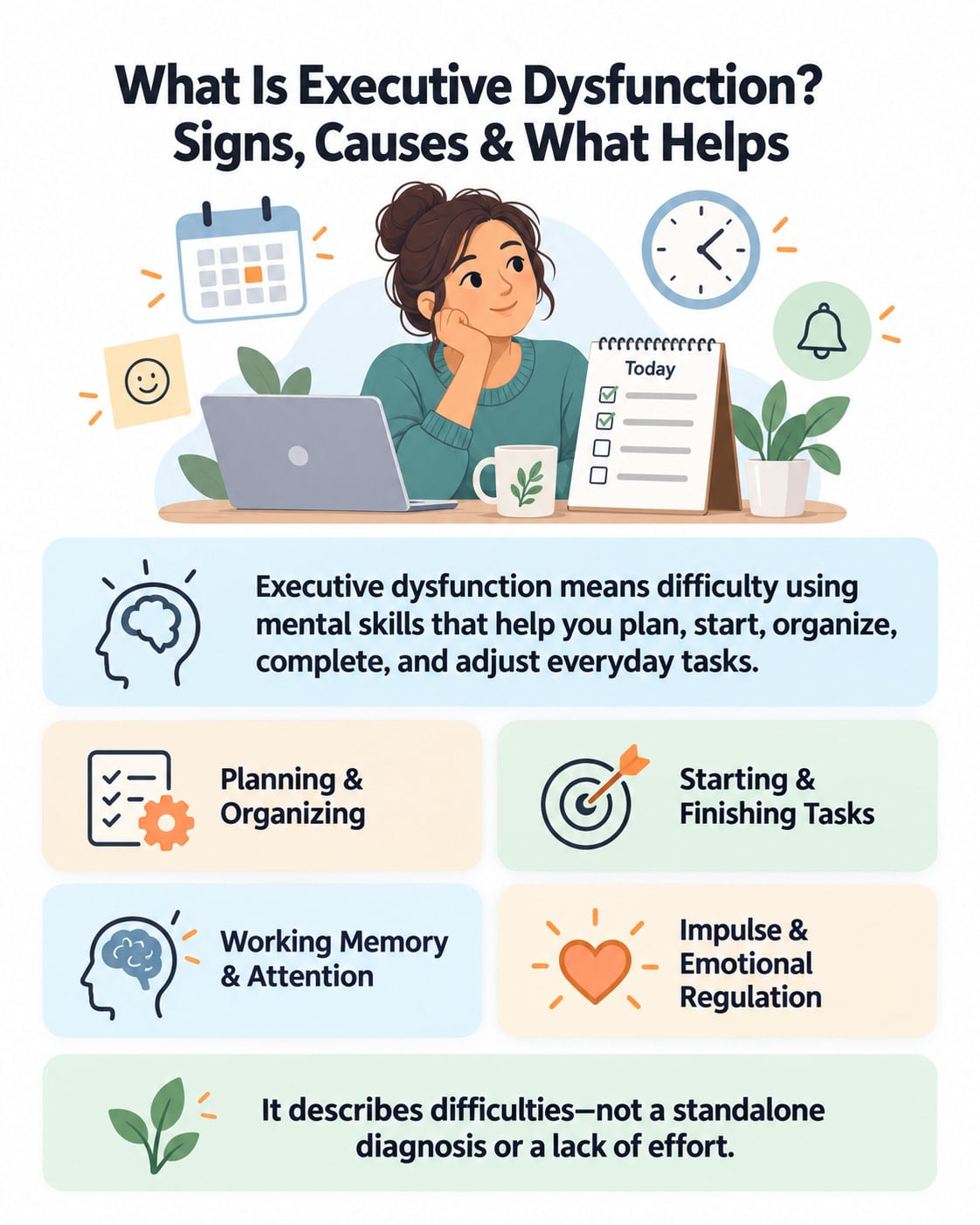
What is executive dysfunction? It means difficulty using the mental skills that help you plan, start, organize, and complete tasks, manage impulses, and adapt to change. Cleveland Clinic explains that executive dysfunction is a symptom associated with several conditions—not simply a lack of effort.
Understanding these difficulties can help you identify useful supports instead of relying on self-blame. Smaller task steps, visible reminders, and consistent routines may help with everyday demands. Persistent or disruptive problems also deserve professional evaluation.
What Is Executive Dysfunction in Everyday Life?
Executive functions are the mental processes that help you turn intentions into actions. Three core skills support this process: working memory, cognitive flexibility, and inhibitory control. Together, they contribute to planning, problem-solving, and managing your responses.
| Core skill | What it helps you do | Everyday example |
|---|---|---|
| Working memory | Hold information in mind while using it | Remember several instructions while completing a task |
| Cognitive flexibility | Switch approaches and adjust to change | Make a new plan when an appointment moves |
| Inhibitory control | Pause before acting and filter distractions | Stay with a task instead of responding to every notification |
These skills work together rather than operating as completely separate abilities.
Executive dysfunction is not necessarily a problem with understanding what needs to happen. You may know how to do something but struggle to organize and carry out the steps. Someone can be intellectually capable while finding daily responsibilities unusually difficult.
Common Signs of Executive Dysfunction
Executive-function difficulties can affect different parts of daily life. The examples below describe possible patterns—not a diagnostic checklist.
| Area of difficulty | What it may look like |
|---|---|
| Starting tasks | Knowing a task matters but struggling to begin |
| Planning and prioritizing | Feeling unsure which step or responsibility comes first |
| Time management | Underestimating task length or repeatedly missing deadlines |
| Working memory | Losing track of instructions partway through |
| Organization | Misplacing materials or forgetting appointments |
| Attention and follow-through | Leaving tasks unfinished after getting distracted |
| Switching tasks | Struggling to stop one activity and move to another |
| Impulse and emotional regulation | Reacting before pausing or struggling to manage frustration |
These patterns reflect difficulties described in NHS executive-function guidance.
In children, problems may show up as forgotten school materials, difficulty starting assignments, or unfinished work. Adults may notice problems with household responsibilities, appointments, and work deadlines.
A missed deadline or distracted afternoon does not establish a condition. What matters is the broader pattern: how often difficulties happen, how disruptive they are, and whether they represent a change from your usual functioning.
What Causes Executive Dysfunction?
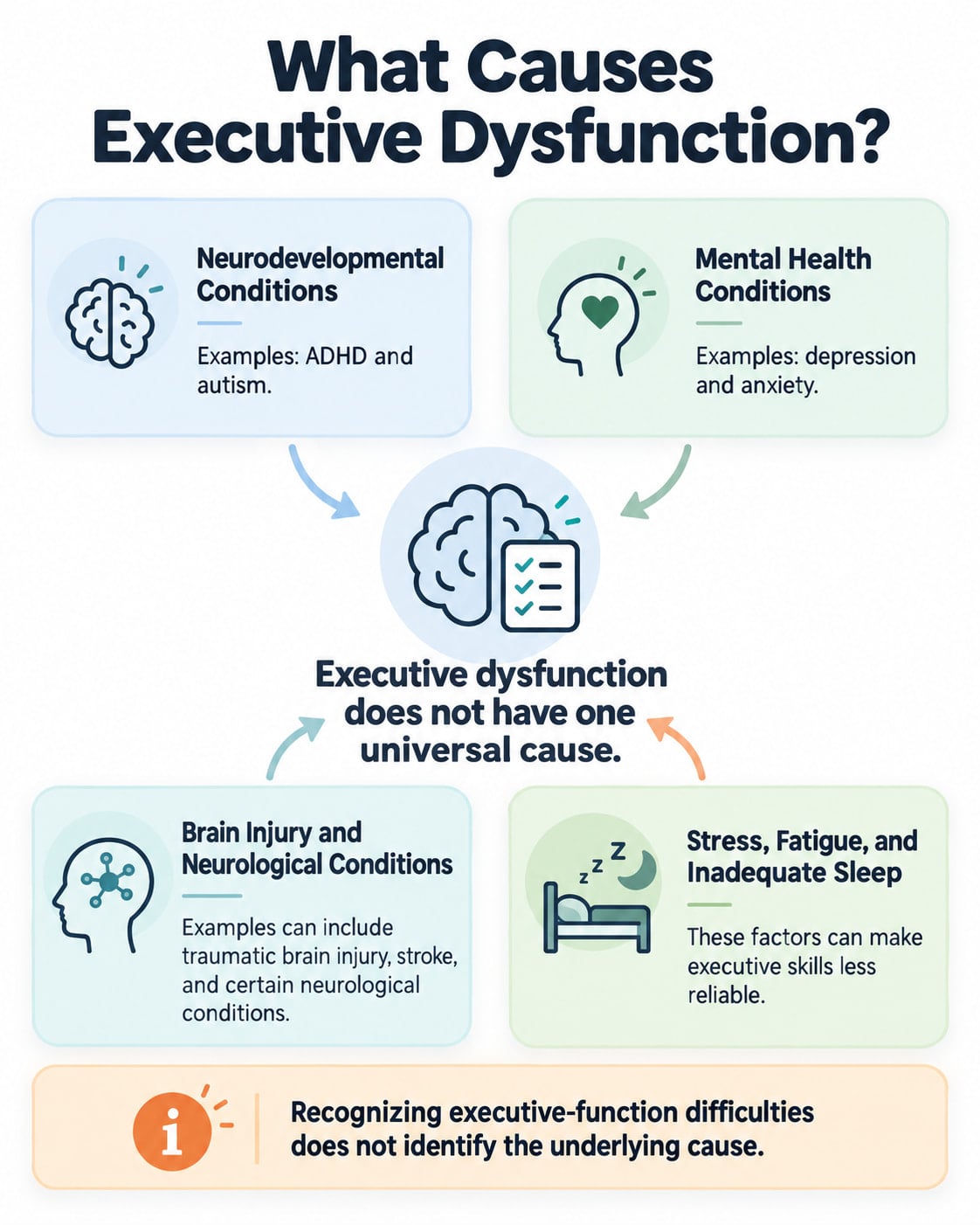
Executive dysfunction does not have one universal cause. Several conditions and everyday factors can affect the skills involved. Recognizing the difficulty is only the starting point; it does not explain why it is happening.
Neurodevelopmental Conditions
Executive-function difficulties can occur with ADHD and autism. However, abilities vary considerably. For example, not every autistic person struggles with executive functioning, and some have particular strengths in organization or planning.
Mental Health Conditions
Depression and anxiety can involve difficulties with attention, decision-making, organization, and emotional regulation. These conditions may overlap with other explanations, which is one reason a broader assessment can be useful.
Brain Injury and Neurological Conditions
A traumatic brain injury, stroke, or certain neurological conditions, including some forms of dementia, can affect executive functioning. These are possible causes—not conclusions to draw from ordinary forgetfulness or an unfinished chore.
Stress, Fatigue, and Inadequate Sleep
Stress, fatigue, and insufficient sleep can make executive skills less reliable. A period of difficulty during exhaustion does not automatically indicate a lifelong condition. Persistent problems still deserve attention, even when stress seems to be contributing.
Executive Dysfunction vs. ADHD and Procrastination
Is Executive Dysfunction the Same as ADHD?
No. Executive dysfunction describes difficulties with certain skills; ADHD is a specific diagnosis.
The CDC’s adult ADHD guidance explains that an assessment considers a person’s history, including whether symptoms were present before age 12. Clinicians also consider other explanations, such as anxiety, depression, sleep problems, or substance use.
An adult may receive an ADHD diagnosis later in life even though symptoms began earlier. Recognizing task-initiation problems alone does not confirm ADHD.
Is It Procrastination or Laziness?
Executive dysfunction can look like procrastination because tasks remain delayed or unfinished. However, someone may care deeply about the outcome and still struggle to begin or follow through. You cannot reliably judge the cause from the outside.
Instead of asking, “Why am I so lazy?” try a more useful question: “Which part is difficult—starting, remembering, choosing a priority, or staying with it?”
That question gives you a specific obstacle to address rather than a character judgment.
What Helps With Executive Dysfunction?
The goal is to make tasks easier to manage—not to build a perfect productivity system. NHS guidance recommends approaches such as visible reminders, consistent routines, and help with prioritization. Different people benefit from different supports.
Choose one recurring difficulty and experiment with one practical change.
1. Make the First Step Small and Specific
Large, vague tasks can be difficult to organize. NIMH recommends breaking larger responsibilities into smaller, manageable steps as a support for people with ADHD.
For example, replace “clean the kitchen” with “put the cups in the dishwasher.” Replace “finish the report” with “open the document and write the first heading.”
The first action should be clear enough that you do not need another planning session before beginning.
2. Put Reminders Outside Your Memory
Use a visible calendar, written checklist, or electronic reminder for responsibilities that are easy to lose track of. Checking that system at a consistent time can make it part of your routine.
Make reminders action-specific. “Leave for the appointment” is more useful than an alert that only says “appointment.”
Start with one place for important tasks rather than scattering them across several notebooks and apps.
3. Plan for Time and Task Transitions
Breaks and transitions deserve space in your plan. NHS guidance suggests allowing time to shift activities and focusing on one task at a time.
For example, set a reminder to begin wrapping up before you need to leave. Before taking a break, write a short note naming the next step.
A timer can also serve as a cue to begin, pause, or check your progress—not as a demand to finish everything before it rings.
4. Reduce Distractions and Simplify Routines
A quieter workspace, fewer notifications, and one task at a time may reduce competing demands. These approaches also appear in cognitive-support guidance for people recovering from traumatic brain injury.
For a practical experiment, close unrelated browser tabs and move your phone out of reach during one short task.
Consistent routines may also make the next action easier to remember. For example, use the same short sequence when preparing to leave home.
5. Ask for Concrete Help
Ask for assistance with the part that is difficult. NHS guidance specifically suggests seeking help with prioritization rather than expecting yourself to work everything out alone.
For example: “Can you help me choose which deadline comes first?” or “Could we turn these instructions into a short checklist?”
For children with ADHD, NIMH recommends clear language, practical help with organization, and patient support. These approaches are more useful than repeatedly demanding greater effort without explaining the next step.
6. Support Sleep and Basic Daily Routines
Regular sleep, meals, and manageable physical activity support general well-being. NIMH includes these foundations in its self-management guidance for ADHD. They complement appropriate care; they are not a substitute for investigating persistent difficulties.
Keep changes realistic. A consistent bedtime reminder or planned meal break may be a more workable starting point than redesigning your entire day.
When to Seek Help for Executive Dysfunction
Speak with a healthcare professional when difficulties repeatedly interfere with school, work, relationships, or everyday responsibilities. For a child, a pediatrician is an appropriate starting point.
Also arrange an assessment for gradually worsening forgetfulness or confusion rather than assuming it is ordinary aging. Sudden confusion requires more urgent attention.
What an Evaluation May Involve
The assessment depends on the suspected cause. A clinician may discuss your history and current difficulties, use questionnaires, or recommend selected cognitive tests. When ADHD is being considered, information about childhood experiences and behavior in different settings can be important.
Before the appointment, write down a few concrete examples and the questions you want answered. Note when problems began and mention recent changes, including possible medication-related concerns. A written list can help you remember important points during the visit.
Professional Support Depends on the Cause
For adults with ADHD, NIMH describes options including medication and psychotherapy, such as cognitive behavioral therapy. Some adults also find skills-focused coaching helpful. The appropriate combination depends on the individual.
After a brain injury, cognitive rehabilitation may involve occupational therapists, speech-language professionals, or neuropsychologists. Support may focus on strengthening affected skills or finding alternative ways to complete activities.
School or workplace support may also matter. For example, people with ADHD may benefit from classroom organizational support or workplace changes that reduce distractions. The useful adjustments depend on the person’s needs.
When Changes Need Urgent Attention
Sudden confusion or disorientation is not the same as familiar difficulty organizing tasks. Seek immediate medical help.
In the United States, CDC’s stroke guidance advises calling 911 immediately for sudden stroke symptoms. These include one-sided weakness, trouble speaking, abrupt vision or balance problems, or a sudden severe headache. Do not drive yourself to the hospital.
Frequently Asked Questions
Is Executive Dysfunction a Standalone Disorder?
Executive dysfunction describes a symptom or pattern of difficulties, not a standalone psychiatric diagnosis. The phrase “executive function disorder” is sometimes used informally, but an assessment is needed to explore the underlying explanation.
Can You Have Executive Dysfunction Without ADHD?
Yes. Executive-function difficulties can occur with other conditions, including autism, and can also be affected by factors such as stress and inadequate sleep. Having these difficulties does not automatically mean you have ADHD.
Why Can I Focus on a Hobby but Struggle With Chores?
Attention can vary with interest and the demands of the activity. CDC notes that adults with ADHD may struggle with lengthy tasks unless they find them interesting. This pattern alone does not establish a diagnosis.
Is Executive Dysfunction a Sign of Low Intelligence?
No. People can have strong intellectual abilities while struggling with planning, organization, or everyday follow-through. Understanding a task and consistently carrying it out are not the same thing.
Does Everyone With Executive Dysfunction Need Medication?
No. Medication decisions depend on the underlying condition and the person’s needs. For diagnosed ADHD, medication is one option, while psychotherapy and practical supports may also be part of an individualized care plan.
Can Executive-Function Difficulties Improve?
They can become more manageable with suitable strategies and support. Improvement varies by cause and individual circumstances. Some people develop stronger skills, while others benefit from adapting how tasks are completed; there is no universal timeline.
Conclusion
Start with one recurring task: name the smallest next action and add one clear reminder. Notice which part remains difficult.
When these problems keep disrupting your life, bring those examples to a healthcare appointment. You do not need to identify the cause on your own before asking for support.
This content is for informational purposes only and not medical advice.
References
- Cleveland Clinic: Executive Dysfunction.
- CDC: ADHD in Adults.
- National Institute of Mental Health: ADHD in Adults: 4 Things to Know, 2024.
- Berkshire Healthcare NHS Foundation Trust: Executive Functioning Difficulties.
- NELFT NHS Foundation Trust: Executive Functioning and Everyday Support Strategies.
- Nottinghamshire Healthcare NHS Foundation Trust: Executive Function and Practical Strategies.
- Model Systems Knowledge Translation Center: Cognitive Problems After Traumatic Brain Injury.
- NHS: Sudden Confusion.