
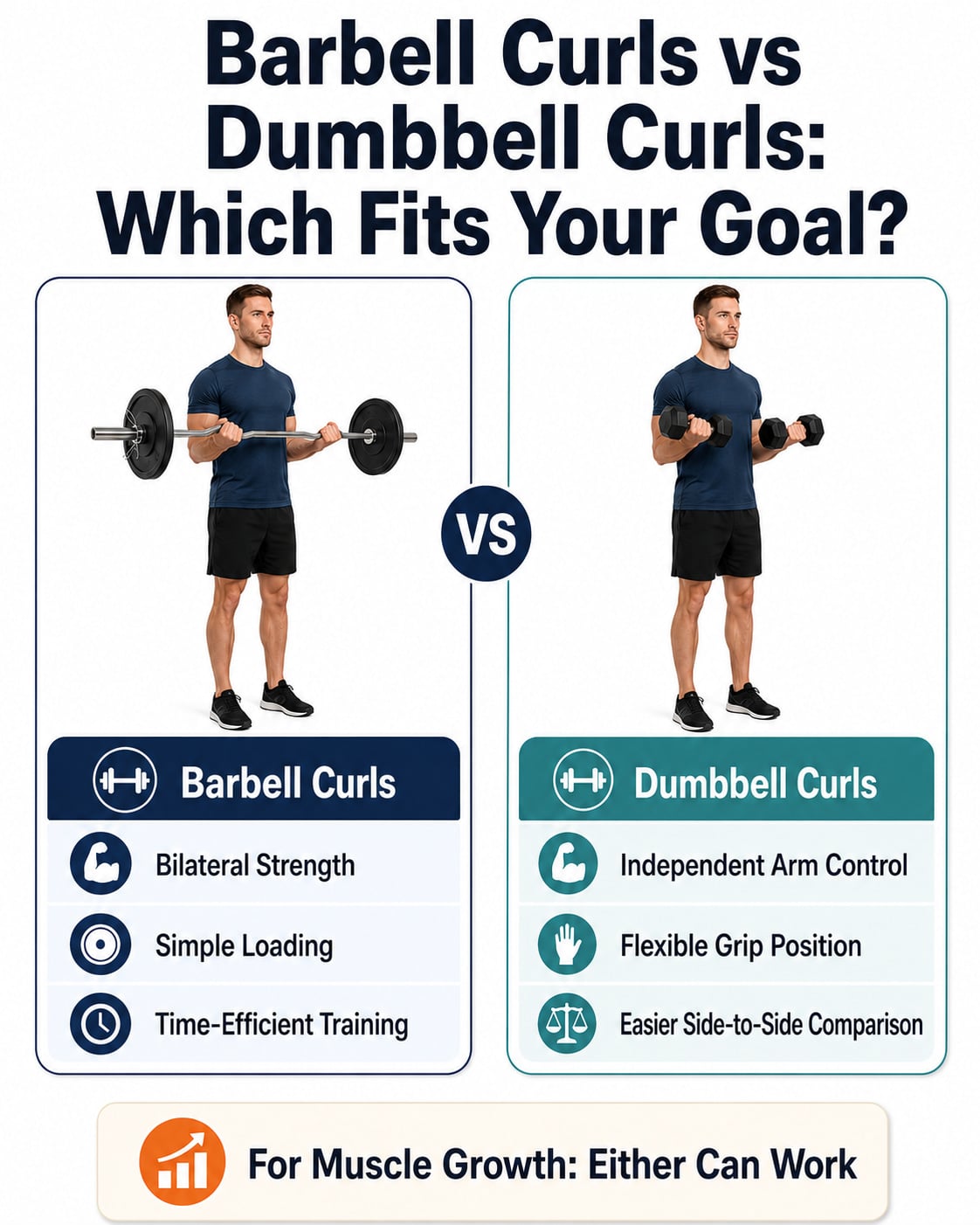
Barbell curls and dumbbell curls can both build stronger, more muscular arms. Barbell curls generally fit efficient bilateral loading and barbell-specific strength, while dumbbell curls fit independent arm training, flexible hand positioning, and closer attention to side-to-side differences.
In the barbell curls vs dumbbell curls debate, there is no universal winner for muscle growth. Your technique, training effort, weekly volume, progression, comfort, and consistency usually matter more than the implement in your hands.
The American College of Sports Medicine’s 2026 resistance-training guidance emphasizes individualization rather than searching for one perfect exercise or piece of equipment. That makes the best curl variation the one that matches your goal, feels comfortable, and allows steady progress.
Barbell Curls vs Dumbbell Curls at a Glance
| Comparison | Barbell curls | Dumbbell curls |
|---|---|---|
| Training style | Both arms move one shared implement | Each arm controls its own weight |
| Grip position | Fixed by the bar | Can remain palms-up or rotate during the curl |
| Loading | Simple to track as one total load | Tracked as weight per dumbbell |
| Side-to-side differences | May be less obvious | Easier to notice and monitor |
| Time efficiency | Both arms always work together | Simultaneous curls are efficient; alternating curls take longer |
| Stability | The shared bar provides a stable setup | Each arm requires independent control |
| Wrist comfort | A straight bar may feel restrictive for some people | Hand and forearm position can be adjusted more freely |
| Exercise variety | Straight-bar, EZ-bar, preacher, and drag curls | Standing, seated, alternating, incline, concentration, and rotating curls |
| Best fit | Bilateral strength and straightforward progression | Independent-arm control and grip flexibility |
The practical verdict: Choose barbell curls when you want a stable bilateral exercise that is easy to load and track. Choose dumbbell curls when you want each arm to work independently or need more freedom to adjust your hand position. For balanced development, you can use both.
What Is a Barbell Curl?
A barbell curl is an elbow-flexion exercise performed while holding one bar with both hands. The standard version uses a straight bar and an underhand, or supinated, grip.
Because both arms move the same implement, barbell curls are considered a bilateral exercise. The shared bar can make the movement feel stable and may allow you to handle a larger combined load than you would with one dumbbell in each hand.
A standard straight bar fixes your hands in place. This can make the exercise easy to repeat consistently, but the fixed position may feel uncomfortable for people who have limited wrist or forearm mobility. An EZ curl bar provides angled grips and may be a more comfortable barbell-based alternative.
How to Do a Barbell Curl Properly
- Stand upright with your feet around hip- to shoulder-width apart.
- Hold the bar with an underhand grip around shoulder width.
- Keep your chest comfortably tall, ribs controlled, and abdomen braced.
- Begin with your arms extended without aggressively locking your elbows.
- Curl the bar by bending your elbows while keeping your upper arms mostly still.
- Stop before your shoulders roll forward or the movement turns into a front raise.
- Lower the bar under control until you return to the starting position.
A small amount of natural upper-arm movement is not automatically a mistake. The goal is to prevent excessive shoulder motion from replacing elbow flexion.
What Is a Dumbbell Curl?
A dumbbell curl is performed with a separate weight in each hand. You can curl both dumbbells simultaneously, alternate arms, or complete all repetitions on one side before switching.
There are two common ways to perform a standard dumbbell curl:
- Start with your palms facing forward and maintain that position.
- Start with your palms facing your thighs, then rotate your forearms so your palms face upward as you curl.
The second option adds active supination, one of the biceps brachii’s functions. However, you should only rotate through a range that feels natural. Do not force your wrist or forearm into an uncomfortable position.
A hammer curl, in which the palms remain facing each other, is a related but different exercise. It places relatively more emphasis on the brachialis and brachioradialis than a traditional palms-up curl.
How to Do a Dumbbell Curl Properly
- Stand or sit with one dumbbell in each hand.
- Keep your shoulders relaxed and your upper arms near your sides.
- Begin with your palms facing forward, or start neutral and rotate gradually as you curl.
- Bend the elbow without twisting or leaning your torso.
- Finish when you have reached a strong contraction without pushing the elbow far forward.
- Lower each dumbbell under control.
- Use the same range of motion and number of repetitions on both sides.
You can curl both dumbbells together or alternate arms. The best option is the one that lets you maintain consistent technique.
Muscles Worked by Barbell and Dumbbell Curls
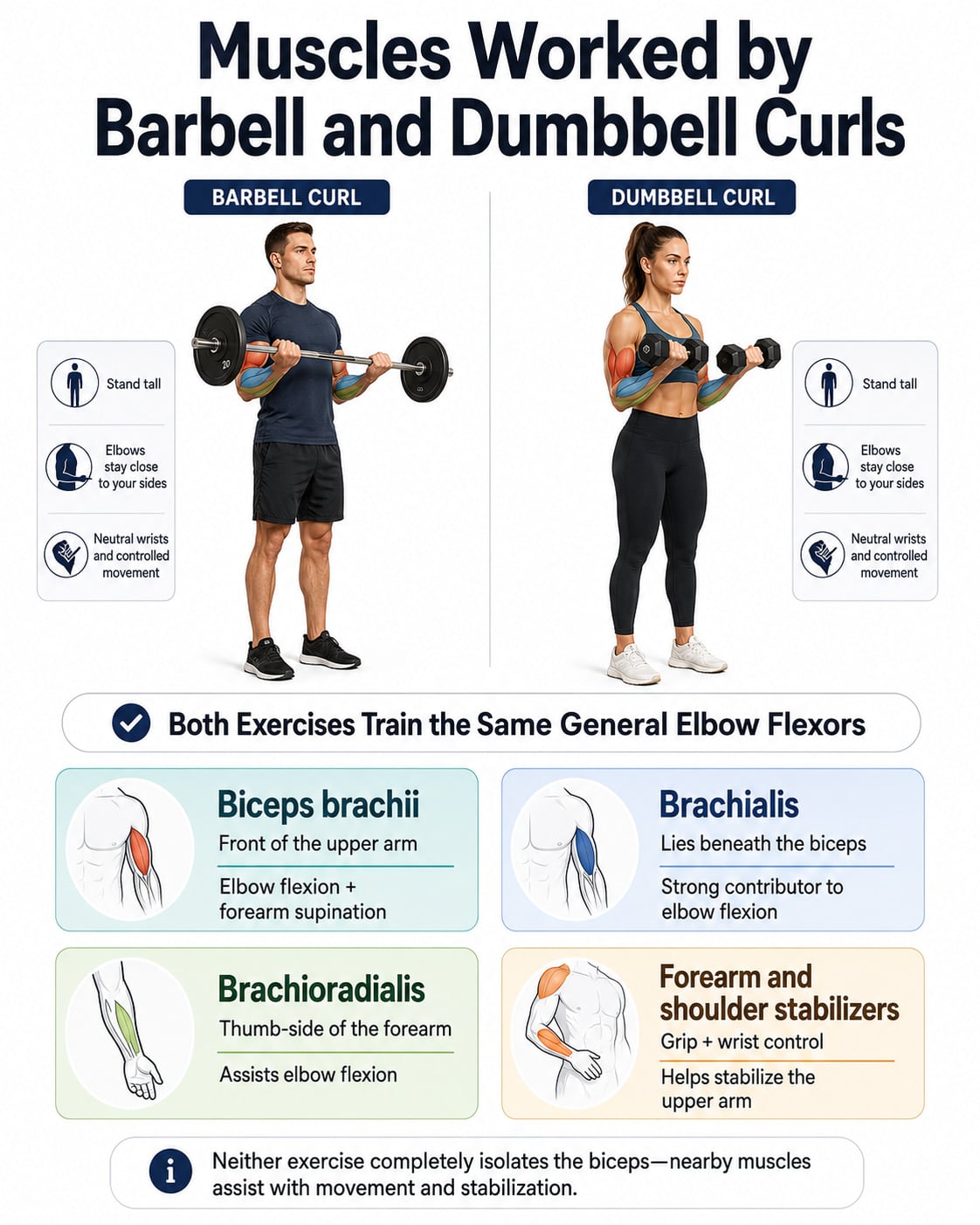
Both exercises train the same general group of elbow flexors.
Biceps brachii
The biceps brachii is the prominent muscle at the front of the upper arm. It helps bend the elbow and rotate the forearm into a palms-up position.
Brachialis
The brachialis lies beneath the biceps and contributes strongly to elbow flexion regardless of whether you use a barbell or dumbbells.
Brachioradialis
The brachioradialis runs along the thumb side of the forearm. It assists elbow flexion, especially when the hand is in a neutral or partially rotated position.
Forearm and shoulder stabilizers
Your forearm muscles maintain a secure grip and help control the wrist. Muscles around the shoulder blade and shoulder joint stabilize the upper arm while you curl.
Neither implement completely isolates the biceps. Both require assistance and stabilization from nearby muscles.
Barbell Curls vs Dumbbell Curls for Muscle Growth
Current evidence does not establish either barbell curls or dumbbell curls as the better choice for biceps growth.
A 2025 systematic review and meta-analysis of unilateral and bilateral resistance training included nine studies. The researchers found no significant difference in muscle hypertrophy between unilateral and bilateral training, although they emphasized that the available hypertrophy evidence was limited.
This research was not a direct long-term comparison of standing barbell curls and standing dumbbell curls. It also does not mean every dumbbell curl is unilateral, because dumbbells can be curled simultaneously. However, it supports the broader conclusion that training one limb independently does not automatically produce more muscle growth than training both limbs together.
The 2026 ACSM position stand reached a similar practical conclusion: equipment type did not consistently determine strength or hypertrophy outcomes for healthy adults. Regular training, sufficient effort, appropriate volume, and long-term adherence were more important.
What matters more for biceps growth?
Whichever variation you select, prioritize the following:
- Use a weight that makes the final repetitions challenging without breaking your form.
- Train through the largest comfortable range of motion you can control.
- Lower the weight instead of letting it drop.
- Add repetitions or load gradually.
- Complete enough weekly work to stimulate progress without overwhelming recovery.
- Allow the biceps and elbow tendons time to recover between demanding sessions.
The ACSM’s March 2026 guidance reported that higher weekly volume, around 10 sets per muscle group, can support hypertrophy. However, this is a general target rather than a requirement for 10 direct sets of curls. Rows, pull-ups, pulldowns, and other pulling exercises also involve the elbow flexors.
For many lifters, four to eight direct curl sets per week is a reasonable starting point. Increase that amount only when your recovery is good and your repetitions, load, or arm measurements have stopped progressing.
Does higher muscle activation mean better growth?
A small 2018 study compared dumbbell curls, straight-bar curls, and EZ-bar curls. It found differences in acute electrical activity in the biceps brachii and brachioradialis, with the bar variations producing higher readings than dumbbells during some phases of the movement. (Read the curl comparison study)
That does not prove that barbell curls build more muscle. Surface electromyography, or EMG, measures electrical activity during an exercise. It does not directly measure long-term muscle growth, and acute EMG amplitude has not been validated as a reliable predictor of hypertrophy. (Review the EMG and hypertrophy analysis)
Use EMG findings to understand that exercises may produce different acute sensations and activation patterns—not to declare one exercise an automatic mass builder.
Which Is Better for Strength?
Strength is specific to the movement you practice.
If your goal is to increase your strict barbell-curl weight, barbell curls should receive priority. If your goal is to improve one-arm dumbbell-curl strength, train with dumbbells.
The 2025 unilateral-versus-bilateral meta-analysis found that bilateral training produced greater improvements in bilateral strength tests, while unilateral training produced greater improvements in unilateral strength tests.
A barbell can be particularly useful for strength-focused curls because:
- Both arms contribute to one shared load.
- The setup is stable and easy to repeat.
- Small weight plates may allow gradual load increases.
- Total load is straightforward to record.
Dumbbells remain effective for strength. They simply express that strength separately in each arm. This can be valuable when unilateral strength or control is part of your goal.
Do not assume that lifting a heavier total barbell automatically creates a better biceps stimulus. The load only helps when you can control it without excessive leaning, hip drive, shortened repetitions, or shoulder movement.
Key Differences Between Barbell and Dumbbell Curls
Grip and wrist position
A straight bar places both hands in a fixed palms-up position. Some lifters find this stable and comfortable. Others feel unwanted pressure in the wrists or forearms.
Dumbbells allow each hand to find its own path. You can begin with a neutral grip, rotate gradually, and stop at a comfortable level of supination.
An EZ curl bar offers a middle ground. It retains the stable, two-handed setup while providing a semi-supinated grip.
No variation should cause sharp or escalating joint pain. Changing the implement is more sensible than forcing an uncomfortable grip.
Independent arm control
With dumbbells, each arm must control its own weight. This makes it easier to notice differences in:
- Repetition quality
- Range of motion
- Strength
- Coordination
- Fatigue
A stronger arm can still move its side of a barbell more forcefully, although an uneven contribution may be difficult to see.
Dumbbells do not automatically correct an imbalance. To manage a mild side-to-side difference, begin with the weaker arm and match that number of controlled repetitions with the stronger arm. Do not give the weaker side extra work unless a qualified professional has identified a reason to do so.
Loading and progression
Barbell progression can be simple because you add plates to one implement. Fractional plates also make small increases possible.
Fixed dumbbells sometimes have larger jumps between available weights. For example, moving from one pair to the next may be too large an increase to maintain the same repetition range.
When the next dumbbell is too heavy, you can:
- Add repetitions within your planned range.
- Improve control and consistency at the current weight.
- Add one set if recovery allows.
- Use adjustable dumbbells or smaller weight increments when available.
Do not change several variables at once. A clear training log makes it easier to see what is working.
Time efficiency
Barbell curls train both arms at the same time, making them efficient.
Simultaneous dumbbell curls can be almost as quick. Alternating dumbbell curls usually take longer because only one arm completes a repetition at a time, but they can make it easier to focus on each side.
Choose simultaneous curls when time is limited. Choose alternating curls when independent control is the priority.
Exercise variety
Dumbbells offer more freedom to change your shoulder, elbow, and forearm positions. Common options include:
- Alternating dumbbell curls
- Seated dumbbell curls
- Incline dumbbell curls
- Concentration curls
- Hammer curls
- Preacher dumbbell curls
Barbell options include:
- Straight-bar curls
- EZ-bar curls
- Preacher curls
- Drag curls
- Seated partial curls
- Strict wall-supported curls
Variety can make training more enjoyable, but changing exercises every workout makes progress difficult to measure. Keep a primary curl variation for at least several weeks before evaluating it.
Barbell Curl Benefits and Limitations
| Benefits | Limitations |
|---|---|
| Stable bilateral setup | Straight bar fixes the hand position |
| Easy to track total load | Side-to-side differences can be less obvious |
| Efficient for training both arms | Heavy loads may encourage swinging |
| Often allows small plate increases | May feel uncomfortable in some wrists or forearms |
| Direct transfer to barbell-curl strength | Less freedom to adjust each arm’s path |
Dumbbell Curl Benefits and Limitations
| Benefits | Limitations |
|---|---|
| Each arm controls its own load | Requires more independent control |
| Easy to compare sides | Alternating sets take longer |
| Allows adjustable hand positioning | Fixed dumbbell jumps may be large |
| Offers numerous variations | Technique may differ between arms |
| Can be performed simultaneously or one arm at a time | Heavy dumbbells can be awkward to position |
Common Barbell Curl Mistakes
Using hip and back momentum
Leaning backward may help you lift a heavier bar, but it shifts work away from the intended movement and can make progression difficult to evaluate.
Reduce the load and keep your torso stable.
Letting the elbows travel far forward
Some forward movement can occur naturally near the top. Excessive movement turns the exercise into a combination of a curl and shoulder raise.
Keep your elbows near your sides for most of the repetition.
Bending the wrists backward
Keep the wrists relatively neutral and stacked with the forearms. If the straight bar forces an uncomfortable position, use an EZ bar or dumbbells.
Cutting the range of motion short
Do not stop every repetition halfway down simply to maintain a heavier load. Lower the bar through a comfortable, repeatable range.
Choosing an uncomfortable grip width
A grip that is too narrow or wide may make the wrists, elbows, or shoulders feel awkward. Adjust your grip before adding more weight.
Common Dumbbell Curl Mistakes
Rotating the torso during alternating curls
Turning toward the working arm helps move the dumbbell but reduces the value of independent arm training. Keep your hips and chest facing forward.
Allowing one arm to use a shorter range
Watch for one elbow bending less or one dumbbell stopping higher. Use a mirror or record a set from the front when you need to check symmetry.
Forcing excessive wrist rotation
More rotation is not always better. Supinate only as far as your forearm and wrist can move comfortably.
Dropping the dumbbell quickly
Control the lowering phase. You should be able to stop the dumbbell at any point rather than letting gravity pull it down.
Using mismatched repetitions
When training for balanced control, complete the same number of quality repetitions per arm. Let the weaker side set the limit.
Which Curl Fits Your Goal?
| Your goal | Better starting choice | Why |
|---|---|---|
| Build bigger biceps | Either | Neither has a proven overall hypertrophy advantage |
| Improve barbell-curl strength | Barbell curls | You improve the specific movement you practice |
| Improve one-arm curl strength | Dumbbell curls | Each arm produces and controls force independently |
| Monitor side-to-side differences | Dumbbell curls | Repetition quality is easier to compare |
| Use a flexible hand position | Dumbbell curls | The forearms can rotate independently |
| Train both arms quickly | Barbell or simultaneous dumbbell curls | Both sides work at the same time |
| Progress with small plates | Barbell curls | Fractional plates may allow smaller increases |
| Reduce discomfort from a fixed straight-bar grip | Dumbbells or an EZ bar | Both provide less rigid hand positioning |
| Add more exercise variety | Dumbbell curls | Dumbbells work in numerous body and grip positions |
| Keep training simple | Barbell curls | One implement and one combined load are easy to track |
Best choice for muscle size
Select the variation that allows you to complete challenging sets with a comfortable grip, controlled range of motion, and consistent progression. Use both if you enjoy them, but you do not need both to grow your biceps.
Best choice for strength
Use barbell curls for barbell-specific strength and dumbbell curls for independent-arm strength. Keep heavier sets strict rather than turning them into full-body movements.
Best choice for uneven arms
Dumbbells make differences easier to observe. Start with the less coordinated or weaker arm, then match its repetitions on the other side.
A substantial or sudden loss of strength on one side, especially with pain, numbness, or tingling, should be evaluated by a qualified healthcare professional.
Best choice for wrist comfort
Dumbbells or an EZ bar are often practical alternatives when a straight bar feels restrictive. Comfort varies by person, so test the movement with a light load before beginning hard sets.
Best choice for beginners
Beginners can use either exercise. Start with the option that makes it easiest to:
- Keep the torso still
- Control the lowering phase
- Use the same range on every repetition
- Train without joint pain
- Increase the challenge gradually
Barbell and Dumbbell Curl Sets, Reps, and Frequency
These ranges are practical starting points rather than rigid rules.
| Goal | Sets | Repetitions | Rest |
|---|---|---|---|
| Learn the movement | 2–3 | 8–12 | 60–120 seconds |
| Muscle growth | 2–4 | 8–15 | 60–120 seconds |
| Curl-strength emphasis | 2–4 | 5–8 | 2–3 minutes |
| Higher-repetition accessory work | 2–3 | 12–20 | 60–90 seconds |
Most people can train the biceps directly one or two times per week, depending on their total pulling volume and recovery.
For muscle growth, finish most working sets with approximately one to three good repetitions left before your form would break down. You do not need to reach complete failure on every set. The 2026 ACSM review found that momentary muscle failure was not consistently required for results in healthy adults.
How to progress
Use a double-progression method:
- Select a repetition range, such as 8–12.
- Use the same load until you reach 12 controlled repetitions on every set.
- Add the smallest practical amount of weight.
- Return to the lower end of the range and build up again.
Increase the load only when your range of motion and posture remain consistent.
Can You Do Barbell and Dumbbell Curls in the Same Workout?
Yes, but you do not have to.
Using both can make sense when one serves as your primary strength movement and the other provides lighter independent-arm work. For example:
Sample biceps workout
Barbell curl
- 3 sets of 6–10 repetitions
- Rest 90–150 seconds
Alternating dumbbell curl
- 2–3 sets of 10–15 repetitions per arm
- Rest 60–90 seconds
Another option is to separate them:
- Workout 1: Barbell curls for 3 sets of 6–10
- Workout 2: Dumbbell curls for 3 sets of 8–12
Keep the total workload appropriate for your experience and recovery. If you already perform several hard sets of rows, pull-ups, or pulldowns, you may need fewer direct curl sets.
When Should You Switch Curl Variations?
Consider changing your primary curl when:
- The grip repeatedly causes discomfort.
- You can no longer progress despite appropriate recovery.
- Your technique remains inconsistent with that implement.
- You want to prioritize unilateral control.
- Your current equipment does not provide manageable load increases.
- You have used the same variation for several months and want a new but measurable training stimulus.
Do not switch simply because one workout felt difficult. Progress naturally fluctuates. Evaluate an exercise over several weeks using your training log.
Safety Tips
Warm up with one or two light curl sets before using your working weight. Increase loads gradually, especially when performing low-repetition curls.
Stop or modify the exercise if you experience sharp pain, tingling, numbness, sudden weakness, or pain that worsens with each repetition. Persistent pain around the wrist, elbow, or shoulder deserves assessment by a qualified healthcare professional.
People returning from an upper-body injury or managing a medical condition should seek personalized guidance before beginning heavy resistance training.
Frequently Asked Questions
Are barbell curls better than dumbbell curls for mass?
No clear evidence shows that barbell curls produce more biceps growth than dumbbell curls. Both can support muscle growth when you use sufficient effort, controlled technique, progressive overload, and appropriate weekly volume.
Do barbell curls let you lift more weight?
Many lifters can handle a larger combined load with a barbell because both arms move one stable implement. However, the total weight is not the only factor that determines the quality of a set. A lighter, controlled curl can be more useful than a heavier curl performed with excessive momentum.
Are dumbbell curls better for muscle imbalances?
Dumbbells make side-to-side differences easier to identify because each arm controls its own load. They do not automatically correct an imbalance. Start with the weaker side and match its controlled repetitions with the stronger side.
Are barbell curls bad for your wrists?
Barbell curls are not inherently bad for the wrists. However, the fixed position of a straight bar may feel uncomfortable for some people. A lighter load, different grip width, EZ bar, or dumbbells may provide a more comfortable option.
Should I use a straight bar or an EZ curl bar?
Use the bar that allows comfortable, controlled repetitions. A straight bar creates a fully supinated grip, while an EZ bar places the hands at an angle. Neither is automatically superior for long-term biceps growth.
Can I perform barbell and dumbbell curls on the same day?
Yes. Use one as the primary exercise and the other as lighter accessory work. Avoid adding unnecessary sets when your biceps already receive substantial work from pulling exercises.
Which curl should a beginner learn first?
A beginner should start with whichever variation makes good technique easiest. Dumbbells provide adjustable arm paths, while a barbell provides a stable shared implement. Begin light and prioritize consistent repetitions before adding weight.
Conclusion
Barbell curls and dumbbell curls are both effective choices when they are performed consistently and progressed intelligently.
Choose barbell curls for a stable bilateral movement, efficient training, and barbell-specific strength. Choose dumbbell curls for independent arm control, flexible hand positioning, and easier side-to-side comparison.
For many lifters, the most practical solution is not choosing one forever. Keep one variation as your main curl for several weeks, track your performance, and add or rotate the other when it serves a clear purpose.
Start with a manageable weight, use controlled repetitions, and let measurable progress—not gym myths—guide your choice.
References
- American College of Sports Medicine: 2026 Resistance Training Guidelines
- Kassiano et al.: Unilateral vs Bilateral Resistance Training Systematic Review and Meta-Analysis
- Marcolin et al.: EMG Activity During Dumbbell, Straight-Bar, and EZ-Bar Curls
- Vigotsky et al.: Why Acute EMG Does Not Predict Muscle Hypertrophy