
What does hyaluronic acid do for skin? It helps skin attract and retain water, which can improve hydration, soften dry-feeling skin, and make some fine lines look less noticeable. Its main value in everyday skin care is moisturizing—not dramatically lifting skin or replacing lost facial volume.
According to the AAD, hyaluronic acid is one moisturizing ingredient worth looking for in skin-care products. Understanding what it can realistically do helps you choose a suitable formula without adding unnecessary steps to your routine.
What Is Hyaluronic Acid?
Hyaluronic acid, often shortened to HA, is a substance your body naturally produces, including in your skin. In skin-care products, it functions as a humectant: an ingredient that attracts and holds water. You will find it in serums, lotions, creams, and other moisturizing products.
Despite the word “acid,” its purpose is hydration rather than exfoliation. It does not serve the same role as peeling ingredients such as glycolic acid.
This article focuses on topical hyaluronic acid—products applied to the skin—not oral supplements or injectable fillers.
What Does Hyaluronic Acid Do for Skin?
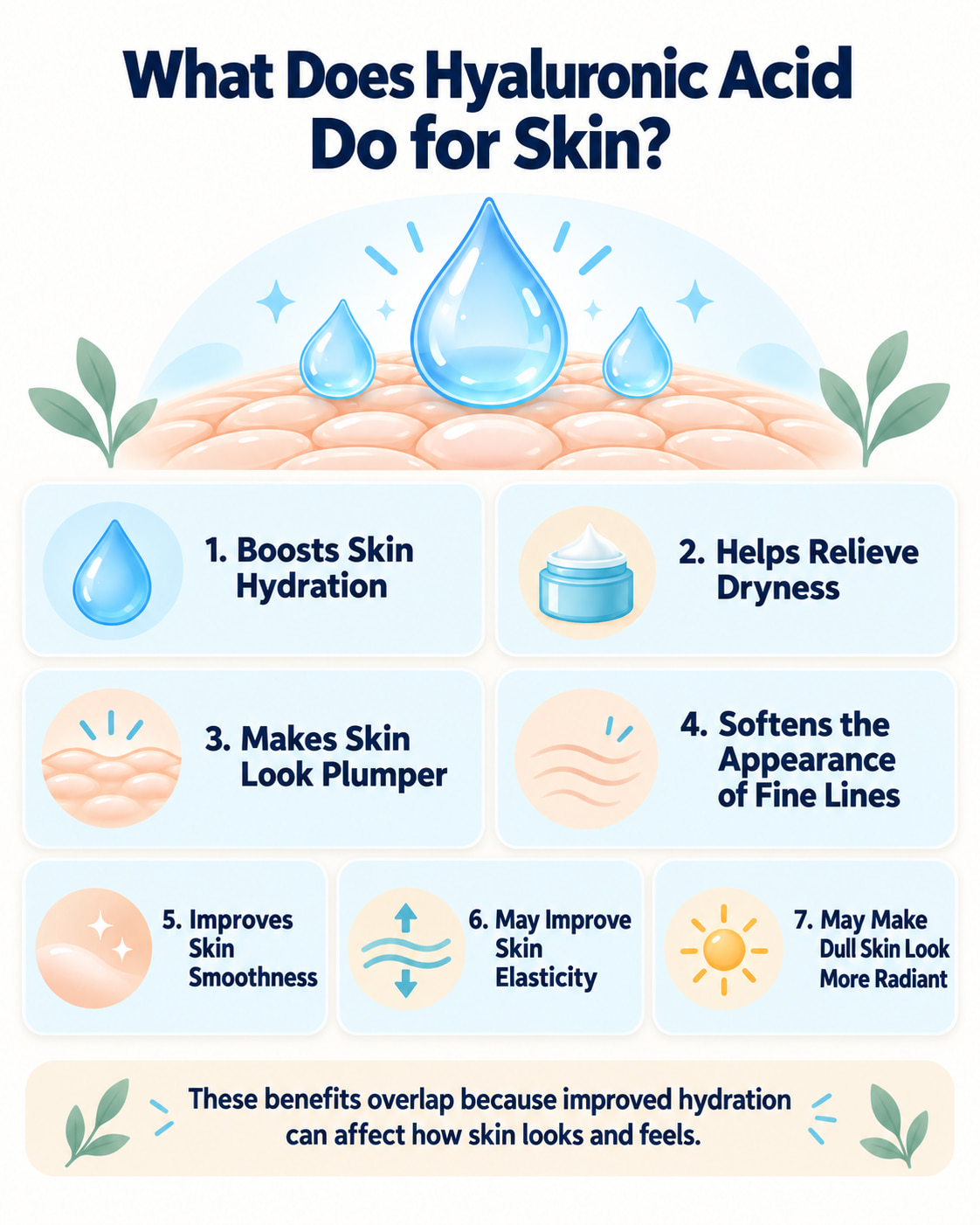
The benefits below overlap. Better hydration can influence how skin feels, how smooth it looks, and how noticeable some lines appear. These are related cosmetic improvements, not seven separate ways to reverse skin aging.
1. Boosts Skin Hydration
Hyaluronic acid’s clearest benefit is helping the skin hold water. This makes it a useful ingredient when your skin needs additional hydration.
A 2024 randomized trial involving 36 adults ages 60–80 with dry skin compared lotions containing different molecular weights of HA with a base lotion without HA. After four weeks, the low-molecular-weight formula produced higher hydration measurements than the other formulas. The findings support a moisturizing benefit, although they do not establish that every HA product works equally well.
2. Helps Relieve Dryness
An HA-containing moisturizer may help skin feel less dry and more comfortable. However, the entire formula matters: attracting water is only part of keeping skin moisturized.
For example, someone whose cheeks feel dry after washing may benefit more from a suitable cream than from layering several lightweight serums. The AAD recommends creams or ointments rather than lotions for dry skin and lists hyaluronic acid among useful moisturizing ingredients.
3. Makes Skin Look Plumper
Better-hydrated skin can have a fuller-looking surface. In a 2021 study, investigators observed improved plumping after 40 women used an HA-containing serum for six weeks. However, it was a manufacturer-funded study without a placebo group, and the serum contained multiple ingredients. Its results should not become a promise for every HA serum.
Surface plumping is not the same as injectable filler. Fillers are medical devices injected beneath the skin to address specific volume or contour concerns, and they have their own risks. A topical serum is not an equivalent alternative.
4. Softens the Appearance of Fine Lines
Hyaluronic acid may make some fine lines less noticeable, particularly when dryness emphasizes the skin’s surface texture. Think of this as a possible softening effect—not permanent wrinkle removal.
In 2011, a controlled study found that certain HA creams reduced measured wrinkle depth around the eyes after 60 days compared with a base cream without HA. The study involved 76 women, and the wrinkle findings differed by formulation. This supports realistic expectations rather than assuming all products will produce the same result.
5. Improves Skin Smoothness
HA-containing products may improve how smooth skin looks and feels. In the six-week serum study, investigators recorded improvements in smoothness alongside hydration and plumping.
This does not mean HA scrubs away dead skin. Its moisturizing role is different from exfoliation, so you should not expect an HA serum to work like a chemical peel.
6. May Improve Skin Elasticity
Skin elasticity describes how well skin returns toward its original shape after stretching. The 2011 controlled cream study found improvements in measured elasticity with the tested HA formulations compared with the base cream.
That is encouraging, but improved instrument readings do not necessarily translate into visibly lifted skin. A reasonable expectation is a possible improvement in suppleness—not a dramatic change in facial shape.
7. May Make Dull Skin Look More Radiant
Some HA formulations may improve surface radiance. A 2025 placebo-controlled trial comparing topical and oral HA, separately and together, reported improved measured skin brightness with the tested cream after 56 days. The study was funded by the ingredient manufacturer, so its findings should remain specific to the tested formulation.
Importantly, a brighter-looking surface is not the same as reducing excess pigment. These findings do not establish that an ordinary HA serum fades dark spots or changes your natural skin color.
How to Use Hyaluronic Acid for Skin
In guidance published on August, 2026, Harvard Health recommends applying HA serum to damp skin and following it with moisturizer. Always follow the individual product’s directions, especially when it contains additional active ingredients.
| Step | What to do |
|---|---|
| Cleanse gently | Use a gentle cleanser and pat your skin so it remains slightly damp. Avoid harsh scrubbing. |
| Apply the serum | Use the amount directed on the label. Spread it over the intended area without adding unnecessary layers. |
| Follow with moisturizer | Apply a suitable moisturizer to help retain hydration. A lightweight serum may not provide everything dry skin needs. |
| Protect your skin during the day | Use broad-spectrum, water-resistant sunscreen with SPF 30 or higher, along with shade and protective clothing. |
A separate HA serum is optional. When your moisturizer already keeps your skin comfortable, you do not need another product simply because HA is popular. A basic routine can consist of a cleanser, moisturizer, and daytime sunscreen.
How to Choose a Hyaluronic Acid Product
Match the Formula to Your Skin
For dry skin, a cream may be more suitable than a thin gel. For oily or acne-prone skin, consider a lighter moisturizer labeled “oil-free” or “non-comedogenic,” meaning it is unlikely to clog pores. For sensitive skin, fragrance-free products are a sensible starting point.
For combination skin, you may need more moisturizer on dry areas and less on oily areas. Adjust the amount to how each part of your face feels rather than applying multiple heavy layers everywhere.
Check the Label Without Chasing Marketing Claims
Ingredient lists may name hyaluronic acid, sodium hyaluronate, or hydrolyzed hyaluronic acid. These related ingredients are used for their water-binding properties.
You may also see claims about molecular weight or concentration. Molecular weight refers to molecule size, but no single label claim tells you how the complete product will perform. For context, the 2011 controlled trial found benefits with 0.1% HA creams; that does not establish an ideal percentage for every product.
Prioritize a formula that suits your skin and works within a manageable routine. More products are not automatically better, and adding too many can increase the chance of irritation.
How Long Does Hyaluronic Acid Take to Work?
Some moisturizing effects may appear soon after application. Changes in fine lines, smoothness, or other appearance measures are usually assessed over longer periods. The topical studies discussed here evaluated results over approximately four to eight weeks, depending on the product and study design.
These are research time frames—not deadlines by which your skin must improve.
For a practical check, pay attention to comfort and dryness rather than expecting a dramatic transformation. Comparing your skin under similar lighting can also be more useful than comparing unrelated before-and-after photos.
Hyaluronic Acid Side Effects and Precautions
Topical HA is generally well tolerated, but the complete product can still cause a reaction. Fragrances, preservatives, or other ingredients may be responsible for redness, itching, or swelling.
Test a New Product First
The AAD testing guidance recommends applying a new product to a small area, such as the underside of your arm, twice daily for seven to 10 days before wider use. Use the normal amount and leave it on for the intended duration.
An at-home test can help identify a problem, but it does not guarantee that a reaction will never develop. It is also different from diagnostic patch testing performed to investigate contact allergies.
Stop When a Product Causes a Reaction
Wash the product off and stop using it if you develop a rash, itching, swelling, or ongoing irritation. A dermatologist can help when symptoms are significant, persistent, or difficult to trace to a particular ingredient.
Also seek professional advice when dryness becomes painful, cracked, or bleeding, or does not improve with a gentle moisturizing routine. Persistent dry skin may need more than another serum.
What Hyaluronic Acid Cannot Do for Skin
The topical research discussed here does not establish that a standard HA serum rebuilds collagen, lifts sagging skin, or permanently removes wrinkles. Improvements in hydration and appearance should not be presented as proof that skin aging has been reversed.
Hydration is also not identical to complete skin-barrier repair. In the 2024 trial, the low-molecular-weight lotion improved hydration measurements, but the groups did not differ significantly in water-loss measurements or dry-skin symptom scores. That distinction matters when interpreting broad “barrier repair” claims.
Frequently Asked Questions
Can You Use Hyaluronic Acid Every Day?
Many topical HA products can be used daily, including morning and evening. Follow the label and adjust for tolerability. A combination serum may have different directions because of its other ingredients.
Is Hyaluronic Acid Good for Oily or Acne-Prone Skin?
It can be part of a moisturizing routine for acne-prone skin, but HA itself is not a proven acne-clearing ingredient. Choose the complete formula carefully, looking for an oil-free or non-comedogenic moisturizer when appropriate.
Should You Apply Hyaluronic Acid Before or After Moisturizer?
A typical lightweight HA serum goes before a thicker moisturizer. Product texture and label instructions matter, however. When HA is already included in your moisturizer, there is no separate HA step to arrange.
Can You Use Hyaluronic Acid With Retinol?
Yes, HA can be used in a routine that includes retinol. Its moisturizing role may help with some dryness associated with retinol use. However, adding HA does not make persistent burning, peeling, or irritation something to ignore. Follow the retinol product’s instructions.
Why Does My Skin Feel Dry After Using Hyaluronic Acid?
The formula may not provide enough moisturization on its own, or another product in your routine may be contributing to dryness. Review your cleanser, other active ingredients, and moisturizer rather than simply adding more serum. Stop products that cause persistent irritation.
Does Hyaluronic Acid Help With Dark Spots?
The topical studies discussed here do not establish HA alone as an effective way to fade dark spots. Improved surface brightness is different from reducing excess pigment. Expect hydration benefits rather than reliable pigment correction.
Conclusion
Hyaluronic acid is primarily a moisturizing ingredient. It may also improve surface smoothness, plumpness, and the appearance of some fine lines, but expectations should remain realistic.
Start by checking your current moisturizer’s label before adding another product. Choose a formula your skin tolerates, test anything new, and keep your routine simple enough to use consistently.
This content is for informational purposes only and not medical advice.
References
- Cleveland Clinic. Hyaluronic Acid: What It Is, Benefits, How To Use & Side Effects
- American Academy of Dermatology. How to Pick the Right Moisturizer for Your Skin
- Harvard Health Publishing. Hyaluronic Acid for Skin: Benefits, How to Use It, and Side Effects.
- Pavicic T, Gauglitz GG, Lersch P, et al. Efficacy of Cream-Based Novel Formulations of Hyaluronic Acid of Different Molecular Weights in Anti-Wrinkle Treatment.
- Draelos ZD, Diaz I, Namkoong J, Wu J, Boyd T. Efficacy Evaluation of a Topical Hyaluronic Acid Serum in Facial Photoaging. Dermatology and Therapy. 2021.
- Muhammad M, et al. Randomized Trial of Hyaluronic Acid Lotions for Older Adults With Dry Skin. Archives of Dermatological Research. 2024.
- Nobile V, et al. Oral Intake and Topical Application of Hyaluronic Acid Ameliorates Skin Aging Signs: Efficacy Results of a Placebo-Controlled In&Out Trial. Cosmetics. 2025.
- Cleveland Clinic. Skin-Care Product Application Order.
- American Academy of Dermatology. How to Test Skin Care Products
- U.S. Food and Drug Administration. Dermal Fillers (Soft Tissue Fillers)