
The different types of hair fall into four main groups—straight, wavy, curly, and coily—with a commonly used chart dividing them into 12 subtypes, from 1A to 4C. These labels describe your natural pattern, not how your hair looks after styling.
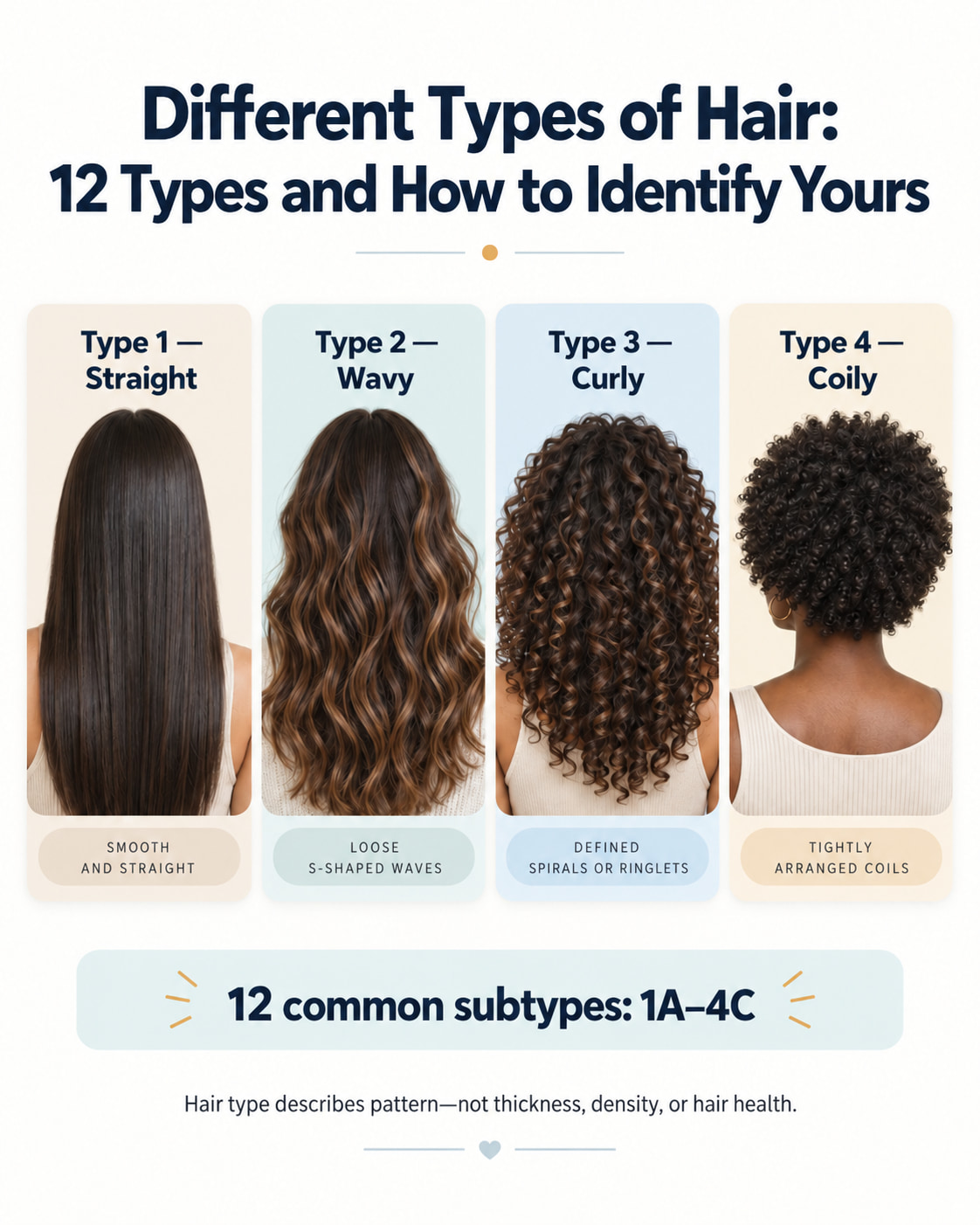
Knowing your pattern gives you a starting point for your routine. However, the American Academy of Dermatology’s hair-care recommendations also emphasize individual needs, including oiliness, dryness, and strand thickness.
Use the guide below to identify your general pattern, understand the differences between neighboring types, and choose gentle care habits without getting stuck on a perfect label.
What Are the Different Types of Hair?
The expanded hair-type chart organizes hair into these groups:
| Main type | Natural pattern | Subtypes |
|---|---|---|
| Type 1 | Straight | 1A, 1B, 1C |
| Type 2 | Wavy | 2A, 2B, 2C |
| Type 3 | Curly | 3A, 3B, 3C |
| Type 4 | Coily | 4A, 4B, 4C |
Within the wavy, curly, and coily groups, the letters generally describe increasingly pronounced or tighter patterns. Straight-hair subtypes also use descriptions of body and strand thickness.
Treat this chart as a descriptive tool, not a medical classification or a ranking of hair quality. There is no reason to force every head of hair into one exact category.
For perspective, a 2016 observational study involving 2,249 adults measured curliness, diameter, and density separately. Its background also described an eight-category hair-shape system. The familiar 12-label chart is therefore not the only approach to describing hair.
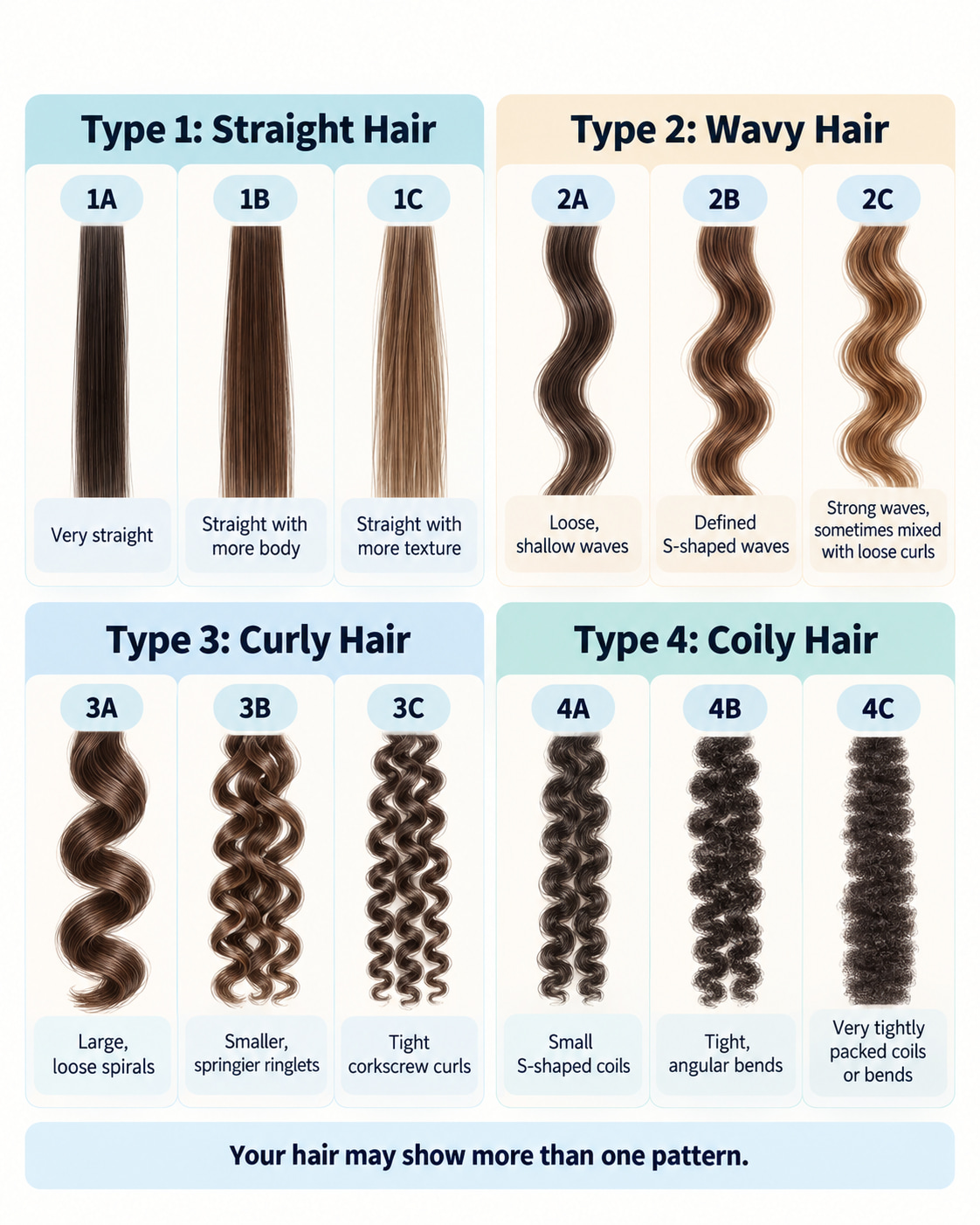
Type 1: Straight Hair
1A Hair
Type 1A is very straight, with almost no natural bend. Consumer charts commonly describe it as fine, with little body.
1B Hair
Type 1B stays predominantly straight but has more movement and body than 1A. A slight bend may appear toward the ends.
1C Hair
Type 1C is straight with more noticeable texture and is commonly described as coarser. It lacks the recurring S-shaped waves associated with Type 2. These distinctions are approximate rather than firm boundaries.
Type 2: Wavy Hair
Wavy hair bends into S-shaped curves rather than consistently forming complete spirals. The roots may look straighter than the lengths, especially in looser patterns.
2A Hair
Type 2A has shallow, relaxed waves. It can look nearly straight at first, particularly around the roots, while gentle bends become more apparent farther down.
Look for: Subtle, recurring curves rather than just one flipped end.
2B Hair
Type 2B has clearer S-shaped waves, often most visible from the mid-lengths downward. The wave pattern is more pronounced than 2A but generally does not form consistent ringlets.
Look for: Defined waves through much of the length.
2C Hair
Type 2C has strong, deep waves that may begin closer to the scalp. Some sections can resemble loose curls, making the boundary between 2C and 3A difficult to judge.
Look for: Pronounced S-shaped bends, with waves remaining the dominant pattern.
Type 3: Curly Hair
Type 3 hair forms recognizable spirals or ringlets. The main distinction between its subtypes is how loose or tight those curls appear.
3A Hair
Type 3A has large, loose curls. Unlike a wave that bends back and forth, a typical 3A section makes a visible spiral.
Look for: Open ringlets with relatively wide loops.
3B Hair
Type 3B has smaller, springier ringlets than 3A. The curls appear more compact while retaining a clear rounded shape.
Look for: Medium-sized spirals that repeat along the strand.
3C Hair
Type 3C has tight corkscrew curls. These are smaller than 3B ringlets and sit closely together.
Look for: Narrow, clearly formed spirals. References to “pencil-sized” curls are only visual comparisons—not measurements you must match.
Type 4: Coily Hair
Type 4 hair has very tight coils, compact bends, or a combination of both. It can show substantial shrinkage, meaning it looks shorter in its resting pattern than when gently stretched.
4A Hair
Type 4A forms small, springy S-shaped coils. The individual coil pattern is often visible when you examine a section closely.
Look for: Tight, rounded coils that repeat from near the roots through the lengths.
4B Hair
Type 4B is commonly described as having more angular, Z-like bends rather than consistently rounded spirals.
Look for: Compact sections with sharper changes in direction. The pattern may not look identical across your entire head.
4C Hair
Type 4C has extremely tight coils or bends that can be difficult to distinguish without looking closely. Less visible definition does not mean the hair has no pattern.
Look for: Very compact texture, tiny coils, and noticeable shrinkage. You do not need a particular shrinkage percentage to use this label.
Do not automatically interpret a tighter pattern as a thicker individual strand. Curl shape and strand diameter are separate characteristics.
How to Identify Your Hair Type
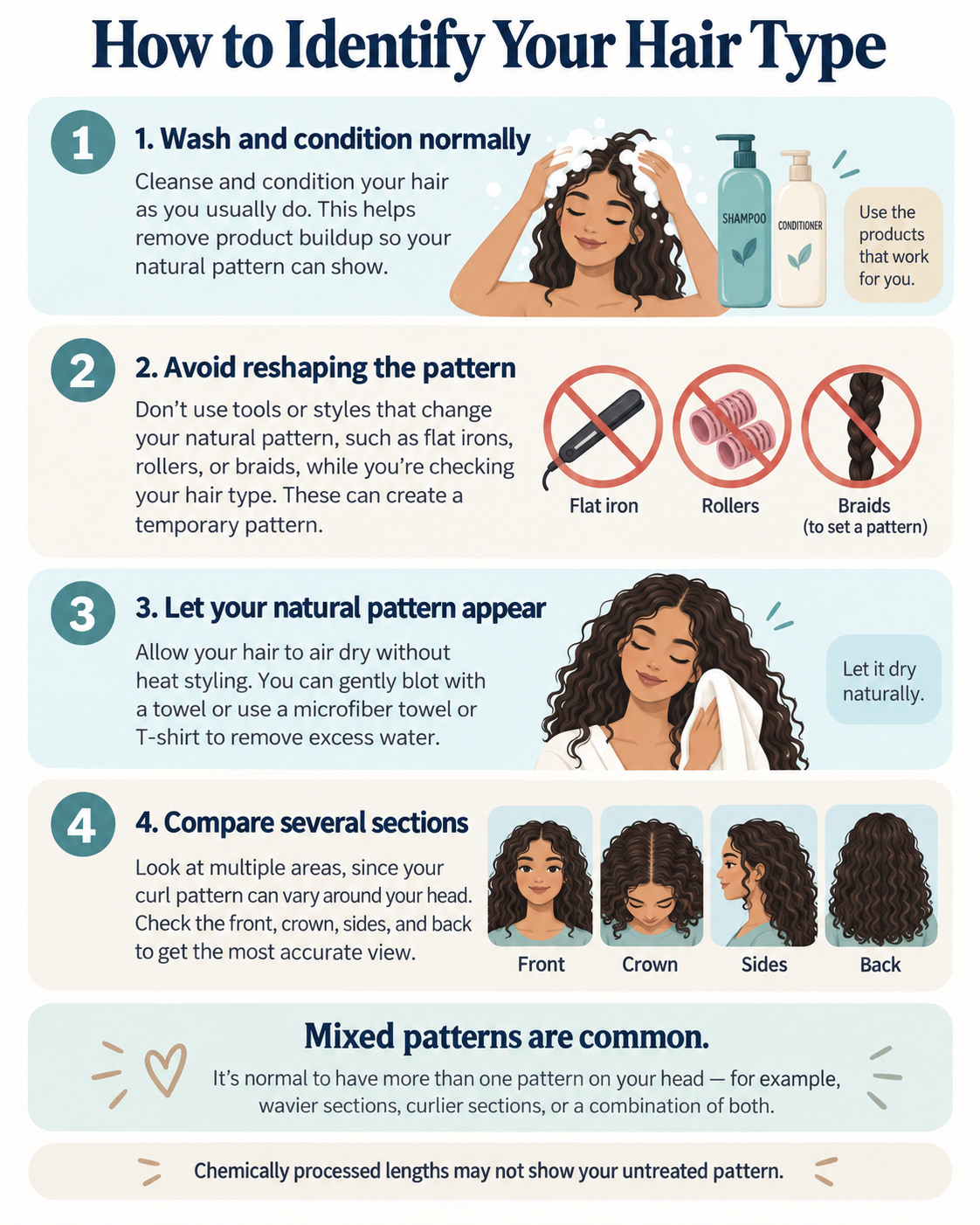
The goal is to observe what your hair naturally does—not to create a particular result for the test.
Start With Clean, Gently Detangled Hair
Wash and condition as usual. Remove tangles carefully rather than skipping conditioner to make your hair completely product-free.
For curly or coily hair, working in sections while the hair is wet and conditioned can make detangling easier. Avoid pulling through resistant knots.
Avoid Techniques That Change the Pattern
For this observation, skip flat-ironing, roller sets, braids, and other methods that deliberately stretch or reshape the hair.
Even heatless styling can temporarily change its appearance. A braid-out or wrapped style shows the result of a technique, not necessarily your untreated pattern.
Compare Several Sections After Drying
Examine the front, crown, sides, and back. Compare the overall shapes with the descriptions above rather than judging one isolated strand.
Mixed patterns are possible. You might describe your hair as “mostly 2B with some 2C sections” instead of choosing only one label.
For loose waves, allow the hair to finish drying before making your final comparison; Type 2 hair can look straighter when wet.
Account for Chemical Processing
Relaxers and perms alter hair characteristics, so processed lengths may not represent your untreated pattern. Consider any untreated new growth separately from the previously processed sections.
A useful note to take to a stylist might be: “Mostly loose waves, fine strands, oily roots, and color-treated ends.” That gives more information than a subtype alone.
Hair Type vs. Thickness, Density, and Porosity
These terms describe different features. Understanding the differences helps prevent buying products based on the wrong assumption.
Strand Thickness: Fine, Medium, or Coarse
Strand thickness refers to the width of an individual hair. Fine strands have a smaller diameter; coarse strands have a larger diameter.
Fine hair is not the same as thin hair. You can have many fine strands and still have a full-looking head of hair.
Density: How Many Hairs Occupy an Area
Density describes the number of hairs growing within an area of the scalp. It is separate from the diameter and shape of those hairs.
That is why “thick hair” can be an unclear description: someone may be referring to large individual strands, a high number of strands, or both.
Porosity: How Hair Takes Up Moisture
In hair care, porosity describes how readily hair absorbs and retains moisture. It relates to the condition of the cuticle, the strand’s outer layer.
Chemical processing and damage can affect porosity. Your curl label alone does not tell you how porous your hair is.
You do not need to settle every classification before building a routine. Start by noticing practical issues: whether your hair tangles, feels dry, becomes weighed down, or develops buildup. Adjust one thing at a time.
How to Care for Different Types of Hair
A useful routine responds to both your scalp and your hair. Two people with the same curl pattern may need different amounts of conditioning or different washing frequencies.
Wash According to Oiliness and Buildup
Wash when your scalp and hair need cleansing, rather than following a fixed schedule for a subtype.
An oily scalp with straight hair may need frequent shampooing. Dry or tightly textured hair may need less frequent washing. Focus shampoo on the scalp instead of aggressively rubbing it through the lengths.
Less frequent washing should not mean neglecting scalp hygiene. The AAD advises washing thick, curly hair at least every two to three weeks, while individual needs may call for washing sooner.
Condition Without Automatically Choosing the Heaviest Formula
Use conditioner after shampooing. Fine or straight hair may need it mainly toward the ends, while dry or curly hair may benefit from application throughout the lengths.
In its guidance updated March, 2024, the AAD’s dermatologists recommend matching leave-in conditioner to the hair’s needs. Fine, straight hair generally needs a lighter formula, while curly hair often needs more conditioning. Start with a small amount and apply it where needed.
For example, fine curls may become weighed down by a rich product. The solution is not necessarily to stop conditioning; a lighter formula or smaller amount may work better.
Detangle at the Right Stage
For straight hair, let it dry somewhat before gently using a wide-tooth comb. For textured hair or tight curls, detangle while damp.
Work through the ends first, then gradually move upward. Avoid pulling a comb from the roots through a full length of tangled hair.
Keep Styling Optional and Gentle
For waves, a lightweight mousse or gel can provide hold and definition. Start with a modest amount rather than layering several products immediately. Dry brushing can reduce wave definition, so consider when you detangle as well as what you apply.
For curly and coily hair, sectioning can make washing and detangling more manageable. You do not need to brush the hair dry to make it look neat.
Limit Excessive Heat and Pulling
Use lower heat settings, reduce repeated heat styling, and use a product labeled for heat protection. No hair type is immune to heat damage.
Avoid hairstyles that continually pull tightly on the hair. Braids, extensions, buns, and ponytails are not automatically gentle simply because they are convenient or described as protective.
Can Your Hair Type Change?
Yes. MedlinePlus Genetics explains that hair texture and thickness are strongly influenced by genetics, but hormones, aging, certain medications, relaxers, and perms can also change hair characteristics.
It helps to distinguish between new growth changing over time and existing hair being reshaped or processed. A temporary style does not establish that your underlying pattern has permanently changed.
Heatless styling, moisture, and humidity can also affect how a pattern appears between washes. Avoid reclassifying your hair based on one unusually straight or frizzy day.
When to See a Dermatologist
A hair-type chart cannot explain persistent breakage, thinning, or hair loss.
The AAD recommends seeking a dermatologist’s assessment when changing your routine does not improve the problem, especially when you notice thinning or hair loss. Do not assume those changes are simply part of having a particular hair type.
Frequently Asked Questions
What Is the Difference Between 1C and 2A Hair?
Type 1C remains predominantly straight, while 2A has a recurring, loose wave pattern. Look at the overall shape rather than using frizz or strand thickness alone to decide. The boundary is approximate.
How Can You Tell Whether Your Hair Is Wavy or Curly?
Wavy hair primarily makes back-and-forth S-shaped bends. Curly hair forms recognizable spirals or ringlets. Hair near the 2C–3A boundary may show both, so a mixed description can be more useful than one exact label.
Can You Have More Than One Hair Type?
Yes. Different areas can have different patterns. For example, the crown may have tighter curls than the sides. Describe the variation instead of assuming that every section must match.
Is Fine Hair the Same as Thin Hair?
No. Fine describes the diameter of individual strands. Thin usually refers to lower density. Fine hair can be dense, and larger-diameter strands can grow at a lower density.
Does 4C Hair Have No Curl Pattern?
No. Its coils and bends can be so small and closely arranged that they are less obvious at a glance. Limited visible definition does not mean the hair lacks a natural pattern.
Does Every Hair Type Need Leave-In Conditioner?
Not necessarily. A leave-in may help when hair remains dry, tangled, or difficult to manage after rinse-out conditioning. Choose a formula and amount suited to your needs rather than adding it solely because of your curl label.
The Bottom Line
Understanding the different types of hair is most useful when it helps you describe your hair—not when it becomes a rule you must fit.
At your next wash, observe several sections, note your closest pattern, and consider thickness, dryness, and scalp needs separately. Start with a simple routine and change one product or habit at a time. Aim for comfortable care and manageable hair, not a perfect match to a chart.
This content is for informational purposes only and not medical advice.
References
Dermatology and medical sources
- American Academy of Dermatology. Tips for healthy hair.
- American Academy of Dermatology. Dermatologists’ top tips for using leave-in conditioner.
- American Academy of Dermatology. 6 curly hair care tips from dermatologists.
- American Academy of Dermatology. 10 hair care habits that can damage your hair.
- MedlinePlus Genetics. Is hair texture determined by genetics?.
- Loussouarn G, et al. Diversity in human hair growth, diameter, colour and shape. European Journal of Dermatology. 2016;26:144–154.
Consumer terminology and styling sources
- L’Oréal Paris. Hair types and textures guide.
- L’Oréal Paris. Identifying hair characteristics.
- L’Oréal Paris. Wavy hair types and care.
- L’Oréal Paris. Wavy hair routine.
- L’Oréal Paris. Curly hair patterns and routines.
- L’Oréal Paris. Coily hair characteristics.
- L’Oréal Paris. Hair porosity overview.
- L’Oréal Paris. Temporary straightening and styling methods.