
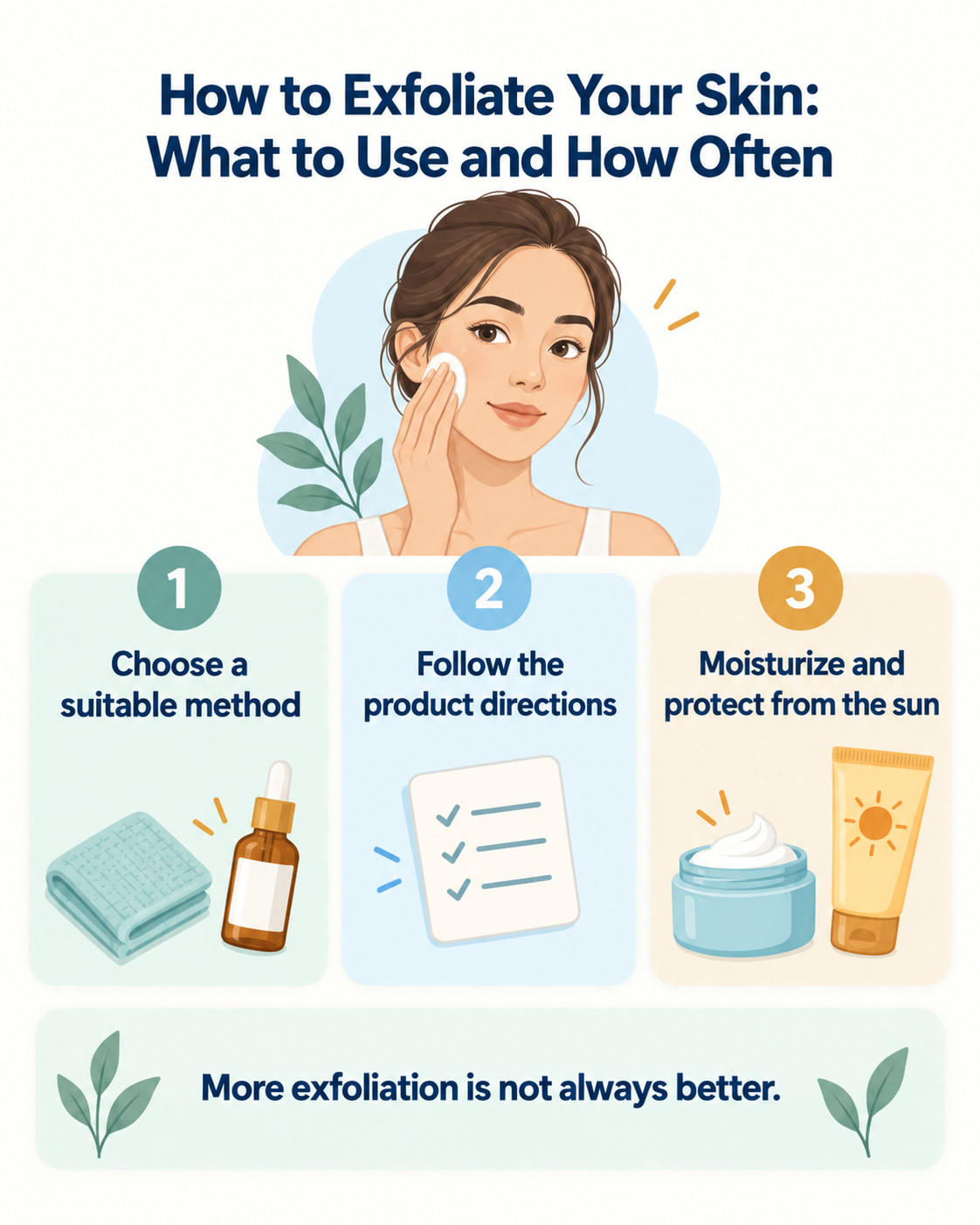
Here’s how to exfoliate your skin safely: choose one suitable method, follow its directions, moisturize afterward, and use sun protection. How often you exfoliate depends on your skin, the product, and the rest of your routine—not a universal daily or weekly rule.
Exfoliation is optional. Done too aggressively, it can leave your skin irritated rather than smoother. In guidance updated February, 2026, the American Academy of Dermatology recommends choosing an exfoliation method that suits your skin. The goal is a comfortable, manageable routine—not the strongest product you can tolerate.
What Does Exfoliating Do for Your Skin?
Exfoliation removes dead cells from the skin’s outer surface. It may improve the appearance of dullness and rough texture, but it is not essential for everyone. It also has limits: exfoliation should not be expected to erase wrinkles or resolve every skin concern.
Consider what you actually want to improve. Occasional roughness, clogged pores, and persistent peeling are different concerns, so they should not automatically lead to the same product choice.
What Should You Use to Exfoliate Your Skin?
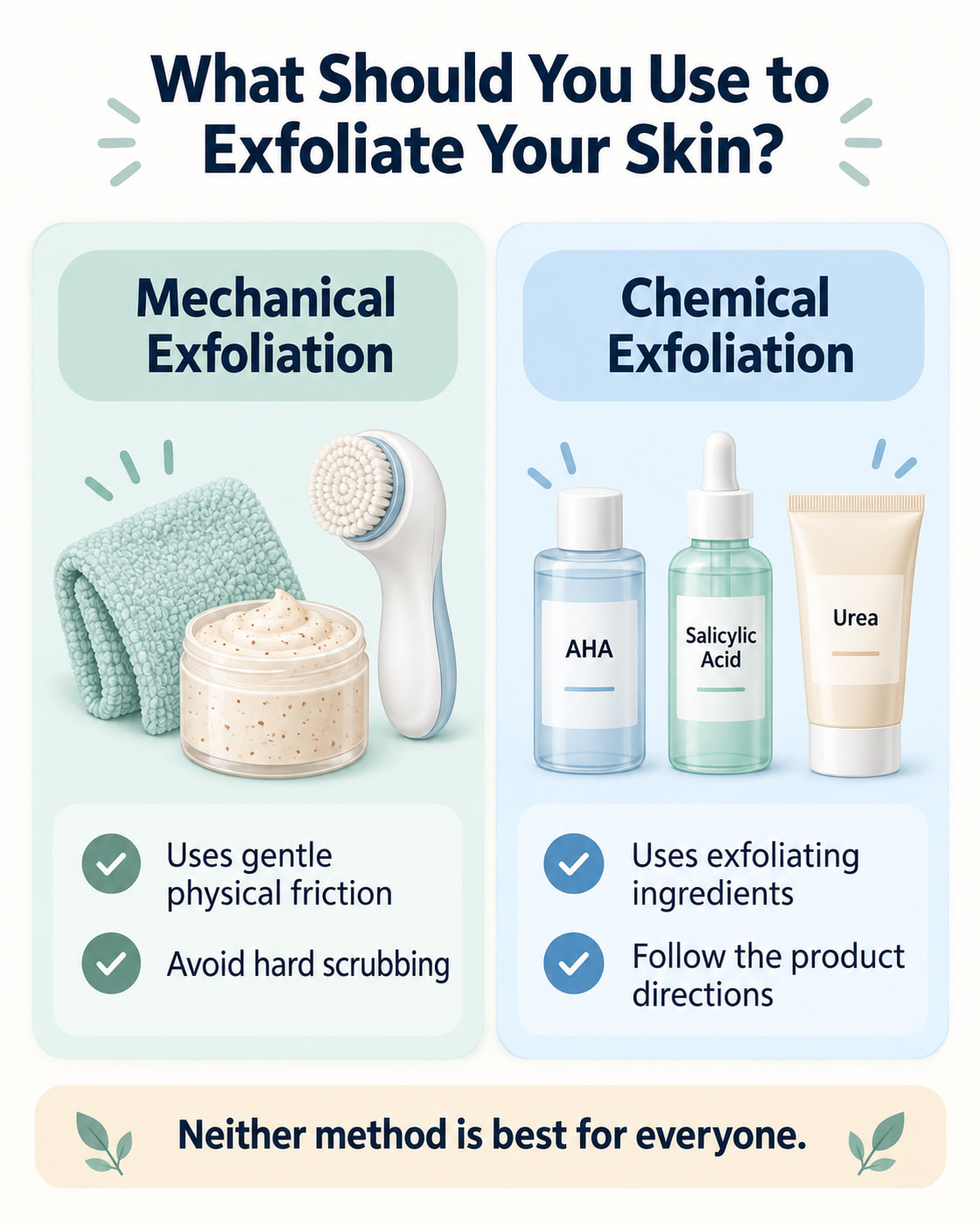
At-home exfoliation falls into two main categories: mechanical exfoliation and chemical exfoliation. Neither is automatically the best choice for every person.
Mechanical Exfoliation
Mechanical, or physical, exfoliation uses friction from a washcloth, scrub, brush, or similar tool to remove surface cells.
A simple washcloth can provide mild exfoliation, but pressure matters. Abrasive scrubs and vigorous rubbing can irritate skin, particularly when inflammatory acne is present.
Chemical Exfoliation
Chemical exfoliants use ingredients that encourage surface cells to shed.
| Ingredient | What to know |
|---|---|
| Glycolic acid and lactic acid | Common alpha hydroxy acids, or AHAs. Their exfoliating effects depend on the formulation, including concentration and pH. |
| Salicylic acid | Commonly labeled a beta hydroxy acid, or BHA. It is used in some acne products and may help with blocked pores. |
| Urea | Included in some products for rough, thickened body skin. Its role depends on the formulation and intended use. |
A product’s name is not enough to tell you how to use it. An exfoliating cleanser, leave-on serum, and rinse-off mask may require very different application steps. Follow the specific directions rather than treating them as interchangeable.
How to Read an Exfoliant Label
Check the intended body area, application amount, contact time, frequency, and warnings. Confirm whether the product stays on or must be rinsed off.
The FDA explains that AHA strength depends on more than the acid percentage. Acidity and other ingredients also affect exfoliation. A lower number on the label is therefore not a guarantee that a product will suit sensitive skin.
How to Choose an Exfoliant for Your Skin Type
Use your skin’s current condition—not just its usual “type”—to guide your decision.
| Your skin or concern | A practical approach |
|---|---|
| Dry, tight, or peeling skin | Prioritize gentle cleansing and moisturizer rather than trying to scrub away every flake. |
| Sensitive skin | Consider skipping exfoliation. Even ingredients such as glycolic acid can irritate sensitive skin, so test any new product carefully. |
| Oily skin with clogged pores | A salicylic-acid product may be an option. Use it according to its label, not more frequently simply because your skin is oily. |
| Combination skin | Consider oily and dry areas separately. For example, avoid assuming that dry cheeks need the same exfoliation as an oily forehead. |
| Acne already under treatment | Keep supporting skin care gentle. Extra exfoliants can add irritation and make acne appear worse. |
Darker skin tones need particular care with irritation. Aggressive exfoliation can contribute to dark marks, especially when your skin tends to develop discoloration after acne, burns, or other irritation. Stronger exfoliation is not necessarily a better approach to uneven tone.
How to Exfoliate Your Skin Safely
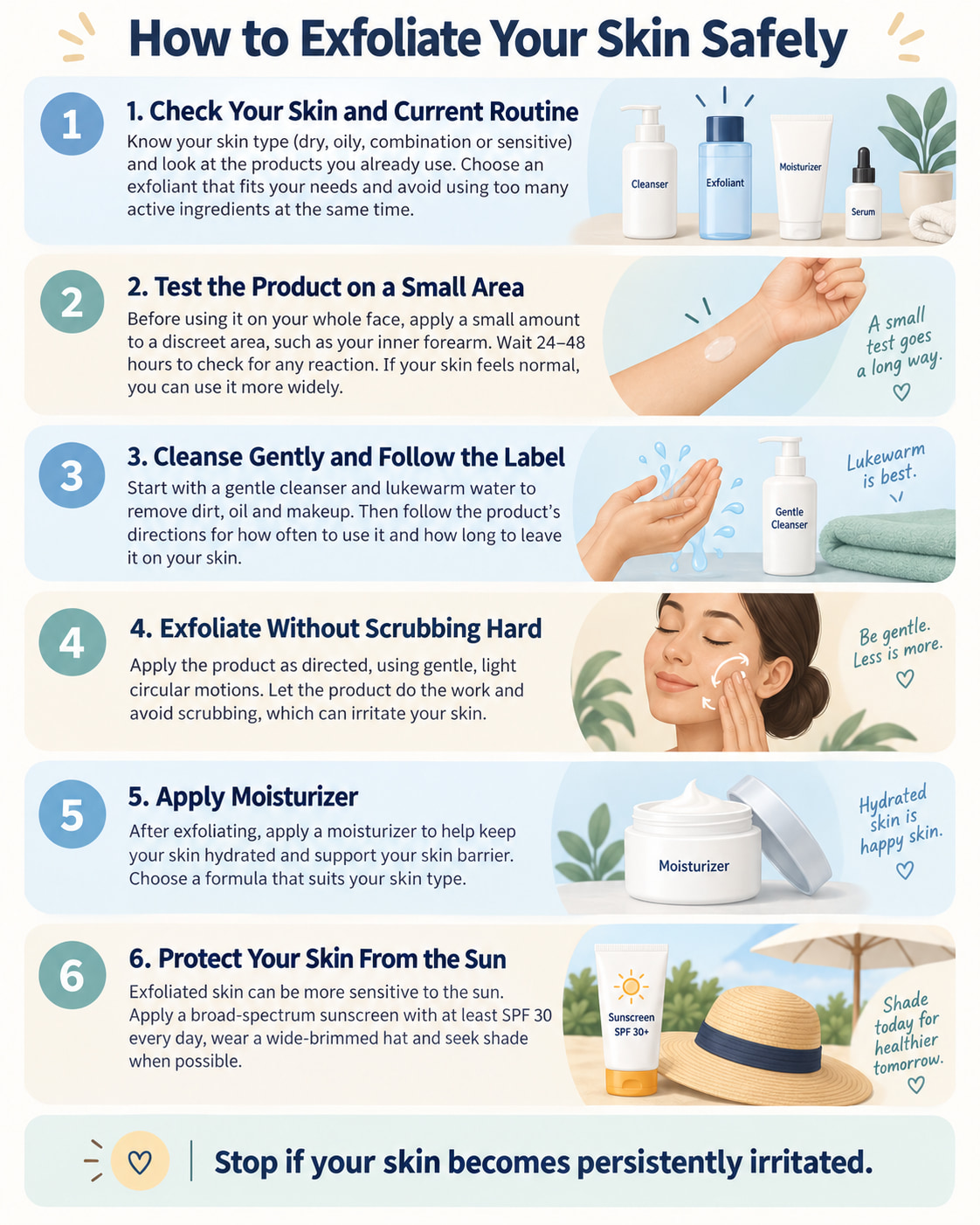
1. Check Your Skin and Current Routine
Review what you already use. Retinol, prescription retinoids, and benzoyl peroxide can increase dryness or sensitivity, and adding exfoliation may worsen those effects.
Also check for exfoliating ingredients in cleansers, pads, and body lotions. An exfoliating serum may not be your routine’s only source of exfoliation.
2. Test the Product on a Small Area
The FDA recommends testing BHA products on a small area before wider application. Follow any first-use testing instructions on the label. Do not apply an acid more often than directed just to complete a generic product-testing routine.
Watch for itching, swelling, redness, or discomfort. Home testing can help identify a reaction, but it is not the same as diagnostic patch testing performed by a dermatologist.
3. Cleanse Gently and Follow the Label
For a separate leave-on product, start with gentle cleansing unless its instructions say otherwise. Use your fingertips, lukewarm water, and a nonabrasive cleanser. Pat dry rather than rubbing.
Then check whether the exfoliant requires wet or dry skin. An exfoliating cleanser may already perform the cleansing step; follow its instructions instead of automatically adding another wash.
4. Exfoliate Without Scrubbing Hard
For a mild rinse-off scrub, AAD guidance describes approximately 30 seconds of gentle circular motion, followed by rinsing with lukewarm water. This is not a universal contact time for acid products.
For a chemical exfoliant, follow its stated amount and contact time. Rinse off a rinse-off product when directed; use a leave-on product only as instructed. Do not add extra applications to try to speed results.
5. Apply Moisturizer
Follow exfoliation with a moisturizer suited to your skin. Exfoliating products can cause dryness, and moisturizer helps support hydration. You do not need to make the moisturizing step another exfoliation step.
For dry skin, a fragrance-free cream or ointment may be more useful than repeatedly adding exfoliating products. Apply it gently.
6. Protect Your Skin From the Sun
When outdoors, use broad-spectrum, water-resistant SPF 30 or higher on exposed skin, along with shade and protective clothing.
AHAs deserve particular attention: FDA guidance warns that they may increase sun sensitivity during use and for one week after stopping. Evening application does not remove the need for daytime protection.
How Often Should You Exfoliate Your Skin?
There is no single schedule that works for everyone. In Harvard Health’s dermatologist-led guidance on exfoliation, dermatologist Rachel Reynolds advises against daily cosmetic exfoliation and suggests a maximum of two or three sessions weekly. That is an upper limit in that guidance—not a frequency everyone should reach.
For an adult with healthy, comfortable skin trying optional exfoliation, once weekly is a cautious starting example, not a research-established ideal.
A practical way to approach that example is to use one product, keep the rest of your routine consistent, and observe how your skin responds between applications. There is no reason to increase frequency just because the calendar says you can.
For example, you might choose Sunday for an initial session. A second session is not automatically due on Tuesday. First consider whether your skin remained comfortable and whether the product’s directions allow more frequent use.
Acne medications and condition-specific products are different. Some salicylic-acid products have schedules that differ from occasional cosmetic exfoliation. Follow the product label or your clinician’s plan rather than imposing a generic once-weekly limit.
How to Exfoliate Your Face vs. Your Body
Do not assume that a product suitable for one area belongs everywhere. Salicylic-acid products, for example, come in different strengths and forms for different uses. Follow the intended application area and avoid using them over large body areas unless directed by a clinician.
For rough bumps on the upper arms or thighs caused by keratosis pilaris, AAD guidance discusses ingredients such as lactic acid, salicylic acid, and urea. It also emphasizes gentle application, moisturizing, and avoiding excessive use that leaves skin raw or irritated.
That does not mean every body bump needs exfoliation. Persistent, changing, or uncomfortable bumps deserve an assessment rather than progressively stronger scrubbing.
Exfoliation Mistakes to Avoid
Adding Too Many Products at Once
An acne cleanser, exfoliating toner, scrub, and new serum can make it difficult to identify what is causing a reaction. AAD acne guidance warns that frequently changing products and adding irritating skin care can contribute to breakouts.
Introduce changes individually so you have a clearer picture of what your skin tolerates.
Treating High-Strength Peels Like Everyday Skin Care
A strong chemical peel is not simply a faster version of an ordinary exfoliant.
In its July, 2024 safety alert, the FDA warned. High concentrations, repeated applications, and prolonged contact can cause serious burns, pigment changes, infection, and scarring.
Do not attempt to recreate a professional peel by layering products or extending the recommended application time.
Signs You Are Over-Exfoliating
Possible warning signs include:
- Persistent stinging, burning, or tenderness.
- New dryness, peeling, or raw-feeling skin.
- Redness, itching, swelling, or a rash.
These symptoms can also reflect an allergic reaction or another skin problem; they are not proof that exfoliation is “working.” FDA guidance advises stopping BHA products and consulting a clinician when irritation or prolonged stinging occurs.
If a new product causes a reaction, gently wash it off and stop using it. Avoid trying to correct irritation with another acid or scrub. A dermatologist can help when a reaction is significant or the cause is unclear.
For mild dryness without signs of a burn, return your attention to gentle cleansing and a fragrance-free moisturizer.
When to Skip Exfoliation or See a Dermatologist
Skip exfoliation on sunburned skin, open cuts, or wounds.
Rosacea is another important exception. AAD rosacea guidance specifically advises stopping exfoliation and avoiding rubbing or scrubbing. It also identifies glycolic acid and lactic acid among ingredients that can irritate rosacea-prone skin.
Ask a dermatologist before adding exfoliation when you have an ongoing rash, troublesome sensitivity, or symptoms that are not improving with gentle care.
Seek urgent medical assessment for a suspected chemical burn, particularly with severe pain, blistering, or eye exposure. Begin rinsing the affected area with plenty of cool or lukewarm running water while obtaining help. Do not put other chemicals or skin creams on a suspected burn.
Frequently Asked Questions
Should You Exfoliate Before or After Cleansing?
For a separate exfoliating product, gentle cleansing usually comes first, unless the label directs otherwise. An exfoliating cleanser combines steps, so another wash is not automatically necessary. Avoid scrubbing during cleansing before adding an exfoliant.
Can You Exfoliate Every Day?
Daily cosmetic exfoliation is not a good default. Some medicated products have different schedules, however. Follow the specific label or clinician’s instructions and do not exceed the recommended applications.
Can You Use an Exfoliant With Retinol?
Retinol can already cause irritation, especially on sensitive skin. Adding another potentially irritating product requires caution. Ask your dermatologist whether an exfoliant would add anything useful to your routine before combining them.
Is Chemical Exfoliation Better Than a Scrub?
Not automatically. Avoiding friction may be helpful, but chemical exfoliants can still irritate skin. The formulation, application method, and your individual response matter more than assuming one category is always gentler.
Should You Exfoliate Dry, Flaky Skin?
Do not assume flakes mean you need more exfoliation. Dry skin can also itch, crack, and become uncomfortable. Start with gentle washing and regular moisturizer; seek advice when dryness persists or becomes severe.
Should You Exfoliate in the Morning or at Night?
Use the timing specified by the product or your clinician. Nighttime use does not cancel AHA-related sun sensitivity, so sun protection still matters the following day and after you stop using the product.
The Bottom Line
Learning how to exfoliate your skin does not require a complicated routine. Start by checking your product’s instructions and what is already in your skin care routine. Choose a restrained approach, pay attention to discomfort, and remember that skipping exfoliation is a valid option.
This content is for informational purposes only and not medical advice.
References
- American Academy of Dermatology. How to safely exfoliate at home.
- U.S. Food and Drug Administration. Alpha Hydroxy Acids.
- U.S. Food and Drug Administration. Beta Hydroxy Acids.
- American Academy of Dermatology. Dermatologists’ top tips for relieving dry skin.
- American Academy of Dermatology. Acne: Tips for managing.
- American Academy of Dermatology. Keratosis pilaris: Self-care.
- American Academy of Dermatology. 7 rosacea skin care tips dermatologists recommend.
- NHS. Acid and chemical burns.