
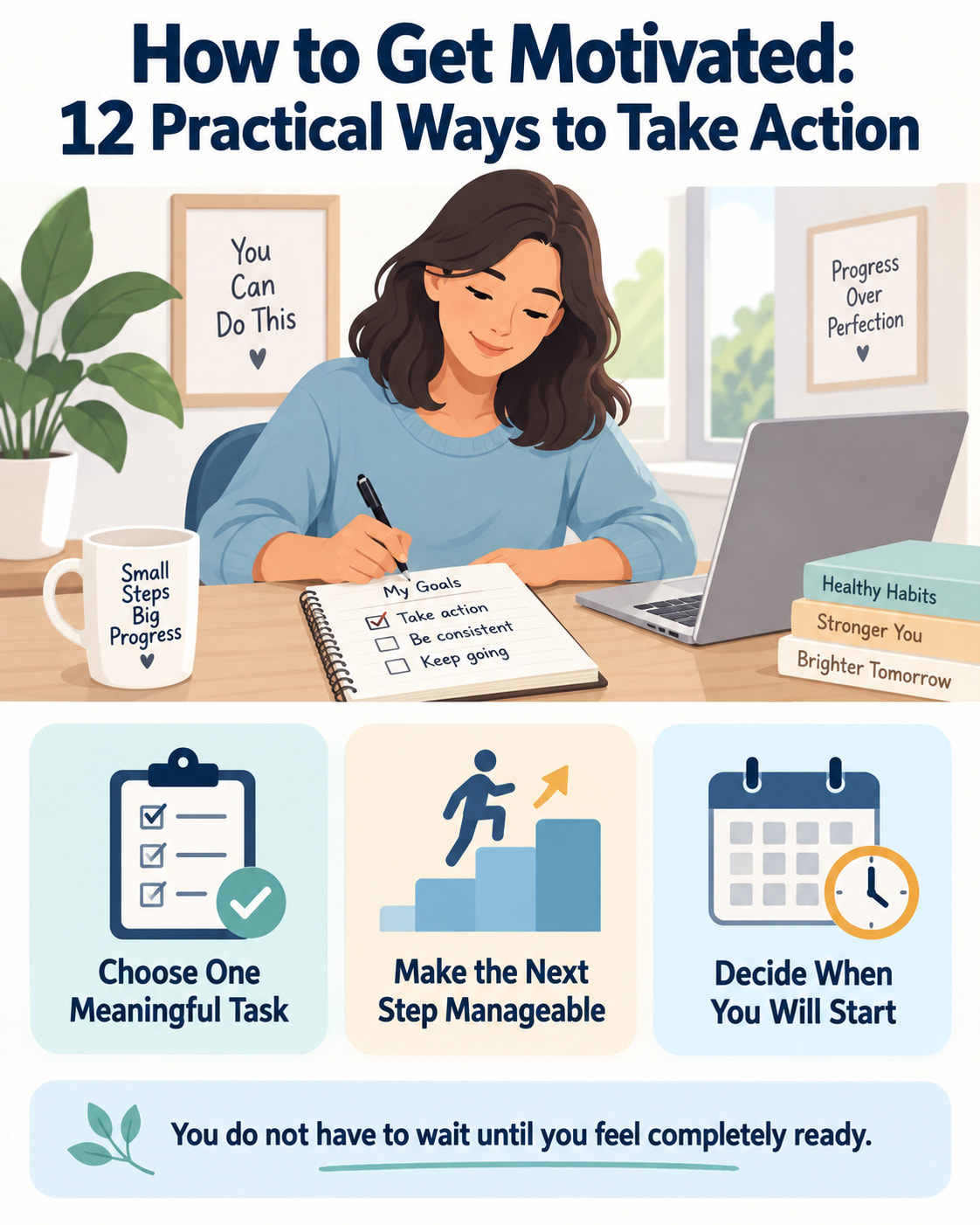
To get motivated, choose one meaningful task, break it into a manageable next step, and decide when you will begin. Rather than waiting to feel completely ready, give yourself a small, realistic action to try.
Learning how to get motivated is not about demanding more productivity from yourself at any cost. It is about finding an approach that fits the task, your resources, and your current capacity.
The strategies below cover starting, following through, and restarting after setbacks. They also leave room for rest, changing an unrealistic plan, and seeking support when motivation tips are not enough.
Why Is It Hard to Get Motivated?
Before looking for more willpower, ask: “What is making this particular task difficult to start?”
Use the following examples to identify a practical adjustment—not to diagnose yourself.
| What you are thinking | An adjustment to try |
|---|---|
| “I do not know where to begin.” | Define one specific action you can complete next. |
| “There is too much to do.” | Choose one priority and postpone, delegate, or renegotiate another. |
| “I am worried I will do it badly.” | Make the first attempt a draft or practice session. |
| “I do not have the time, information, or help.” | Address the missing resource rather than expecting motivation to replace it. |
Also consider whether the task still deserves your attention. Not every unfinished goal needs a stronger commitment. Some need a smaller scope, a different deadline, or a decision to stop.
How to Get Motivated: 12 Practical Strategies
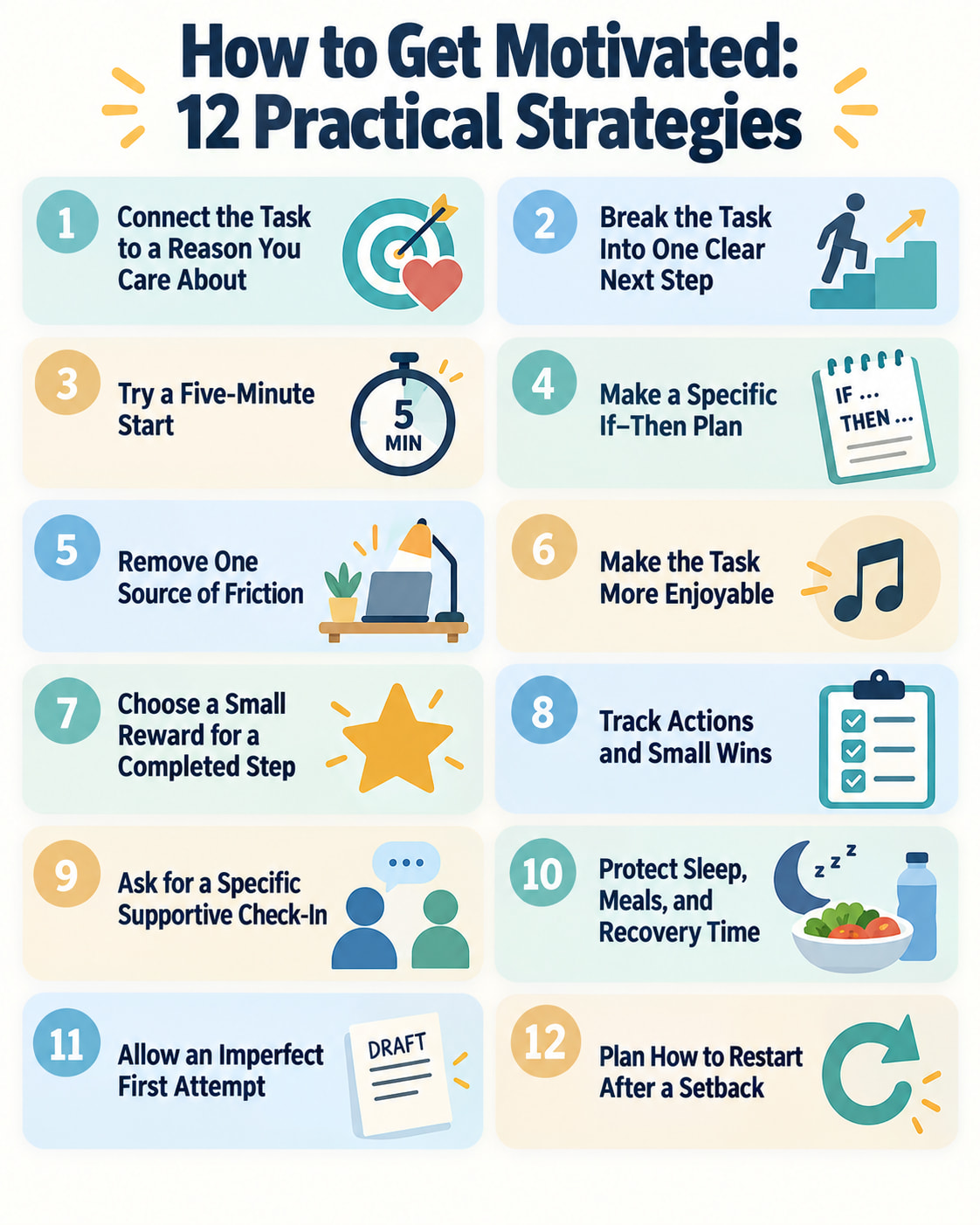
Choose one or two strategies to test first. You do not need to turn all 12 into another demanding checklist.
1. Connect the Task to a Reason You Care About
Ask what completing the task would make possible for you.
Instead of “I should update my resume,” try: “Updating my resume will let me apply for a role that better matches my interests.”
Your reason does not have to be inspiring or life-changing. Making your home easier to use, keeping a commitment, or learning something useful are reasonable goals.
Write your reason in one sentence. Then check whether the task actually serves it. When a goal mainly reflects someone else’s expectations, consider whether you want to keep it, change it, or set a boundary.
2. Break the Task Into One Clear Next Step
Replace a broad instruction with an action you can picture doing.
“Get organized” leaves many decisions unresolved. “Put the loose papers on my desk into one folder” gives you a starting point.
Likewise, change “study for the exam” to “answer three practice questions from the first topic.” Change “finish the presentation” to “write the heading and main point for the opening slide.”
Make the next step small enough to attempt, but concrete enough to move the task forward. Avoid spending the whole session reorganizing your plan when you already know what needs to happen next.
3. Try a Five-Minute Start
Commit to a brief attempt rather than the entire task.
The NHS recommends a five-minute starting technique for activities you have been avoiding: set a timer, begin, and check how you feel when the time is up. You may decide to continue, but you do not have to.
For example, spend five minutes sorting one small pile of laundry rather than promising to clean the whole room.
Five minutes is a practical suggestion, not a scientifically established threshold that guarantees motivation. Use a shorter starting period when that feels more manageable. Afterward, decide whether to continue, pause, or change the task.
4. Make a Specific If–Then Plan
Connect your action to a situation you will recognize.
A useful format is:
“If this situation happens, then I will take this action.”
For example: “After I put away my breakfast dishes, I will sit at the table and review one page of notes.”
A large meta-analysis of implementation intentions examined 642 independent tests and found benefits across behavioral and other outcomes. Results varied, and effects were larger when plans used an if–then format and participants already had stronger motivation to pursue the goal. Planning can support follow-through; it is not a guarantee.
Choose a cue that realistically occurs in your day. “After lunch” is more actionable than “when I have plenty of free time.”
5. Remove One Source of Friction
Identify one unnecessary obstacle between you and the task.
Before a writing session, open the document you need. Before practicing an instrument, place the music and instrument where you will use them. For a phone call, find the number and write down your main question.
When your phone repeatedly interrupts you, try putting it out of reach or silencing nonessential notifications during the attempt.
Keep preparation brief. You do not need a perfect workspace, a new app, or expensive equipment before beginning an ordinary task. Remove the obstacle that matters most, then start.
6. Make the Task More Enjoyable
Look for an acceptable version of the task—not necessarily the most impressive one.
Try listening to a favorite playlist while folding laundry, using a comfortable reading spot, or practicing a skill with someone whose company you enjoy.
For tasks that require concentration, experiment with quiet rather than automatically adding music or entertainment.
Ask: “What would make this experience more pleasant without getting in the way?”
You do not need to turn every responsibility into a hobby. One small change to the setting, method, or company may be worth testing.
7. Choose a Small Reward for a Completed Step
Plan something enjoyable after a clearly defined action. The NHS includes planning a reward among its suggestions for approaching necessary tasks.
For example, after completing one section of an application, spend a few minutes reading something you enjoy. Tie the reward to a manageable step rather than an entire project that could take weeks.
Keep rewards affordable and proportionate. A short enjoyable activity is enough; you do not need to buy something.
Do not make meals, sleep, or necessary rest something you must “earn.” Keep basic needs separate from your reward system.
8. Track Actions and Small Wins
Record what you actually complete.
A 2016 meta-analysis in Psychological Bulletin included 138 studies involving 19,951 participants. Interventions that encouraged progress monitoring improved goal attainment on average, with larger effects when progress was physically recorded or reported. That supports tracking as a useful tool, not a promise of success for every goal.
For a practical application, note completed practice sessions, pages drafted, or applications submitted. A checkmark or one-line note is enough.
Review both your actions and whether they are moving you toward the outcome. Completing many low-priority tasks should not replace the important task you are avoiding.
Use the record as information, not a score of your worth.
9. Ask for a Specific Supportive Check-In
Make a clear request rather than asking someone to “keep me motivated.”
For example: “Could you check in on Friday about whether I drafted the opening section? I would appreciate encouragement, not pressure.”
You could also arrange a quiet work session with a friend or ask someone to help you identify the first step.
Choose the kind of support you actually need. That might be feedback, company, practical help, or a reminder.
Keep the arrangement voluntary. You do not have to post your progress publicly or share details you would rather keep private.
10. Protect Sleep, Meals, and Recovery Time
Check whether your plan leaves room for basic care.
The National Institute of Mental Health’s self-care guidance recommends prioritizing sleep, regular meals, physical activity, relaxing activities, and supportive relationships. These practices support well-being; they are not guaranteed solutions to low motivation.
Build your task list around those needs rather than repeatedly borrowing time from them. Avoid scheduling demanding work so late that finishing it routinely means cutting sleep.
When your commitments exceed your available time, consider reducing the workload or asking for help. A better plan may involve doing less, not pushing harder.
11. Allow an Imperfect First Attempt
Separate creating something from evaluating it.
For a report, write a rough explanation before polishing the wording. For a presentation, practice once without restarting every time you make a mistake.
Give the first attempt a limited purpose: produce material you can improve, discover what you do not understand, or identify the next question.
A useful instruction is: “Make a workable draft, then review it.”
This does not mean ignoring accuracy or safety. Keep appropriate standards for finished work and safety-sensitive tasks. The permission to be imperfect applies to learning and drafting—not skipping necessary checks.
12. Plan How to Restart After a Setback
Decide how you will respond when a session does not happen.
Instead of “I have ruined the week,” describe the situation specifically: “The meeting ran late, and my planned study time disappeared.”
Then adjust something within your control. Choose another realistic opportunity, reduce the next session, or change the cue.
For example: “When an evening commitment interrupts my reading plan, I will read one page after breakfast the next morning.”
Do not automatically double the next task as a penalty. Review whether the original workload still makes sense, and resume with an achievable step.
A Simple Plan to Get Started Today
Suppose you have been putting off a presentation. Here is how to combine a few strategies without building a complicated system.
Choose the task: Work on the presentation opening—not the entire slide deck.
Define the next action: Write one sentence stating what the audience should understand.
Set the cue: “After lunch, I will open the presentation file and work on that sentence for five minutes.”
Remove one obstacle: Close unrelated tabs before starting.
When the timer ends, check what you completed. Continue when it feels manageable, or leave a note identifying the next action before you stop.
The aim is a concrete attempt and a clear place to resume, not a promise to finish everything today.
When to Seek Help for Low Motivation
Low motivation alone does not establish a diagnosis. However, NIMH’s depression guidance identifies persistent loss of interest, low energy, concentration difficulties, and changes in sleep or appetite as possible symptoms of depression. Some medical conditions and medications can cause similar symptoms, which a healthcare professional can assess.
NIMH recommends seeking professional help for severe or distressing symptoms lasting two weeks or longer, including loss of interest and difficulty completing usual activities. You do not need to wait two weeks when you are concerned or struggling significantly.
Consider speaking with a primary care provider or mental health professional when the difficulty is persistent, worsening, or affecting daily responsibilities. Explain when it began, what has changed, and how it affects your day.
For thoughts of suicide, call or text 988 in the United States. In an immediate, life-threatening emergency, call 911. Outside the United States, contact your local crisis service or emergency number.
Frequently Asked Questions
How Do I Get Motivated When I Do Not Feel Like Doing Anything?
Choose one necessary or meaningful task and make the first step very small. Put one item away instead of cleaning a room, or open a document instead of finishing a project. Give yourself permission to reassess after that step rather than immediately adding more demands.
How Can I Get Motivated to Study or Work?
Replace “work harder” with a specific output, such as answering three practice questions or drafting one paragraph. Choose a realistic starting cue, gather the materials, and limit avoidable interruptions. When you do not understand the assignment, make asking for clarification your first task.
Can I Start a Task Before I Feel Motivated?
You can try a small, planned action without first feeling enthusiastic. The NHS’s five-minute technique offers one way to approach this: begin briefly and then reassess. Starting may reveal that you can continue, but it does not guarantee a change in mood or energy.
How Can I Get Motivated to Exercise?
Choose an activity you enjoy and a manageable starting amount that fits your abilities. Prepare what you need and identify a realistic opportunity to begin. Focus on following through with that plan rather than competing with someone else’s workout or aiming for exhaustion.
How Do I Stay Consistent After the Initial Excitement Fades?
Keep using a specific cue, record completed actions, and review obstacles. Have a smaller version of the task available for busy days. When your priorities or circumstances change, revise the plan instead of expecting the original schedule to work indefinitely.
When Should I Seek Help for Low Motivation?
Seek support when the problem persists, worsens, or interferes with ordinary activities—especially alongside loss of interest, mood changes, or sleep difficulties. NIMH highlights severe or distressing symptoms lasting two weeks or more, but you can contact a professional sooner.
Conclusion
Getting motivated does not have to begin with a dramatic burst of enthusiasm. Start by making one important task clearer and more manageable. Give it a realistic starting cue, notice what you complete, and adjust the plan when life changes.
Make room for rest and support along the way. Choose one task today, write down its next step, and decide when you will attempt it.
This content is for informational purposes only and not medical advice.
References
- NHS Every Mind Matters. Tackling Your To-Do List.
- Sheeran, Listrom, and Gollwitzer. The When and How of Planning.
- Harkin and colleagues. Does Monitoring Goal Progress Promote Goal Attainment? A Meta-Analysis of the Experimental Evidence.
- National Institute of Mental Health. Caring for Your Mental Health.
- National Institute of Mental Health. Depression.