

A dinner of about 600–700 calories is one planning example for a 2,000-calorie day—not a target everyone needs to follow. To decide how many calories for dinner make sense for you, start with your daily needs, your goal, and what you eat during the rest of the day.
That example gives dinner 30%–35% of the day’s calories. This is a meal-planning assumption, not an official recommendation.
Your needs may be higher or lower. As the FDA explains about calorie needs, 2,000 calories is a general reference. Age, sex, height, weight, and physical activity all influence your daily requirements.
How Many Calories Should You Eat for Dinner?
There is no single dinner-calorie target that fits everyone. Current dietary guidance focuses on individual calorie needs and the overall eating pattern rather than prescribing a specific number for dinner.
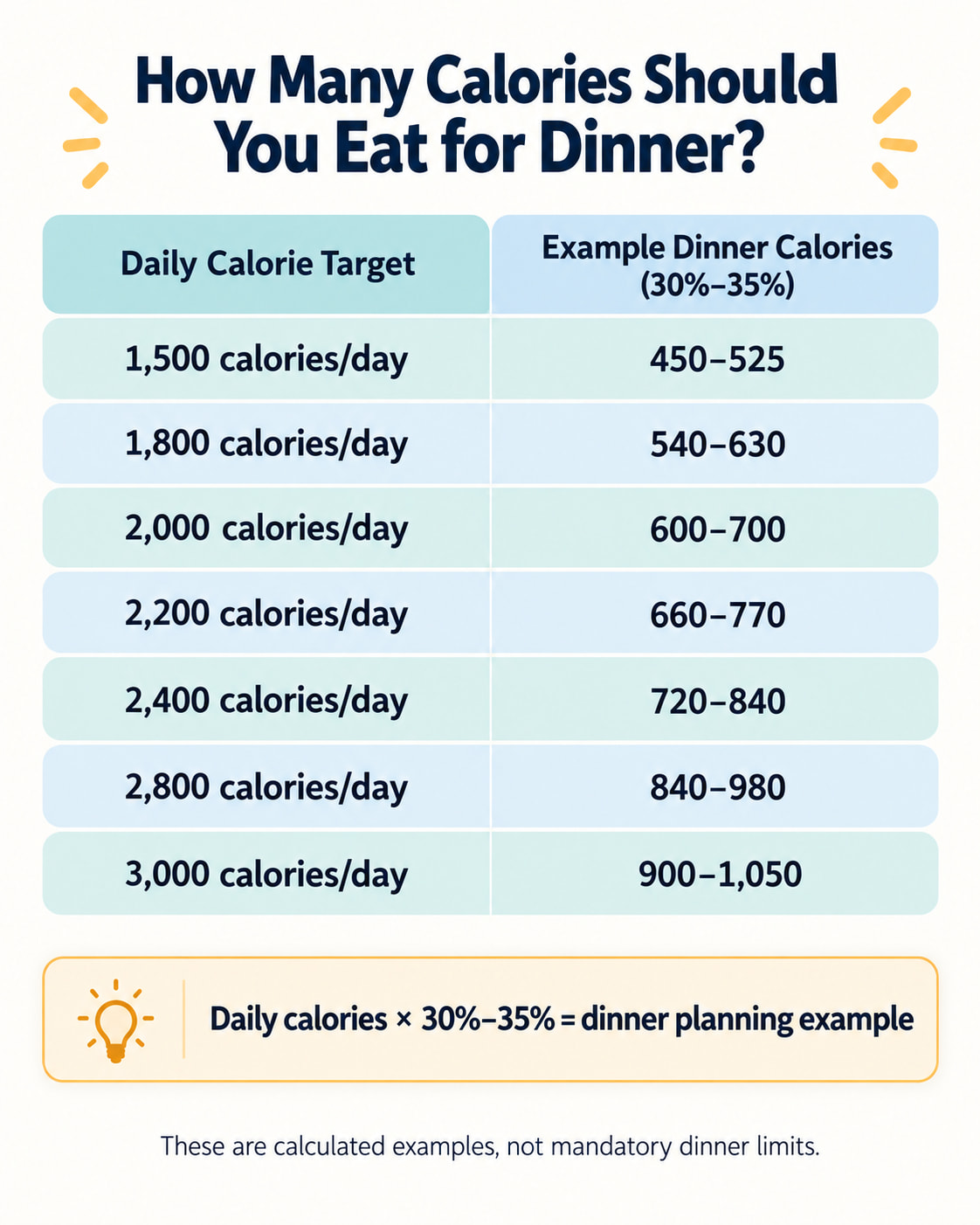
For planning purposes, you can calculate what dinner would look like at 30%–35% of your daily intake:
Daily calorie target × 0.30 to 0.35 = illustrative dinner range
| Daily calorie target | Dinner at 30% | Dinner at 35% |
|---|---|---|
| 1,500 calories | 450 calories | 525 calories |
| 1,800 calories | 540 calories | 630 calories |
| 2,000 calories | 600 calories | 700 calories |
| 2,200 calories | 660 calories | 770 calories |
| 2,400 calories | 720 calories | 840 calories |
| 2,800 calories | 840 calories | 980 calories |
| 3,000 calories | 900 calories | 1,050 calories |
These are calculated examples, not recommended daily intakes or mandatory dinner limits. A dinner outside these ranges may still fit your needs.
For example, on a hypothetical 2,000-calorie day, a 500-calorie dinner leaves 1,500 calories for other meals and snacks. An 800-calorie dinner leaves 1,200. The dinner number alone does not tell you whether the full day is appropriate.
How Many Calories for Dinner by Goal?
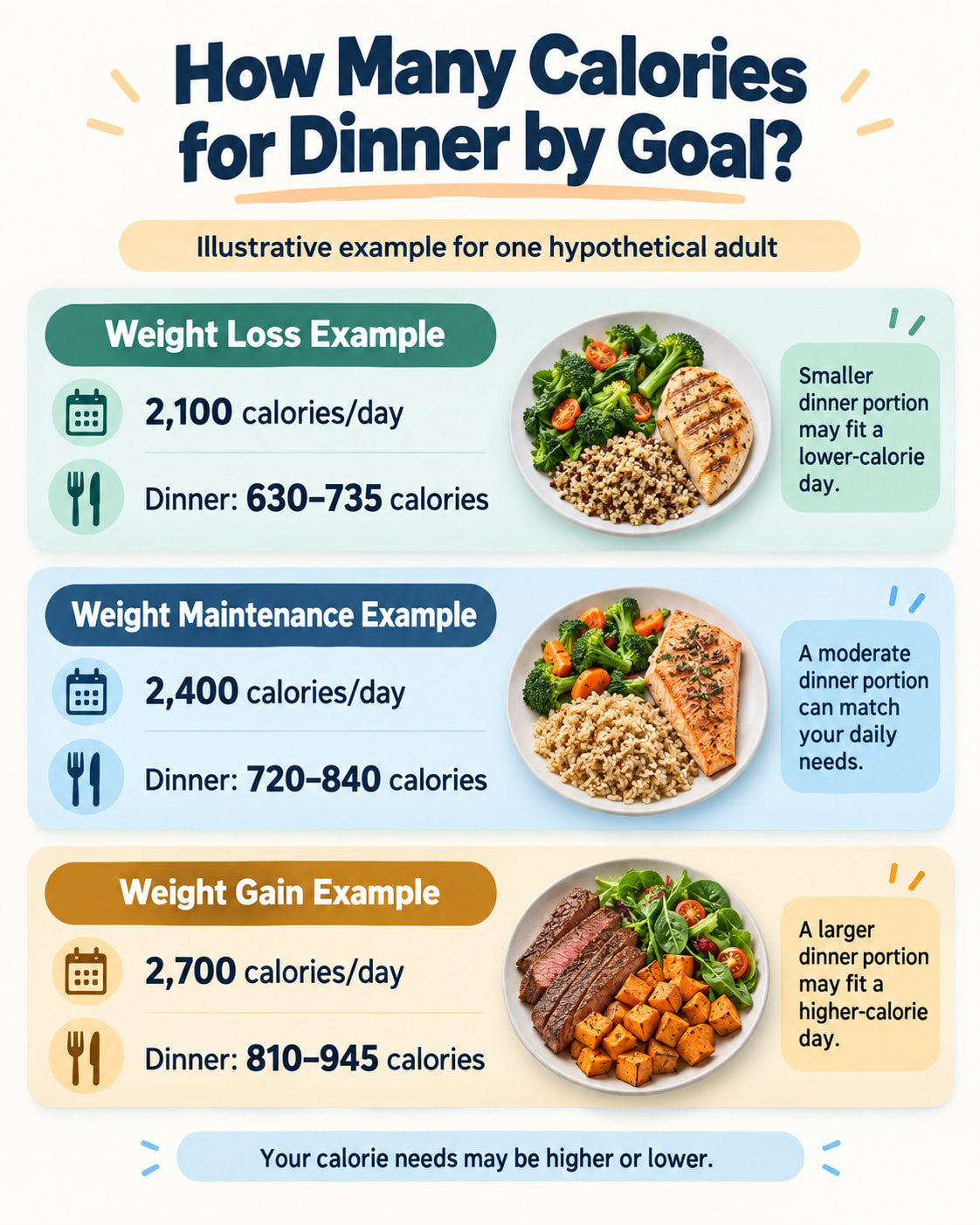
Weight loss, maintenance, and weight gain involve your overall intake—not a special calorie threshold at dinner. Your dinner portion should fit a suitable daily plan rather than determine the plan by itself.
Dinner Calories for Weight Loss
For weight loss, the first step is an individualized, sustainable daily eating plan. NIDDK recommends an approach that reduces overall calorie intake while fitting your health needs, preferences, and circumstances.
Consider a hypothetical adult whose estimated maintenance intake is 2,400 calories per day. Using 2,100 calories as an illustrative reduced-calorie plan would put dinner at 630–735 calories under the 30%–35% calculation.
The 300-calorie reduction is chosen to demonstrate the math. It is not a recommendation for every reader.
Avoid assuming that dinner must be exceptionally small for weight loss. The practical question is whether your full-day plan is appropriate and manageable—not whether dinner stays below an arbitrary number.
Dinner Calories for Weight Maintenance
Using the same hypothetical maintenance intake of 2,400 calories, dinner would be 720–840 calories under this guide’s calculation.
That does not mean you must reach this range every night. You could allocate more calories to breakfast or lunch and fewer to dinner, or reserve some for an evening snack. These are different ways of dividing the same daily total.
Dinner Calories for Weight Gain
For gradual weight gain, extra calories can be distributed across meals and snacks rather than concentrated in one very large dinner. NHS guidance recommends increasing intake gradually and choosing a variety of nutritious foods.
For the hypothetical adult above, a 2,700-calorie daily plan would give dinner 810–945 calories under the same calculation.
Again, the additional 300 calories is an illustration, not a prescription. Someone with a smaller appetite could spread the additional food across the day instead.
How to Calculate Your Dinner Calories
Start With Your Daily Needs
Do not choose a daily calorie target simply because it appears in a chart.
The NIDDK Body Weight Planner estimates calorie needs using information such as age, body size, activity, and weight goals. It is intended for adults and is not designed for children, pregnant people, or those who are breastfeeding.
An estimate is a starting point, not an exact measurement of what your body requires every day.
Plan Around Your Other Meals and Snacks
Once you have an appropriate daily estimate, decide how dinner fits alongside the rest of your food.
Here is one illustrative 2,000-calorie day:
| Eating occasion | Example calories |
|---|---|
| Breakfast | 450 |
| Lunch | 600 |
| Afternoon snack | 150 |
| Dinner | 650 |
| Evening snack | 150 |
| Daily total | 2,000 |
This example includes an evening snack separately from dinner. You could organize those calories differently.
Use the calculation to plan ahead—not as a rule requiring you to skip a meal because earlier eating did not go exactly as expected.
Count the Whole Meal, Not Just the Main Dish
Include the foods and drinks you actually consume: the main dish, sides, cooking oil, sauces, dressings, beverages, and dessert.
Check whether a label lists calories per serving or per package. The FDA notes that serving size is not a recommendation for how much you should eat. Eating two labeled servings generally means twice the listed calories.
For a homemade recipe, add the calories from all ingredients, then divide by the number of equal portions. For example, a recipe totaling 2,400 calories provides about 600 calories per portion when divided into four equal servings.
Balanced Dinner Examples at Different Calorie Levels
A useful dinner plan considers more than its calorie total. The 2025–2030 Dietary Guidelines for Americans emphasize nutrient-dense foods, including vegetables, protein foods, and whole grains.
One practical combination is a chicken, brown rice, black bean, and broccoli bowl.
Example Dinner: About 610 Calories
| Ingredient | Amount | Approximate calories |
|---|---|---|
| Roasted, skinless chicken breast | 4 ounces, weighed after cooking | 187 |
| Cooked long-grain brown rice | 1 cup | 216 |
| Cooked black beans | ½ cup | 114 |
| Broccoli | 150 grams, weighed raw before steaming | 51 |
| Olive oil | 1 teaspoon total | 40 |
| Estimated total | 608, or about 610 |
These estimates use USDA FoodData Central and University of Rochester Medical Center food-composition data. They assume plain ingredients and no added sauce, cheese, dressing, or cooking fat beyond the listed teaspoon of oil. Actual totals vary with the ingredients and portions used.
Smaller Example: About 495 Calories
Using the same bowl without the half-cup of black beans brings the calculated total to approximately 495 calories.
This illustrates how changing one portion changes the total. It does not make the smaller bowl automatically better.
Larger Example: About 755 Calories
Starting with the original bowl, add another ½ cup of cooked brown rice and 1 teaspoon of olive oil. The calculated total becomes approximately 755 calories.
These examples demonstrate portion adjustments, not three separate definitions of a healthy dinner. Choose the version—or a different meal altogether—that fits your needs and preferences.
What About Evening Hunger and After-Dinner Snacks?
An evening snack can be part of a planned eating pattern. It does not have to represent a failure to stay within a dinner target.
When you regularly arrive at dinner extremely hungry, look at the hours before dinner. Did you skip lunch? Was there a long gap between meals? NIDDK notes that delaying or skipping meals can lead to eating more later and suggests planning food around your schedule.
For a practical starting point, notice when hunger begins and whether an earlier meal or planned snack would suit your routine better.
You also do not need to weigh and record every food indefinitely. Portion measurement can be used to learn about serving amounts rather than something everyone must do for life.
How to Handle Restaurant Dinners
When a restaurant provides nutrition information, use it to estimate the full meal, including sides, drinks, and additions. Apply the same whole-meal calculation you would use at home.
You do not have to finish a large restaurant portion. Sharing a dish, saving part for another meal, or requesting dressing on the side are practical options.
Does Eating Dinner Late Affect Weight?
Meal timing may play a role, but research does not establish one dinner deadline that everyone should follow.
A 2024 systematic review and meta-analysis examined 29 randomized trials of meal-timing strategies. Only four specifically studied calorie distribution across the day. Earlier calorie distribution was associated with modestly greater weight reduction, but the authors described the effects as small and of uncertain clinical importance. Study quality and differences between trials also limited confidence in the findings.
That evidence does not justify a rule that everyone must finish dinner by 7 p.m. or make dinner their smallest meal.
Nighttime reflux is a separate consideration. For people with GERD symptoms at night or when lying down, NIDDK’s reflux guidance says eating meals at least three hours before lying down or going to bed may improve symptoms. This is symptom-related guidance, not a universal weight-loss rule.
When to Get Personalized Nutrition Advice
A generic dinner-calorie table is not suitable for every situation.
Children, teenagers, pregnant people, and those who are breastfeeding should not automatically apply adult weight-management calculations. The NIDDK Body Weight Planner specifically excludes these groups.
Work with a clinician or registered dietitian when a health condition, prescribed eating plan, or specific nutritional concern affects what or how much you should eat.
Seek professional support for sudden or unexplained weight loss, or when controlling food becomes a way to cope with difficult feelings. Tightening a dinner-calorie limit is not an appropriate response to those concerns.
FAQs About Dinner Calories
Is 500 Calories Enough for Dinner?
It can fit some eating plans, but the number alone cannot establish whether the meal is enough for you. For example, a 500-calorie dinner represents 25% of a hypothetical 2,000-calorie day. You still need to consider the other 1,500 calories and your individual needs.
Is 700 Calories Too Much for Dinner?
Not automatically. A 700-calorie dinner is 35% of a 2,000-calorie day and about 29% of a 2,400-calorie day. These calculations show why a fixed dinner number needs context rather than a “too much” label.
Can a 1,000-Calorie Dinner Fit My Daily Needs?
It can fit mathematically into some daily plans. It would account for one-third of a 3,000-calorie day, but half of a 2,000-calorie day. Whether either daily plan is appropriate requires an individualized estimate; this example does not recommend either intake.
Should Dinner Be the Smallest Meal?
There is no established requirement that dinner must be your smallest meal. Research suggests that earlier calorie distribution may offer modest benefits for some adults, but it does not establish one ideal meal-size pattern for everyone.
Should I Count Dessert and Drinks as Part of Dinner?
Include their calories when estimating the meal total. Alternatively, record dessert separately as a snack. Either approach works for the calculation as long as you include it once rather than omit it or count it twice.
Should I Skip Dinner After a Large Lunch?
Avoid automatically turning a larger lunch into a requirement to skip dinner. Consider your appetite and overall eating pattern. Skipping or delaying meals can lead to eating more later, so a rigid compensation rule may not be helpful.
The Bottom Line
When deciding how many calories for dinner to plan, start with your daily needs rather than a fixed meal limit. A 600–700-calorie dinner is one example for a 2,000-calorie day—not a universal definition of a healthy dinner.
For your next dinner, choose the foods and portions first, include sauces and drinks in the estimate, and check how the meal fits alongside the rest of your day. Use the number as a planning tool, not a pass-or-fail test.
References
- U.S. Food and Drug Administration: Calories on the Nutrition Facts Label.
- U.S. Departments of Agriculture and Health and Human Services: Dietary Guidelines for Americans, 2025–2030.
- National Institute of Diabetes and Digestive and Kidney Diseases: Body Weight Planner.
- National Institute of Diabetes and Digestive and Kidney Diseases: Choosing a Safe & Successful Weight-loss Program.
- National Institute of Diabetes and Digestive and Kidney Diseases: Just Enough for You: About Food Portions.
- NHS: Healthy Ways to Gain Weight.
- Liu and colleagues, JAMA Network Open, November 2024: Meal Timing and Anthropometric and Metabolic Outcomes: A Systematic Review and Meta-Analysis.
- National Institute of Diabetes and Digestive and Kidney Diseases: Eating, Diet, & Nutrition for GER & GERD.
- U.S. Department of Agriculture: FoodData Central—chicken breast and broccoli composition data.
- University of Rochester Medical Center: Nutrition facts for cooked brown rice, cooked black beans, and olive oil.
This content is for informational purposes only and not medical advice.