
A 5 minute arm workout can be a useful starting point for training your arms without weights, provided the movements offer enough resistance and you practice consistently. The American College of Sports Medicine’s March 2026 resistance-training guidance recognizes bodyweight and home-based exercise as effective options—not just workouts performed with gym equipment.
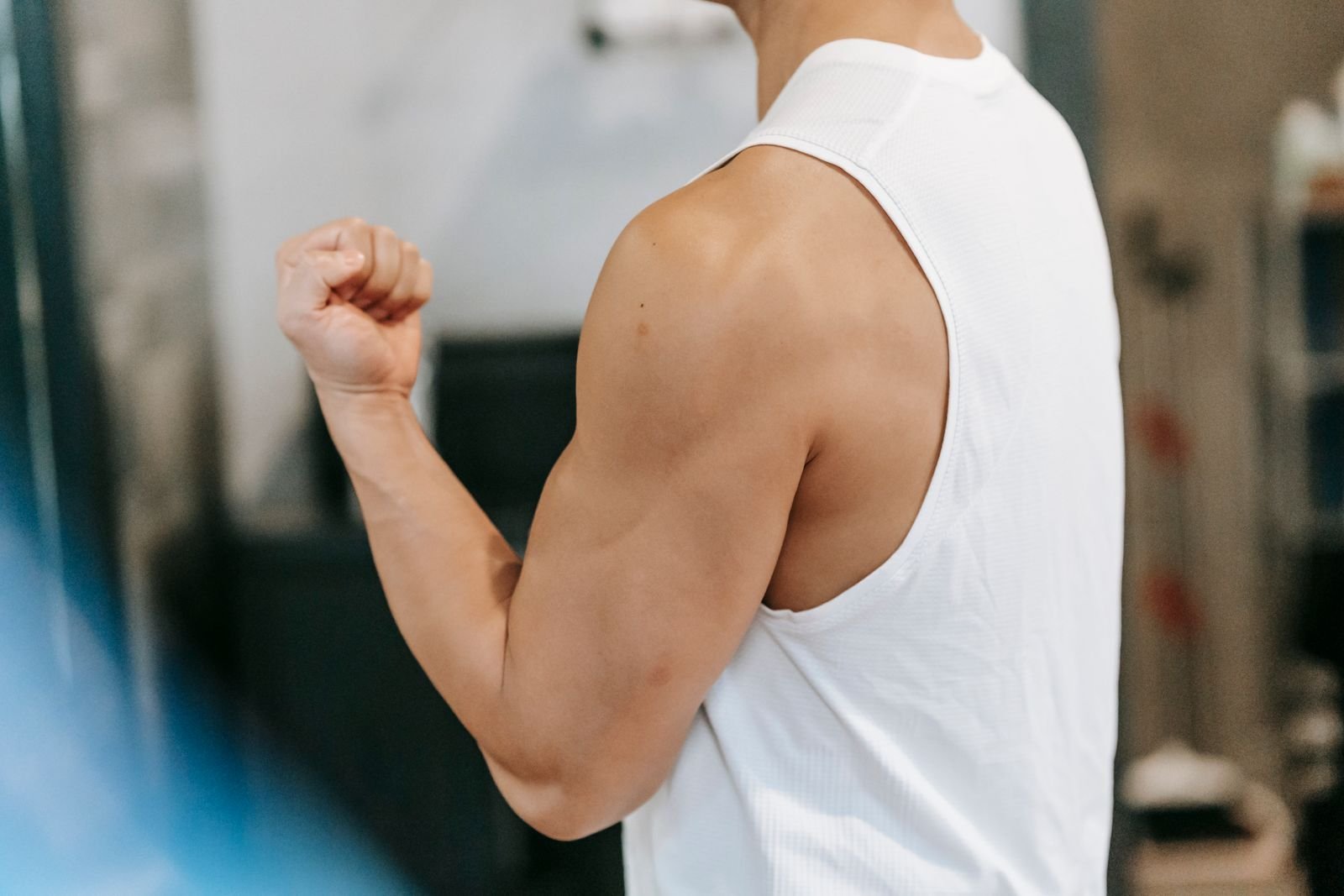
This routine combines arm circles, wall push-ups, self-resisted biceps curls, incline shoulder taps, and triceps-focused push-ups. You need a timer, a wall, and a sturdy elevated surface, such as a securely installed countertop. No dumbbells, resistance bands, or floor exercises are required.
5 Minute Arm Workout at a Glance
Perform each exercise for 40 seconds, followed by 20 seconds of rest or transition. Complete one round.
| Time | Exercise | Instructions for the interval |
|---|---|---|
| 0:00–1:00 | Arm circles | Circle forward for 20 seconds, backward for 20 seconds, then rest for 20 seconds. |
| 1:00–2:00 | Wall push-ups | Perform controlled repetitions for up to 40 seconds, then rest for 20 seconds. |
| 2:00–3:00 | Self-resisted biceps curls | Work one arm for approximately 20 seconds, switch sides within the interval, then rest for 20 seconds. |
| 3:00–4:00 | Incline shoulder taps | Alternate sides for up to 40 seconds, then rest for 20 seconds. |
| 4:00–5:00 | Triceps-focused push-ups | Perform controlled repetitions for up to 40 seconds, then finish with 20 seconds of recovery. |
Beginner option: Use 30 seconds of movement and 30 seconds of rest. For arm circles and curls, divide the movement interval approximately equally between directions or sides.
The timer organizes the workout; it is not a requirement to keep moving until the beep. Stop early and use the remaining seconds to rest whenever you cannot maintain controlled technique.
Before You Start
Warm up with a few minutes of walking or another comfortable aerobic activity before starting the timer. The five-minute circuit does not include this preparation. Mayo Clinic’s strength-training guidance also recommends breathing throughout exercise and stopping movements that cause pain.
Choose a dry, nonslip area and a support surface that cannot slide or tip. Avoid rolling chairs, lightweight tables, and unsecured furniture.
Check with a healthcare professional first if you have a chronic condition or concerns about exercising safely. This routine is not an injury-rehabilitation program.
How to Do the 5 Minute Arm Workout
1. Arm Circles
Use this first interval as a gentle shoulder-focused movement, rather than treating it as your main strength exercise.
Stand comfortably with your feet about shoulder-width apart. Raise your arms out to the sides and make small forward circles. Keep your torso still instead of swinging your whole body. Reverse direction halfway through the movement interval. Arm circles can also be performed seated with your feet on the floor.
Keep the circles small and comfortable. There is no need to make large, fast rotations.
Make it easier: Bend your elbows slightly, keep your arms a little lower, or lower them briefly to rest.
Form reminder: Keep your shoulders relaxed rather than repeatedly shrugging them toward your ears.
2. Wall Push-Ups
Wall push-ups introduce a bodyweight pushing movement without requiring you to get onto the floor. The NHS includes them in its home strength-exercise guidance.
Face a wall and place your palms against it at approximately chest height. Start around arm’s length away, adjusting your stance so the movement feels manageable.
Slowly bend your elbows to bring your chest toward the wall. Keep your back straight and let your body move as one unit. Press through your palms to return to the starting position. Avoid reaching your head forward while leaving your chest behind.
Make it easier: Stand slightly closer to the wall and use a smaller, comfortable movement range.
Form reminder: Keep your elbows at a comfortable angle near your sides rather than lifting them straight outward.
3. Self-Resisted Biceps Curls
For this exercise, your opposite hand supplies the resistance that a dumbbell would normally provide.
Stand or sit upright. Keep your right upper arm beside your torso, with your palm facing upward. Place your left hand on your right forearm.
Bend your right elbow to curl your hand upward while your left hand presses downward enough to make the movement challenging but smooth. Then lower your right forearm slowly while maintaining controlled opposing pressure. Switch arms halfway through the interval.
Keep your wrist comfortably aligned with your forearm. Your working arm should move without needing to swing your torso.
Make it easier: Reduce the pressure from your opposite hand.
Form reminder: Apply steady resistance, not sudden pushes. This is a controlled curl, not a contest between your arms.
4. Incline Shoulder Taps
Shoulder taps ask your arms and shoulders to support you while your trunk stays steady. Elevating your hands is an easier variation than performing them in a floor plank.
Place your hands on a sturdy, fixed countertop, approximately shoulder-width apart. Step backward until your body forms a straight line from your head toward your heels. Position your feet slightly apart.
Shift your weight gently into your left hand, lift your right hand, and tap your left shoulder. Return your right hand to the countertop before switching sides. Move slowly and keep your hips as still as possible.
Make it easier: Keep both hands on the surface and practice holding the inclined position instead of tapping. You can also use a more upright position against a wall.
Form reminder: Do not rush the hand changes or let your lower back sag. Rest whenever you lose control of the position.
5. Triceps-Focused Push-Ups
Finish with another pushing interval, this time emphasizing an elbows-close position. The American Council on Exercise explains that keeping the elbows closer to the torso shifts more emphasis toward the triceps compared with a more outward-elbow push-up.
Use a wall or the same fixed countertop. Position your hands approximately shoulder-width apart, with your fingers pointing upward on a wall or forward on a countertop.
Bend your elbows so they travel close to your ribs as you lower your chest toward the surface. Press back to the starting position without letting your hips sag. You do not need to place your hands together in a diamond shape.
Make it easier: Use the wall, stand closer, or perform fewer repetitions.
Form reminder: Your arms have already worked during the circuit. Choose a manageable version instead of forcing a harder variation while tired.
How Often Should You Do This Arm Workout?
A practical starting schedule is two nonconsecutive days per week, such as Monday and Thursday. For challenging strength sessions, Mayo Clinic recommends allowing one full day of recovery before training the same muscle group again.
Remember that other workouts may already train your arms. A session containing push-ups or pressing exercises also contributes to their workload.
This routine should be part of a broader plan. The CDC’s adult activity guidance recommends strengthening all major muscle groups on at least two days each week. Adults also need aerobic activity, such as at least 150 minutes of moderate-intensity activity weekly or an equivalent amount of vigorous activity. An arm-only circuit does not cover those full-body recommendations.
How to Make the 5 Minute Arm Workout Harder
Once the movements feel easy, increase the challenge gradually rather than simply completing more rushed repetitions. Appropriate resistance and progression matter more than keeping the workout unchanged indefinitely.
For the push-ups, a possible progression is moving from the wall to a sturdy countertop, provided you can maintain the same controlled alignment. For self-resisted curls, apply slightly more opposing pressure. Make one adjustment at a time so you can judge how it feels.
You can also add another set or round when your schedule and recovery allow. That becomes a longer workout, not a five-minute session—and that is fine.
You do not need to continue until your muscles completely fail. ACSM’s updated guidance notes that training to momentary muscle failure is not consistently necessary for results in the average healthy adult.
What Results Can You Expect From a 5 Minute Arm Workout?
Short sessions can be worthwhile, but this exact circuit has not been tested in a clinical study.
A study published in the European Journal of Applied Physiology in March 2025 followed 22 sedentary adults who completed a five-minute daily home exercise program for four weeks. Researchers reported improvements in several fitness measures, including push-up endurance, but no significant changes in body composition.
That program included lower-body and trunk exercises as well as wall push-ups. It also used a small sample and a control period rather than a separate parallel control group. Its findings do not prove that this arm circuit will produce the same results or change how your arms look within four weeks.
For a practical progress check, record which variations you use and how many controlled repetitions you complete. Compare similar sessions rather than judging success only by appearance.
Frequently Asked Questions
Is a 5 Minute Arm Workout Enough?
It can be enough to start practicing a manageable routine. However, whether it provides a useful training challenge depends on the resistance and your current ability. It is not a complete exercise program because it does not adequately train every major muscle group.
Can You Strengthen Your Arms Without Weights?
Yes. Bodyweight exercises provide resistance, and you can also create resistance with your opposite hand. Regular practice and a suitable level of challenge matter more than whether you use dumbbells.
Can You Do This Arm Workout Every Day?
Avoid making challenging arm training a daily requirement. Allow at least one full recovery day between sessions that substantially challenge the same muscles, and account for arm work in your other workouts.
Can This Workout Reduce Arm Fat?
It cannot reliably target fat loss specifically from your arms. Exercising a muscle and selectively removing the fat around it are different things. University of Sydney guidance explains why targeted exercises are not a reliable way to choose where your body loses fat.
What Should You Do if You Cannot Perform Floor Push-Ups?
Use the wall version. This circuit does not require floor push-ups, and the final triceps-focused interval can also be performed against a wall. For shoulder taps, start with an elevated support or keep both hands down while practicing the position.
How Quickly Will You Notice Results?
There is no established timeline for this specific routine. The small study discussed above used a different program, so its four-week findings cannot predict your results. Track technique, repetitions, and exercise difficulty instead of expecting a visible change by a particular date.
Make Five Minutes a Starting Point
A 5 minute arm workout gives you a clear, manageable place to begin. Choose the versions you can control, use the rest periods, and record what you complete.
Start with one round after warming up, then schedule your next session on a nonconsecutive day. Let consistent practice—not a promise of instant results—guide your next step.
References
- American College of Sports Medicine: Updated resistance-training guidance
- Mayo Clinic: Strength training: Getting started and exercising safely
- NHS: Strength exercises, including wall push-ups
- CDC: What counts as physical activity for adults
- European Journal of Applied Physiology: Effects of a five-minute home-based exercise program