
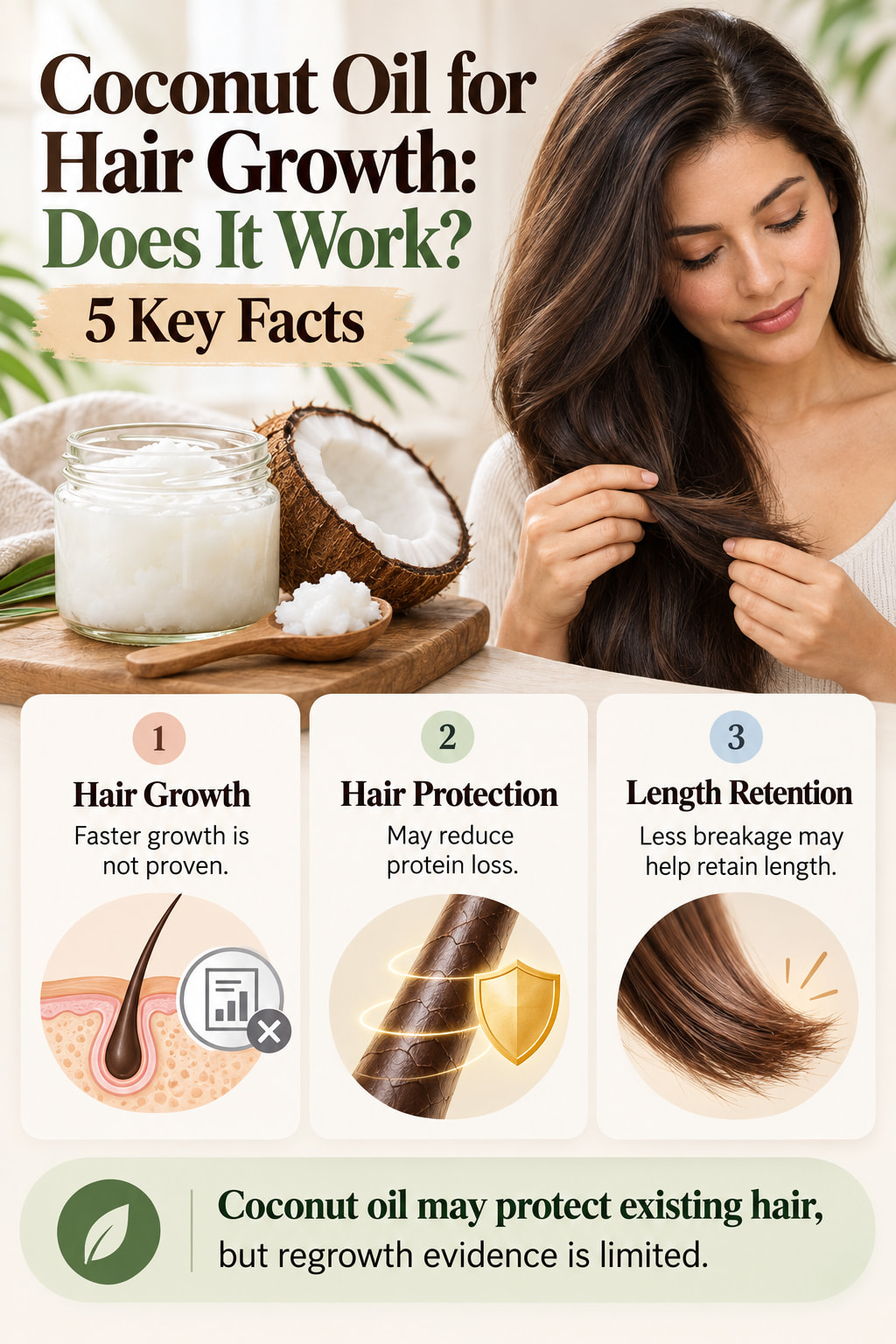
Coconut oil for hair growth is a popular home-care option. It may help protect hair from damage and reduce breakage, but evidence that it speeds growth or regrows thinning hair is still limited.
That distinction matters when you are trying to grow your hair longer. Keeping strands intact may help you retain length, even without changing how quickly hair grows from the scalp. Understanding the benefits and limits can help you decide whether coconut oil belongs in your routine.
5 Key Facts About Coconut Oil for Hair Growth
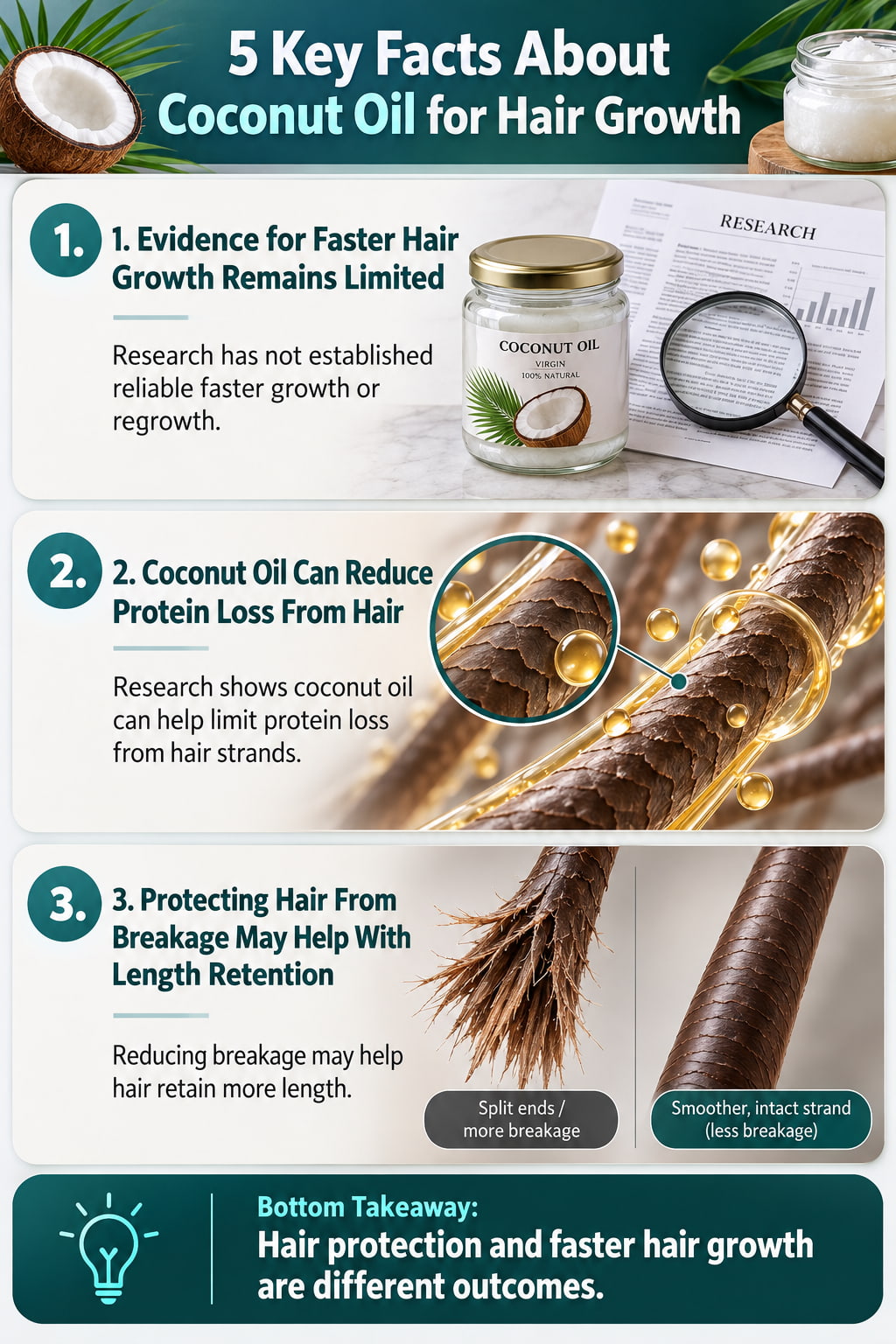
1. Evidence for Faster Hair Growth Remains Limited
A 2022 systematic review in the Journal of Drugs in Dermatology examined research on coconut, castor, and argan oils. It found more support for coconut oil’s benefits for brittle hair than for hair growth.
Two small studies published in 2025 also included coconut-oil groups and reported improvements in some hair measurements. However, one had no untreated comparison group. The other combined oil application with scalp massage and provided limited comparative statistics. Both had industry funding.
These early findings deserve further research. They do not establish coconut oil as a reliable way to speed growth or regrow thinning areas, and they cannot tell you how much new hair to expect.
2. Coconut Oil Can Reduce Protein Loss From Hair
The hair shaft is the strand you can see above the skin. Research on coconut oil has shown benefits for this existing structure.
A 2003 study on hair damage compared coconut, sunflower, and mineral oils. Under the study’s conditions, coconut oil reduced protein loss from both damaged and undamaged hair when applied before or after washing.
The researchers suggested that coconut oil’s composition helps it enter the hair shaft and limit protein loss. This supports its use for protecting strands during hair care.
It does not show that applying oil supplies protein to hair follicles or reverses a hair-loss condition.
3. Protecting Hair From Breakage May Help With Length Retention
A 2024 laboratory study found that coconut, camellia, and safflower oils could penetrate hair fibers and improve their resistance to repeated mechanical stress. Coconut oil was one of several oils that showed this benefit.
A reasonable implication is that reducing breakage may help you retain length. For example, if your hair grows from the scalp but the ends keep breaking, it may seem as though it never gets longer.
These terms describe different outcomes:
| Term | What it means |
|---|---|
| Hair growth | Follicles produce new hair. |
| Length retention | Strands stay intact instead of losing length through breakage. |
| Hair appearance | Hair looks smoother, shinier, or less frizzy. |
The laboratory findings support hair-fiber protection. They did not demonstrate faster growth from follicles.
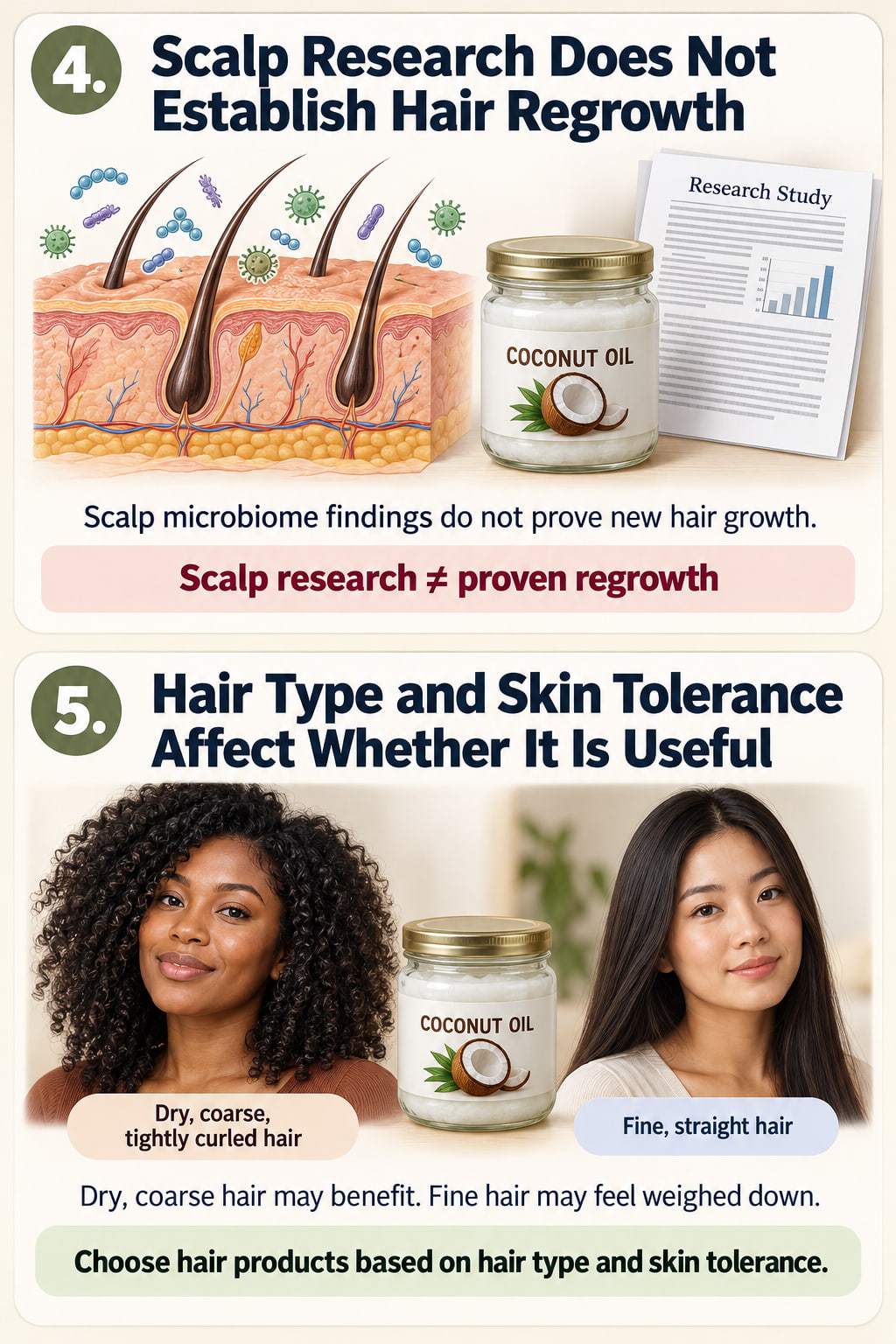
4. Scalp Research Does Not Establish Hair Regrowth
A 2021 study in Scientific Reports enrolled 140 Indian women with healthy scalps or dandruff. Researchers examined coconut-oil use during a 12-week intervention, followed by four weeks without the oil.
The researchers observed changes in the scalp microbiome—the community of microorganisms living on the scalp—and relationships with scalp health. They did not establish that coconut oil grows new hair or increases hair density.
This is useful preliminary research, but a change in the scalp environment does not automatically translate into visible regrowth. It also does not make coconut oil an established solution for persistent dandruff.
5. Hair Type and Skin Tolerance Affect Whether It Is Useful
Cleveland Clinic notes that dry, coarse, tightly curled hair may benefit from oiling, while fine, straight hair can feel weighed down.
Your skin’s response matters too. A product that makes your hair feel softer may still be unsuitable if it causes irritation or breakouts. Judge the results by both your hair’s condition and your skin’s comfort.
How to Use Coconut Oil on Your Hair
If you want to try coconut oil, approach it as an optional hair-care product. There is no established dose or application schedule that reliably produces hair regrowth.
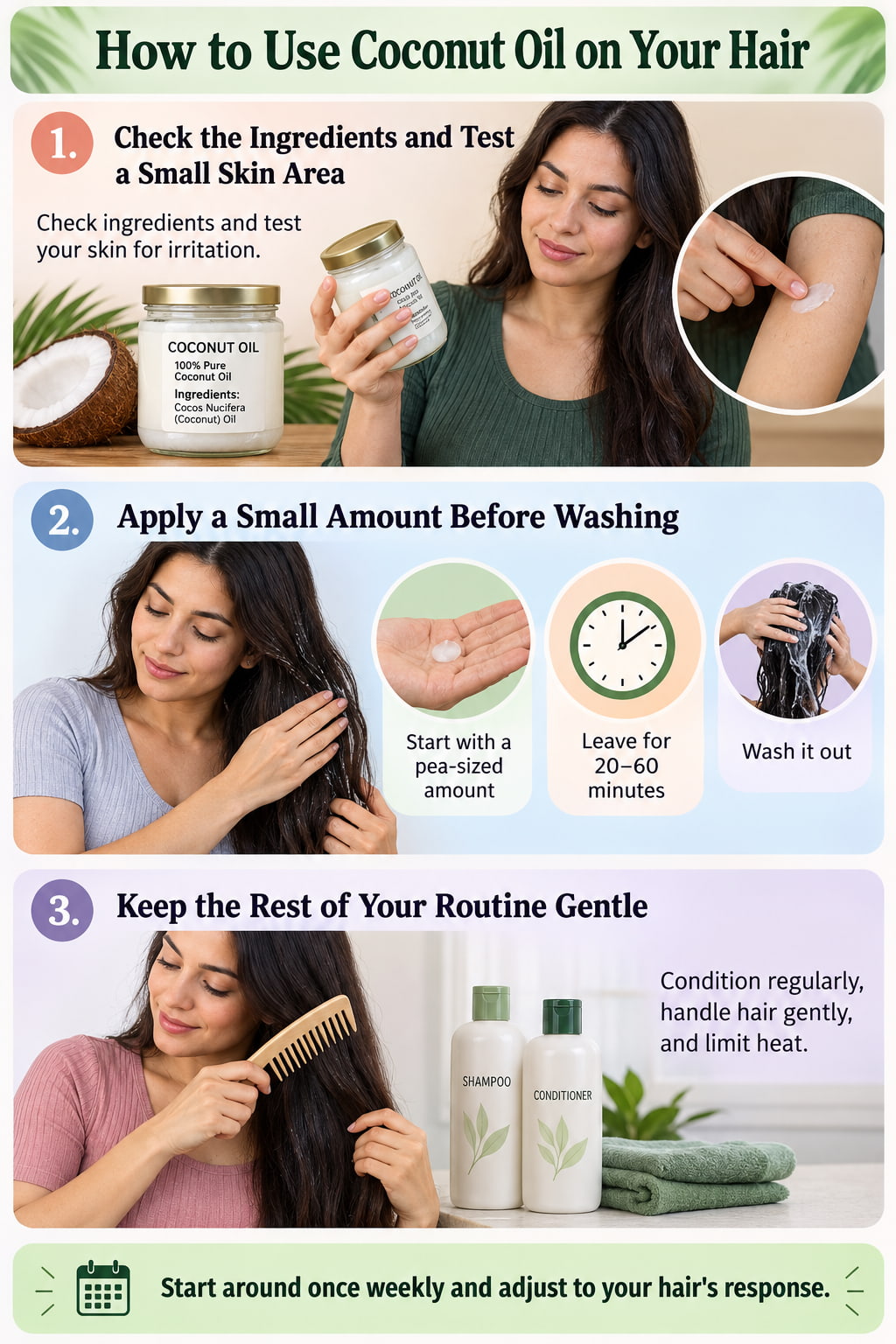
1. Check the Ingredients and Test a Small Skin Area
Read the ingredient list and avoid ingredients that have caused reactions before. Added fragrance can be a problem for sensitive skin.
The American Academy of Dermatology recommends testing a new skin-care product on a small area twice daily for seven to 10 days. Follow the product’s usual contact time, including rinsing when appropriate.
Wash it off and stop using it if redness, itching, or swelling develops. A home product test cannot guarantee that you will never react.
2. Apply a Small Amount Before Washing
Cleveland Clinic’s hair-oiling guidance offers a simple starting routine:
- Begin with a pea-sized amount.
- Spread it through dry hair, focusing on the middle of the strands and the ends.
- Leave it on for about 20 minutes to one hour.
- Wash it out.
Start around once weekly and adjust to your hair’s response. This is a cosmetic routine, not a proven growth regimen.
3. Keep the Rest of Your Routine Gentle
Continue using a gentle shampoo and conditioner. The American Academy of Dermatology recommends conditioning after shampooing to reduce breakage and split ends, especially when hair is fragile.
Handle your hair gently, avoid tugging when brushing, and limit unnecessary heat. The academy also advises people with thinning or fragile hair to avoid hot-oil treatments because heat can cause further damage.
You do not need to heat coconut oil to follow the routine above.
Possible Side Effects and Who Should Be Cautious
Coconut oil does not suit every scalp or skin type. Watch for:
- Heavy or greasy hair: Use less or stop if you dislike the result.
- Breakouts: Coconut oil can clog pores, especially on acne-prone skin. Keep it away from affected areas of the face, chest, shoulders, and back.
- Irritation: Stop if you develop itching, redness, or swelling.
- Worsening scalp symptoms: Cleveland Clinic advises people prone to dandruff to avoid scalp oiling.
Do not keep applying a product that makes your skin uncomfortable. Persistent dandruff or scalp irritation deserves appropriate care rather than repeated experiments with oil.
When to See a Dermatologist About Hair Loss
Arrange an assessment if you notice:
- Ongoing or increasing hair thinning.
- New bald patches or sudden hair loss.
- Hair loss with burning, marked itching, or tenderness.
- Scaly patches, sores, swelling, or discharge on the scalp.
The American Academy of Dermatology explains that identifying the cause is central to choosing appropriate care. A dermatologist can examine your scalp and hair and determine whether further testing is needed.
Improving the feel of your hair does not establish that the cause of thinning has been addressed.
Frequently Asked Questions
How Long Does Coconut Oil Take to Grow Hair?
There is no proven number of days or weeks in which coconut oil will produce new growth. Improved softness or easier handling should not be taken as evidence that follicles are growing hair faster.
Can You Leave Coconut Oil in Your Hair Overnight?
Overnight application is not necessary for a basic prewash routine. Longer contact has not been established to produce more hair growth. A shorter application gives you a practical starting point for assessing tolerance.
Can You Use Coconut Oil on Your Hair Every Day?
Daily use has no established growth advantage. Starting with occasional use lets you assess whether the oil improves your hair’s condition without making it feel overly greasy or heavy.
Should You Apply Coconut Oil to Wet or Dry Hair?
For the prewash routine described above, apply a small amount to dry hair. Concentrate on the lengths and ends.
Is Virgin Coconut Oil Better for Hair Growth?
Labels such as virgin, cold-pressed, or organic do not demonstrate that a product regrows hair. The research discussed here does not establish a superior processing method for hair growth.
Can Coconut Oil Help With Thinning Hair?
It may help protect existing strands, but reliable regrowth benefits are not established. If your hair is becoming noticeably thinner, seek an assessment rather than relying on an oil to resolve the cause.
Conclusion
Coconut oil has useful evidence for protecting existing hair, including reducing protein loss and improving resistance to damage. Its ability to speed growth or regrow thinning areas remains uncertain.
If your main concern is dry, breakage-prone hair, try a small amount and continue only if your hair and skin respond well. For persistent thinning or scalp symptoms, make an appointment with a dermatologist.
This content is for informational purposes only and not medical advice.
References
- Journal of Drugs in Dermatology, 2022: Systematic review of coconut, castor, and argan oils.
- Journal of Cosmetic Science, 2003: Coconut oil and prevention of hair damage.
- International Journal of Cosmetic Science, 2024: Penetration of oils into hair.
- Cureus, 2025: Comparative hair-oil trial including coconut oil.
- International Journal of Research in Dermatology, 2025: Trial with coconut-oil and no-oil comparison groups.
- Scientific Reports, 2021: Coconut oil and the scalp microbiome.