
Muscular strength is the maximum force a muscle or muscle group can produce against resistance. You can improve it through regular resistance training, gradually increasing the challenge, and allowing time for recovery.

Strength matters when you lift groceries, climb stairs, push a heavy door, or get up from a chair. A useful routine starts with exercises you can control and a schedule you can maintain.
Below, you’ll learn how strength differs from endurance and muscle size, seven practical ways to improve it, and a simple beginner routine.
What Is Muscular Strength?
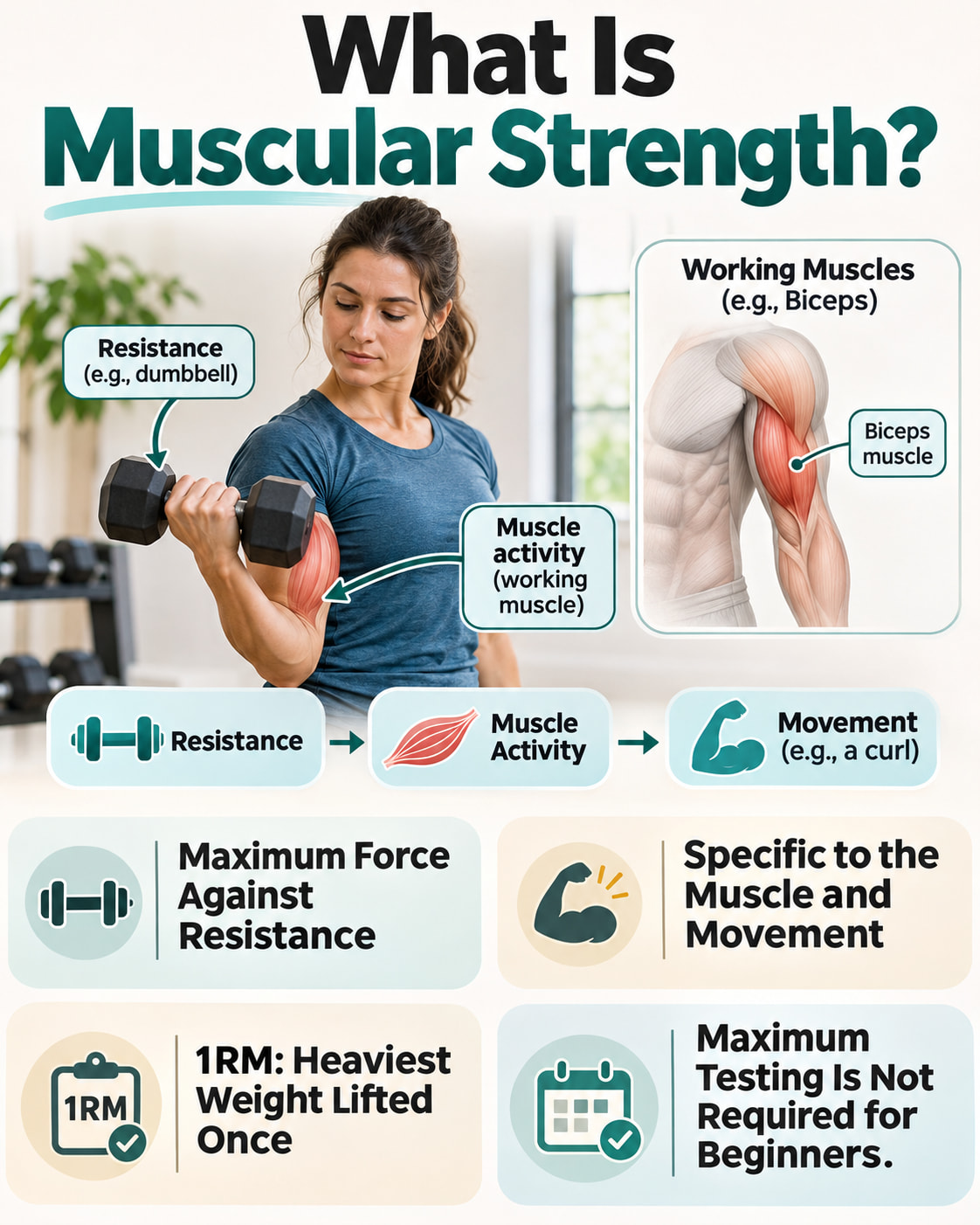
Muscular strength describes your capacity to produce force in a particular movement. It is specific to the muscles, exercise, and position involved. Someone can have strong legs while finding an upper-body pulling exercise difficult.
In weight training, strength is sometimes assessed using a one-repetition maximum, or 1RM. This is the heaviest weight someone can lift once with appropriate technique in a specific exercise. You do not need to test a maximum lift to begin training.
Muscular Strength vs. Muscular Endurance, Power, and Muscle Size
These terms describe different qualities:
| Term | What it means | Simple example |
|---|---|---|
| Muscular strength | The greatest force you can produce against resistance | Lifting a challenging weight once |
| Muscular endurance | The ability to repeat muscular effort or sustain it over time | Repeating an exercise with a lighter weight |
| Muscular power | Producing force quickly during movement | Pushing off the ground during a jump |
| Muscle hypertrophy | An increase in muscle size | A muscle becoming larger with training |
One training program can improve several of these qualities. However, the best way to organize training depends on which outcome matters most to you.
Why Muscular Strength Matters
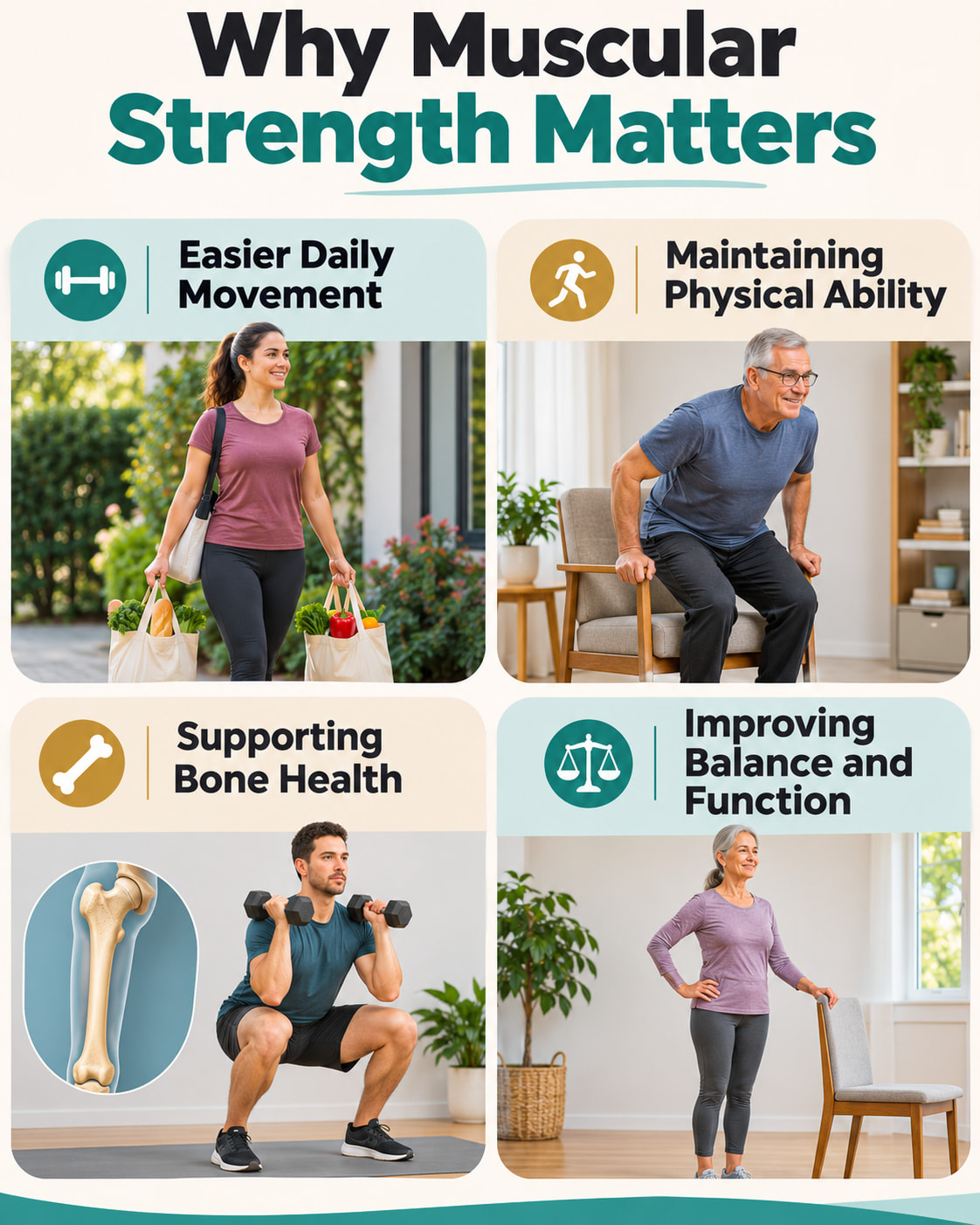
Muscle-strengthening activity can make everyday tasks more manageable and support independence as you age. The National Institute on Aging highlights benefits such as maintaining strength, slowing muscle loss, and improving physical function.
Practical benefits include:
- Easier daily movement: Standing up, climbing stairs, and carrying objects require muscular effort.
- Maintaining physical ability: Regular training supports the strength needed for daily activities.
- Supporting bone health: Appropriately chosen strength exercises place useful demands on bones.
- Improving balance and function: Stronger muscles can contribute to more capable movement.
Strength training also fits alongside walking, cycling, swimming, or other aerobic activity. Each contributes to a well-rounded activity routine.
7 Ways to Improve Muscular Strength
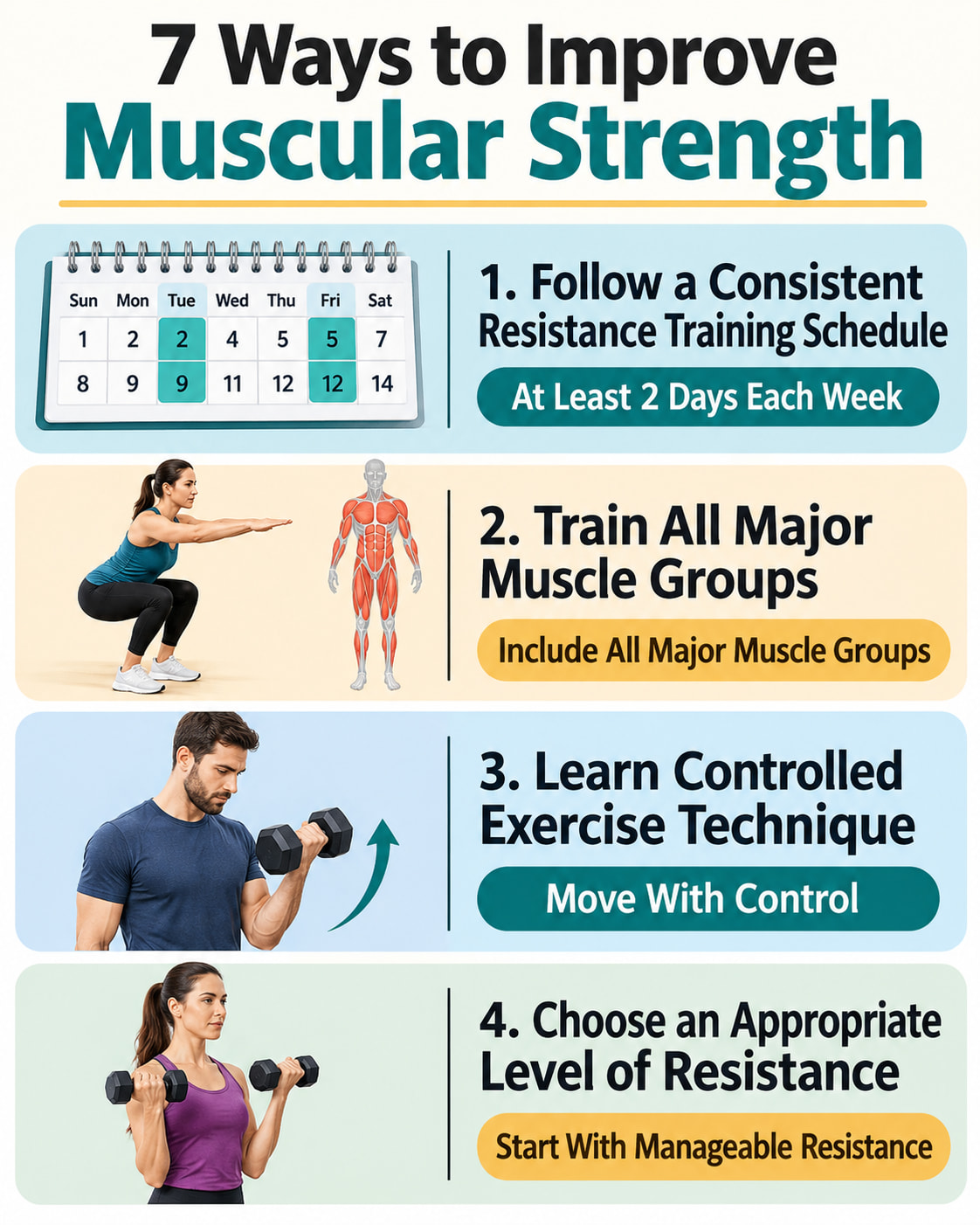
1. Follow a Consistent Resistance Training Schedule
According to CDC guidance, adults should do muscle-strengthening activity on at least two days each week.
A practical starting schedule is two full-body sessions on nonconsecutive days. For example:
| Day | Example activity |
|---|---|
| Monday | Full-body strength session |
| Tuesday and Wednesday | Other activity or rest, depending on your needs |
| Thursday | Full-body strength session |
| Friday through Sunday | Other activity and recovery |
Choose days that fit your normal week. If you miss a session, return to your schedule without doubling the next workout.
If you already follow a strength program, count the work you are doing before adding more sessions.
2. Train All Major Muscle Groups
Include exercises for your legs, hips, back, abdomen, chest, shoulders, and arms.
A simple way to organize exercise selection is to cover several types of movement:
- Squatting or sitting and standing: For example, a chair squat.
- Pushing: For example, a wall push-up.
- Pulling: For example, a supported dumbbell row.
- Hip movement: For example, a glute bridge.
- Trunk control: For example, a dead bug.
These categories help you notice gaps in your routine. A plan built entirely around arm curls, for example, leaves much of the body untrained.
Bodyweight exercises, bands, machines, and free weights can all be useful. Choose equipment you can use comfortably and consistently.
3. Learn Controlled Exercise Technique
Begin with a manageable version of each movement. Practice the setup and movement before adding substantial resistance.
Useful habits include:
- Warm up with easy movement and lighter versions of the planned exercises.
- Move smoothly instead of bouncing or swinging.
- Use a range of motion you can control comfortably.
- Breathe throughout the repetition.
- End the set when you cannot maintain the intended position.
For general beginner lifting, breathe out during the effort and in during the return.
If you are unsure how an exercise should feel or look, a qualified trainer can help with technique. A physical therapist can provide guidance when an injury or movement limitation affects exercise selection.
4. Choose an Appropriate Level of Resistance
Your muscles need a meaningful challenge, but the resistance should still allow controlled repetitions.
A repetition, or rep, is one complete movement. A set is a group of repetitions performed before resting.
For many beginners, one set of 8–12 controlled repetitions is a practical starting point. You can build toward two sets as the routine becomes manageable.
The ACSM’s 2026 resistance training position stand reviewed 137 systematic reviews involving more than 30,000 participants. It found that heavier loads, at least 80% of 1RM, and two to three sets can enhance maximal strength gains. These findings describe ways to optimize strength; they are not starting requirements for every beginner.
You do not need to reach complete muscular failure. Finishing a set while you could still perform roughly two or three more controlled repetitions is one practical effort target. Treat this as an estimate, especially while learning.
If you must swing, shorten the movement substantially, or lose your position to finish, reduce the resistance or use an easier variation.
5. Increase the Challenge Gradually
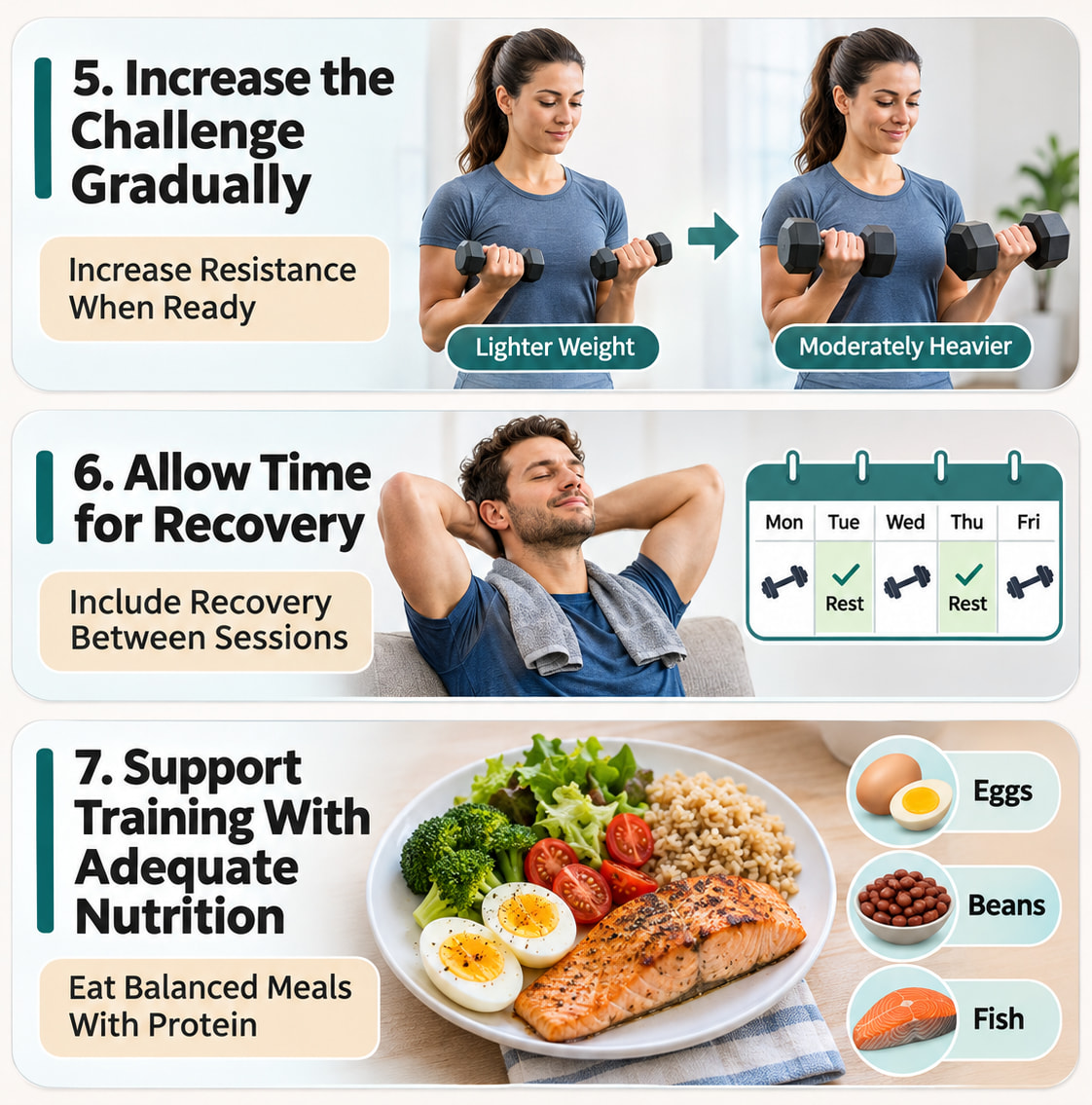
As an exercise becomes easier, adjust the demand. This process is often called progressive overload.
You can make progress by:
- Adding a small amount of weight.
- Performing additional controlled repetitions within your planned range.
- Adding a set when the existing workload feels manageable.
- Choosing a more challenging exercise variation.
Change one element at a time so you can judge how you respond.
For example, you might begin a dumbbell row with eight controlled repetitions per side. As that becomes manageable, work toward 12. When the top of the range feels comfortable, try a small weight increase and reassess your repetitions and technique.
This is an example, not a requirement to increase weight every week. Repeat the current workload when you need more practice or recovery.
6. Allow Time for Recovery
A simple beginner approach is to leave at least one full day between sessions that train the same muscle groups.
Rest between sets matters, too. For the sample routine below, start with about one to two minutes between sets or exercises. Take longer if you need it to regain control and feel ready for the next set. More demanding sets may require several minutes.
Protect your sleep routine as well. CDC sleep guidance recommends at least seven hours nightly for adults ages 18–60, seven to nine hours for ages 61–64, and seven to eight hours for adults 65 and older.
If fatigue repeatedly prevents you from completing your normal training with control, reassess the workload and recovery time.
7. Support Training With Adequate Nutrition
Regular meals, enough overall food, and protein-containing foods support the demands of training.
Practical protein options include:
- Eggs, fish, poultry, and lean meat.
- Milk, yogurt, and cottage cheese.
- Beans, lentils, tofu, and other soy foods.
Include carbohydrate-containing foods and dietary fats as part of balanced meals, too.
The NIH Office of Dietary Supplements lists a protein range of 1.2–2.0 grams per kilogram of body weight daily for athletes. This is athlete-oriented guidance, not a universal requirement for every person beginning strength training.
Protein supplements are optional. They may be convenient when needed, but ordinary foods can provide protein. If you have prescribed dietary restrictions, use a target agreed on with your healthcare professional or registered dietitian.
A Simple Beginner Muscular Strength Routine
This sample routine applies general training principles to a small selection of exercises. It is intended for generally healthy adults who are new to strength training or returning after a break.
Use a stable chair, a wall, an exercise mat if desired, and manageable dumbbells. Secure any chair used for support so it cannot slide.
Start with one set per exercise on two nonconsecutive days each week. Add a second set when you can complete the routine comfortably and recover well.
| Exercise | Starting repetitions | Main focus | Key cue |
|---|---|---|---|
| Chair squat | 8–12 | Thighs and hips | Lower toward the chair with control, then stand |
| Wall push-up | 8–12 | Chest, shoulders, and triceps | Keep your body aligned as you bend and straighten your elbows |
| Supported one-arm dumbbell row | 8–12 per side | Back and biceps | Pull the elbow toward your hip without twisting |
| Glute bridge | 8–12 | Glutes, with assistance from the hamstrings | Lift through your hips without arching your lower back |
| Seated dumbbell shoulder press | 8–12 | Shoulders and triceps | Press through a comfortable overhead range |
| Standing calf raise | 8–12 | Calves | Rise and lower slowly while holding stable support |
| Dead bug | 5–8 per side | Abdominal control | Move your limbs only as far as you can keep your trunk steady |
The repetition ranges are starting examples. Use fewer repetitions or an easier variation when needed.
How to Perform the Exercises
Chair squat: Stand in front of a sturdy chair with your feet comfortably apart. Bend your hips and knees to lower toward the seat. Touch down lightly or sit briefly, then stand. Use hand support if needed.
Wall push-up: Place your hands on a wall around shoulder height. Step back to create a comfortable lean. Bend your elbows to bring your chest toward the wall, then push away while keeping your body aligned.
Supported one-arm dumbbell row: Support one hand on a sturdy surface and hinge forward at your hips. Hold a dumbbell in the other hand. Pull it toward the side of your waist, then lower it without rotating your torso. Repeat on the other side.
Glute bridge: Lie on your back with your knees bent and feet flat. Gently tighten your abdomen and lift your hips. Stop before your lower back arches, then lower with control.
Seated dumbbell shoulder press: Sit upright on a stable chair with your feet planted. Hold light dumbbells near shoulder height. Press upward through a comfortable range without arching your lower back, then lower slowly. Stop if the movement causes pain.
Standing calf raise: Stand with your fingertips on a sturdy support. Lift your heels, pause briefly, and lower them slowly. Keep the movement controlled.
Dead bug: Lie on your back with your arms pointing upward and your knees bent above your hips. Slowly move one arm and the opposite leg away from your body. Return and switch sides. Shorten the reach if your back starts to arch.
For the dead bug, prioritize trunk control rather than trying to reach fatigue.
How to Track Your Muscular Strength Progress
Keep a short record of each session:
- Exercise and variation.
- Weight or resistance used.
- Sets and repetitions.
- Whether the movement felt controlled.
Compare the same exercise under similar conditions. For example, lifting a slightly heavier dumbbell for the same repetitions and range of motion can indicate progress.
Additional repetitions at the same weight also show improved exercise performance, although endurance and technique may contribute.
Every few weeks, review what has changed. Ask whether you are handling more resistance, using better control, or completing a previously difficult variation.
If progress stalls, review consistency, exercise difficulty, and recovery before adding more work.
Muscular Strength Training Safety Tips
Mayo Clinic guidance recommends learning appropriate technique, stopping an exercise that causes pain, and discussing training with a healthcare professional when a chronic condition or safety concern affects participation.
Keep these practical precautions in mind:
- Use stable equipment and clear the area around you.
- Start unfamiliar exercises with light resistance.
- Avoid forcing a painful range of motion.
- Ask for help with equipment you do not understand.
- Seek individualized advice for persistent pain or an existing injury.
A sample workout can provide structure, but it should be adjusted to your abilities and circumstances.
Frequently Asked Questions
What Is an Example of Muscular Strength?
Lifting a heavy object from the floor or pushing a heavy door requires muscular strength. In exercise testing, the greatest weight you can lift once in a specific movement is one way to assess it.
What Is the Difference Between Muscular Strength and Muscular Endurance?
Strength describes how much force you can produce. Endurance describes how long you can sustain muscular effort or repeat it. A heavy lift emphasizes strength, while repeated lighter efforts place more demand on endurance.
Can You Improve Muscular Strength Without Weights?
Yes. Bodyweight exercises can provide resistance. Squats, push-up variations, and bridges are examples. As an exercise becomes easier, you may need a more challenging variation or added resistance to keep progressing.
How Often Should You Train for Muscular Strength?
A practical starting point is to train all major muscle groups at least twice each week. Two full-body workouts on nonconsecutive days can make that schedule straightforward.
How Many Sets and Repetitions Should Beginners Do?
One set of 8–12 controlled repetitions per exercise is a useful starting example. Build toward additional sets when appropriate. The resistance, exercise, and your experience influence which repetition range works best.
How Long Does It Take to Improve Muscular Strength?
There is no single timeline for everyone. Your starting point and training consistency affect progress. Review your workout log over several weeks and look for changes in resistance, repetitions, and control rather than expecting a fixed transformation date.
Do You Need Protein Supplements to Become Stronger?
No. Protein-containing foods can meet your needs. A supplement may be convenient if food intake falls short, but it does not replace consistent training, adequate nutrition, or recovery.
Conclusion
Improving muscular strength starts with a routine you can repeat: train regularly, cover your major muscle groups, use controlled technique, and increase the challenge when you are ready. Recovery and adequate nutrition support that process.
Choose two training days this week, start with manageable exercises, and record your first session. Use those notes to guide your next step.
This content is for informational purposes only and not medical advice.
References
- American College of Sports Medicine. The Components of Physical Fitness: A Roundtable Statement.
- American College of Sports Medicine. Resistance Training Prescription for Muscle Function, Hypertrophy, and Physical Performance in Healthy Adults.
- American College of Sports Medicine. Updated Resistance Training Guidelines.
- Centers for Disease Control and Prevention. What Counts as Physical Activity for Adults.
- National Institute on Aging. Three Types of Exercise Can Improve Your Health and Physical Ability.
- Mayo Clinic. Strength Training: Get Stronger, Leaner, Healthier.