
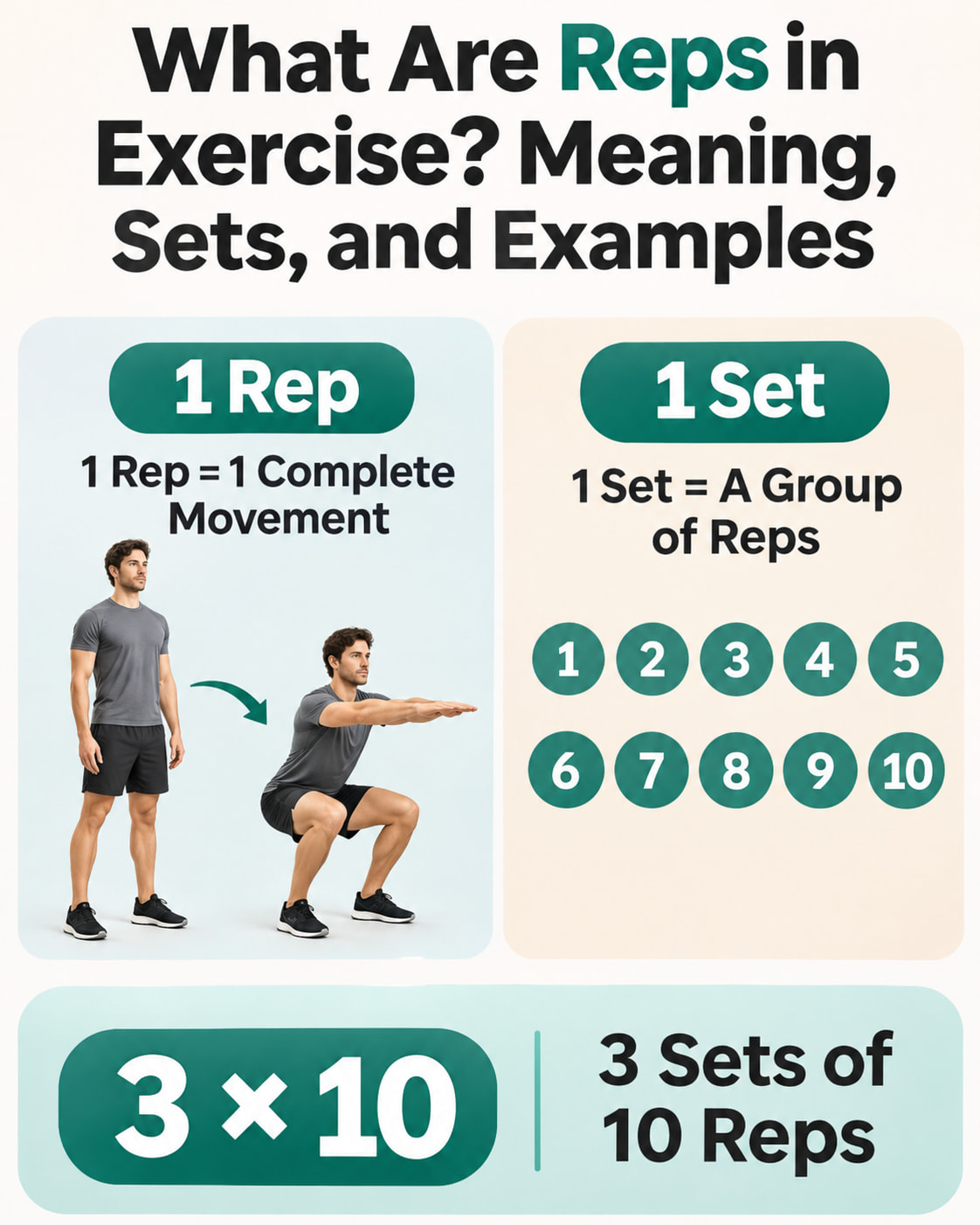
Reps, short for repetitions, are the number of times you complete an exercise movement. If you’re asking “what are reps?” while reading a workout plan, lowering into a squat and standing back up is one rep.
A set is a group of reps performed together. Understanding the difference helps you follow workout instructions, choose a manageable amount of work, and track your progress.
What Are Reps and Sets in Exercise?
Reps count individual movements. Sets organize those movements into groups.
| Term | Meaning | Example |
|---|---|---|
| Rep | One complete exercise movement | One squat down and back up |
| Set | A group of repetitions performed together | 10 squats before a rest |
| Rest interval | Recovery time between sets or exercises | Taking a break before your next set |
| Rep range | A target interval for repetitions | Completing 8–12 reps in a set |
A set can contain different numbers of repetitions. Five reps can be a set, and so can 15. The number depends on the workout instructions and the exercise.
What Does 3 Sets of 10 Reps Mean?
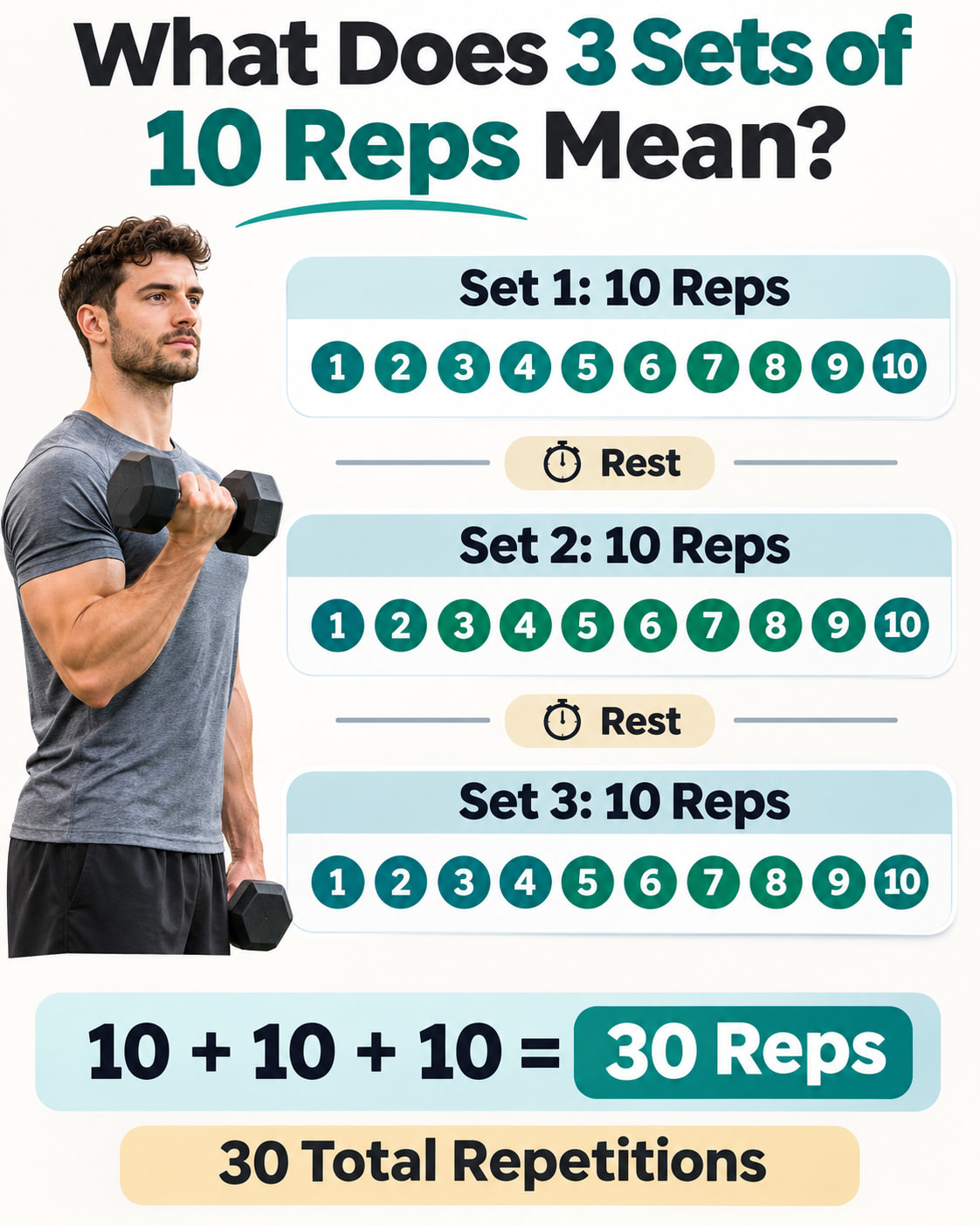
In a typical workout plan, 3 × 10 means three sets of 10 repetitions:
- Complete 10 reps.
- Rest.
- Complete another 10 reps.
- Rest.
- Complete the final 10 reps.
You have completed 30 repetitions across three sets. The breaks separate the sets; the instruction does not mean you must perform 30 uninterrupted reps.
What Does 8–12 Reps Mean?
A range such as 8–12 reps gives you a lower and upper target for each set. Completing eight, nine, 10, 11, or 12 repetitions falls within that range.
For example, 2 × 8–12 means two sets, each targeting eight to 12 repetitions. You might record 10 reps in the first set and nine in the second.
The target should guide your effort. If your technique breaks down before you reach it, stop and adjust the exercise or resistance.
How to Count Reps for Common Exercises
For the movements below, count one rep after completing the movement and returning to the starting position.
| Exercise | What counts as one rep? |
|---|---|
| Bodyweight squat | Lower into the squat, then return to standing |
| Wall push-up | Bend your elbows to move toward the wall, then press back to the starting position |
| Dumbbell biceps curl | Curl the weight upward, then lower it back down |
| One-arm dumbbell row | Pull the dumbbell toward your torso, then lower it back to the starting position |
The lifting and lowering portions belong to the same repetition. For example, curling a dumbbell upward and lowering it counts as one rep, not two.
Counting Reps Per Side
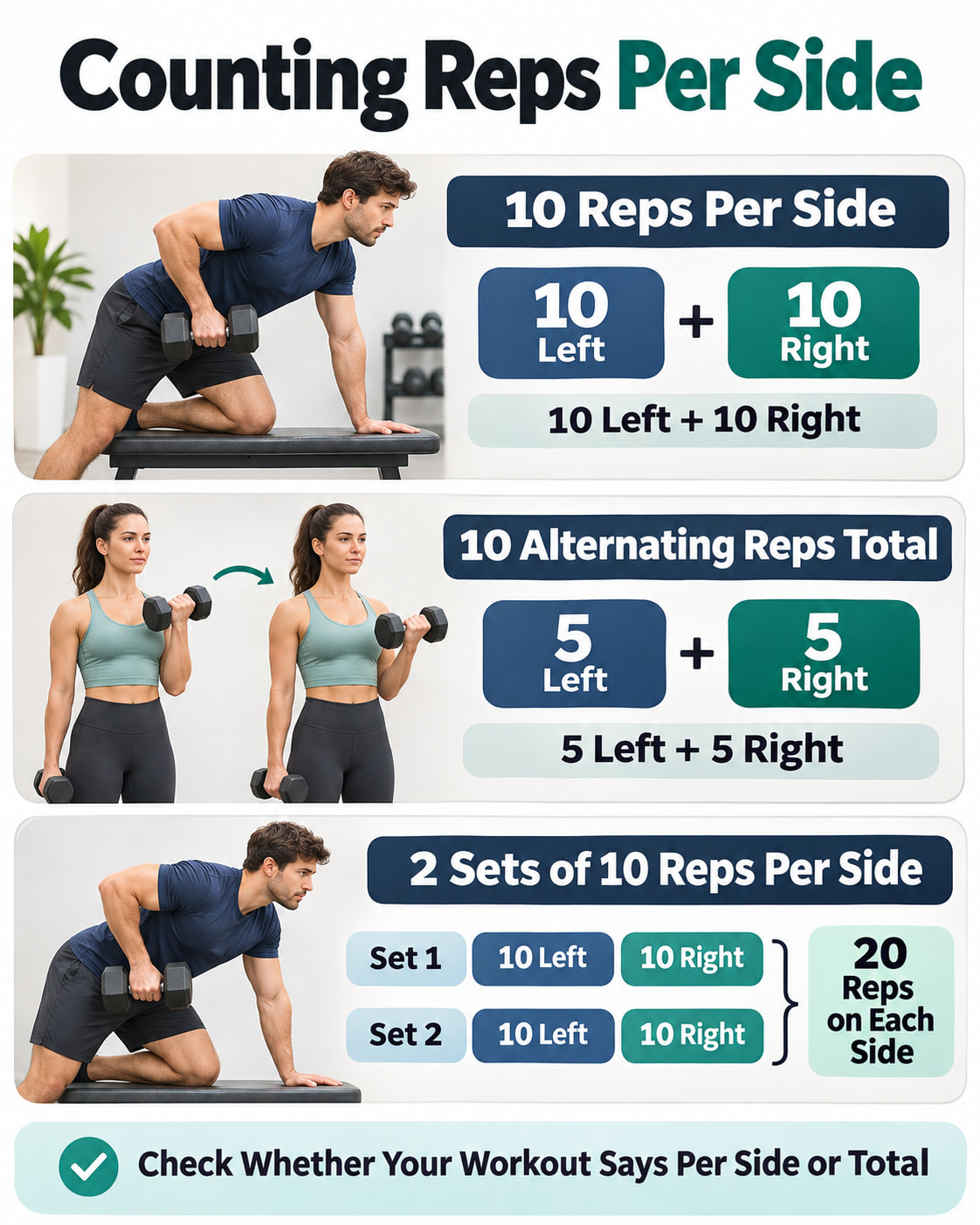
Exercises performed with one arm or leg at a time need clear counting instructions.
- 10 reps per side: Complete 10 with the left side and 10 with the right side.
- 10 alternating reps total: Complete 10 movements combined, usually five on each side when alternating evenly.
- 2 sets of 10 reps per side: Each side completes 20 repetitions across the two sets.
For a one-arm dumbbell row, “10 reps per arm” means 10 rows with each arm.
If you curl two dumbbells at the same time, 10 complete paired movements give each arm 10 repetitions. An alternating curl may use a different counting convention, so check whether the plan specifies “total” or “per arm.”
Do not assume that “alternating” automatically means a particular total. Check the workout instructions when the wording is unclear.
Counting Timed Holds
Some exercises are prescribed in seconds instead of reps.
For example, 3 × 20-second plank holds means:
- Hold the plank for 20 seconds.
- Rest.
- Repeat until you have completed three holds.
That adds up to 60 seconds of holding time, divided into three sets. Seconds and repetitions are different measurements, so do not convert a 20-second hold into “20 reps.”
How Many Reps Should Beginners Do?
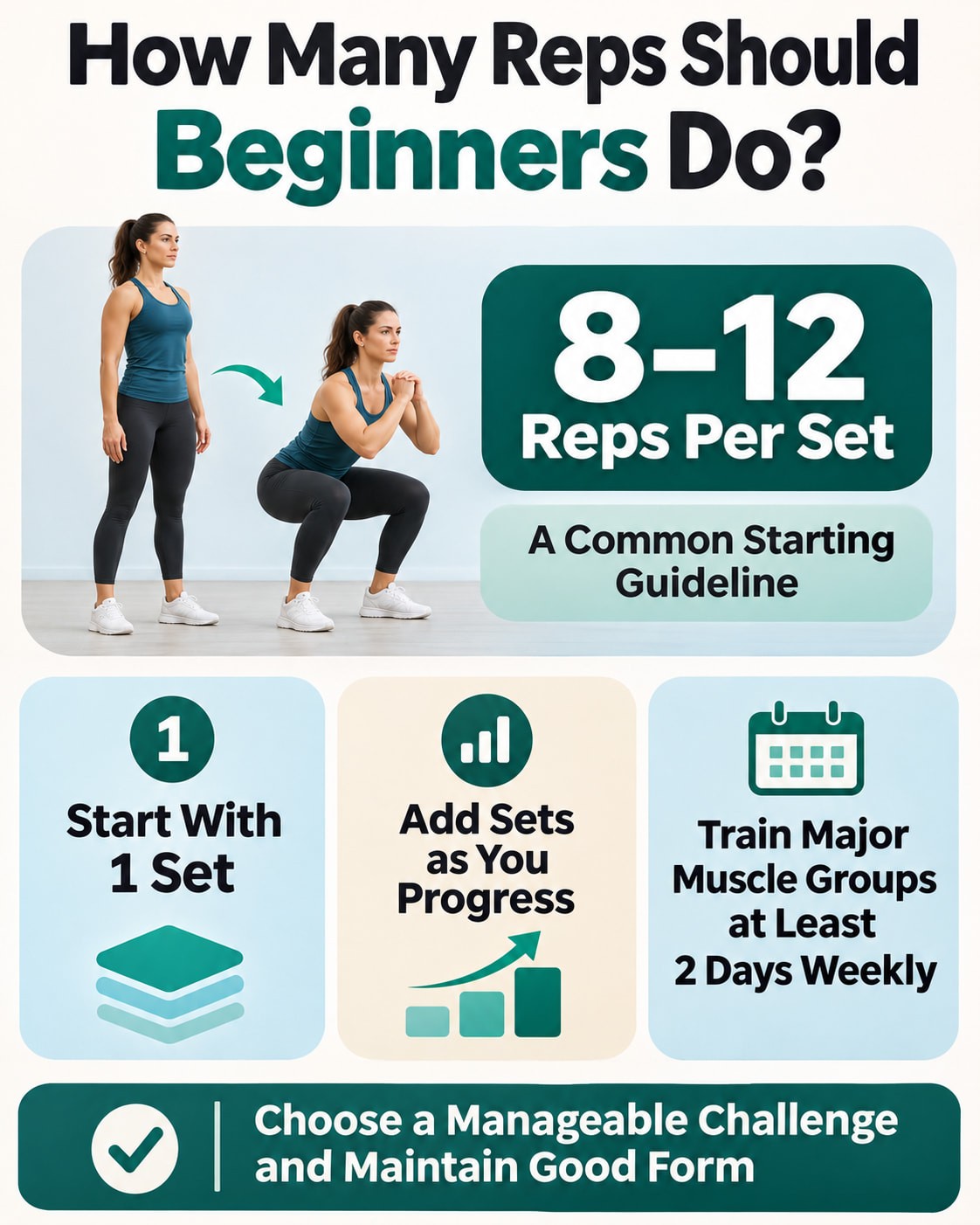
Eight to 12 reps per set is one common starting guideline for muscle-strengthening exercise. The CDC’s activity guidance suggests this range, with at least one set and two or three sets for additional benefits. It also recommends working all major muscle groups on at least two days each week.
Start with an exercise variation and resistance you can control. If you are learning a movement, focus on getting comfortable with it before adding more work.
There is flexibility in the numbers. Mayo Clinic’s strength-training guidance, dated June, 2026, suggests resistance that tires your muscles after about 12–15 repetitions.
These ranges are general guides. Your exercise choice, ability, resistance, and goals affect the appropriate target.
How Many Sets Should You Start With?
One set can be a manageable starting point while you learn an exercise. As the work becomes familiar and you recover well, you may add a second or third set.
For example, a workout might begin with one set of eight to 12 repetitions of a particular exercise. Adding another set later increases the amount of work without requiring you to change the movement.
You do not need to increase the number of sets, repetitions, and weight all at once.
How Long Should You Rest Between Sets?
Rest long enough to feel ready to repeat the movement with control. If you are still catching your breath or cannot comfortably set up for the next set, take more time.
Follow the rest instructions in your workout when provided, and adjust when needed. A demanding set may require more recovery than an easy practice set.
Also allow recovery between workouts. Mayo Clinic recommends a full day of rest between sessions that exercise the same muscle group.
How Weight and Effort Affect Your Reps
A rep count tells you how many movements you completed. To understand the work involved, also consider the resistance and how challenging those repetitions felt.
For example, 10 dumbbell curls with a light weight and 10 with a heavier weight have the same rep count. The amount of resistance is different.
The 2026 ACSM position stand supports adjusting training to your goals. Heavier loads can enhance maximal-strength gains, while higher weekly set volume can enhance muscle growth. It also finds that reaching muscular failure is unnecessary for benefits.
This means a particular rep range is a useful programming tool, rather than a rule that produces only one kind of result.
Do You Need to Finish Every Set at Failure?
No. Muscular failure means reaching the point where you cannot complete another repetition under the exercise’s required conditions.
A set can be challenging without reaching that point. For beginners, the practical priority is maintaining control throughout the movement.
If you start swinging the weight, changing your position to force the movement, or losing control, finish the set and reassess the resistance or target.
How to Progress Your Reps Over Time
Use your workout notes to decide when an exercise is becoming more manageable.
For example, suppose your target is two sets of eight to 12 reps:
- Choose resistance that lets you perform the movement with control.
- Record the repetitions you complete in each set.
- As the exercise becomes easier, work toward the upper end of the range.
- When that target is consistently manageable, consider a small increase in resistance.
After increasing the resistance, you may complete fewer repetitions within your target range. That can be a normal part of adjusting the challenge.
Mayo Clinic recommends gradually increasing resistance when additional repetitions become easy. There is no need to force a weight increase on a fixed weekly schedule.
For bodyweight exercises, a more challenging variation can change the difficulty. Choose a version whose technique you understand and can control.
A simple training log can include:
| Exercise | Resistance or variation | Set 1 | Set 2 |
|---|---|---|---|
| Dumbbell biceps curl | Weight used | 10 reps | 9 reps |
| Wall push-up | Wall position used | 12 reps | 10 reps |
| One-arm dumbbell row | Weight used | 10 per side | 10 per side |
These are recording examples. Use the exercises and targets from your own plan.
Tips for Controlled Repetitions
Mayo Clinic’s technique guidance emphasizes choosing suitable resistance, maintaining form, breathing, and stopping an exercise that causes pain.
Keep these habits in mind:
- Warm up first. Begin with a few minutes of easy movement before strength training.
- Move with control. Avoid rushing or using momentum to finish the count.
- Keep breathing. For many lifting exercises, exhale during the lifting effort and inhale during the return.
- Adjust when technique changes. Reduce the weight or number of reps if you cannot maintain your form.
- Stop if the exercise causes pain. Do not force yourself through the remaining repetitions.
- Ask for help when needed. A qualified trainer or other fitness professional can check unfamiliar movements.
If you have a chronic condition or specific concerns about exercising safely, discuss a new program with your healthcare professional.
Frequently Asked Questions
What Does 10 Reps Mean?
It means completing an exercise movement 10 times. For a squat, lowering your body and returning to standing counts as one repetition. Repeat that complete movement 10 times.
Is a Rep the Same as a Set?
No. A rep is one complete movement. A set is a group of repetitions performed together. Completing 10 curls before resting is one set of 10 reps.
Does 3 × 10 Mean 30 Reps?
Yes. It usually means three sets of 10 reps, for 30 total repetitions. If the instruction says “per side,” you complete 30 repetitions on each side across the three sets.
Are Reps Counted Per Arm or for Both Arms?
Follow the workout’s wording. “10 per arm” means 10 repetitions with each arm. When both arms move together, 10 paired movements give each arm 10 reps. Alternating exercises should specify whether the count is total or per side.
Is It Better to Do 10 or 15 Reps?
Either may fit a workout. The better choice depends on the exercise, resistance, goal, and your ability to maintain technique. Fifteen reps are not automatically more useful than 10; consider how challenging the set is and what your plan calls for.
What Are Reps in Reserve?
Reps in reserve, or RIR, estimates how many more repetitions you could complete before muscular failure. Finishing with two RIR means you estimate that two additional reps were possible. It describes effort; it does not change the number of reps you completed.
Do Planks Have Reps?
A static plank is often prescribed as a timed hold, such as 20 seconds. Moving plank variations may use repetitions. Follow the units shown in your workout: seconds for a hold or reps for a repeated movement.
Conclusion
Reps count individual exercise movements, and sets group those repetitions together. Once you understand that difference, instructions such as “3 × 10” or “8–12 per side” become easier to follow.
For your next workout, check the rep target, set count, and whether the instructions apply per side. Choose a manageable challenge, keep your movements controlled, and record what you complete so you can build from there.
This content is for informational purposes only and not medical advice.
References
- Centers for Disease Control and Prevention. What Counts as Physical Activity for Adults.
- Mayo Clinic. Strength Training: Get Stronger, Leaner, Healthier.
- Currier BS, et al. Resistance Training Prescription for Muscle Function, Hypertrophy, and Physical Performance in Healthy Adults: An Overview of Reviews.
- Mayo Clinic. Weight Training: Do’s and Don’ts of Proper Technique.