
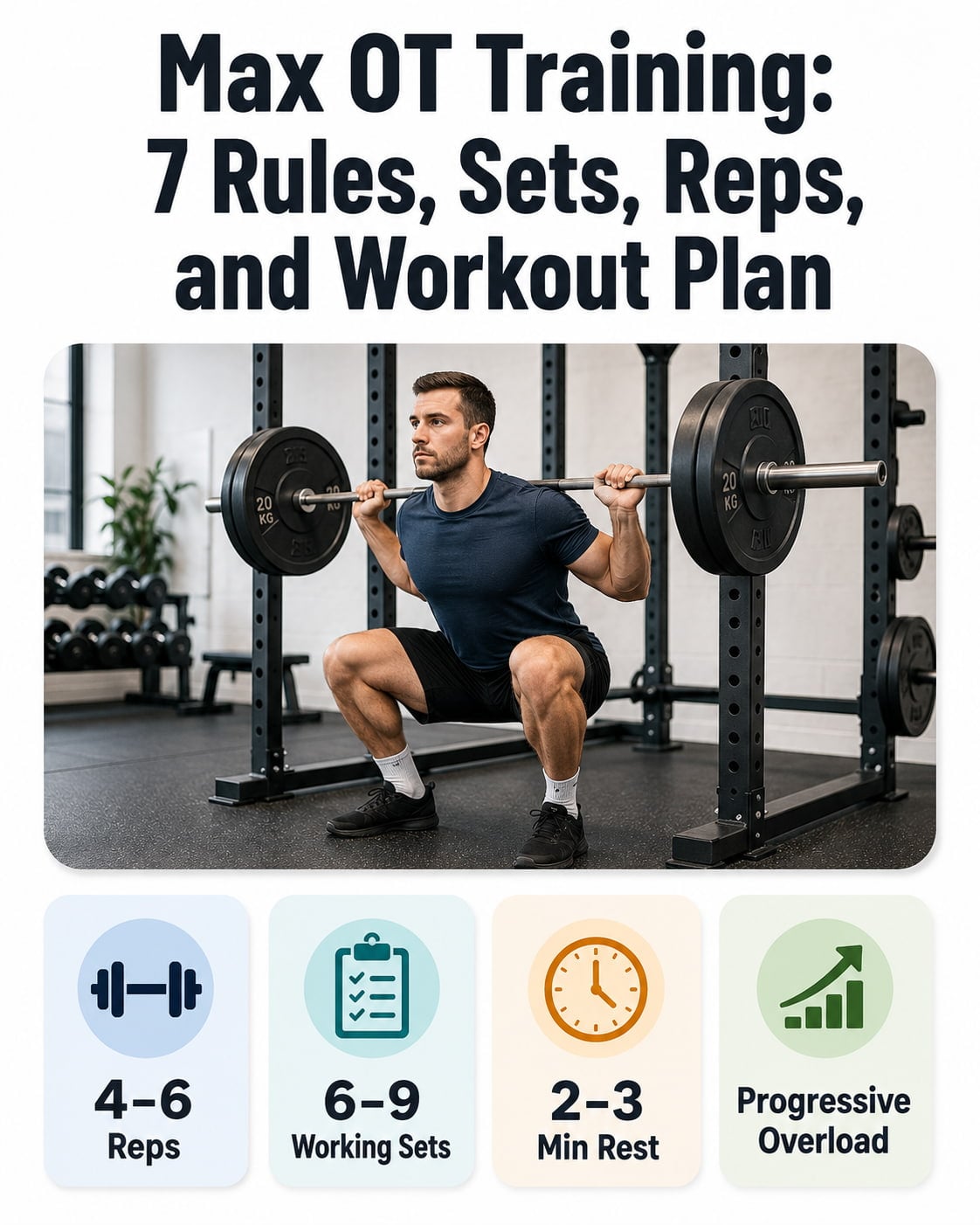
Max OT training is a heavy, low-volume resistance program built around 4–6-rep working sets, 6–9 hard sets per muscle group, 2–3 minutes of rest, and progressive overload. It can support strength and muscle growth, but its original requirement to take every working set to failure is not necessary for good results.
The official system—styled Max-OT—also limits most workouts to one or two muscle groups, trains each muscle once every 5–7 days, and schedules a week away from training after every 8–10 weeks. These rules create a simple program, but some should be adjusted according to your experience, recovery, equipment, and current resistance-training evidence.
Max OT Training at a Glance
| Program variable | Traditional Max-OT guideline |
|---|---|
| Full name | Maximum Overload Training |
| Main goal | Muscle growth and strength |
| Working-set repetitions | Usually 4–6 reps |
| Working sets per muscle group | 6–9 total heavy sets |
| Rest between sets | 2–3 minutes |
| Muscles trained per workout | One or two |
| Muscle-group frequency | Once every 5–7 days |
| Workout duration | Approximately 30–45 minutes |
| Original effort target | Positive failure |
| Recovery week | One week off every 8–10 weeks |
| Best suited for | Intermediate or experienced lifters |
What Is Max OT Training?
Max OT stands for Maximum Overload Training. It is a resistance-training system presented by Paul Delia through the official AST Sports Science Max-OT course.
The program emphasizes lifting progressively heavier weights through a controlled range of motion. Most exercises are performed for four to six repetitions, using a weight that is heavy enough to prevent a seventh complete repetition.
Max-OT is primarily a bodybuilding program, but its heavy loading also makes it strength-focused. Workouts normally use basic presses, squats, rows, pulldowns, curls, and extensions rather than complicated intensity techniques.
The branded program makes strong claims about being the most effective way to build muscle. Those claims should be viewed as part of the program’s original presentation—not as proof that Max-OT is superior to every other well-designed resistance routine.
The 7 Max OT Training Rules
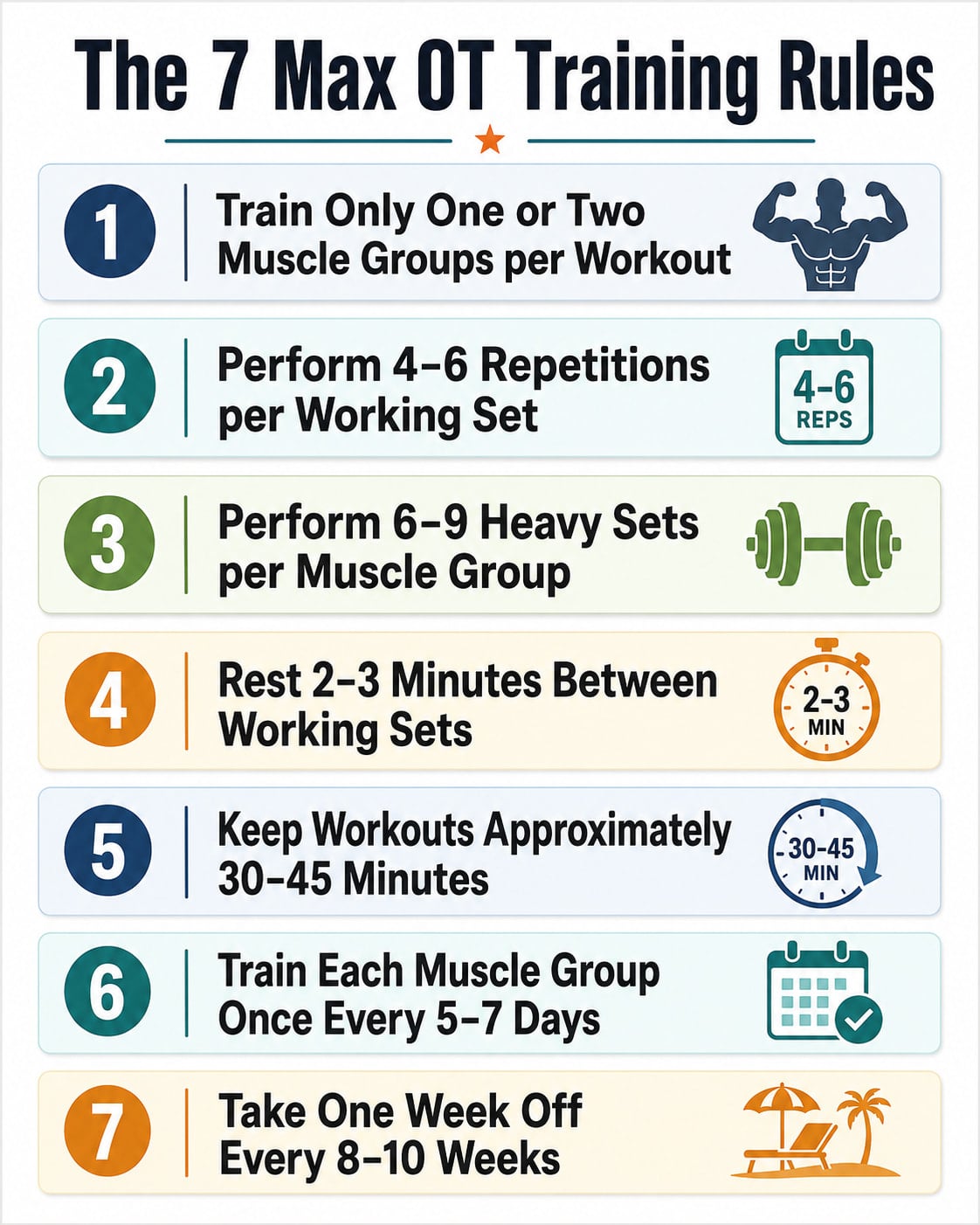
1. Train Only One or Two Muscle Groups per Workout
Traditional Max-OT divides the body across several short, focused sessions. A workout may train only the chest, back, or legs, while smaller muscle groups such as biceps and triceps may be paired.
This structure allows you to direct most of your effort toward a limited number of exercises. It may also make a five-day schedule easier to organize.
Training one muscle group per workout is not physiologically required, however. Full-body, upper-lower, and push-pull-legs programs can also build strength and muscle when they provide appropriate loading, volume, progression, and recovery.
2. Perform 4–6 Repetitions per Working Set
The 4–6-rep range is the defining feature of Max OT training.
Choose a weight that allows:
- At least four technically sound repetitions
- No more than six complete repetitions
- A consistent range of motion
- No assistance from a spotter to finish additional repetitions
If you cannot perform four clean reps, the load is too heavy for that set. If you can perform more than six, the traditional Max-OT rule considers the load too light.
Heavy 4–6-rep training is particularly useful for developing maximal strength. However, it is not the only effective muscle-building range. A systematic review and network meta-analysis of resistance-training loads found that higher loads generally produced greater maximal-strength gains, while muscle growth could occur across low, moderate, and high loads when sets were sufficiently challenging.
3. Perform 6–9 Heavy Sets per Muscle Group
Traditional Max-OT prescribes 6–9 working sets for the muscle group being trained. Warm-up and weight-acclimation sets do not count toward this total.
A typical chest workout could include:
- Bench press: 3 working sets
- Incline dumbbell press: 3 working sets
- Machine press or weighted dips: 2 working sets
That creates eight direct working sets for the chest.
Six to nine weekly sets can produce progress, particularly when the sets are challenging and performance improves over time. However, it is not a universal maximum. The American College of Sports Medicine’s 2026 resistance-training guidance identifies approximately 10 weekly sets per muscle group as a useful general target for optimizing hypertrophy, while emphasizing that volume should be individualized.
4. Rest 2–3 Minutes Between Working Sets
Max OT uses relatively long rest periods because the goal is to repeat high-force efforts rather than create as much fatigue as possible.
Rest for approximately two to three minutes after a working set. Before another heavy squat, press, or row, take slightly longer when necessary to restore your breathing, concentration, and lifting position.
Starting the next set while still heavily fatigued may reduce your repetitions or cause your technique to deteriorate. The rest period should therefore support the next quality set rather than serve as a rigid countdown.
5. Keep Workouts Approximately 30–45 Minutes
Brief sessions are intended to improve focus and prevent unnecessary exercises from being added to the program.
A workout may fit within 30–45 minutes when it includes one major muscle group, a small number of movements, and limited equipment changes. Sessions involving two muscle groups or a longer warm-up may take more time.
The official program also connects this time limit to hormonal and “anabolic window” claims. Current resistance-training guidance does not establish a universal 45-minute point at which a productive workout suddenly becomes catabolic. Treat 30–45 minutes as an efficiency target, not a physiological deadline.
6. Train Each Muscle Group Once Every 5–7 Days
The traditional Max-OT split directly trains each muscle group approximately once per week. This provides several recovery days after the heavy working sets.
Once-weekly training can produce results when the session provides enough effective weekly work. However, current ACSM guidance emphasizes training all major muscle groups at least twice per week for most healthy adults. Frequency can help distribute weekly volume, maintain exercise practice, and prevent too much work from being compressed into one session.
You can follow the original once-weekly structure, but it is not the only effective schedule. A modified Max-OT program can divide the same weekly sets across two sessions.
7. Take One Week Off Every 8–10 Weeks
The original system schedules a full week away from resistance training after every 8–10 weeks of heavy workouts.
A recovery week can be useful after a demanding training block. It may be especially appropriate when several of the following occur together:
- Performance declines across repeated workouts
- Normal loads feel unusually difficult
- Muscle or joint soreness does not settle between sessions
- Motivation and concentration decrease
- Technique becomes harder to maintain
A complete week off is not mandatory for everyone. You may instead use a deload week by reducing the number of working sets, using lighter loads, or stopping farther from failure.
Max OT Sets, Reps, and Effort
The traditional 4–6-rep rule works best for stable exercises that allow safe, measurable loading. Higher repetitions may be more practical for smaller isolation exercises.
| Exercise type | Practical repetition range |
|---|---|
| Squats, presses, rows, and pulldowns | 4–6 reps |
| Machine compound exercises | 4–6 reps |
| Curls and triceps extensions | 4–8 reps |
| Lateral and rear-delt raises | 6–12 reps |
| Calf exercises | 6–10 reps |
| Abdominal exercises | 8–15 reps |
These higher ranges are modifications rather than strict original Max-OT rules. They can make it easier to control movements where adding a small amount of weight creates a large change in difficulty.
What Does Positive Failure Mean?
The original program describes a Max-OT working set as one performed to positive failure. This is the point at which you cannot complete another full repetition without assistance.
For example, a set may look like this:
- Rep 1: Controlled
- Rep 2: Controlled
- Rep 3: Controlled
- Rep 4: Difficult but technically sound
- Rep 5: Very difficult but complete
- Rep 6: Cannot be completed without assistance
The completed five repetitions would count. A spotter should help you safely rack the weight rather than force additional repetitions.
Do Max OT Sets Need to Reach Failure?
No. Failure is part of the original system, but it is not required to build strength or muscle.
A 2026 systematic review and meta-analysis included 20 studies and 556 participants. Non-failure and failure training produced similar outcomes for hypertrophy, muscular endurance, power, and isometric strength. Non-failure training also showed a small advantage for dynamic strength in the pooled analysis.
A practical approach is to:
- Stop most compound sets with one or two repetitions in reserve
- End the set before your lifting position breaks down
- Reserve true failure for selected machine or isolation exercises
- Avoid unassisted failure on squats, bench presses, or other exercises where a missed repetition could trap the weight
You can train very hard without attempting an impossible repetition on every set.
How to Warm Up for Max OT Training
Max-OT separates sets into three categories:
- Warm-up sets: Easy sets of approximately 6–12 repetitions
- Weight-acclimation sets: Heavier sets of approximately 1–3 repetitions
- Working sets: The programmed heavy sets, usually for 4–6 repetitions
The preparation sets introduce progressively heavier loads without exhausting the target muscles. The final acclimation set should be reasonably close to the working weight, but it should still feel controlled.
Sample Max OT Warm-Up Sequence
| Set | Repetitions | Purpose |
|---|---|---|
| Warm-up set 1 | 10–12 | Practice the movement and increase blood flow |
| Warm-up set 2 | 6–8 | Introduce a moderate load |
| Warm-up set 3 | 3–5 | Prepare for heavier loading |
| Acclimation set 1 | 2–3 | Experience a weight near the working load |
| Acclimation set 2 | 1 | Final non-fatiguing preparation |
| Working sets | 4–6 | Perform the programmed sets |
The exact number of preparation sets depends on the exercise and working weight. A heavy squat or bench press normally requires more preparation than a cable curl.
You generally do not need to repeat the entire sequence for every exercise. However, add one or two acclimation sets when changing to a movement with a substantially different setup or loading pattern.
How to Progress on Max OT
Max OT uses a simple form of progressive overload. Record the load and completed repetitions for every working set.
Use this progression process:
- Select a weight that allows 4–6 clean repetitions.
- Keep that weight until you can complete six repetitions without assistance.
- Increase the load by the smallest practical amount.
- Expect repetitions to return to the lower end of the range.
- Build back toward six repetitions.
- Repeat the process.
The official progression guidance permits increasing the weight after the first set reaches six clean repetitions. For simpler recordkeeping, many lifters will find it easier to make the increase at the next workout. Small increases are preferable to jumps that immediately push performance below four reps.
Consider a repetition valid only when you maintain the planned range of motion and technique. Shortening the movement or changing your body position simply to reach six does not represent meaningful progression.
Five-Day Max OT Workout Plan
This plan keeps the heavy, low-volume Max-OT structure while making several practical adjustments:
- Most compound sets stop with one or two repetitions in reserve.
- Higher repetitions are used for selected isolation exercises.
- Chest-supported rows replace heavy good mornings as a primary back movement.
- Back extensions are not taken to failure.
- A rack, safety arms, or competent spotter should be used when appropriate.
Warm-up sets are not included in the listed totals.
Monday: Legs and Calves
| Exercise | Working sets | Reps |
|---|---|---|
| Back squat or hack squat | 3 | 4–6 |
| Leg press | 2 | 4–6 |
| Romanian deadlift | 2 | 4–6 |
| Seated or lying leg curl | 2 | 6–8 |
| Standing calf raise | 3 | 6–10 |
Keep the squat depth and stance consistent. During Romanian deadlifts, stop the descent when you can no longer maintain a stable torso and controlled hip hinge.
Tuesday: Arms and Abs
| Exercise | Working sets | Reps |
|---|---|---|
| EZ-bar curl | 2 | 4–6 |
| Alternating dumbbell curl | 2 | 4–6 |
| Cable curl | 1 | 6–8 |
| Close-grip bench press or machine dip | 2 | 4–6 |
| Lying triceps extension | 2 | 4–6 |
| Cable pressdown | 1 | 6–8 |
| Cable crunch | 2 | 8–12 |
| Hanging knee raise or reverse crunch | 2 | 8–12 |
Keep your shoulders and upper arms controlled during curls and extensions. Do not turn isolation exercises into full-body movements simply to lift more weight.
Wednesday: Shoulders and Traps
| Exercise | Working sets | Reps |
|---|---|---|
| Seated overhead press | 3 | 4–6 |
| Dumbbell or machine shoulder press | 2 | 4–6 |
| Dumbbell lateral raise | 2 | 6–10 |
| Reverse pec deck | 2 | 8–12 |
| Dumbbell or machine shrug | 3 | 4–6 |
Use a neutral, supported pressing position when possible. Avoid forcing a painful overhead range.
Thursday: Back
| Exercise | Working sets | Reps |
|---|---|---|
| Neutral-grip pulldown or weighted pull-up | 3 | 4–6 |
| Chest-supported row | 3 | 4–6 |
| Seated cable row | 2 | 4–6 |
| 45-degree back extension | 2 | 6–8 |
Pull through a controlled range without aggressively jerking the torso. Stop back extensions before fatigue causes excessive lower-back movement.
Friday: Chest
| Exercise | Working sets | Reps |
|---|---|---|
| Barbell or machine bench press | 3 | 4–6 |
| Incline dumbbell press | 3 | 4–6 |
| Machine chest press or weighted dip | 2 | 4–6 |
Use safety arms or a capable spotter for barbell bench presses. Select a dip variation only when it feels comfortable through your shoulders and sternum.
Saturday and Sunday: Recovery
Use the weekend for recovery or comfortable physical activity. Easy walking, mobility work, or recreational activity is usually compatible with the program when it does not interfere with the next training week.
How to Use the Workout Plan
Follow these guidelines for each session:
- Perform a full warm-up before the first heavy compound movement.
- Rest approximately 2–3 minutes between working sets.
- Take additional rest before technically demanding sets when needed.
- Stop compound sets with one or two good repetitions still possible.
- Record every working-set load and repetition.
- Add weight only after reaching the top of the range with consistent technique.
- Follow the plan for approximately 8–10 weeks before reviewing volume, exercise selection, and recovery.
- Use a deload or recovery week when accumulated fatigue is affecting performance.
The program should be adjusted when an exercise repeatedly causes pain, cannot be performed with stable technique, or is unavailable at your gym.
Does Max OT Training Build Muscle and Strength?
Max OT can build both, but not every traditional claim about the system is supported equally.
The 2026 ACSM position stand synthesized 137 systematic reviews representing more than 30,000 participants. It supports heavy loading—approximately 80% of one-repetition maximum or higher—for optimizing strength and identifies greater weekly volume as an important factor for muscle growth. It does not find consistent benefits from taking every set to momentary failure.
| Traditional Max-OT position | Current evidence-based interpretation |
|---|---|
| Four to six reps is the ideal muscle-building range | It is effective, particularly for strength, but muscle can grow across a wider range |
| Every working set should reach failure | Hard sets are important, but failure is not required |
| Six to nine weekly sets is enough for everyone | It can work, but some lifters may benefit from more weekly volume |
| Each muscle needs 5–7 days before being trained again | Recovery needs vary, and twice-weekly training can distribute volume effectively |
| Workouts must end within 45 minutes | Brief sessions are efficient, but 45 minutes is not a proven hormonal cutoff |
| A full week off is mandatory every 8–10 weeks | A recovery week can help, but its timing and format should be individualized |
The most defensible way to use Max OT is to keep its useful elements—heavy loading, limited exercise selection, progressive overload, sufficient rest, and detailed recordkeeping—without treating every original rule as mandatory.
Benefits of Max OT Training
Simple Progression
The 4–6-rep range provides a clear progression target. You either complete more clean repetitions or use a slightly heavier load.
Strength Emphasis
Heavy compound exercises provide frequent practice with high-force lifting, making the system useful for people who want to become stronger while building muscle.
Focused Workouts
Training one or two muscle groups at a time limits distractions and unnecessary exercise changes.
Manageable Direct Volume
Six to nine direct sets can be easier to recover from than very high-volume bodybuilding sessions, especially when the sets are genuinely challenging.
Detailed Recordkeeping
The program encourages you to track loads and repetitions instead of judging workouts only by soreness, fatigue, or muscle “pump.”
Limitations of Max OT Training
Heavy Loads Require Reliable Technique
Sets of four to six repetitions leave less room for technical mistakes than lighter, higher-repetition practice.
Repeated Failure Creates More Fatigue
Taking every set to failure can reduce performance on later exercises and make recovery harder without reliably producing better results.
Once-Weekly Frequency May Not Suit Everyone
Some lifters perform better when weekly sets are distributed across two sessions rather than completed in one workout.
Five Training Days May Be Impractical
The traditional body-part split requires frequent gym visits even though each individual session is relatively short.
Some Exercises Do Not Suit Very Low Repetitions
Lateral raises, rear-delt movements, abdominal exercises, and certain cable exercises are often easier to control with moderately higher repetitions.
Is Max OT Good for Beginners?
The original program is not the best starting point for most true beginners. New lifters must first learn how to brace, control each exercise, recognize technical failure, and use safety equipment correctly.
A beginner can borrow several Max-OT principles:
- Keep the exercise list simple
- Track weights and repetitions
- Add resistance gradually
- Rest adequately between sets
- Avoid unnecessary intensity techniques
However, beginners may benefit from starting with two or three full-body workouts per week, moderate loads, and approximately 6–12 repetitions per set. After developing consistent technique, they can gradually introduce heavier 4–6-rep work.
Max OT Safety Tips
Heavy resistance training should be challenging, but it should not require ignoring pain or warning symptoms.
- Use safety arms for squats and barbell presses.
- Use a spotter who understands when and how to assist.
- Do not perform forced repetitions after you have reached failure.
- Stop a set when your position or range of motion significantly changes.
- Avoid attempting personal records when unusually fatigued or distracted.
- Increase weight in small increments.
- Keep the lowering phase controlled.
- Replace exercises that repeatedly cause joint pain with suitable alternatives.
According to the CDC’s guidance for adults beginning physical activity, people with chronic health conditions should discuss appropriate types and amounts of exercise with a healthcare professional. The CDC also advises some inactive adults and people with disabilities or overweight to seek medical guidance before beginning vigorous activity.
Stop exercising and seek appropriate medical care for chest pressure, fainting, severe shortness of breath, sudden weakness, or another concerning symptom.
Frequently Asked Questions
What does Max OT stand for?
Max OT stands for Maximum Overload Training. The system uses heavy working sets, limited workout volume, long recovery periods, and progressive increases in resistance.
How many sets and reps are used in Max OT?
Most exercises use 4–6 repetitions. The traditional program prescribes 6–9 total heavy working sets per muscle group, excluding all warm-up and acclimation sets.
Does Max OT build muscle or strength?
It can build both. Its heavy loading is especially well suited to strength development. The program can also support muscle growth, although 4–6 reps is not the only effective hypertrophy range.
Should every Max OT set go to failure?
No. The original program takes working sets to positive failure, but current evidence does not show that failure is necessary for maximizing strength or muscle growth. Stopping most sets with one or two repetitions in reserve is a practical alternative.
How long should a Max OT workout last?
The traditional target is approximately 30–45 minutes. A session may take longer when it includes an extensive warm-up, two muscle groups, busy equipment, or longer recovery between heavy compound sets.
Can Max OT be done three or four days per week?
Yes, but it will no longer follow the original five-day split exactly. You can rotate the five sessions across a longer schedule rather than forcing all of them into one week. Another option is to combine related muscle groups while keeping the number of hard sets manageable.
When should I increase the weight?
Increase the weight after you can perform six clean repetitions at the current load. Use the smallest available increase and make sure the new weight still allows at least four technically sound repetitions.
Do I need a full week off every 8–10 weeks?
Not necessarily. That is the original Max-OT rule. Depending on your fatigue and recovery, you can take a full week off or complete a deload week with fewer sets, lighter weights, and more repetitions in reserve.
Conclusion
Max OT training offers a straightforward way to organize heavy resistance exercise. Its 4–6-rep sets, focused sessions, longer rest periods, and clear progression rules can support strength and muscle growth.
The best approach is not to follow every original claim blindly. Use safe exercise selections, keep most compound sets just short of failure, increase weight gradually, and adjust weekly volume and frequency according to your performance and recovery.
Start conservatively, record every workout, and let several weeks of consistent training—not one exhausting session—determine whether the program is working.
References
- AST Sports Science: Official Max-OT Week 1 Course
- AST Sports Science: Max-OT Warm-Ups—A Closer Look
- AST Sports Science: Progressive Overload, Progressive Gains
- American College of Sports Medicine: 2026 Resistance-Training Guidelines
- Lopez et al.: Resistance-Training Load Effects on Muscle Hypertrophy and Strength
- Wu et al.: Failure Versus Non-Failure Resistance Training
- CDC: Adding Physical Activity as an Adult