
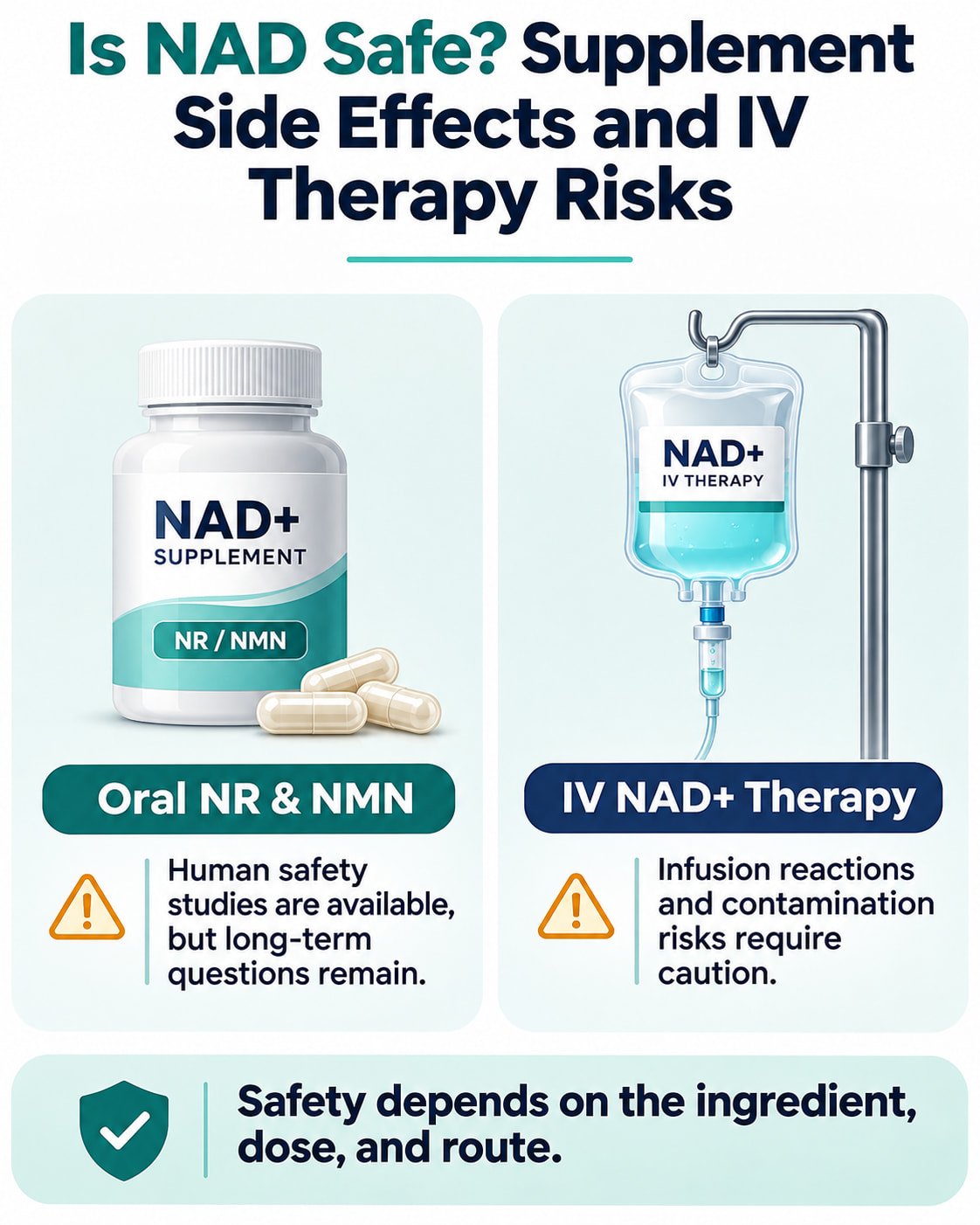
Some oral NAD-boosting supplements have been well tolerated in human studies, but that does not make every NAD product safe for everyone. The ingredient, dose, duration, formulation, and your health all matter. Evidence for nicotinamide riboside (NR) or nicotinamide mononucleotide (NMN) cannot automatically establish the safety of other products labeled “NAD.”
NAD+ IV therapy requires a separate safety assessment. Beyond symptoms during an infusion, injectable products can pose contamination risks. The U.S. Food and Drug Administration (FDA) has received reports of severe reactions to injectable NAD+, some requiring medical treatment.
The useful question is not simply whether NAD is safe. It is whether a particular product and route have enough evidence—and a worthwhile potential benefit—to justify their risks.
What Does “NAD” Mean on a Supplement Label?
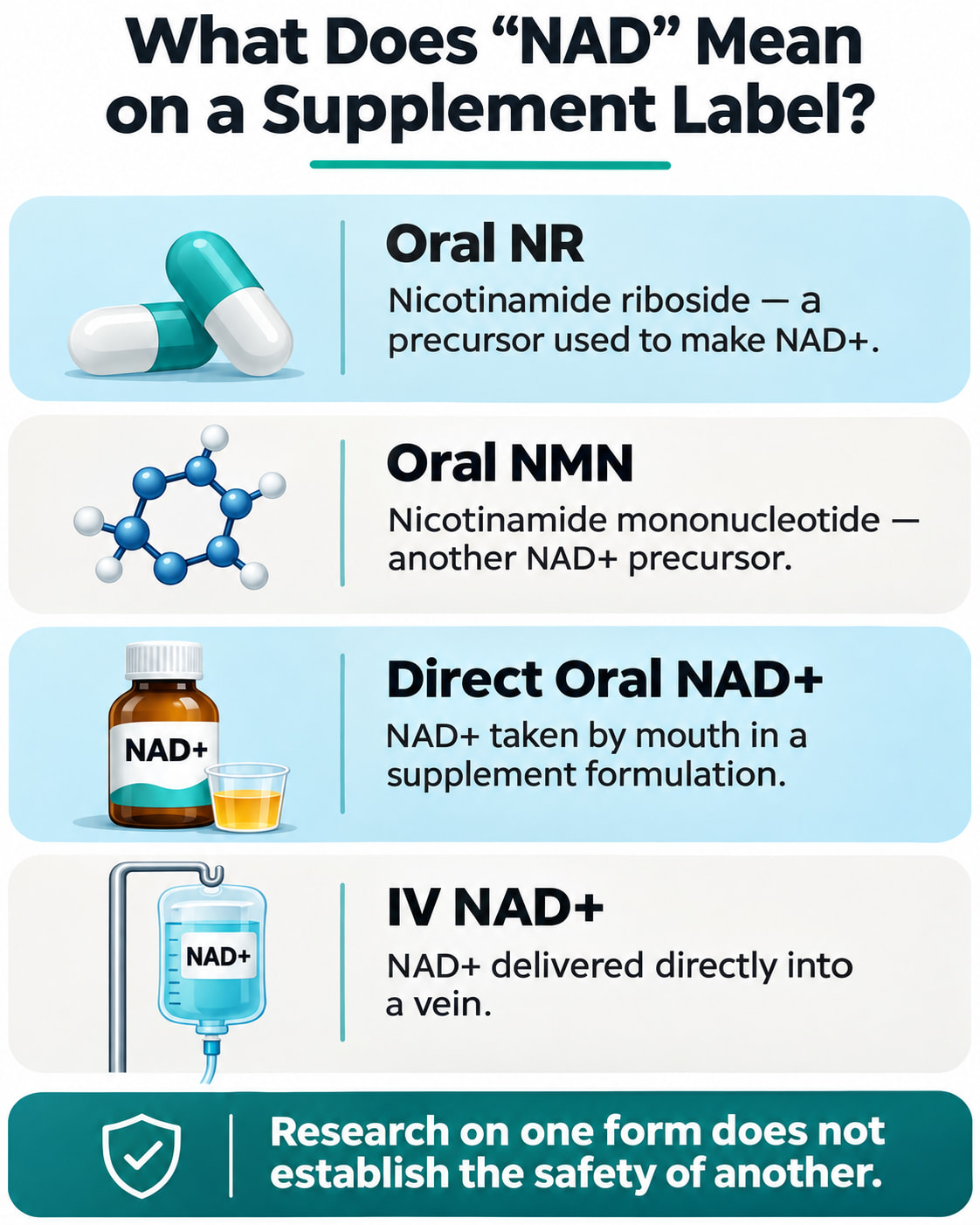
NAD stands for nicotinamide adenine dinucleotide, a coenzyme your cells use in energy metabolism and other essential functions. NAD+ is its oxidized form. The NIH Office of Dietary Supplements explains NAD’s role in converting energy from food and maintaining normal cellular processes. Its presence in your body, however, does not establish that taking extra amounts is beneficial or harmless.
Products discussed as “NAD supplements” are not necessarily the same thing:
| Ingredient or route | What it means |
|---|---|
| Oral NR | Nicotinamide riboside, a precursor your body can use to make NAD+. |
| Oral NMN | Nicotinamide mononucleotide, another NAD+ precursor. |
| Direct oral NAD+ | NAD+ itself in a swallowed or specialized oral formulation, rather than NR or NMN. |
| IV NAD+ | NAD+ delivered into a vein, introducing considerations that do not apply to swallowing a supplement. |
These distinctions matter because research on one ingredient or route does not validate the others. A study of an NR capsule is not a safety study of an NAD+ infusion.
Also check for nicotinic acid or nicotinamide, also called niacinamide. These related vitamin B3 compounds have different adverse-effect profiles. Nicotinic acid can cause flushing, and high doses can injure the liver. Those risks should not simply be copied onto NR or NMN, but they matter when reviewing a combination product’s ingredients.
Are Oral NAD Supplements Safe?
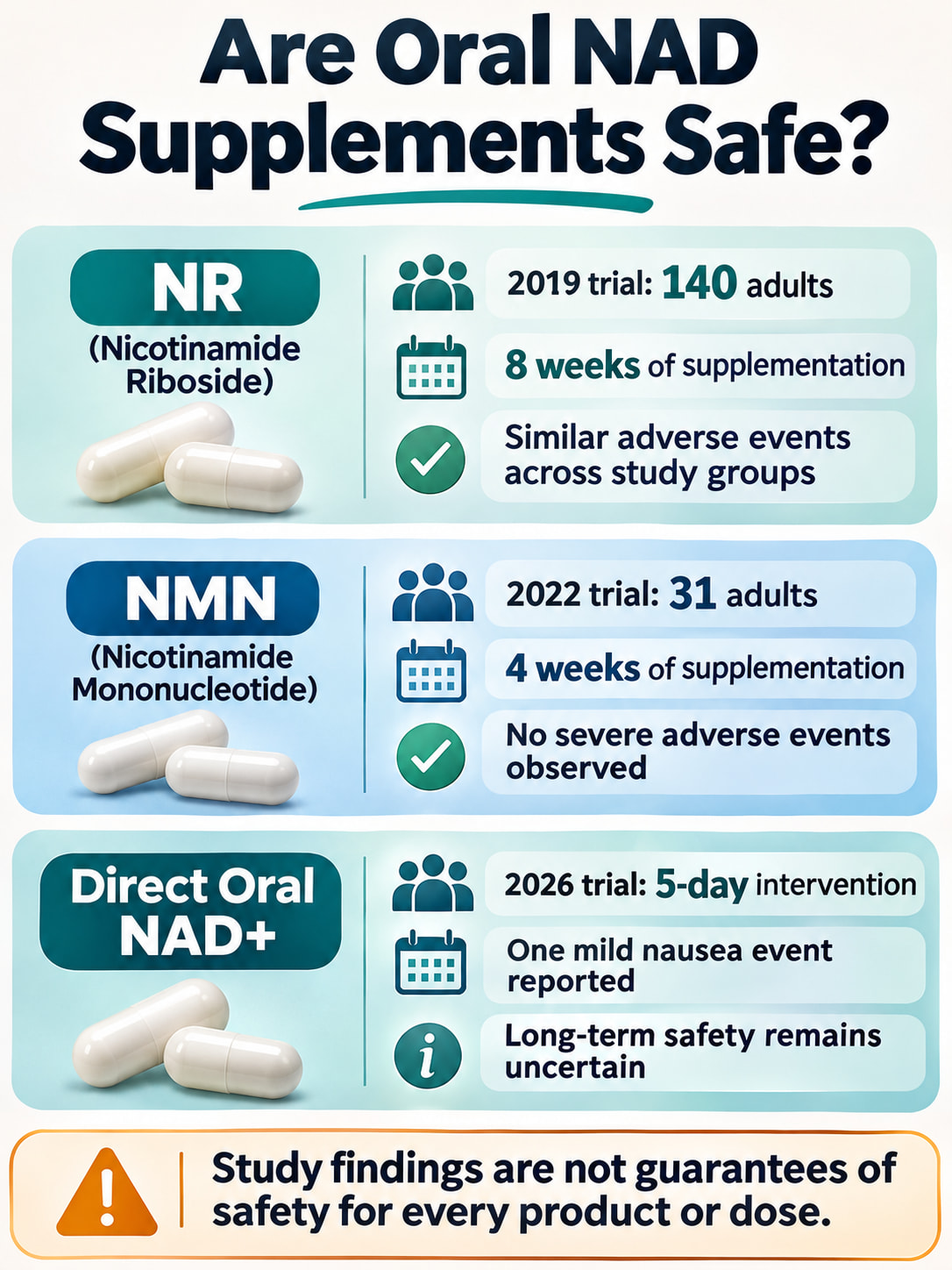
Human research provides some reassurance about specific oral formulations, particularly over limited treatment periods. It does not establish a universal safe dose or guarantee that a retail product matches what researchers tested.
The doses below describe research or a safety assessment—not recommended personal regimens.
Nicotinamide Riboside: Reassuring Trial Results, Not a Blanket Guarantee
In a 2019 randomized NR trial, 140 otherwise healthy adults with overweight received placebo or 100, 300, or 1,000 milligrams of NR daily for eight weeks. Adverse events were similar across groups, with no serious adverse events or reports of flushing.
Mild nausea and muscle discomfort were among events considered possibly related to NR. Nausea also occurred with placebo, so the study does not establish that it is a frequent NR side effect. The findings support tolerability of that NR formulation under those conditions—not indefinite use at any dose.
Nicotinamide Mononucleotide: Dose and Product Specifications Matter
A 2022 NMN safety trial included 31 healthy adults ages 20–65 and tested 1,250 mg daily for four weeks. No severe adverse events were observed. Loose stool occurred in both the NMN and placebo groups; investigators considered the recorded events unrelated to the study product.
This illustrates an important distinction: a symptom occurring during a study is not automatically a proven supplement side effect.
There is also a formulation-specific regulatory assessment. In its 2026 β-NMN safety opinion, the European Food Safety Authority concluded that the evaluated chemically synthesized ingredient was safe under its proposed conditions: up to 300 mg daily in adults, excluding pregnant and breastfeeding women.
That conclusion does not establish the safety of every NMN brand, higher doses, injections, or multi-ingredient mixtures. It is also not evidence that NMN slows aging.
Direct Oral NAD+: Do Not Borrow Evidence From NR or NMN
Research on direct oral NAD+ exists, but the formulation matters. A 2026 randomized trial tested a proprietary swish-and-swallow preparation for five days, using 2,000–2,500 mg daily. Researchers reported one mild nausea event and similar overall symptom burden between groups.
Five days cannot establish long-term safety, and results from that preparation do not validate every NAD+ capsule, gummy, or liquid. Several authors disclosed financial relationships with the product company, another reason to interpret the findings cautiously rather than as a product endorsement.
Is NAD Safe to Take Every Day?
Some trials involve daily dosing, but “studied daily for several weeks or months” is not the same as “proven safe to take for years.” Longer studies add useful information without eliminating uncertainty about rare effects, medically vulnerable people, or combinations of supplements.
A 24-week NMN trial published in September 2026 tested 1,250 mg daily in adults age 65 and older. Overall tolerability was reassuring, and similar proportions of participants reported adverse events in the NMN and placebo groups.
However, one participant stopped NMN after liver enzymes increased. Mild abnormalities were already present before treatment. Researchers considered a causal relationship unlikely but could not completely exclude it and emphasized careful safety monitoring. This is neither proof that NMN routinely damages the liver nor a finding to omit when discussing high-dose use.
Longer research also shows why your medical situation matters. A 2026 trial involving 410 people with early Parkinson disease tested NR at 500 mg twice daily for 52 weeks. It found no clinical benefit and modestly worse disease-rating outcomes than placebo. That result should not be generalized to healthy adults, but it argues against self-treating Parkinson disease with NR.
Finally, safety and effectiveness are separate questions. The 24-week NMN trial increased blood NAD-related metabolites without improving its primary hearing outcome or physical performance measures. A higher blood measurement is not, by itself, proof that you will feel better or function better.
What Are the Risks of NAD IV Therapy?
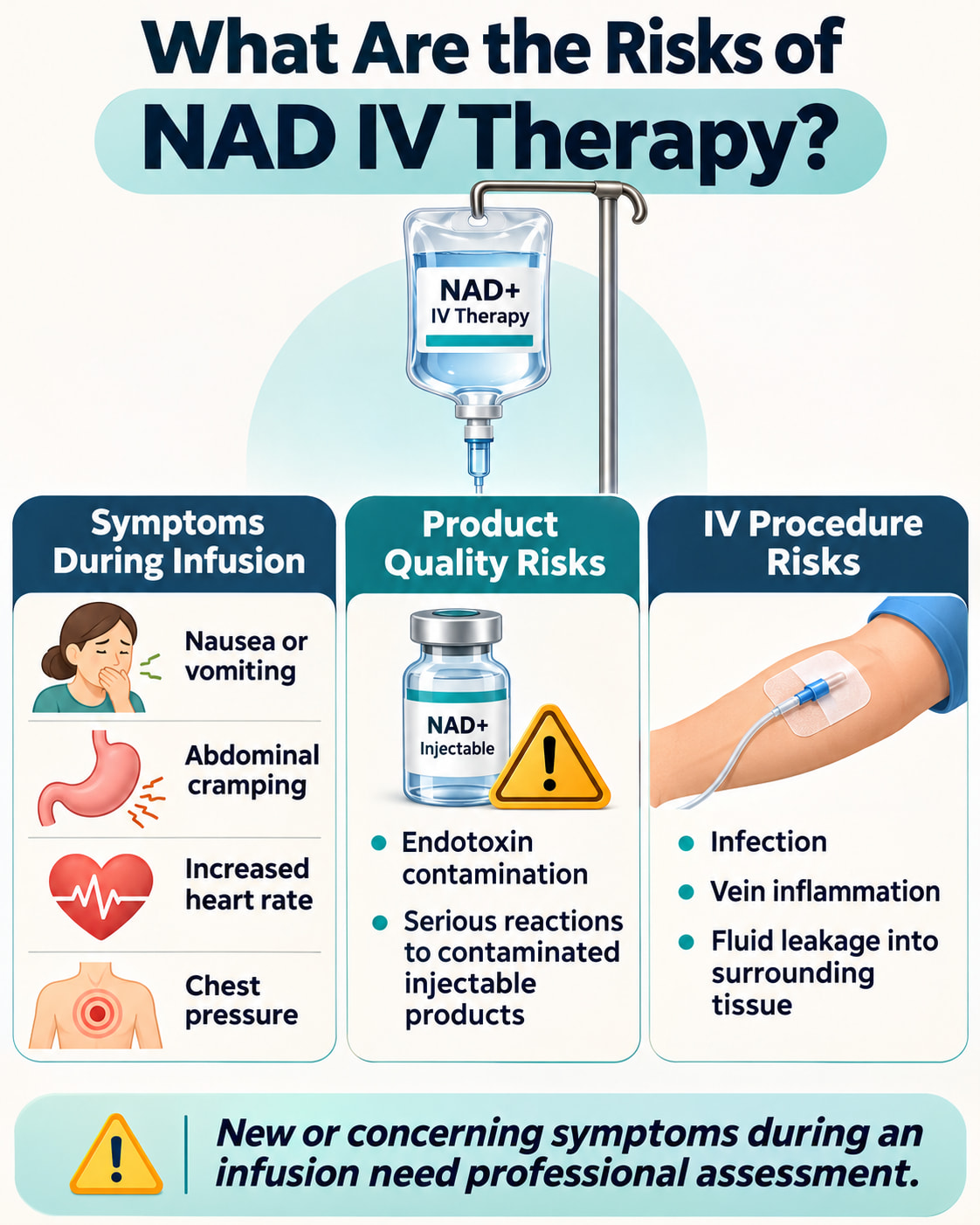
IV NAD+ deserves more caution than a discussion of oral supplements alone can provide. It involves both the administered substance and the preparation and delivery of a sterile injectable product.
Symptoms During an Infusion
A small 2026 retrospective study reviewed six people who received 500 mg of IV NAD+ on four consecutive days. Reported symptoms included nausea, vomiting, abdominal cramping, diarrhea, increased heart rate, and chest pressure. Symptoms stopped when the infusions ended.
This was a very small study conducted in a commercial wellness setting, with authors employed by the clinic company. It cannot tell us how frequently these reactions occur across all patients, doses, or infusion protocols.
An earlier 2019 pilot study observed no adverse events in eight men receiving 750 mg over six hours. The different findings do not establish a universally safe infusion rate: both studies were small and used different protocols.
Contamination and Ordinary IV Complications
The FDA’s NAD+ compounding warning describes severe chills, shaking, vomiting, and fatigue following injectable NAD+. The agency says these reactions are consistent with excessive endotoxins—bacterial contaminants—and warns that food-grade ingredients are not suitable for sterile drug preparation without appropriate processing.
A January, 2026, FDA warning letter to GenoGenix documents a specific incident. Three patients receiving NAD+ from the same vial developed symptoms including low blood pressure and uncontrollable shaking and were directed to an emergency room. An unopened vial from the same lot contained excessive bacterial endotoxins.
That incident demonstrates a contaminated-product hazard. It does not establish the frequency of reactions to properly prepared NAD+, or prove that NAD+ itself caused those symptoms.
IV treatment also carries risks unrelated to NAD specifically, including infection, vein inflammation, and fluid leaking into surrounding tissue. MedlinePlus guidance on IV treatment explains these complications and their warning signs.
When to Get Medical Help
During an infusion, tell the treating professional immediately about any new symptoms. Do not treat significant discomfort as something you must endure to obtain a benefit.
- Call emergency services for breathing difficulty, chest pain, a racing heart, or significant dizziness during or after IV treatment. These symptoms need urgent assessment, not reassurance that they are expected.
- Seek prompt medical evaluation for severe chills, uncontrollable shaking, or persistent vomiting after NAD+ injection. FDA reports show that these can occur with problematic injectable preparations.
- Contact a clinician for increasing redness, swelling, pain at the IV site, or fever. These may indicate an IV-related complication.
A professional may decide to stop an infusion or take other action after assessment. Simply slowing it down should not replace evaluation of concerning symptoms.
Who Should Get Medical Advice Before Using NAD?
Extra caution is appropriate during pregnancy or breastfeeding, for children, and for anyone taking medications or managing a significant medical condition. NIH supplement guidance emphasizes that many supplements have not been adequately tested in pregnant or breastfeeding people or children.
People with liver disease, kidney disease, heart conditions, or other chronic illnesses should not assume that findings in selected healthy adults apply to them. For example, the 2022 NMN safety trial excluded people taking medications and those being treated for numerous chronic conditions. An exclusion does not prove the supplement is harmful in that group; it means the trial cannot answer that group’s safety question.
For interactions, have a clinician or pharmacist review the complete product, including additional ingredients, alongside your medication and supplement list. An absence of a familiar interaction warning is not evidence that a combination has been tested. FDA recommends discussing supplements with a health professional before purchase or use.
What About Cancer Concerns?
Some concern comes from animal research, not demonstrated harm in human supplement users. A University of Missouri research explanation describes findings linking NR supplementation to cancer growth and spread in an animal model. The researchers explicitly state that those findings were not established in humans.
That research does not prove that NAD supplements cause cancer in people. It also does not justify declaring them risk-free for someone with cancer. Discuss NAD-related products with your oncology team before using them during cancer treatment; this is a precaution in an uncertain area, not a claim that every NAD product is contraindicated.
What to Check Before Taking NAD or Booking an Infusion
Start with the exact product, not the marketing phrase “NAD booster.” A useful discussion with your clinician or pharmacist should answer these questions:
| Question | What to look for |
|---|---|
| What exactly is in it? | The ingredient name, amount per serving, number of servings per day, and all additional active ingredients. |
| Does the evidence match this product and goal? | Research using the same ingredient and route, with a relevant dose, population, and outcome—not just a rise in blood NAD+. |
| How is quality checked? | For oral products, verifiable independent testing. For injections, the preparation’s source and the provider’s explanation of sterile preparation and quality controls. |
| Who will assess and respond to problems? | Medication and medical-history review, a qualified professional responsible for treatment, and clear instructions for reactions during and after an infusion. |
These questions help identify evidence and safeguards; they cannot make an inadequately studied treatment risk-free.
Understand What a Quality Seal Can—and Cannot—Tell You
Independent testing can help confirm that a supplement contains its listed ingredients and does not contain harmful levels of tested contaminants. However, NIH explains that quality seals do not guarantee safety or effectiveness. A tested product can still be inappropriate for your health situation or lack evidence for the benefit being advertised.
Do Not Confuse Availability With FDA Approval
In the United States, dietary supplements are not FDA-approved before marketing. A product’s presence on a store shelf or a manufacturer’s suggested serving size is not an FDA determination that it is safe and effective for your intended use.
Likewise, compounded drugs are not FDA-approved. FDA does not review their safety, effectiveness, or quality before marketing. A prescription or pharmacy source should therefore not be interpreted as proof that a compounded NAD+ infusion has demonstrated anti-aging or wellness benefits.
For an optional supplement, avoid assuming that a higher dose or several overlapping “NAD boosters” will be better. NIH cautions that high doses and combining multiple supplements can increase the chance of adverse effects. Report a suspected reaction to a health professional rather than repeatedly taking the product to see whether you can tolerate it.
The Bottom Line
NAD safety is product- and route-specific. Oral NR and NMN have some reassuring human safety data, but findings from defined studies are not guarantees about every formulation, long-term regimen, or medical condition. IV NAD+ adds infusion and sterile-product risks that oral research cannot resolve.
Before starting, identify the actual ingredient, clarify what benefit you expect, and review the evidence and your health circumstances with a qualified professional. A plausible benefit is not enough when the product, dose, or safety safeguards remain unclear.
This content is for informational purposes only and not medical advice.