
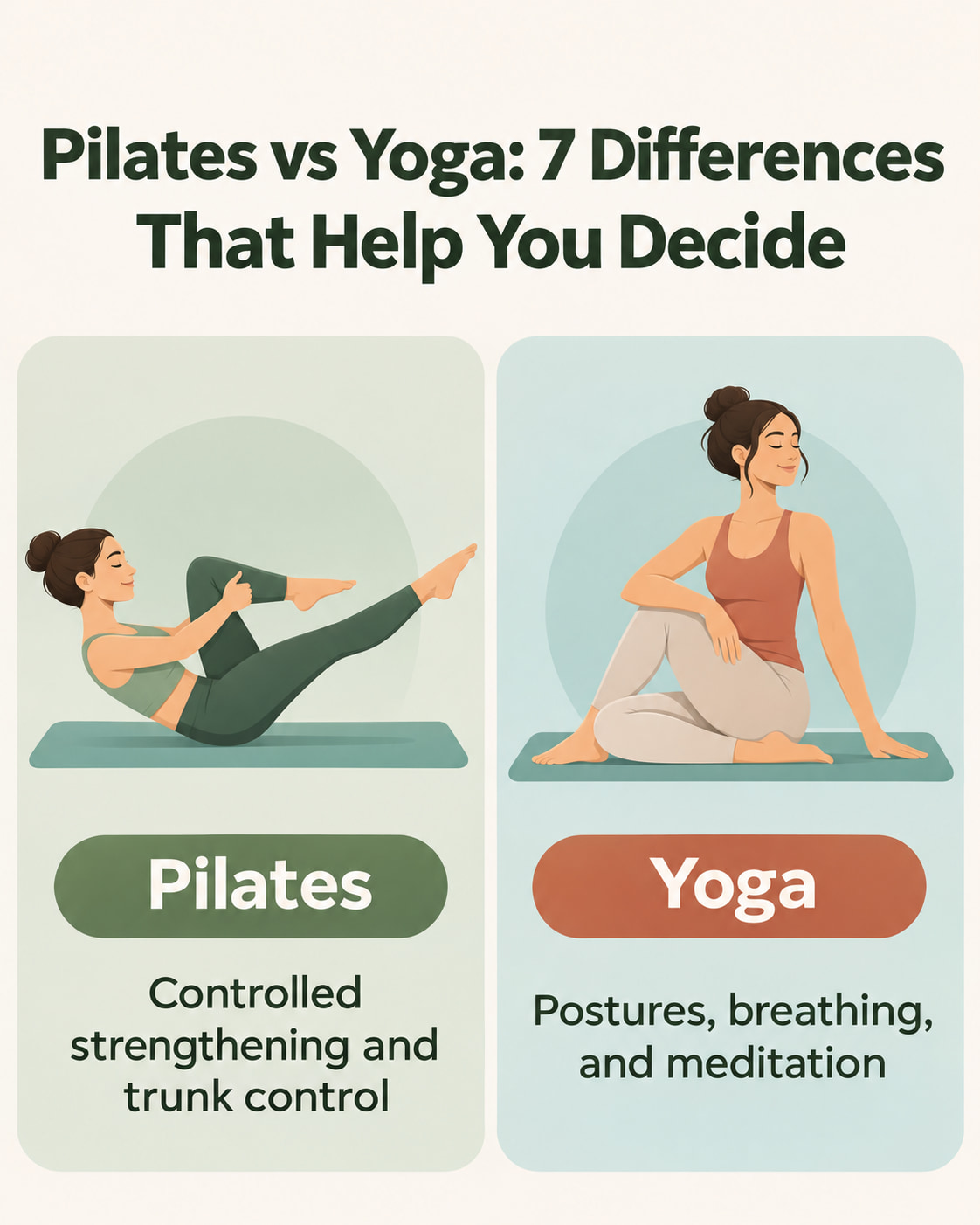
Pilates and yoga overlap more than their reputations suggest. Pilates generally emphasizes controlled strengthening and trunk control, while yoga combines physical postures with breathing and, depending on the class, meditation. Both can challenge strength, flexibility, and balance; neither is simply an abdominal workout or a stretching session. Healthdirect’s comparison outlines these shared features.
When deciding between Pilates vs yoga, start with the experience you want. Controlled exercise sequences may draw you toward Pilates. A practice that explicitly includes meditation or relaxation may draw you toward yoga. Then compare actual classes: beginner mat Pilates, reformer Pilates, and different yoga styles can offer quite different experiences.
Pilates vs Yoga: The 7 Main Differences
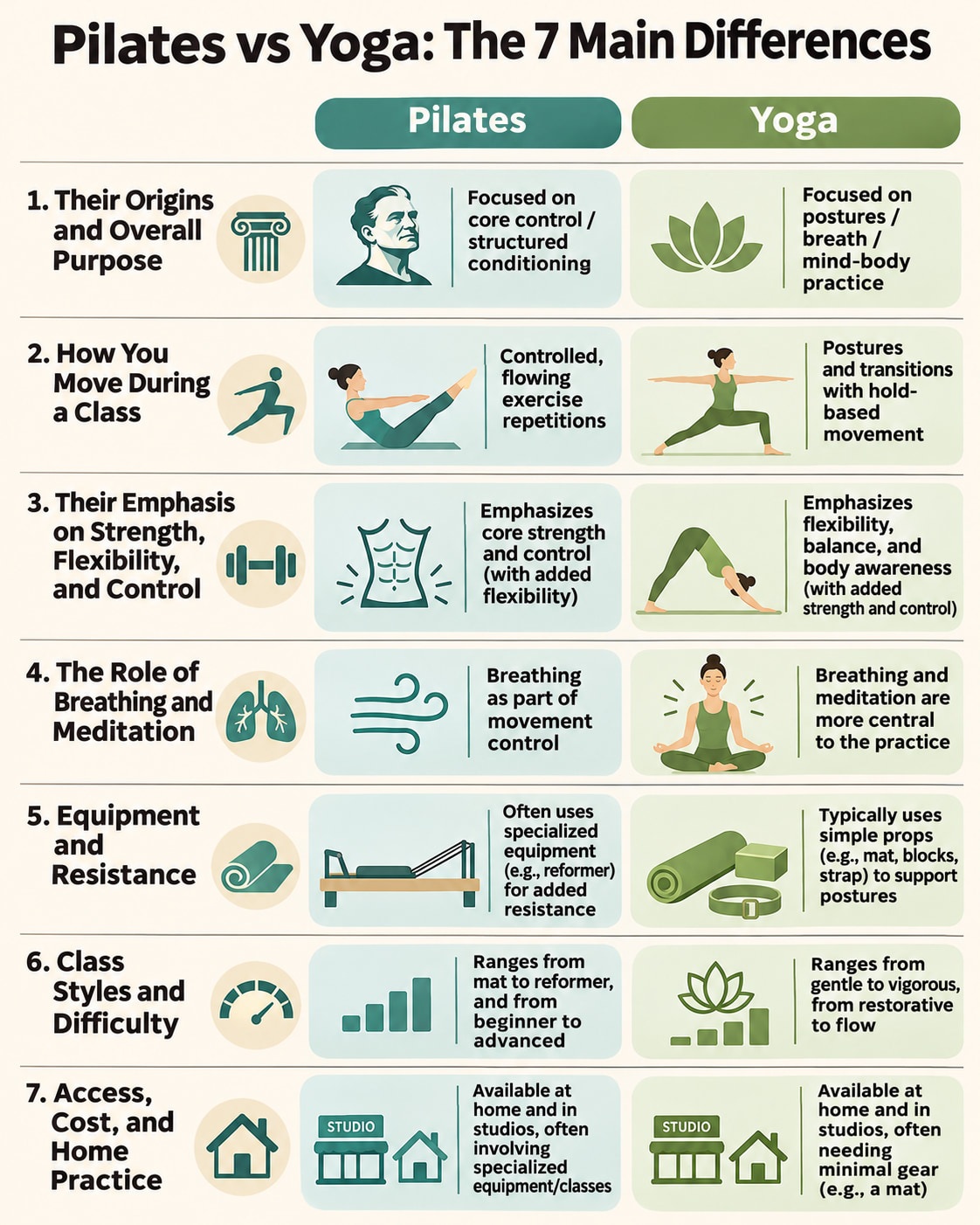
1. Their Origins and Overall Purpose
Pilates is a modern exercise method developed by Joseph Pilates. He and his wife, Clara, taught it in their New York studio, and it evolved into the mat- and equipment-based practice offered today. The Pilates Method Alliance describes a method combining physical exercises with focused breathing.
Yoga has much older roots in Indian philosophy and encompasses more than exercise. Physical postures are one part of a broader tradition that includes breathing and meditative practices, as the National Center for Complementary and Integrative Health, or NCCIH, explains.
For choosing a class, the practical question is how much of that broader tradition you would like included. Ask whether the session focuses on movement alone or also incorporates meditation, chanting, or philosophical teaching.
2. How You Move During a Class
Pilates commonly involves controlled exercise sequences with repeated movements. Attention goes to how you perform each repetition rather than simply completing more of them. The Better Health Channel’s Pilates guide emphasizes precision, breathing, and movement quality.
Yoga may involve holding postures, moving between them, or both. For example, power yoga can involve quicker transitions, while Iyengar yoga places particular attention on alignment and may include longer holds. MedlinePlus’s guide to yoga styles describes this range.
The distinction is therefore not “Pilates moves; yoga stays still.” Before booking, ask whether the class mostly involves repeated exercises, sustained positions, or flowing movement—and which of those sounds appealing.
3. Their Emphasis on Strength, Flexibility, and Control
Pilates gives particular attention to the muscles around your trunk and hips, often grouped under the term core. But it is not limited to abdominal exercises: it also involves movement and strengthening across other major muscle groups. Yoga postures can likewise challenge muscular strength, flexibility, and balance.
“Pilates for strength, yoga for flexibility” is an oversimplification. A class’s exercises, difficulty, and progression matter more than that shorthand.
A 2022 systematic review of 11 randomized trials found no clear differences between Pilates and other exercise approaches for the strength, balance, and flexibility outcomes assessed. Evidence certainty was low or very low, and the comparisons were not exclusively against yoga. That does not prove all approaches are equally effective; it means this research does not establish Pilates as a universal winner.
For your own choice, ask what the class will actually challenge and how the instructor makes exercises more demanding as you progress.
4. The Role of Breathing and Meditation
Both practices involve attention and breathing. Pilates coordinates breathing with exercise; yoga may also include dedicated breathing exercises and meditation. Pilates is therefore not purely physical, and yoga is not necessarily a relaxation-only session.
Research summarized by NCCIH on yoga and well-being suggests that yoga may help with stress management. However, that does not establish that yoga relieves stress more effectively than Pilates.
When relaxation is a priority, look for a class description that explicitly includes it. Ask how much time is devoted to breathing, meditation, or quiet rest rather than assuming every yoga class offers the same experience.
5. Equipment and Resistance
The equipment distinction is clearest when comparing mat Pilates, reformer Pilates, and yoga.
Mat Pilates uses body weight and may include small tools such as a resistance band or ball. A reformer has a moving platform, springs, and an adjustable footbar. Yoga commonly uses a mat and may include props such as blocks. Check the class description before buying anything. Healthdirect’s equipment guidance explains the basic options.
A reformer is not simply a way to make Pilates harder. Springs provide resistance, but they can also support movement. As Pilates Anytime’s spring guide explains, lighter springs can require more strength and control in some exercises.
Do not choose spring settings by treating them like a competition over how much weight you can lift. Learn the machine’s setup and follow the instructor’s guidance for the particular exercise.
6. Class Styles and Difficulty
Yoga styles vary substantially. A gentle class may feel very different from a demanding power-yoga session. Pilates also has beginner through advanced options, on both mats and equipment. Neither practice’s name reliably tells you how difficult a class will be.
A more useful comparison is:
“Is this particular class appropriate for someone with my experience and current abilities?”
Ask about the pace, expected experience, and available modifications. Someone who exercises regularly may still benefit from an introductory class when the movements or equipment are unfamiliar.
Do not use an advanced class as your test of whether you “can do” Pilates or yoga. Start with an option designed to teach the basics.
7. Access, Cost, and Home Practice
Yoga and mat Pilates do not require a large exercise machine. Reformer Pilates does require access to the apparatus. That distinction matters when deciding whether you want studio sessions, home practice, or a combination.
Rather than assuming one practice is always cheaper, compare the options available to you. Include class fees, transportation, equipment rental, introductory-session requirements, and cancellation policies.
Also consider how much instruction you are purchasing. A low-cost video and a small class with individual feedback are different services. Before committing to a membership or package, try an introductory session and decide whether the teaching style works for you.
Which Should You Choose for Your Goals?
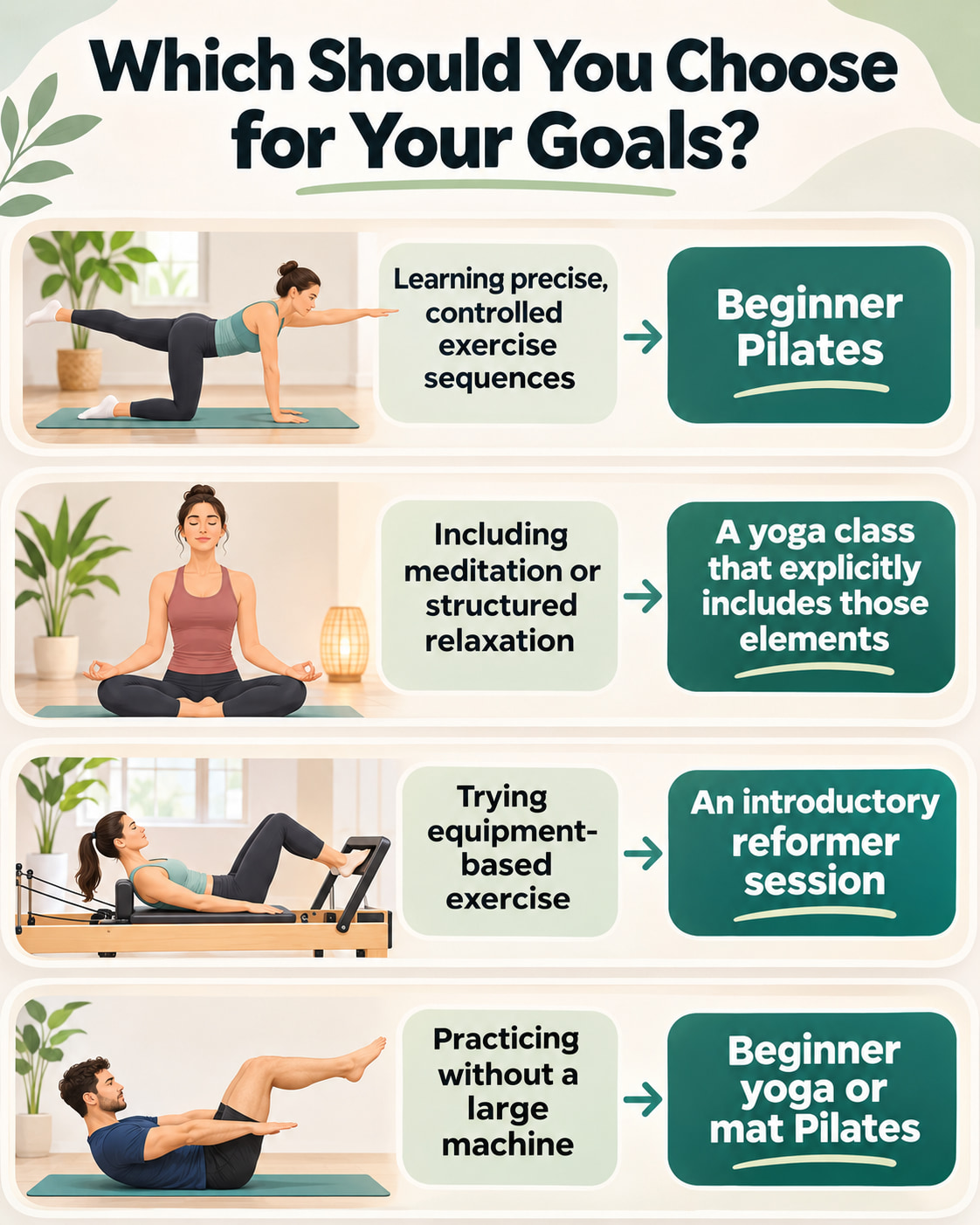
Use these as starting points for choosing a class—not as rankings of proven health benefits.
| What matters most to you | A sensible starting point | What to ask before booking |
|---|---|---|
| Learning precise, controlled exercise sequences | Beginner Pilates | “How do you teach technique and offer modifications?” |
| Including meditation or structured relaxation | A yoga class that explicitly includes those elements | “How much of the session is devoted to breathing or meditation?” |
| Trying equipment-based exercise | An introductory reformer session | “Will someone teach me the machine setup before class?” |
| Practicing without a large machine | Beginner yoga or mat Pilates | “What space and props will I need?” |
For flexibility, balance, or general strength, either practice may be worth exploring. Look for a class that addresses your goal rather than expecting the label alone to deliver it.
What About Back Pain?
Back pain is a reason to consider the suitability of the program—not a reason to assume Pilates or yoga is automatically the better treatment.
A 2025 review of 70 systematic reviews found generally small benefits from exercise approaches, including Pilates and yoga, for low-back pain and disability. Some analyses favored Pilates for pain reduction, but that comparative evidence was low certainty.
For yoga specifically, a 2022 Cochrane review included 21 trials involving adults with chronic nonspecific low-back pain. Average improvements compared with no exercise were small and did not reach the review’s thresholds for clinical importance. Back-related function was similar to other back-focused exercise, while differences in pain remained uncertain.
The practical takeaway is not to treat an ordinary group class as interchangeable with a rehabilitation program. With persistent pain, a recent injury, or symptoms that limit movement, seek guidance from a qualified clinician or physical therapist about suitable exercise and modifications.
What About Weight Loss?
When weight loss is a personal goal, consider your overall activity and eating patterns rather than choosing by promises attached to either practice.
The CDC’s guidance on physical activity and weight explains that activity contributes to energy expenditure, while the amount needed for weight management varies between people.
A class name alone cannot provide a dependable calorie estimate: a gentle session and a physically demanding one are not equivalent. Choose a format you are willing and able to practice regularly, and avoid treating either Pilates or yoga as a guaranteed route to a particular body shape.
How to Choose a Beginner-Friendly Class
Start with a beginner or introductory session and an appropriately trained instructor. Learn the movements before increasing difficulty, and stop painful movements rather than trying to push through them. These are central points in Healthdirect’s guidance on starting safely.
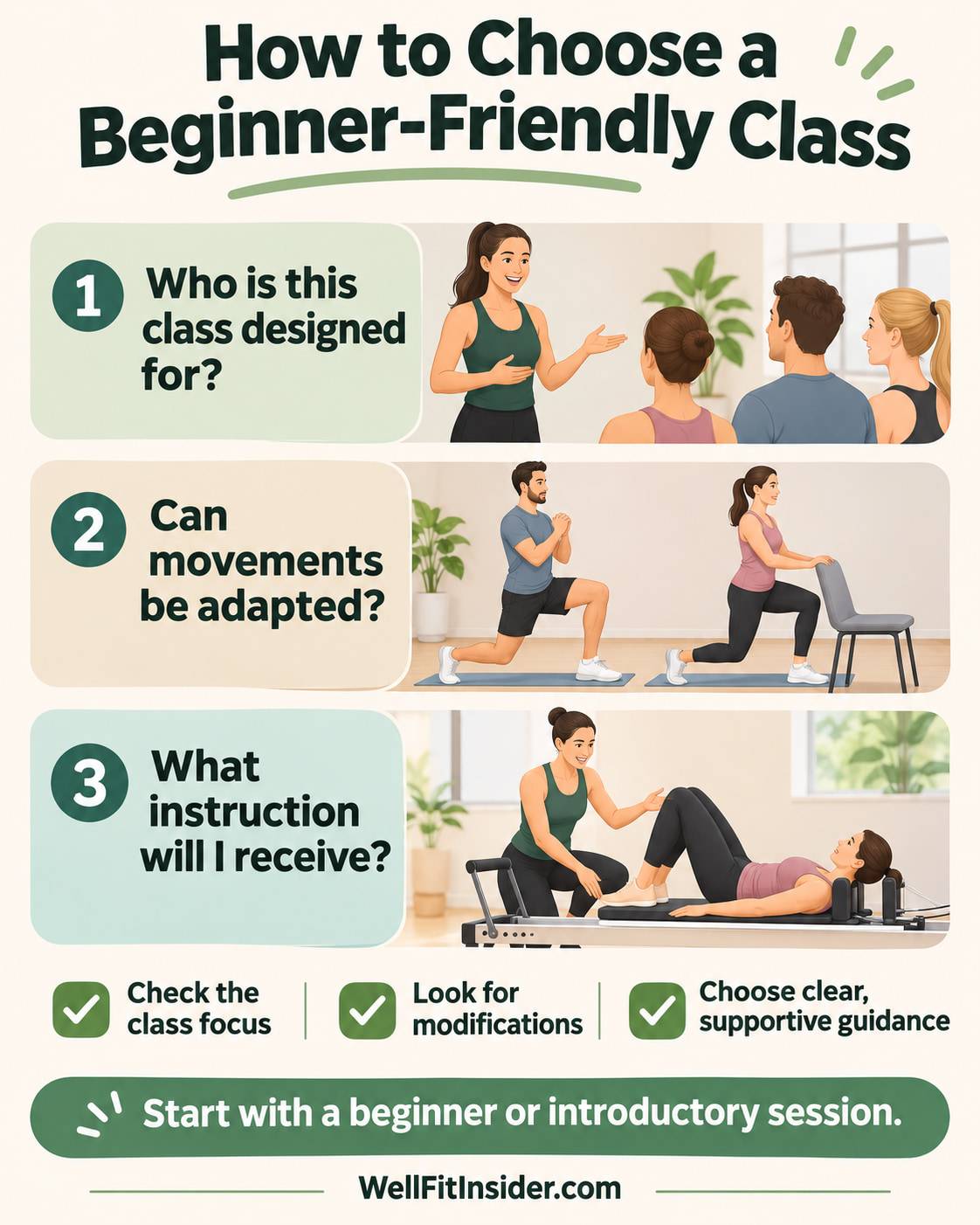
Before booking, ask three practical questions:
- Who is this class designed for? Look for a clear answer about experience level, not just “everyone.”
- Can movements be adapted? Mention relevant needs, such as difficulty kneeling, getting onto the floor, or placing weight through your wrists.
- What instruction will I receive? Ask about feedback during class and, for reformer Pilates, equipment orientation.
Tell the instructor about relevant injuries and health conditions. During pregnancy, after surgery, or when a medical condition affects your ability to exercise, get individualized guidance about suitable activities.
Yoga has a few additional considerations. NCCIH advises beginners to avoid extreme practices such as headstands and forceful breathing. Hot yoga carries overheating and dehydration risks and should be avoided during pregnancy. A nonheated beginner class is a straightforward option when you are still learning what feels manageable.
Can You Do Both—and Is Either a Complete Exercise Routine?
There is no need to choose a permanent side. You might prefer Pilates for controlled conditioning and a yoga class for a session that includes meditation. Build the combination around your interests, schedule, and ability to recover rather than feeling obligated to add more classes.
Also consider what the rest of your week includes. As a general reference, US adult physical activity guidelines summarized by the CDC recommend at least 150 minutes of moderate-intensity aerobic activity or 75 minutes of vigorous activity weekly, plus muscle-strengthening activities on at least two days that work all major muscle groups. Some activity is better than none, and you can build up gradually.
Whether a class contributes to those goals depends on what you actually do. Strengthening work needs to challenge the muscles; aerobic activity needs to reach an appropriate intensity. The CDC’s explanation of what counts includes body-weight exercise and some yoga postures as strengthening activities. Do not automatically count every minute of a Pilates or yoga class as cardio—or assume neither can contribute to strength training.
For a first decision, choose one beginner class whose description appeals to you. Afterward, ask whether the instruction was clear, modifications were welcomed, and the experience made you interested in returning. Those answers are more useful for your next booking than trying to declare a universal winner in Pilates vs yoga.
This content is for informational purposes only and not medical advice.