
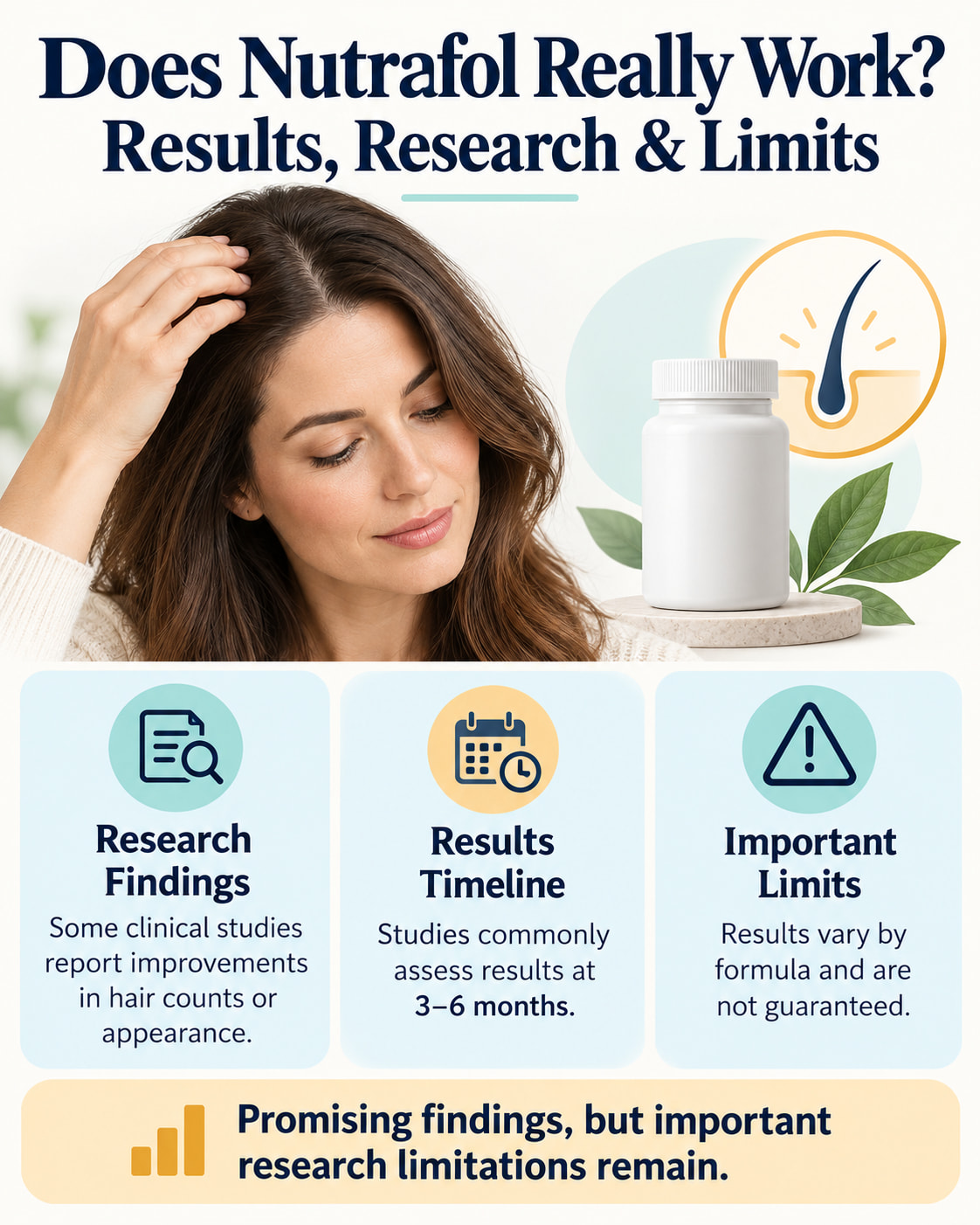
Nutrafol may help some people with thinning hair, but results are not guaranteed. Small clinical trials have reported improvements with certain formulas, including increased hair counts and better hair-growth ratings. However, the strength of the evidence varies by product, and some studies lack a placebo comparison.
The practical questions are which formula was tested, how much improvement matters to you, and whether the possible benefit justifies several months of spending.
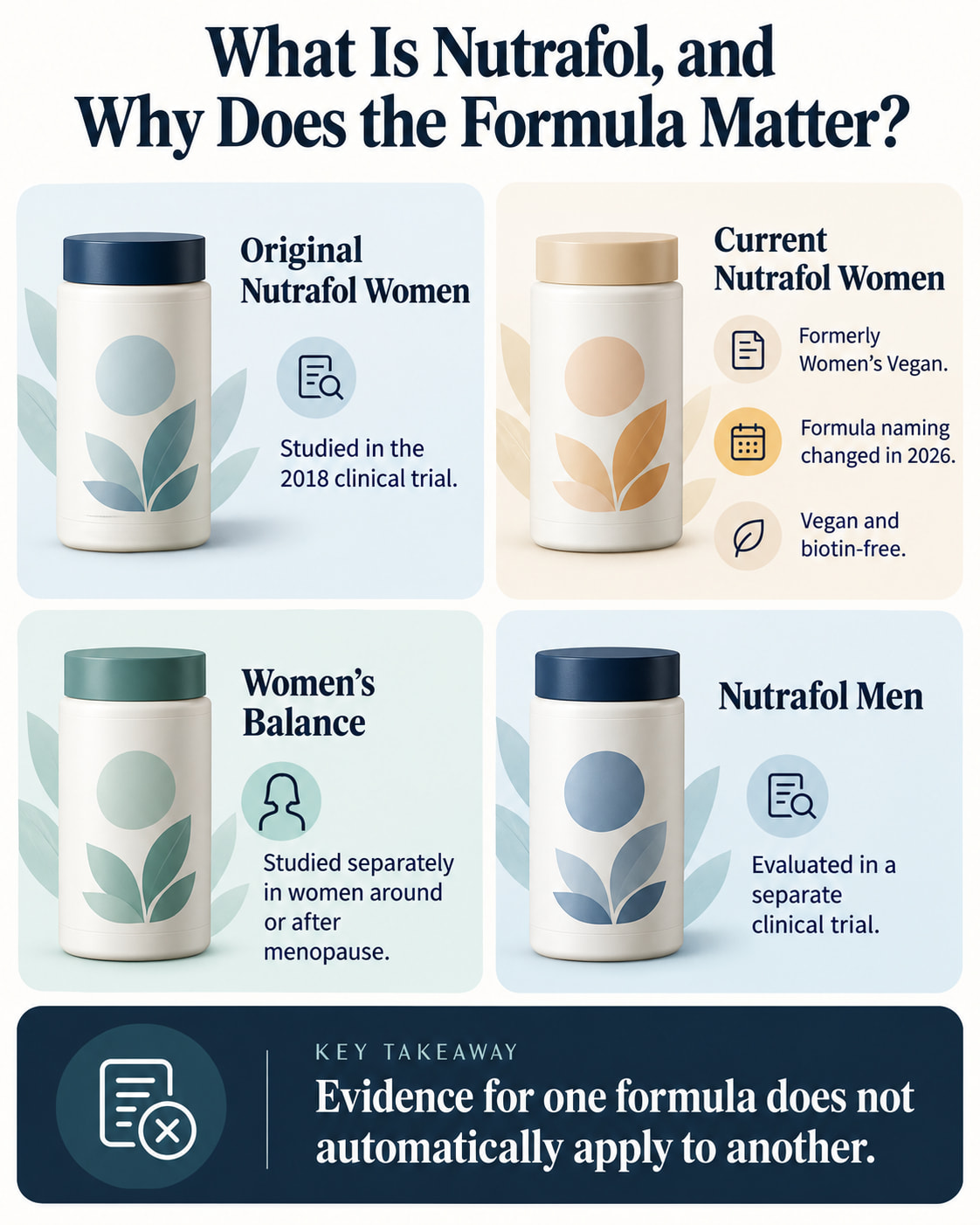
There is also an important update: the product currently sold as Nutrafol Women differs from the original formula used in some frequently cited research.
What Is Nutrafol, and Why Does the Formula Matter?
Nutrafol is a brand of oral dietary supplements marketed for hair thinning. Its formulas combine ingredients such as vitamins, minerals, and botanical extracts, with different products aimed at different groups.
The main products discussed here are Nutrafol Women, Women’s Balance, and Men. Their evidence should be evaluated separately.
In its August 2026 formula announcement, Nutrafol explained that its former Women’s Vegan product became the primary Nutrafol Women offering. The former Vegan formula’s contents remained unchanged; its name and packaging changed. This current Women formula is vegan and biotin-free.
That distinction matters when reading reviews. A study of the original Women formula does not automatically establish the effectiveness of the current Women formula. Likewise, evidence for Women’s Balance should not be treated as evidence for every product in the range.
Does Nutrafol Really Work? What the Studies Show
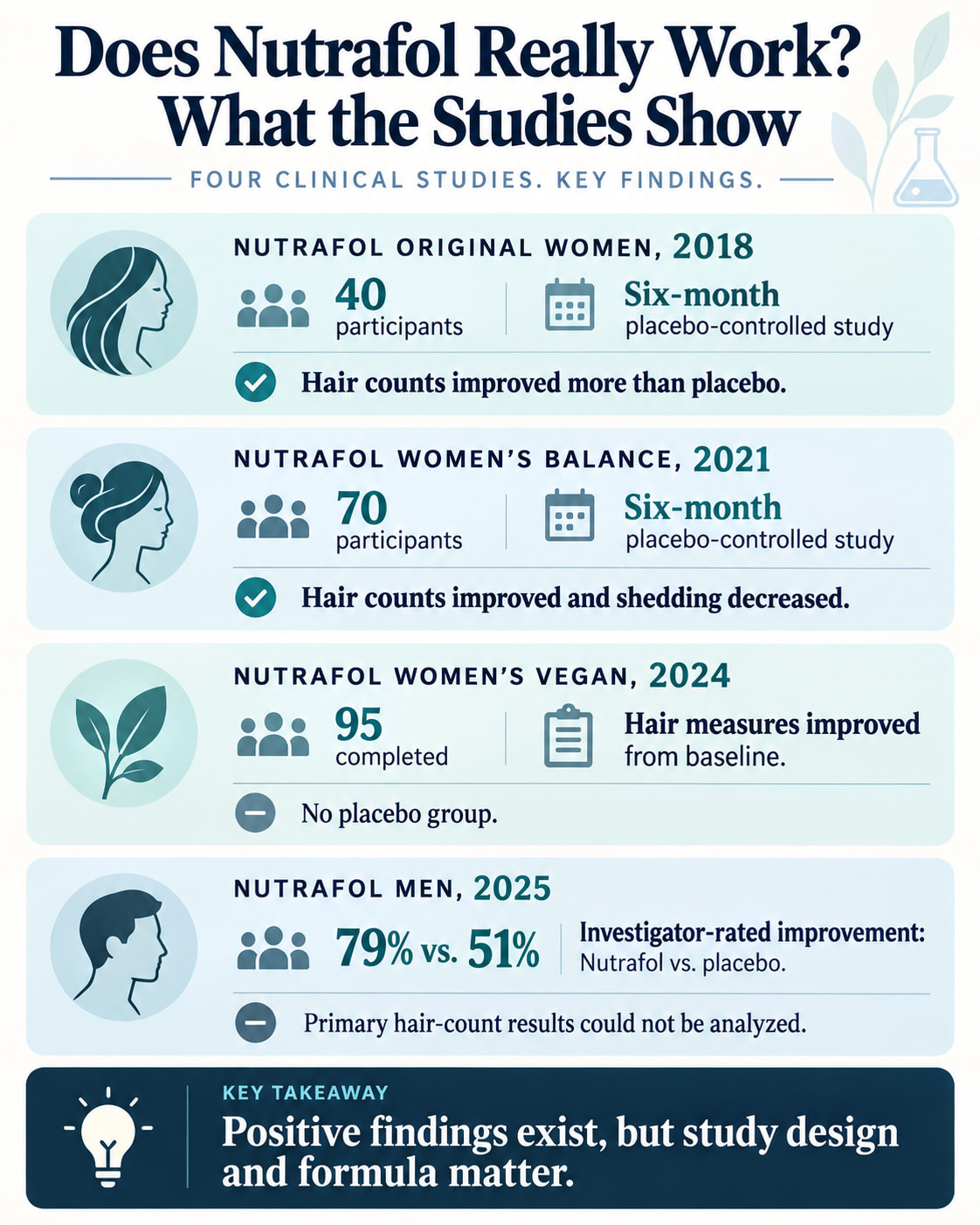
Nutrafol has published clinical research, including randomized trials that compare a supplement with a placebo. Those studies can provide more useful evidence about cause and effect than simply observing people before and after they begin taking a product.
Here are the main findings.
| Formula and study | What researchers studied | What they found | Main limitation |
|---|---|---|---|
| Original Women, 2018 | Forty women in a six-month placebo-controlled trial: 26 received Nutrafol and 14 received placebo. | Hair counts in the measured scalp area improved more with Nutrafol at three and six months. | Small sample; tested the original formula. |
| Women’s Balance, 2021 | Seventy women around or after menopause: 40 received the supplement and 30 received placebo. | Hair counts improved and shedding decreased relative to placebo. | Findings apply to the studied formula and population. |
| Women’s Vegan, 2024 | A six-month study in women following plant-based diets; 95 completed it. | Hair-count and hair-quality measures improved compared with participants’ starting measurements. | No placebo group. This formula is relevant to the current Women product. |
| Men, 2025 | A six-month placebo-controlled trial; 112 enrolled and 85 completed per protocol. | Investigators rated hair growth as improved in 79% of supplement participants versus 51% receiving placebo. | The planned primary hair-count results could not be analyzed. |
These findings come from the original Women trial, Women’s Balance trial, Women’s Vegan study, and men’s trial.
Two details change how to interpret the results
First, a percentage of participants who improved is different from the percentage increase in hair. “79% were rated improved” does not mean those participants grew 79% more hair.
Second, the men’s study had an important technical limitation. Problems with image collection made the planned primary hair-count data unusable, so the publication reported secondary outcomes instead. This weakens the quantitative evidence without showing that the supplement had no effect.
What newer studies add
A study published online in 2025 followed several formulas and reported improvements in hair-fiber thickness among 244 people who completed it. However, it had no placebo group.
A July 2026 study included four women’s formulas, with 150 participants completing six months. Average total hair counts in the measured area increased approximately 4.4%–8.2% across groups compared with starting measurements. Again, there was no placebo group, so the study could not separate the supplement’s effect from natural changes and other influences.
Why the evidence still has limits
Several studies disclose manufacturer funding and authors who were company employees, advisers, or recipients of research funding. Those relationships do not automatically invalidate the findings, but independent replication would strengthen confidence.
Other limitations matter too:
- Study participants are selected. Findings in people with particular patterns of thinning do not establish benefit for every cause or stage of hair loss.
- Improvement can mean different things. Increased strand thickness, reduced shedding, and a favorable appearance rating are not interchangeable.
- Statistical improvement does not guarantee a noticeable personal benefit. A measurable average change may still fall short of what an individual considers worthwhile.
The evidence supports considering a possible benefit while keeping expectations realistic.
What Results Can You Expect, and How Long Might They Take?
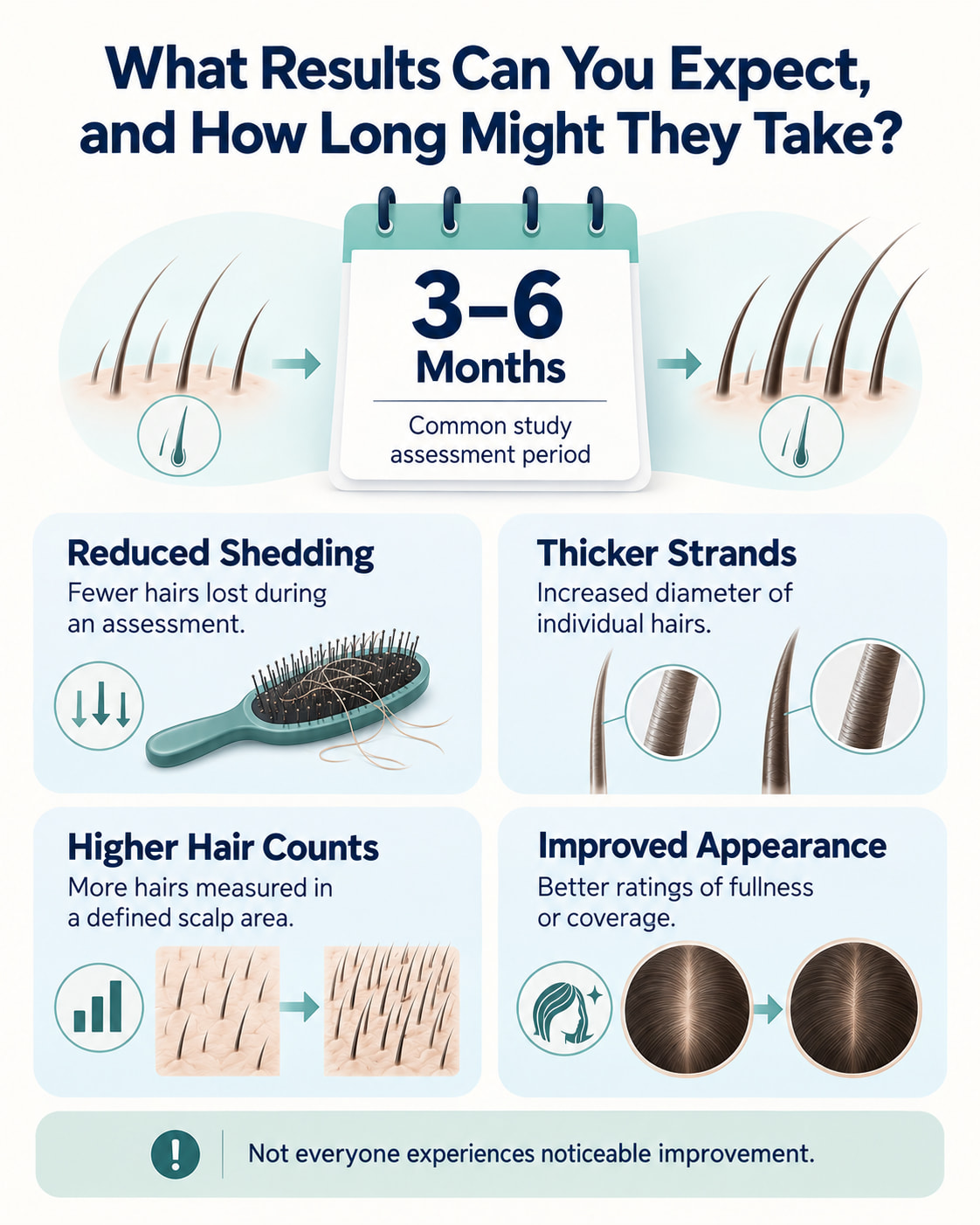
Nutrafol advertises a three-to-six-month results window, and several studies assessed participants at approximately 90 and 180 days. That is a reasonable timeframe to discuss when reviewing the research, but it is not a promise that everyone will improve by a particular date.
“Results” can refer to several different changes:
| Possible change | What it means |
|---|---|
| Reduced shedding | Fewer hairs lost during an assessment |
| Thicker strands | An increase in the diameter of individual hairs |
| Higher hair counts | More hairs measured in a defined scalp area |
| Improved appearance | Better ratings of fullness, coverage, or overall hair quality |
Before-and-after photographs can help you notice changes, but they cannot establish what caused them. Lighting, styling, part placement, and camera angle can also change how full hair looks.
If you and your clinician decide a supplement is appropriate, make progress easier to assess:
- Take baseline photographs. Use the same lighting, hairstyle, part, and camera distance for later pictures.
- Choose a meaningful goal. Examples include a less visible part or less shedding, rather than an undefined expectation of “better hair.”
- Record other changes. Starting another hair product or medication at the same time makes it harder to identify what helped.
- Set a review point. Discuss whether any improvement justifies the ongoing expense instead of continuing indefinitely without reassessment.
Worsening hair loss or scalp symptoms should prompt evaluation rather than simply waiting for a supplement to work.
Nutrafol Side Effects and Who Should Be Cautious
Natural ingredients can still cause side effects or interact with medicines.
Newer research reported digestive upset and acne. The July 2026 study also recorded one case of Hashimoto’s thyroiditis classified as a serious adverse event and considered possibly related to the supplement. This does not establish that Nutrafol caused it or reveal how often such an event might occur.
Thyroid conditions, autoimmune conditions, and medicines
Some formulas contain ashwagandha. According to NCCIH guidance, this ingredient is not recommended for people with thyroid or autoimmune disorders or those approaching surgery. It may interact with medicines including thyroid hormones, immunosuppressants, sedatives, and certain blood-pressure or diabetes medicines.
NCCIH also describes digestive effects, drowsiness, and rare reports of liver injury linked to ashwagandha supplements. These are ingredient-level precautions, not proof that every Nutrafol formula causes those problems.
Have a clinician or pharmacist review the exact product alongside your medicines. Nutrafol’s own product guidance specifically flags anticoagulants and blood-thinning medicines for review.
Pregnancy and breastfeeding
The current Women product advises against use during pregnancy or while trying to conceive and identifies the formula as unsuitable while breastfeeding.
Nutrafol separately markets its Postpartum product as breastfeeding-friendly. That is manufacturer guidance about a different formula; it should not be interpreted as universal safety clearance. Review the actual product with your pregnancy or postpartum care clinician.
Check the actual label
Review the Supplement Facts, allergens, and warnings for the bottle you intend to use. Formulas differ, so statements about one product’s ingredients may not apply to another.
If you develop a suspected adverse reaction, stop using the supplement and seek medical advice, consistent with FDA guidance.
How Much Does Nutrafol Cost, and Is It Worth It?
Nutrafol’s official pricing information lists the following standard US options for its core hair supplements. These prices exclude promotions and applicable taxes. Subscription shipping is listed as free; one-time orders may have additional shipping charges.
| Purchase option | Listed price | Calculated cost for six months |
|---|---|---|
| One-time purchase | $88 per one-month supply | $528 |
| Monthly subscription | $79 per delivery | $474 |
| Three-month subscription | $224 per delivery | $448 for two deliveries |
| Six-month subscription | $422 per delivery | $422 |
Prices checked October, 2026. Six-month totals are calculations from the listed prices, before applicable extras.
Whether that expense is worthwhile depends on the improvement you would consider meaningful and the uncertainty you are willing to accept.
Before subscribing, ask yourself:
- Would a subtle improvement be worth the cost?
- Can I afford several months without assuming the product will work?
- How will I decide whether to continue?
A discount lowers the purchase price. It does not increase the likelihood of a benefit.
How Does Nutrafol Compare With Minoxidil?
Nutrafol is a dietary supplement. Topical minoxidil is an FDA-approved medicine used for certain forms of pattern hair loss. The American Academy of Dermatology identifies it as a well-established option for female pattern hair loss.
The Nutrafol studies discussed above do not establish that it works better than minoxidil. They also do not demonstrate that it has fewer side effects.
Minoxidil has its own limitations, including possible scalp irritation, a months-long assessment period, and the need for continued use to maintain benefits when it works. Suitability depends on the person and the cause of hair loss.
If you have pattern hair loss, discuss established options with a dermatologist before assuming a supplement can provide an equivalent result. Neither product should be selected solely because an advertisement describes it as natural or clinically tested.
When Should You See a Dermatologist About Hair Loss?
An assessment is useful when the cause of thinning is unclear. According to AAD guidance, evaluation may include your medical history, a scalp examination, and targeted testing when indicated. Not everyone needs the same blood tests.
Seek assessment particularly when you notice:
- Sudden or rapidly progressing hair loss.
- Distinct bald patches.
- Scalp pain, burning, marked itching, scaling, or inflammation.
- Hair loss affecting eyebrows or other areas as well as the scalp.
Bring photographs showing the changes, a list of medicines and supplements, and the label of any hair supplement you are considering. This helps make the discussion specific to your situation.
Frequently Asked Questions
Is the current Nutrafol Women formula the same as the original?
No. Nutrafol’s primary Women offering changed in 2026 to the former Women’s Vegan formula. The current product is vegan and biotin-free. Older research and reviews may refer to the original Women formulation, so check which version they describe.
Can Nutrafol cause more shedding at first?
The studies reviewed here do not establish an initial shedding phase as a reliable sign that Nutrafol is working. If shedding increases after starting it, discuss the change with a clinician rather than assuming it is necessary or beneficial.
What happens when you stop taking Nutrafol?
The studies discussed here mainly assessed people while they were using the supplements. They do not establish that results are permanent after stopping or that everyone will lose all improvement on a predictable schedule. Your underlying cause of thinning also remains relevant.
How many Nutrafol capsules do you take each day?
The manufacturer’s current usage directions specify four capsules once daily with a meal. Check your particular label and follow any individualized clinician advice. Taking more than directed is not supported by the studies discussed here.
Can you take Nutrafol with a multivitamin?
Do not assume the combination is appropriate. Compare ingredient amounts and have a clinician or pharmacist check for overlap. FDA notes that combining supplements or taking excessive amounts can increase risk.
Can Nutrafol interfere with blood tests?
Formulas containing biotin can interfere with certain tests, including some thyroid and troponin tests. NIH guidance explains that results can appear falsely high or low.
Tell your clinician and laboratory staff what you take; they can advise whether a pause is needed. This warning is formula-specific—the current Women product is biotin-free.
Is Nutrafol FDA-approved or independently certified?
Nutrafol is not an FDA-approved hair-loss medicine. FDA regulates supplements but does not approve their safety and effectiveness before sale.
Several Nutrafol products appear in the NSF certification listings. Quality certification addresses standards such as contents and manufacturing; it does not guarantee hair growth or suitability for every person.
Conclusion
Nutrafol has evidence of possible benefit, but the findings are specific to particular formulas and study populations. The current Women formula should be judged using its relevant research, and positive appearance ratings should not be mistaken for dramatic regrowth.
The most useful next step is to identify the cause of your thinning, review the exact formula, and decide what improvement would justify the cost. If you choose to use Nutrafol, track changes consistently and reassess whether the results are meaningful to you.
This content is for informational purposes only and not medical advice.
References
- Original Nutrafol Women randomized trial, 2018
- Nutrafol Women’s Balance randomized trial, 2021
- Nutrafol Women’s Vegan study, 2024
- Nutrafol Men randomized trial, 2025
- Multi-formula hair-fiber study, published online 2025
- Women’s hair-growth-rate study, July 2026
- Nutrafol: Women formula announcement, current Women product, pricing information, usage directions, and Postpartum breastfeeding information