
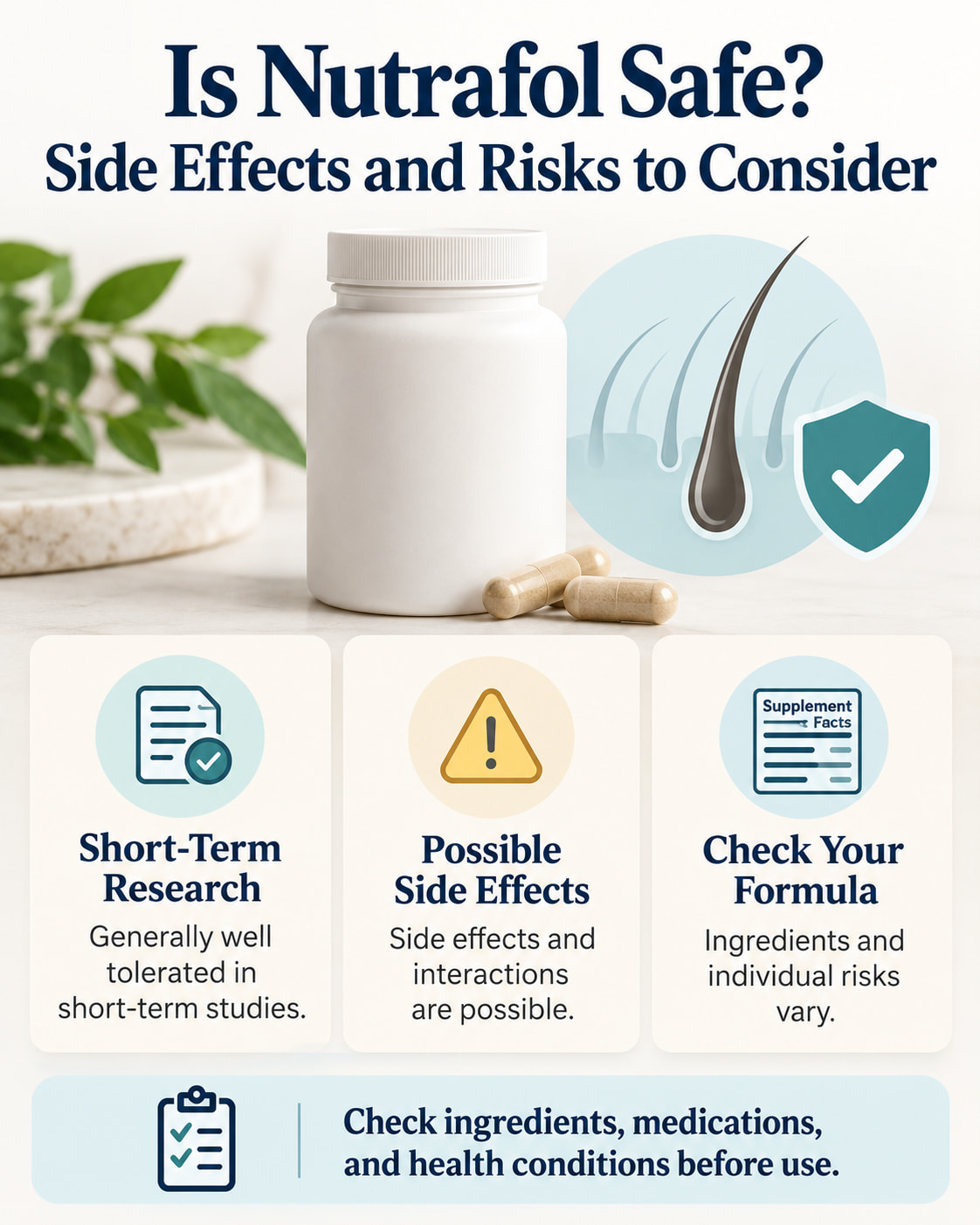
Nutrafol has been generally well tolerated in some short-term studies, but it can cause side effects and is not suitable for everyone. If you are asking, “Is Nutrafol safe?” the answer depends on the specific formula, your health conditions, your medications, and the other supplements you take.
The practical starting point is the label on your bottle. Nutrafol sells several formulas, and information about one does not necessarily apply to another.
Is Nutrafol Safe? What the Research Shows
Clinical studies offer useful information, but their findings need context.
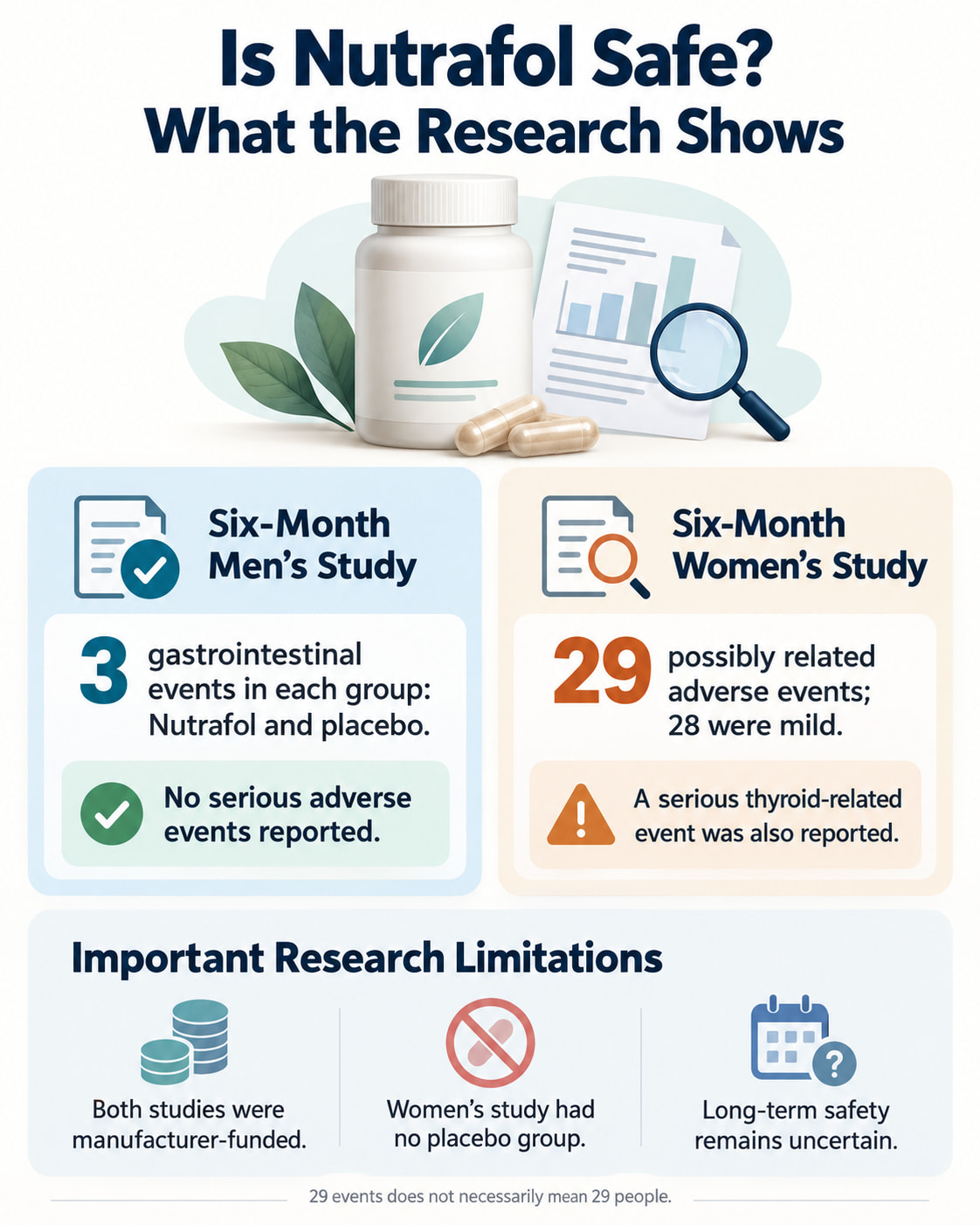
In a six-month study of Nutrafol Men, gastrointestinal events considered possibly or probably related to treatment occurred in three people taking Nutrafol and three taking placebo. No serious adverse events were reported in that trial.
A separate six-month study involving four women’s formulas reported 29 adverse events considered possibly or probably related to supplementation; 28 were mild. These were 29 events, not necessarily 29 different people. The study also reported a serious thyroid-related event, discussed below.
Both studies received manufacturer funding. The women’s study was open-label and had no placebo group. These limitations do not make the findings meaningless, but they mean the research cannot establish safety for every user or tell us how often rare reactions occur. Neither study establishes safety over years of use.
Check Which Nutrafol Formula You Have
Nutrafol’s current Women formula was previously sold as Women’s Vegan. The original Women formula had different ingredients. That distinction matters when reading older reviews or advice about biotin and allergens.
| Formula | Safety-relevant ingredient differences |
|---|---|
| Current Nutrafol Women, formerly Women’s Vegan | Biotin-free and vegan; contains ashwagandha, saw palmetto, and vitamin K2. |
| Original Nutrafol Women | Contains biotin and marine collagen; advice about this version may not apply to the current formula. |
| Nutrafol Men and Women’s Balance | Include ashwagandha, saw palmetto, and marine collagen. |
| Nutrafol Men 50+ | Advertised as biotin-free; that does not remove the need to check its other ingredients. |
These details come from Nutrafol’s formula announcement and product pages. Always compare them with the Supplement Facts and allergen statements on your own bottle, especially when switching products.
Possible Nutrafol Side Effects
Digestive symptoms, acne, and drowsiness
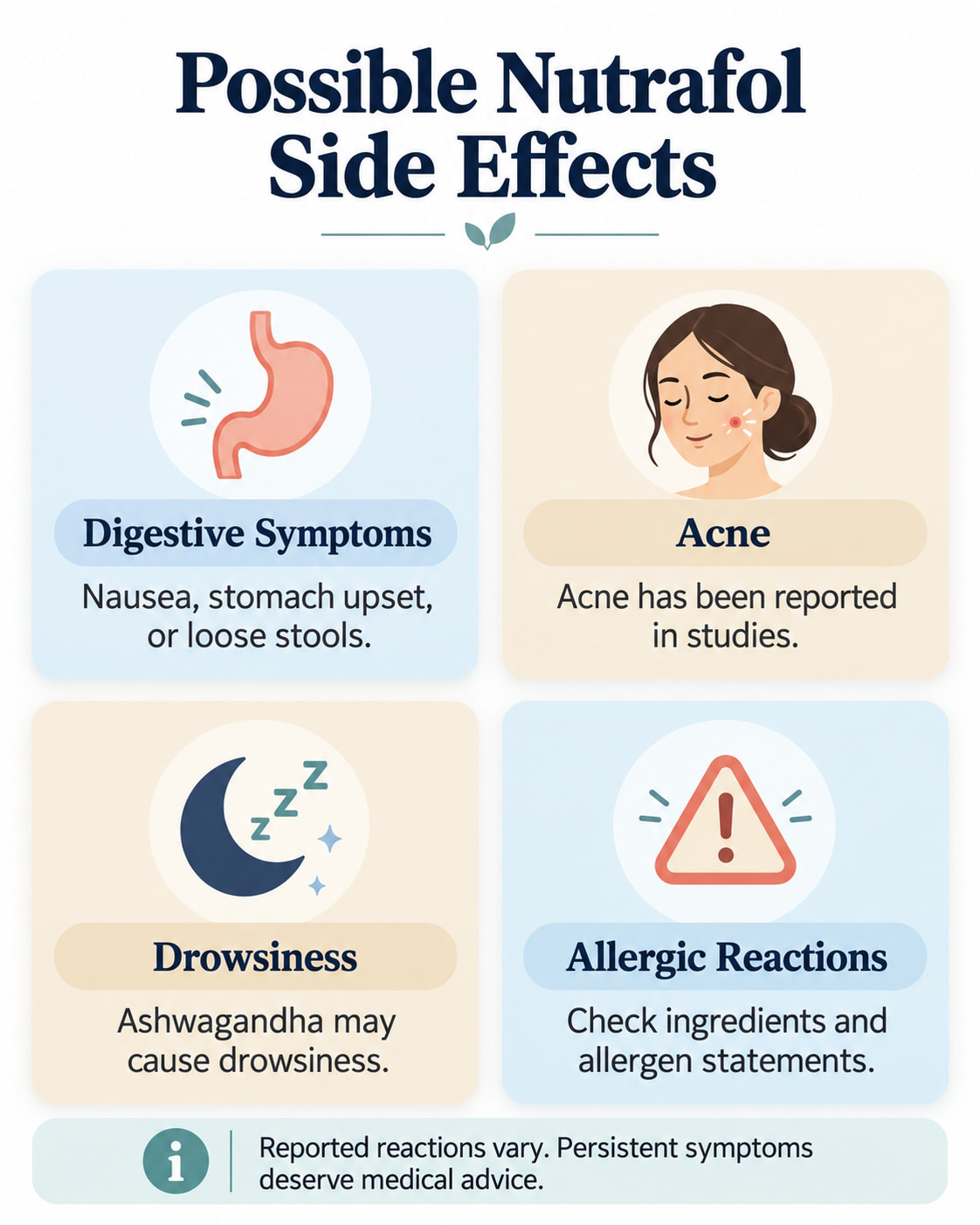
Digestive upset and acne were among the reactions reported in the study of four women’s formulas. Some participants stopped treatment because of adverse events. The study does not provide a reliable side-effect rate for every Nutrafol product.
Ingredients can also have their own effects. Ashwagandha may cause nausea, loose stools, stomach upset, or drowsiness. This is ingredient-level evidence; it does not mean every Nutrafol user will experience those symptoms.
Do not automatically dismiss persistent symptoms as an adjustment period. If symptoms begin after starting Nutrafol or return after each dose, pause the supplement and discuss them with a clinician.
Allergic reactions
Some formulas contain marine collagen. If you have a fish allergy, check the allergen statement and ask an allergist or pharmacist whether that specific product is appropriate. Check the full ingredient list for your other known allergies, too.
Trouble breathing or swelling of the tongue or throat requires emergency medical care.
Can Nutrafol Affect Your Liver or Thyroid?
Liver concerns
The NIH reports that ashwagandha has been linked to rare cases of liver injury. Because several Nutrafol formulas contain it, this risk deserves attention, particularly if you already have liver disease.
A published analysis of FDA adverse-event reports also identified a preliminary signal involving Nutrafol and elevated liver enzymes. This was a researcher’s analysis, not an FDA determination that Nutrafol causes liver injury. Such reports cannot establish causation or calculate how common a reaction is.
Ask your clinician before using an ashwagandha-containing formula if you have liver disease or a history of supplement-related liver injury.
Thyroid and autoimmune conditions
Ashwagandha may affect thyroid function. The National Center for Complementary and Integrative Health advises against its use in people with thyroid or autoimmune disorders. It may also interact with thyroid hormone medications.
In the study of four women’s formulas, researchers reported one case of Hashimoto’s thyroiditis as a serious adverse event considered possibly related to supplementation. That classification deserves attention, but a single case does not prove that Nutrafol caused the condition.
If you have Hashimoto’s disease, hypothyroidism, hyperthyroidism, or another autoimmune condition, review the exact formula with the clinician managing your condition before taking it.
Nutrafol and Medication Interactions
A supplement can be sold without a prescription and still interact with medication. Give your pharmacist the full ingredient list, rather than only the Nutrafol brand name.
Ashwagandha may interact with several medication groups, including:
- Thyroid hormone medicines.
- Medicines for diabetes or high blood pressure.
- Sedatives and anticonvulsants.
- Medicines that suppress the immune system.
The interaction concern depends on the ingredient, dose, and medication; it should be assessed individually.
Warfarin needs particular attention. The current Women formula contains vitamin K2. Vitamin K can affect warfarin’s anticoagulant action, and changes in vitamin K intake can alter treatment control. Speak with the prescriber before starting or stopping a supplement that contains it. This specific interaction should not be generalized to every blood thinner.
Do not stop or adjust prescription medication yourself to accommodate a hair supplement.
Biotin Can Interfere With Blood Tests
Some Nutrafol formulas contain biotin; others are biotin-free. Biotin can distort certain laboratory results even when it is not causing symptoms.
Affected tests can include some thyroid tests and certain troponin tests used when evaluating a possible heart attack. The FDA warns that biotin can produce falsely low troponin results, which can complicate diagnosis.
Before blood work, tell the clinician and laboratory:
- Which Nutrafol formula you take.
- How much biotin the label lists.
- When you last took it.
- Whether you also use other biotin-containing supplements.
Ask whether you should pause the supplement and follow the timing they provide. A misleading thyroid test result from biotin is different from an ingredient actually affecting thyroid function.
Who Should Avoid Nutrafol or Get Medical Advice First?
Nutrafol’s manufacturer does not recommend its supplements for people under 18 or anyone who is pregnant or trying to conceive.
Breastfeeding requires a formula-specific discussion. Nutrafol markets its Postpartum product as breastfeeding-friendly and recommends consulting a healthcare professional. That does not establish that every Nutrafol formula is appropriate during breastfeeding. Ashwagandha is generally advised against during breastfeeding.
In addition to people with liver, thyroid, or autoimmune conditions, those preparing for surgery should discuss ashwagandha-containing supplements with their surgical team. People with hormone-sensitive prostate cancer should avoid ashwagandha because it may increase testosterone.
If any of these situations applies, a product quiz or a “natural” label is not a substitute for reviewing the ingredients with your healthcare professional.
Avoid Doubling Up on Vitamins and Minerals
Taking Nutrafol alongside a multivitamin, a hair-and-nails supplement, or individual nutrients can create unnecessary overlap. The amounts vary by formula, so add up what you actually take.
These U.S. upper intake limits for adults age 19 and older are useful checks:
| Nutrient | Adult daily upper limit from all sources | Why excess matters |
|---|---|---|
| Vitamin D | 100 micrograms, or 4,000 IU | Excess can cause high blood calcium and kidney problems. |
| Zinc | 40 milligrams | Excess can cause digestive symptoms and, with sustained high intake, interfere with copper absorption. |
| Selenium | 400 micrograms | Excess can cause hair loss, nail changes, and digestive symptoms. |
These limits come from NIH guidance and include food and supplements. They are not daily targets or precise thresholds at which toxicity necessarily begins. Clinicians may sometimes prescribe higher amounts for a medical reason.
Follow your product’s labeled serving size. Do not increase it because hair growth seems slow, and review overlapping supplements before combining them.
Is Nutrafol FDA Approved?
Like other dietary supplements, Nutrafol does not receive FDA approval for safety and effectiveness before being sold. The FDA does regulate supplements, but the rules differ from those for prescription drugs. Its dietary supplement guidance explains these distinctions.
Several Nutrafol formulas have earned NSF Certified for Sport certification. That certification addresses matters such as label verification, specified contaminants, and banned substances. It does not prove that a product will regrow your hair or that it is appropriate for your medical conditions and medications.
Quality testing is useful, but it answers a different question from personal medical suitability.
When to Stop Taking Nutrafol and Seek Help
Stop the supplement and get medical advice if you develop a suspected significant reaction. Seek:
- Emergency care for trouble breathing, throat or tongue swelling, or other signs of a serious allergic reaction.
- Prompt medical assessment for yellowing of the skin or eyes, dark urine, severe abdominal pain, or persistent vomiting.
Tell the clinician what you took and bring the bottle or a photograph of its label. Suspected serious supplement reactions can also be reported to the FDA.
Persistent or unexplained hair thinning also deserves assessment. The American Academy of Dermatology explains that finding the cause of hair loss guides treatment. A supplement should not delay evaluation of an underlying condition.
Frequently Asked Questions
Is Nutrafol safe to take long term?
Short-term tolerability does not establish safety over many years. Revisit continued use with your clinician if your health, medications, or supplement routine changes.
Can I take Nutrafol with a multivitamin?
Possibly, but compare both labels first. Pay particular attention to overlapping vitamin D, zinc, and selenium, and ask a pharmacist to review the combined amounts.
Can I take Nutrafol with thyroid medication?
Do not assume the combination is suitable. Ashwagandha may interact with thyroid hormone medicines, while biotin in some formulas can complicate interpretation of thyroid blood tests.
Should I stop Nutrafol before a blood test?
Tell the clinician and laboratory about it first. Whether you need to pause it depends on the ingredients and the tests being performed; follow their instructions.
Is Nutrafol safe while breastfeeding?
The manufacturer markets Nutrafol Postpartum for breastfeeding and advises checking with a doctor. Do not assume its other formulas have the same suitability. Review the exact product with your clinician.
Does Nutrafol cause sexual side effects?
The six-month men’s trial did not find significant worsening on its sexual-function questionnaire. That is reassuring within the trial’s limits, but it does not guarantee that no individual will experience symptoms.
Making an Informed Decision
Nutrafol’s safety depends on the formula and the person taking it. Before starting, check the exact label, review medications and overlapping supplements with a pharmacist, and make sure unexplained hair loss has been assessed. If symptoms appear, seek advice rather than continuing automatically.
This content is for informational purposes only and not medical advice.
References
- Nutrafol: Women’s formula changes and ingredient differences
- Nutrafol product labels and ingredients: Men, Women’s Balance, and Men 50+
- Nutrafol: Product guidance and eligibility
- Nutrafol: Postpartum use while breastfeeding
- Journal of Cosmetic Dermatology: Randomized trial of a hair growth nutraceutical in men
- Dermatology and Therapy: Study of four women’s hair growth nutraceutical formulas
- NIH Office of Dietary Supplements: Ashwagandha
- NCCIH: Ashwagandha safety and interactions
- Food and Chemical Toxicology: Analysis of dietary supplement adverse-event reports
- FDA: Biotin interference with troponin laboratory tests