
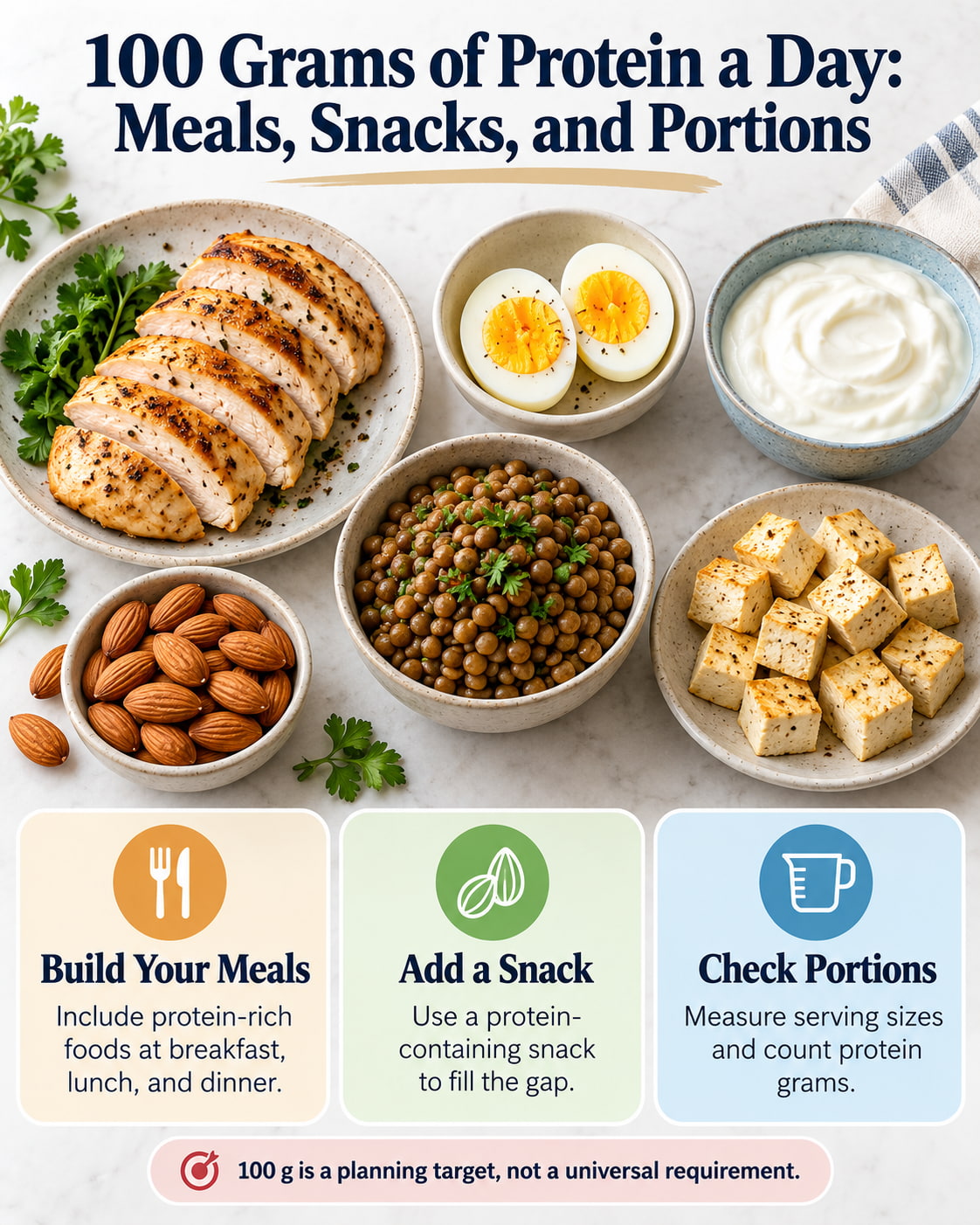
You can get about 100 grams of protein a day by including protein-rich foods at your meals and adding a snack to fill the gap. Chicken, eggs, Greek yogurt, lentils, tofu, and other everyday foods can all contribute.
The right protein target depends on your body size, activity, and health. The portions and examples below show how to build a day near 100 grams, including a fully plant-based option.
What Does 100 Grams of Protein Mean?
“100 grams of protein” describes the amount of the nutrient you consume throughout the day. It is different from the weight of a protein-containing food.
For example:
- 100 grams of roasted, skinless chicken breast provides about 31 grams of protein.
- A 3-ounce cooked portion of that chicken weighs approximately 85 grams and provides about 26 grams of protein.
Your food scale measures the total weight of the food. A nutrition label or food database tells you how much protein that portion contains.
Protein from all foods counts toward your daily total. That includes smaller contributions from grains, vegetables, nuts, and other ingredients—not just the main protein food on your plate.
Is 100 Grams of Protein a Day Right for You?
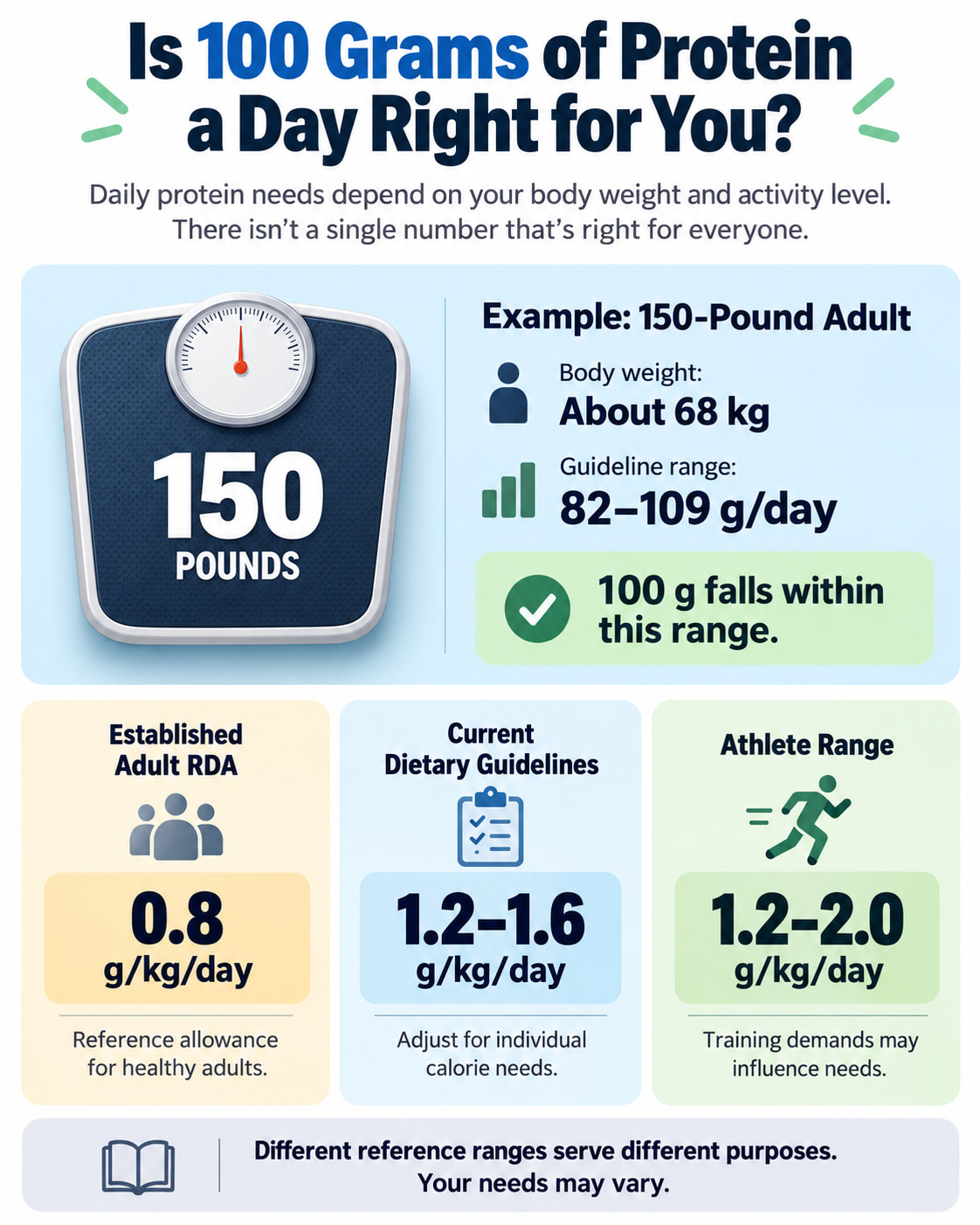
The Dietary Guidelines for Americans, released in January 2026, list a protein goal of 1.2–1.6 grams per kilogram of body weight per day, adjusted for individual calorie requirements.
For someone who weighs 150 pounds, or approximately 68 kilograms, that works out to about 82–109 grams daily. A 100-gram target falls within that range.
The established Recommended Dietary Allowance, or RDA, remains 0.8 grams per kilogram daily for healthy adults. It is a separate reference allowance and should not be confused with the newer dietary guideline goal.
For athletes, the NIH Office of Dietary Supplements cites a range of 1.2–2.0 grams per kilogram daily. Training demands and other individual factors influence where someone may fall within that range.
These differences explain why 100 grams may suit one person while another benefits from a different target. Use the examples below as meal-planning tools, and follow any individualized guidance you have received.
Foods That Help You Reach 100 Grams of Protein
The following estimates use USDA FoodData Central reference values and manufacturer nutrition labels. Preparation methods, brands, and portion sizes can change the amount you actually eat.
| Food | Portion | Approximate protein |
|---|---|---|
| Roasted, skinless chicken breast | 3 oz cooked, about 85 g | 26 g |
| Hard-boiled eggs | 2 large eggs | 13 g |
| Plain nonfat Greek yogurt* | 170 g | 18 g |
| Reduced-fat dairy milk* | 1 cup, 240 mL | 8 g |
| Cooked lentils | 1 cup, about 198 g | 18 g |
| Cooked quinoa | 1 cup, about 185 g | 8 g |
| Cooked tempeh | 3 oz, about 85 g | 17 g |
| Extra firm tofu* | 3 oz, 85 g, measured as packaged | 14 g |
| Unsweetened soy milk* | 1 cup, 240 mL | 8 g |
| Natural peanut butter* | 2 tablespoons, 32 g | 8 g |
| Whole almonds* | 1 oz, 28 g | 6 g |
Packaged-food examples use FAGE Total 0% yogurt, Organic Valley 2% milk in gallon or half-gallon containers, Hodo extra firm tofu, Silk Organic Unsweet Soymilk, Smucker’s Natural Creamy Peanut Butter, and Blue Diamond Whole Natural Almonds. Check your package because other products may differ.
Choose Portions You Will Actually Use
Think about how each food fits into a meal:
- Add chicken to a salad, sandwich, or grain bowl.
- Serve eggs alongside yogurt or another breakfast food.
- Combine lentils with grains and vegetables.
- Use tofu or tempeh in stir-fries, bowls, or wraps.
- Include milk or soy milk in breakfast dishes or smoothies.
A food does not need to provide a large amount of protein by itself to be useful. Several smaller contributions can add up across the day.
How to Eat 100 Grams of Protein a Day
Start by choosing a protein-containing food for each meal. Then estimate the total and decide whether a snack would help.
One possible distribution is:
25 grams at breakfast + 30 grams at lunch + 30 grams at dinner + 15 grams from a snack = 100 grams.
You can adjust that pattern to your appetite and schedule. Breakfast might provide more protein one day, while lunch provides more another day.
Sample Day: Approximately 101 Grams of Protein
This example uses the portions and product assumptions in the food table above.
| Eating occasion | Measured protein-containing foods | Approximate protein |
|---|---|---|
| Breakfast | 170 g plain Greek yogurt + 2 large hard-boiled eggs | 31 g |
| Lunch | 3 oz cooked chicken breast + ½ cup cooked quinoa | 30 g |
| Snack | 1 cup dairy milk + 1 oz almonds | 14 g |
| Dinner | 1 cup cooked lentils + 1 cup cooked quinoa | 26 g |
| Subtotal from listed foods | 101 g |
The subtotal covers the listed foods only. Build complete meals by adding fruits, vegetables, other sides, and fats according to your overall nutrition and energy needs. Include any protein from those additions when calculating the full day.
For example, serve the chicken and quinoa over leafy greens with tomatoes and olive oil. Turn the lentils and quinoa into a warm bowl with roasted vegetables. Add fruit to breakfast or enjoy it with your snack.
This approach lets you keep familiar meals while paying closer attention to their protein portions.
A Plant-Based Way to Get About 100 Grams of Protein
You can also assemble a day near 100 grams using soy foods, legumes, grains, nuts, and nut butter.
The example below uses tofu containing 14 grams of protein per 3-ounce serving and soy milk containing 8 grams per cup.
| Eating occasion | Measured protein-containing foods | Approximate protein |
|---|---|---|
| Breakfast bowl | 1 cup cooked quinoa + 1 cup unsweetened soy milk + 2 tablespoons peanut butter | 24 g |
| Lunch bowl | 6 oz extra firm tofu + ½ cup cooked quinoa | 32 g |
| Snack | 1 oz almonds + 1 cup unsweetened soy milk | 14 g |
| Dinner | 1 cup cooked lentils + 2 oz cooked tempeh, about 57 g | 29 g |
| Subtotal from listed foods | 99 g |
As with the mixed-diet example, these totals cover the specified portions. Add produce and other foods to complete the meals, and count their contributions when tracking the whole day.
You could warm the breakfast bowl with cinnamon, cook the tofu with vegetables, and season the lentils and tempeh with herbs or spices.
Check the Tofu Label Carefully
Tofu protein content varies by product.
In this example, two 3-ounce servings provide 28 grams of protein. If your tofu instead lists 8 grams per 3-ounce serving, the same 6-ounce portion would provide 16 grams.
That difference changes the day’s total. Use your own label to adjust the tofu portion or add another protein-containing food.
High-Protein Snacks to Fill the Gap
A snack can help when your meals leave you short of your chosen target. For example, meals totaling 85 grams leave approximately 15 grams to reach 100.
Using the same food values, practical options include:
- Greek yogurt with fruit: The 170-gram yogurt portion contributes about 18 grams of protein.
- Two hard-boiled eggs with sliced vegetables: The eggs contribute about 13 grams.
- A soy milk and peanut butter smoothie: One cup of the example soy milk plus 2 tablespoons of peanut butter contributes about 16 grams, before fruit or other additions.
Choose a snack that fits your appetite and the rest of your day. If your meals already supply your target, an extra snack is optional.
Nuts and peanut butter can contribute useful protein, but consider their full nutrition profile. The example peanut butter supplies 190 calories with 8 grams of protein, while the almonds supply 160 calories with 6 grams. Portion size matters when you are also managing your total energy intake.
How to Measure Protein Portions Accurately
You do not need complicated calculations. A consistent method is more useful than trying to make every meal land on an exact number.
Match the Food’s Raw or Cooked State
Use a nutrition entry that matches the food when you weigh it.
For example, the chicken portion in this article is weighed after cooking. The lentil and quinoa portions are also cooked amounts.
If you weigh a food raw, use an entry or label that describes its raw or as-packaged state. Avoid applying cooked-food values to a raw-food weight.
Read the Serving Size Before the Protein Amount
The FDA’s Nutrition Facts label guide explains that nutrient amounts correspond to the serving size shown on the label.
If a yogurt provides 18 grams of protein per serving:
- One serving provides 18 grams.
- One and a half servings provide 27 grams.
- Two servings provide 36 grams.
Also check servings per container. A tub, bottle, or package may contain more than one serving.
Count the Whole Meal
Include protein from ingredients such as:
- Milk added to oatmeal.
- Bread used for a sandwich.
- Beans added to a salad.
- Grains served with dinner.
- Nuts or seeds added to yogurt.
For a recipe, add the protein from all ingredients and divide by the number of portions the recipe actually makes.
Keep the Process Manageable
Once you know the approximate protein in a few meals you regularly eat, planning becomes easier. Save those combinations or note the amounts on a simple meal list.
Batch-preparing a protein food and a grain can also make assembling meals quicker. Use the same portioning method each time so your estimates remain consistent.
Do You Need Protein Powder?
The examples above reach approximately 100 grams without protein powder. Ordinary foods can supply the target.
A powder, shake, or bar may be convenient when you need a portable option or have difficulty fitting enough protein into your usual meals. Whether it helps depends on your preferences and overall eating pattern.
If you use one, check the serving size and protein amount on the actual product. Scoop sizes vary. Also count the protein from any milk, soy milk, yogurt, or other ingredients you mix with it.
When to Ask for Personalized Nutrition Advice
If you have kidney disease or have been prescribed a specific protein intake, check with your clinician or registered dietitian before adopting a 100-gram target.
NIDDK’s guidance for adults with chronic kidney disease explains that protein needs may change with the condition and its management. People receiving dialysis can have different requirements from those who are not.
A suitable target should account for those circumstances. The meal examples here are general planning ideas for adults, not individualized nutrition prescriptions.
Frequently Asked Questions
Is 100 Grams of Protein Enough to Build Muscle?
It may be appropriate for some people, but body weight and training matter. At 150 pounds, 100 grams equals approximately 1.47 grams per kilogram. At 200 pounds, it equals approximately 1.10 grams per kilogram.
Muscle-building results also depend on resistance training, adequate energy intake, and other individual factors. Reaching 100 grams alone does not guarantee muscle gain.
Will Eating 100 Grams of Protein Help Me Lose Weight?
A 100-gram protein target does not guarantee weight loss. Your overall calorie intake, activity, and eating pattern also matter.
Consider how protein-containing foods fit into your meals. Adding shakes or snacks on top of your usual intake also adds calories.
How Much Chicken Provides 100 Grams of Protein?
Using the USDA value of approximately 31 grams of protein per 100 grams of roasted, skinless chicken breast, it would take roughly 320–325 grams of cooked chicken, or about 11½ ounces, to supply approximately 100 grams of protein.
Other cuts and preparations can differ. Combining several foods gives you more flexibility across meals.
How Many Calories Are in 100 Grams of Protein?
Protein supplies approximately 4 calories per gram, so 100 grams of protein provides about 400 calories from protein.
The foods supplying that protein may also contain carbohydrates and fat. Their combined calorie content will therefore usually be higher than 400 calories.
Can I Split 100 Grams of Protein Across Two Meals?
Two meals averaging 50 grams each add up to 100 grams. Whether that pattern feels comfortable and fits your overall nutrition needs depends on the meals and your schedule.
Using three meals and a snack is simply another practical way to organize the portions.
Do I Need to Hit Exactly 100 Grams Every Day?
For a general meal-planning goal, the numbers are estimates. Food composition, label rounding, and portion measurements introduce variation.
Focus on a consistent eating pattern rather than making every day total exactly 100. Follow any specific target or monitoring instructions provided by your healthcare team.
Make Your Protein Target Practical
Start with meals you already enjoy. Check the protein in your usual portions, add the amounts across the day, and use a snack when it helps close the gap.
For your next grocery trip, choose a few protein foods you can use in several meals. Build around those foods while keeping room for fruits, vegetables, grains, and other foods that meet your overall needs.
This content is for informational purposes only and not medical advice.
References
- Dietary Guidelines for Americans
- Scientific Foundation for the Dietary Guidelines
- NIH Office of Dietary Supplements: Exercise and Athletic Performance
- USDA FoodData Central
- FDA: Understanding the Nutrition Facts Label
- FDA: Protein and the Nutrition Facts Label
- NIDDK: Healthy Eating for Adults With Chronic Kidney Disease
- Product nutrition labels: FAGE Greek yogurt, Organic Valley milk, Hodo tofu, Silk soy milk, Smucker’s peanut butter, and Blue Diamond almonds.