
Maca root side effects are usually mild and uncommon, but they can happen, and safety data are still limited. Reported problems include digestive upset, headaches, insomnia, mood changes, menstrual changes, cramps, and a rare case of abnormal bleeding. That is why it helps to know who should be careful, which form of maca you are taking, and when to stop and check with a clinician before using it regularly.
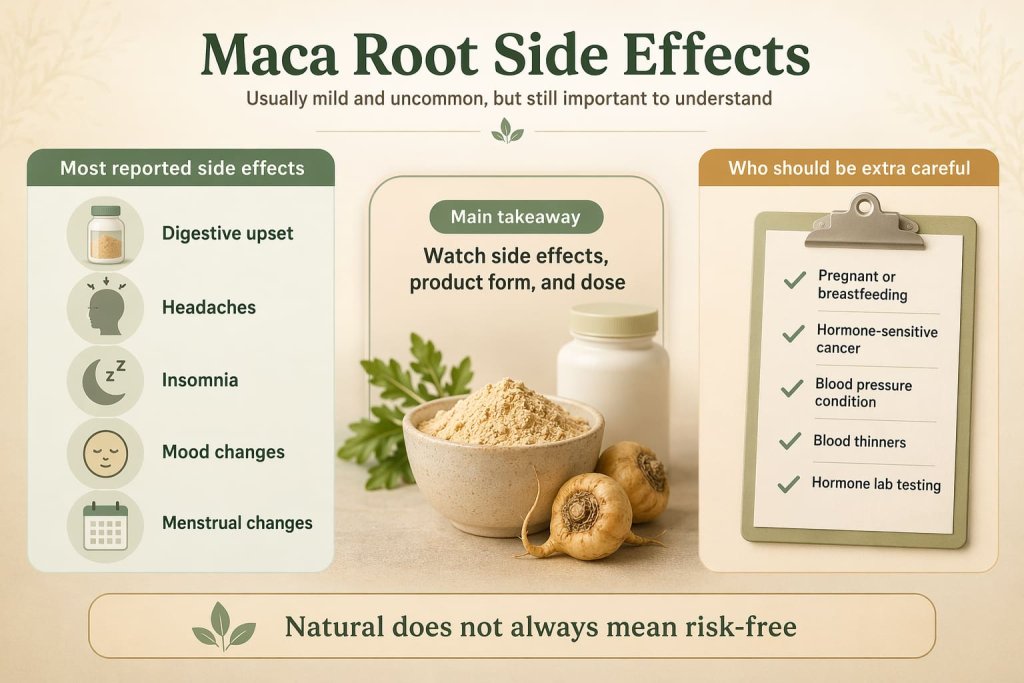
According to NIH LiverTox, Memorial Sloan Kettering Cancer Center, and Health Canada’s maca monograph, maca appears fairly well tolerated in small studies, but it is not risk-free.
Common maca root side effects
The most grounded answer is that reported maca root side effects tend to be mild, but the evidence base is small. LiverTox says maca has been well tolerated in small clinical trials, with only minor and temporary adverse effects, and identifies gastrointestinal symptoms and headaches as the clearest recurring complaints.
One reason maca safety information can feel confusing is that the evidence is limited and not perfectly consistent across sources. Some patient-facing summaries say side effects have not been reported, while healthcare-focused summaries list subjective reports such as menstrual changes, moodiness, cramps, gastritis, and insomnia. Read together, that does not mean maca is proven side-effect free. It means the formal safety data are still limited, and some side effects come from small studies, self-reports, or case reports rather than large long-term trials.
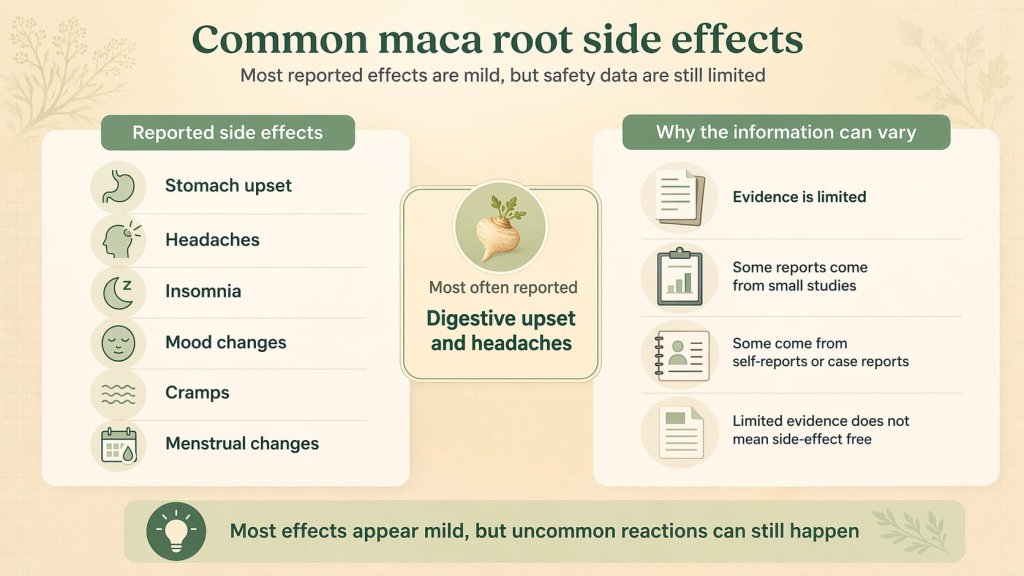
Memorial Sloan Kettering also notes reports of altered menstrual cycles, moodiness, cramps, gastritis, and insomnia. One study also reported flu-like symptoms and vomiting, although it was unclear whether maca actually caused them.
There is also a case report of prolonged intermenstrual bleeding in a woman who used maca powder daily. A single case report does not prove maca causes this in most people, but it is a useful reminder that natural products can still cause unwanted effects.
Who should be careful with maca root
Pregnant and breastfeeding women should talk with a healthcare professional before using maca. Memorial Sloan Kettering and Health Canada both advise caution because safety in these groups is not well established. NCCIH also notes that many dietary supplements have not been adequately tested in pregnant women, nursing mothers, or children.
People with hormone-sensitive cancers should also be careful. Memorial Sloan Kettering says maca may affect treatment in people with hormone-sensitive cancers such as breast or uterine cancer, so it is smart to clear it with your oncology team before using it.
Health Canada also advises checking first if you have a blood pressure condition, take blood thinners, or are using maca for sexual health or mood balance while living with anxiety, depression, or another psychological disorder. That does not automatically mean maca is unsafe for everyone in those groups, but it does mean self-starting it without advice is not the best move.
Maca powder vs extract matters
This is one of the most important safety details. Health Canada’s decision on maca root extract says maca root powder has a history of safe use as a food ingredient, but maca root extracts cannot be assumed equivalent to powder because extraction can concentrate certain constituents.
That difference became more important in 2024, when Health Canada said the publicly available evidence was insufficient to establish acceptable conditions for maca root extract as a supplemental ingredient in supplemented foods. In practical terms, the safety picture for extracts is less settled than the safety picture for traditional maca powder used as a food.
Maca root dosage and duration
For adults, Health Canada’s current monograph lists labeled daily amounts that generally fall between 2 and 3.5 grams of dried root or hypocotyl per day, depending on the intended use. It lists up to 3 grams per day for antioxidant use, 2 to 3.5 grams per day for healthy mood balance during menopause, and 3 to 3.5 grams per day for sexual health.
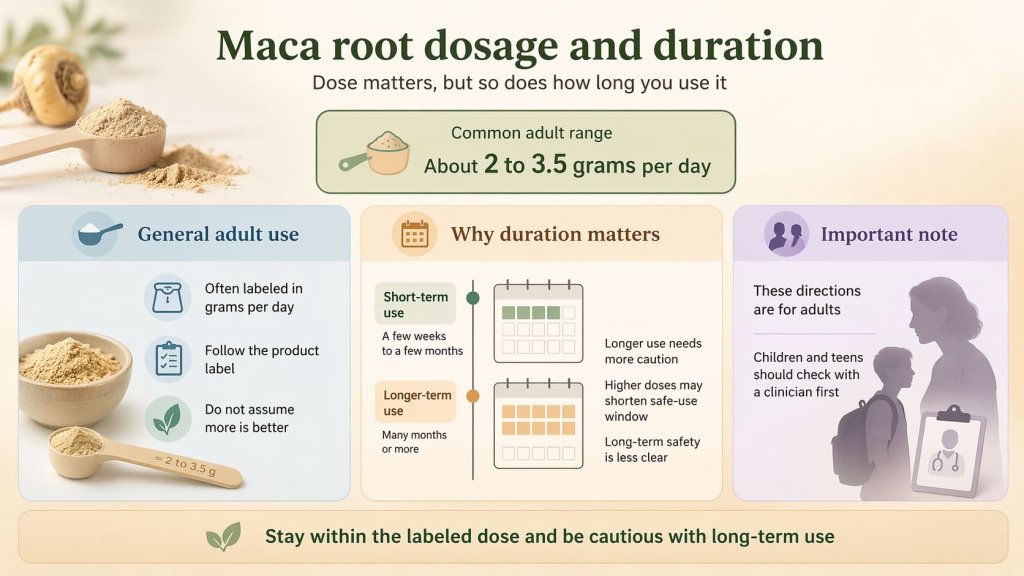
Duration matters too. Health Canada says products providing 0.6 to 3 grams per day should be used beyond 3 months only with guidance from a healthcare professional, while products providing more than 3 grams per day should be used beyond 6 weeks only with professional advice. These limits are a practical reminder that even when a supplement seems well tolerated, long-term safety may still be less clear.
It is also worth noting that these labeled directions are for adults. Health Canada’s maca monograph gives directions for adults 18 years and older, and the NIH Office of Dietary Supplements says many supplements have not been well tested for safety in children. If you are under 18, or you are thinking about giving maca to a child or teen, it is better to check with a healthcare professional first instead of treating it like a routine supplement.
Can maca affect hormones, medicines, or lab tests
Maca is often marketed as a hormone-support supplement, but the evidence is mixed, and one safety issue is clearer than many people realize: maca may interfere with testosterone lab tests. Memorial Sloan Kettering specifically warns that maca can interfere with testosterone immunoassays, so tell your clinician if you used maca before bloodwork.
More broadly, NCCIH says dietary supplements may interact with medications or pose risks if you have certain medical problems, and the U.S. Food and Drug Administration says supplements can interfere with medicines, lab tests, and surgery. That is one reason maca deserves the same medication-style disclosure as any other supplement when you speak with your doctor, pharmacist, or dietitian.
Does maca hurt the liver
Current evidence does not show maca to be a known liver-toxic supplement. LiverTox says there have been no convincing reports linking maca to liver injury and rates it as an unlikely cause of clinically apparent liver injury. That is reassuring, but it still does not prove every product is harmless, especially because supplement quality and formulas vary.
How to choose a safer maca supplement
In the United States, the FDA does not approve dietary supplements for safety and effectiveness before they are sold. Companies are responsible for making sure their products meet legal safety and labeling standards, and FDA action often starts after products reach the market.
That is why product quality matters. The NIH Office of Dietary Supplements says seals from third-party testing programs such as ConsumerLab, NSF, and U.S. Pharmacopeia can indicate that a supplement was properly manufactured, contains the listed ingredients, and does not contain harmful levels of certain contaminants. These seals do not guarantee that a product is safe or effective for you, but they can still be a useful quality check.
A safer buying checklist looks like this:
- Choose a product that clearly lists the form of maca, such as powder or extract
- Follow the label dose instead of doubling up
- Be more cautious with concentrated extracts than with plain root powder
- Look for third-party quality testing
- Stop using it and get medical advice if you develop a bad reaction
- Bring the bottle or a photo of the label to your clinician if you have questions
That advice lines up with FDA, NIH ODS, and NCCIH guidance on supplement safety and label quality.
When to stop maca and talk to a doctor
Stop using maca and get medical advice if you develop a side effect that is persistent, worsening, or unusual. That includes ongoing stomach upset, vomiting, severe sleep problems, marked mood changes, or unexpected vaginal bleeding.
Get urgent medical help rather than routine follow-up if the reaction seems severe. The FDA’s supplement safety guidance says serious supplement reactions can include throat, lip, or tongue swelling, wheezing, shortness of breath, fainting, chest pain, severe persistent vomiting or diarrhea, dark urine, blood in urine or stool, abnormal bleeding, or yellowing of the skin or eyes. Those symptoms are not typical minor side effects and should be treated as possible serious adverse events.
It is also worth checking in with a clinician before continuing maca if you plan to take it for more than a short trial, if you want to use higher doses, or if you have a medical condition or take prescription medicines. That is especially true because maca studies in humans are still relatively small, and supplements sold in stores may differ from the products used in research.
Frequently asked questions about maca root side effects
Is maca root dangerous?
Usually not for healthy adults using a standard product for a short period, but it is not completely risk-free. Reported side effects are generally mild and uncommon, and some groups need extra caution, especially pregnant or breastfeeding women and people with certain medical conditions or hormone-sensitive cancers.
Can maca root cause hormonal side effects?
Possibly. Some reported reactions involve menstrual changes, mood changes, and a rare abnormal bleeding case, which suggests maca may affect hormone-related pathways in some users, even though the data are limited.
Is maca powder safer than maca extract?
Traditional maca powder has a stronger food-use history. Health Canada says maca powder has a history of safe use as a food ingredient, while extracts cannot be assumed equivalent because extraction may concentrate certain compounds.
Can maca affect testosterone tests?
Yes, it may. Memorial Sloan Kettering says maca may interfere with lab tests that measure testosterone, so mention maca use before hormone bloodwork.
Does maca cause liver damage?
Current evidence does not point to maca as a known cause of liver injury. LiverTox rates it as an unlikely cause of clinically apparent liver injury, although that does not remove the need to watch for side effects or choose products carefully.
Safety box
Be extra careful with maca if any of these apply to you:
- You are pregnant or breastfeeding
- You have a hormone-sensitive cancer, such as breast or uterine cancer
- You have a blood pressure condition
- You take blood thinners
- You are using maca for sexual health or mood balance and you have anxiety, depression, or another psychological disorder
- You are scheduled for hormone testing, especially testosterone-related labs
Those cautions are supported by Memorial Sloan Kettering, Health Canada, and general supplement guidance from the National Center for Complementary and Integrative Health.
Bottom line on maca root side effects
Maca root side effects appear to be usually mild, but not nonexistent. The biggest practical concerns are stomach upset, headaches, sleep or mood changes, menstrual changes, product quality, and the fact that powder and extract are not the same thing. The safest approach is to use a clearly labeled product, stay within the dose range on the label, and check with a healthcare professional first if you are pregnant, breastfeeding, have a medical condition, take medication, or plan to use maca longer term.
If you are considering maca, treat it like any other active supplement instead of assuming it is harmless just because it is plant-based. That simple step can help you avoid the most preventable problems.
This content is for informational purposes only and not medical advice.
References
- Health Canada — Maca – Lepidium meyenii monograph
- Health Canada — Decision on maca root extract as a supplemental ingredient in foods
- U.S. Food and Drug Administration — FDA 101: Dietary Supplements
- U.S. Food and Drug Administration — How to Report a Problem with Dietary Supplements
- NIH Office of Dietary Supplements — Dietary Supplements: What You Need to Know
- National Center for Complementary and Integrative Health — Dietary and Herbal Supplements