
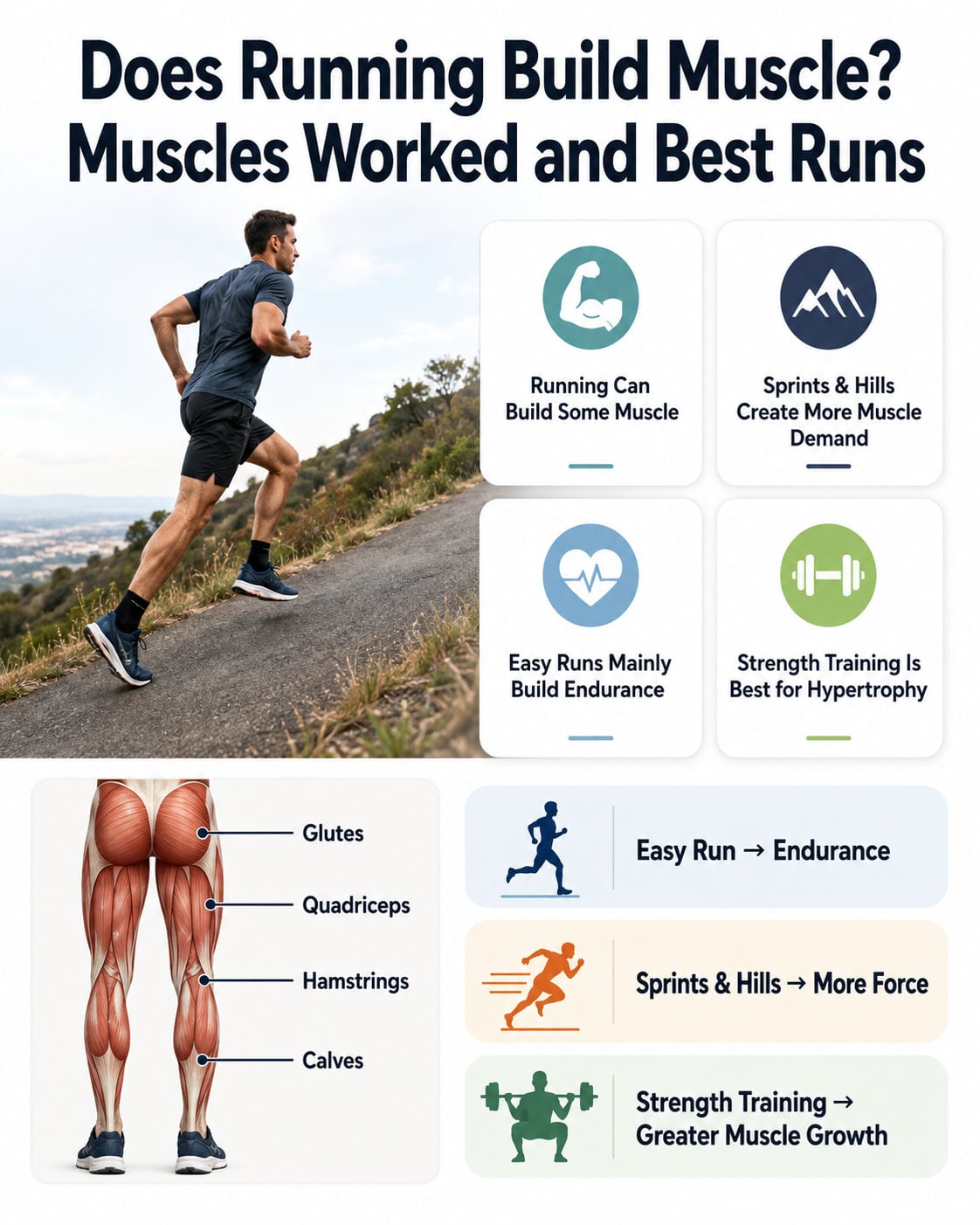
Yes, running can build some muscle, especially in your legs, if you are new to running or regularly perform hills, sprints, and high-intensity intervals. However, easy jogging and long-distance running primarily improve cardiovascular fitness and muscular endurance rather than producing substantial muscle growth.
The type of running matters. Short, powerful efforts place more force on the glutes, quadriceps, hamstrings, and calves than steady jogging. Even so, running does not replace progressive strength training when your main goal is to build noticeably larger muscles.
A 2025 systematic review and meta-analysis found that moderate-intensity continuous aerobic training did not consistently increase muscle size. For the best results, combine appropriate running workouts with resistance training, sufficient food, adequate protein, and recovery.
Does Running Build Muscle?
Running repeatedly requires your muscles to absorb force, support your body, stabilize your joints, and propel you forward. These demands can stimulate muscular adaptation.
Muscle growth from running is most likely when:
- You are a beginner or returning after a long break.
- Your running program is more demanding than your previous activity.
- You perform short sprints, hill runs, or hard intervals.
- You eat enough calories and protein.
- You allow enough time for recovery.
- You also perform resistance training.
The potential for muscle growth becomes smaller as your body adapts. An experienced runner may become faster or more efficient without gaining noticeable muscle size.
Muscle Activation Is Not the Same as Muscle Growth
A muscle can work hard during an activity without becoming substantially larger.
Muscle growth, or hypertrophy, generally requires repeated exposure to enough mechanical tension, adequate training volume, progressive overload, and sufficient recovery. Running activates many muscles, but most running involves relatively light resistance repeated for hundreds or thousands of steps.
That pattern is excellent for endurance. It is less effective for hypertrophy than exercises that let you gradually increase resistance, such as squats, lunges, step-ups, Romanian deadlifts, and calf raises.
Muscle-Building Potential by Running Type
| Running type | Main training effect | General muscle-building potential |
|---|---|---|
| Easy jogging | Aerobic fitness and muscular endurance | Low |
| Long-distance running | Endurance and fatigue resistance | Low |
| Tempo running | Speed endurance and aerobic capacity | Low to modest |
| Running intervals | Aerobic and anaerobic fitness | Modest |
| Hill sprints | Lower-body force and power | Modest |
| Short flat sprints | Speed, force, and power | Modest |
| Progressive resistance training | Strength and hypertrophy | Highest |
These ratings are general expectations rather than guarantees. Training experience, genetics, nutrition, running technique, workout volume, and recovery all affect the outcome.
What Muscles Does Running Work?
Running is a full-body movement, but the lower-body muscles perform most of the support and propulsion.
Biomechanical research has identified the quadriceps and plantar flexors—the gastrocnemius and soleus—as major contributors during running. The quadriceps provide substantial support during the first part of the stance phase, while the calf muscles become major contributors to support and forward propulsion later in the stance phase.
| Muscle group | Role during running |
|---|---|
| Quadriceps | Help absorb landing forces, support body weight, control knee flexion, and extend the knee |
| Gluteus maximus | Extends the hip and contributes to acceleration and propulsion |
| Gluteus medius and minimus | Stabilize the pelvis while one foot is on the ground |
| Hamstrings | Assist hip extension and help control the leg during the swing phase |
| Gastrocnemius | Assists push-off, ankle movement, and forward propulsion |
| Soleus | Provides substantial body support and contributes to push-off |
| Hip flexors | Bring the thigh forward as the leg recovers for the next step |
| Tibialis anterior | Lifts and positions the foot during the swing phase |
| Core muscles | Stabilize the trunk and help transfer force between the upper and lower body |
| Shoulders and arms | Help maintain rhythm and counterbalance lower-body movement |
The exact contribution of each muscle changes with speed, incline, running form, fatigue, and terrain.
Does Running Build Leg Muscle?
Running can build some leg muscle, particularly in beginners. The quadriceps, glutes, hamstrings, and calves are repeatedly loaded with every stride.
A new runner may notice that the legs feel firmer or stronger during the first several months of training. Some of that change may reflect muscle development, while some may come from better coordination, increased glycogen storage, improved muscular endurance, or reduced body fat.
Experienced runners are less likely to gain significant leg size from steady running because their muscles have already adapted to the activity. Increasing mileage usually adds endurance demands rather than the progressively heavier resistance needed for continued hypertrophy.
Does Running Build Glutes?
Running uses the glutes to extend the hips, stabilize the pelvis, and help propel the body forward.
Hill running, sprinting, and acceleration generally place greater demands on the glutes than slow, level jogging. However, running alone may not provide enough progressive resistance to maximize glute growth.
For more noticeable glute development, combine running with exercises such as:
- Squats
- Split squats
- Step-ups
- Hip thrusts or glute bridges
- Romanian deadlifts
- Reverse lunges
Does Running Build Calves?
Running heavily involves the gastrocnemius and soleus. These muscles support your body and help generate push-off during every stride.
Beginners may gain some calf muscle, particularly from hills or faster running. However, calf size is also strongly influenced by genetics, tendon structure, previous training, and total workload.
Progressively loaded standing and seated calf raises offer a more direct way to develop the gastrocnemius and soleus.
Does Running Build Hamstrings?
The hamstrings assist hip extension and control the leg as it swings forward. Their demand generally increases as running speed rises.
Sprinting is more likely to challenge the hamstrings than easy jogging, but sprinting also places greater stress on them. New runners should build speed gradually rather than beginning with maximal sprints.
For direct hamstring development, include exercises such as Romanian deadlifts, leg curls, hip hinges, and controlled Nordic curl progressions.
Best Types of Running for Building Muscle
The best running workouts for muscle development involve relatively high force, short efforts, and adequate recovery. They still provide a smaller and less controllable hypertrophy stimulus than resistance training.
1. Hill Sprints
Hill sprints are one of the most muscle-demanding forms of running because you must produce force while moving against gravity.
Uphill running can increase the demand on the glutes, quadriceps, and calves. A biomechanical study comparing steep incline running with level running found greater stance-phase activation in several lower-body muscles, including the gluteus maximus, quadriceps, gastrocnemius, and soleus. However, muscle activation during one workout does not prove long-term muscle growth.
Beginner Hill Sprint Example
- Warm up with 10–15 minutes of easy walking and jogging.
- Choose a moderate hill with a clear, safe surface.
- Run uphill quickly for 8–12 seconds.
- Walk back down and recover fully.
- Complete 4–6 repetitions.
- Cool down with easy walking or jogging.
Keep the first sessions fast but controlled rather than all-out. One hill session per week may be enough when you are also performing strength training.
2. Short Flat Sprints
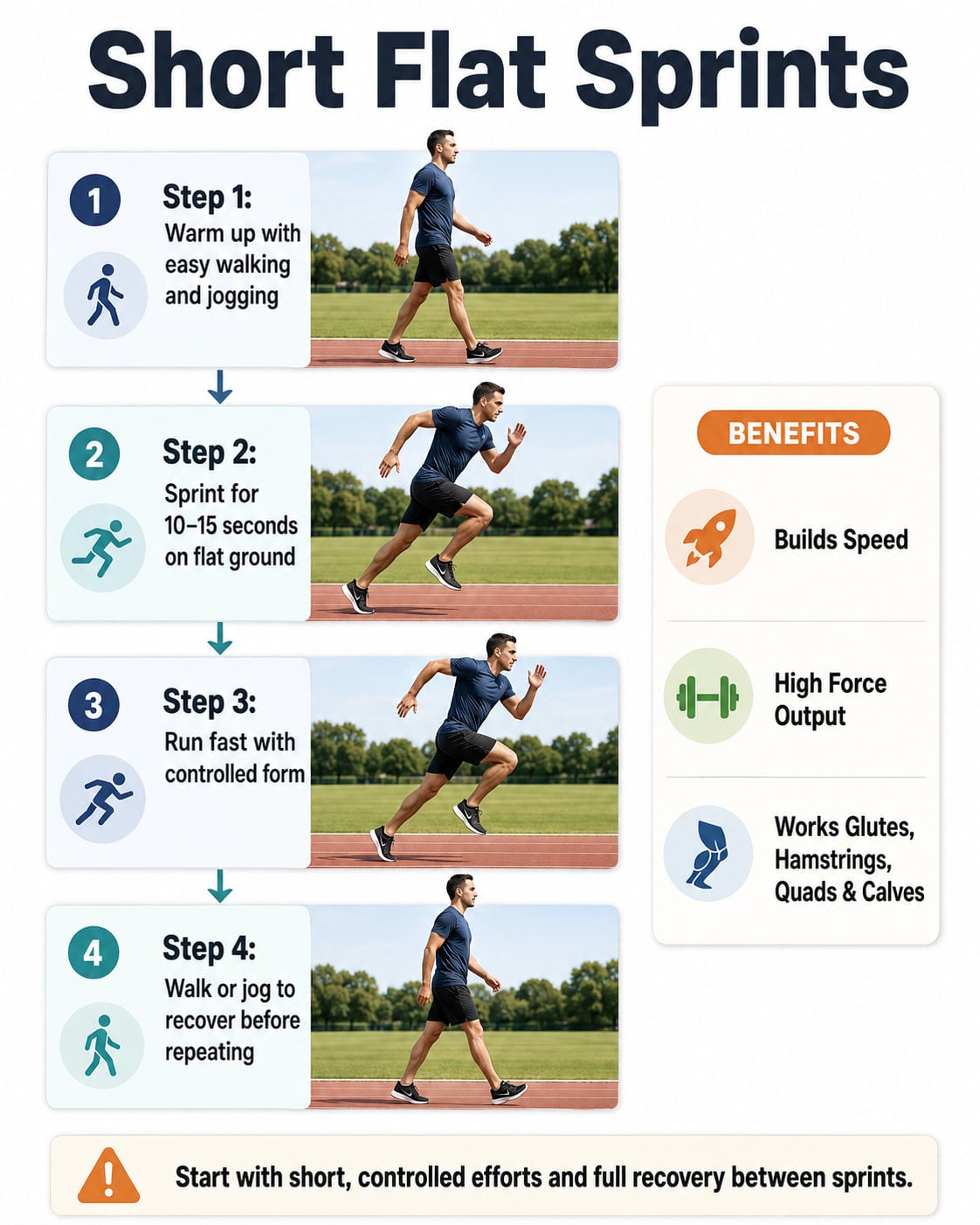
Flat sprints require rapid force production and strongly involve the glutes, hamstrings, quadriceps, and calves.
They are better suited to experienced, pain-free runners who already have a base of easy running. Beginners can start with relaxed strides instead of maximal sprinting.
Controlled Sprint Example
- Warm up for 10–15 minutes.
- Complete 4–6 repetitions of 10–15 seconds.
- Run at approximately 85%–95% of your maximum speed.
- Walk or jog for 2–3 minutes between repetitions.
- Stop if your form noticeably deteriorates.
Do not begin with maximal 100% efforts. Sprint speed should increase gradually over several weeks.
3. Running-Based HIIT
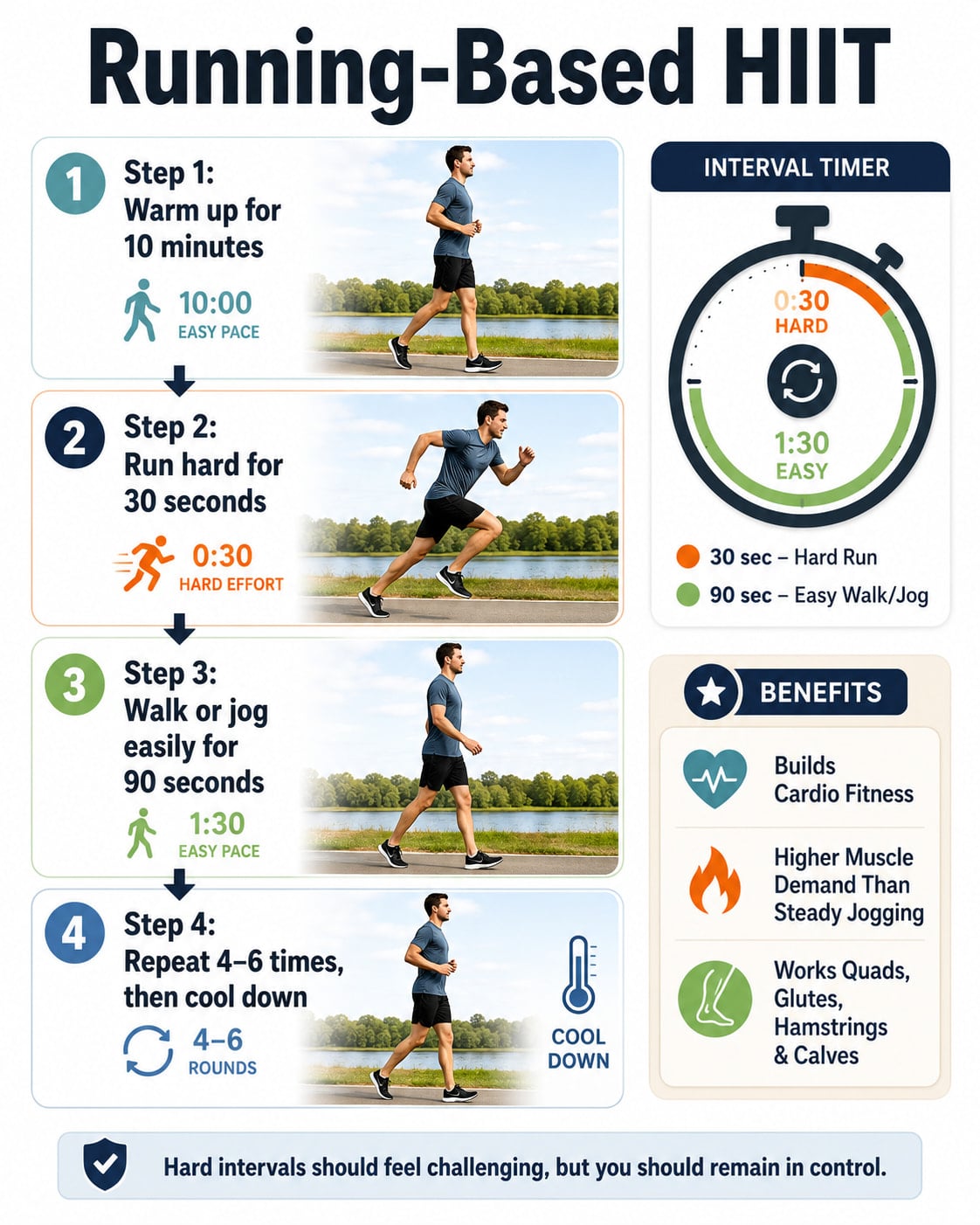
High-intensity interval training alternates hard running with periods of walking or easy jogging. The hard intervals place more force on the muscles than steady running while also improving aerobic and anaerobic fitness.
A 2025 systematic review and meta-analysis included 54 studies and 1,136 participants. The researchers found possible small improvements in fat-free mass from HIIT and sprint interval training, but the evidence was uncertain and included several exercise modes—not only running. Resistance training appeared more effective for improving leg-press strength.
Beginner Running Interval Example
- Warm up for 10 minutes.
- Run hard for 30 seconds.
- Walk or jog easily for 90 seconds.
- Repeat 4–6 times.
- Cool down for 5–10 minutes.
A hard interval should feel challenging, but you should remain in control of your movement and surroundings.
4. Incline Treadmill Intervals
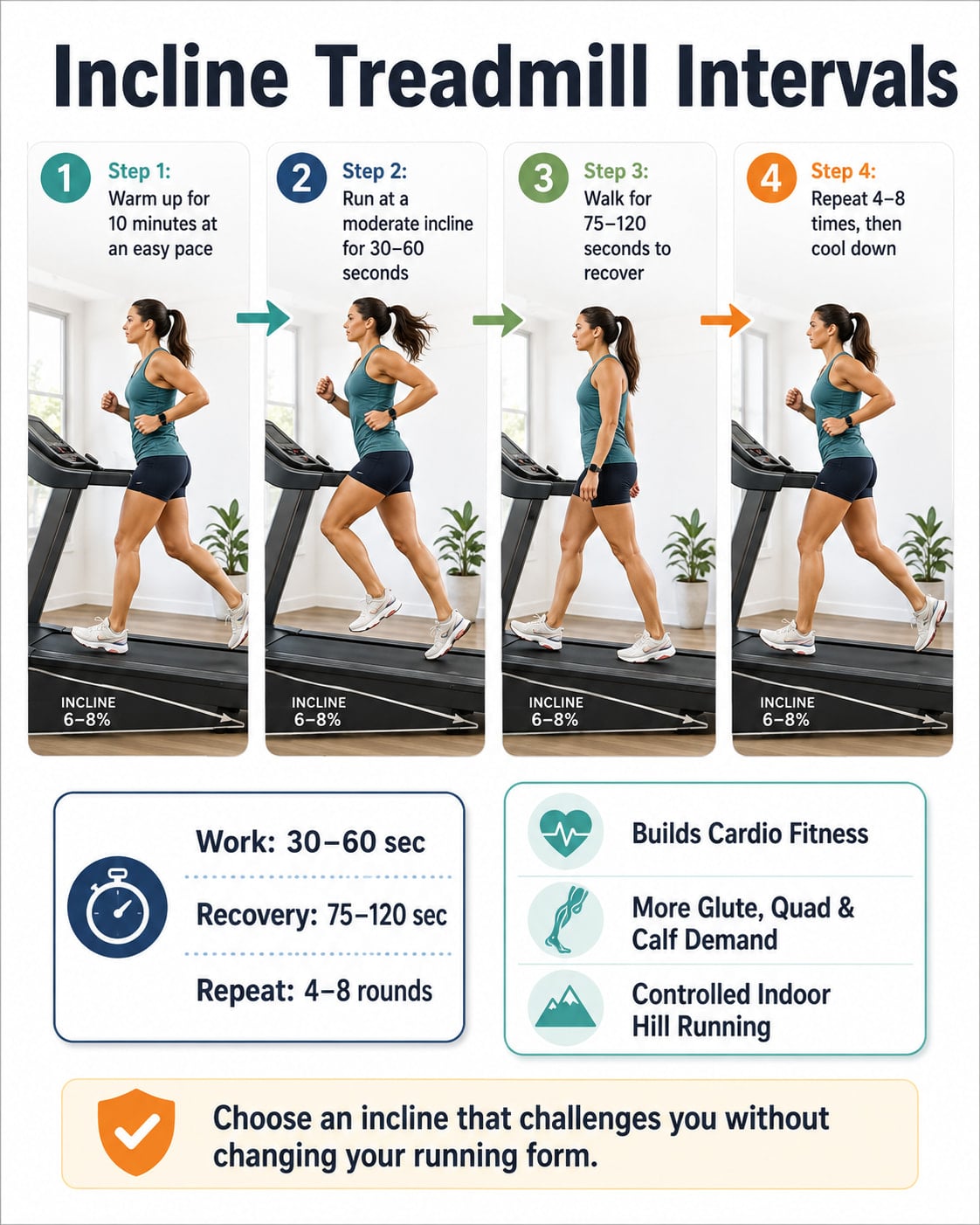
Incline treadmill running provides a controlled alternative to outdoor hill running. You can adjust the incline and speed separately, making it easier to find an effort that challenges the legs without requiring maximal running speed.
Incline Treadmill Example
- Warm up for 10 minutes at an easy pace.
- Select a moderate incline that allows stable posture.
- Run for 30–60 seconds.
- Walk for 75–120 seconds.
- Complete 4–8 repetitions.
- Reduce the incline and cool down.
Avoid choosing an incline so steep that you must hang onto the handrails or significantly alter your normal running mechanics.
5. Easy Runs
Easy runs are not the best choice for building muscle, but they remain valuable.
They improve aerobic fitness, running efficiency, and the ability to recover between harder efforts. Easy running can also help you accumulate training without placing the same neuromuscular demand on your body as sprints or hill intervals.
A well-designed program usually includes more easy running than hard running, even when muscle and speed are important goals.
Does Long-Distance Running Build Muscle?
Long-distance running primarily builds aerobic endurance and muscular fatigue resistance. It does not consistently produce meaningful muscle hypertrophy.
The 2025 review of moderate-intensity continuous aerobic training found no consistent increase in total or regional muscle size across the included studies. This does not mean distance running provides no muscular benefit. It means the primary adaptation is improved endurance rather than larger muscles.
Long-distance running may help a previously inactive person develop some lower-body muscle initially. Continued increases in running distance are unlikely to produce the same muscle growth as continued increases in resistance-training load and volume.
Can Running Make Your Legs Bigger?
Running can make your legs slightly bigger under certain circumstances, particularly when you:
- Are new to exercise.
- Begin sprinting or running hills.
- Increase your training from a low starting point.
- Eat enough to support adaptation.
- Recover adequately between sessions.
- Have not previously trained the lower body.
The changes are usually modest. Running alone is unlikely to produce bodybuilding-level quadriceps, hamstrings, or glutes.
Your legs may also look more defined without becoming much larger. Lower body fat, improved muscle tone, increased glycogen storage, and better posture can all change the appearance of your legs.
Does Running Burn Muscle?
Running does not automatically burn muscle.
Your body can maintain or build muscle while you run when your overall program provides enough resistance training, food, protein, sleep, and recovery. Muscle loss becomes more likely when demanding running is combined with:
- A large or prolonged calorie deficit
- Very high running mileage
- Rapid increases in training volume
- Inadequate protein
- Little or no resistance training
- Poor sleep and insufficient recovery
- Illness or repeated injury
For most healthy exercising adults, the International Society of Sports Nutrition position stand identifies approximately 1.4–2.0 grams of protein per kilogram of body weight per day as sufficient for building or maintaining muscle.
For example, a 150-pound person weighs approximately 68 kilograms. That range would equal roughly 95–136 grams of protein per day. Individual requirements depend on body size, age, total food intake, training volume, and goals.
People with kidney disease, liver disease, pregnancy-related nutrition needs, or another condition affecting protein intake should seek personalized guidance from a qualified healthcare professional.
Running vs. Strength Training for Muscle Growth
Strength training is more effective than running for building substantial muscle because it allows you to target specific muscles and progressively increase the resistance, repetitions, sets, or difficulty.
The American College of Sports Medicine’s 2026 resistance-training guidance recommends training all major muscle groups at least twice per week. For people focusing on hypertrophy, ACSM identifies approximately 10 weekly resistance-training sets per muscle group as a useful general target, with the program adjusted for the individual.
| Goal | Best training emphasis |
|---|---|
| Improve cardiovascular endurance | Running |
| Improve running speed | Running, sprint drills, and strength training |
| Build larger glutes and legs | Progressive resistance training |
| Develop lower-body power | Strength training, plyometrics, hills, and sprints |
| Improve overall fitness | Running plus full-body strength training |
| Lose fat while maintaining muscle | Appropriate nutrition, resistance training, and aerobic activity |
Running and strength training do not need to compete. They can complement each other when total training stress remains manageable.
Current CDC physical activity guidance for adults recommends at least 150 minutes of moderate-intensity aerobic activity or 75 minutes of vigorous activity per week, plus muscle-strengthening activities on at least two days per week. Jogging and running are listed as vigorous aerobic activities, while strengthening remains a separate recommendation.
Can You Run and Build Muscle at the Same Time?
Yes. Combining running and resistance training is known as concurrent training.
An updated meta-analysis found that concurrent aerobic and strength training generally did not reduce gains in whole-muscle size or maximal strength compared with strength training alone. Explosive-strength development appeared more likely to be affected, particularly when aerobic and strength exercises were performed in the same session.
The practical concern is usually recovery. A high-volume running program can leave your legs too fatigued to perform productive strength workouts.
To support both goals:
- Decide whether muscle growth or running performance is your current priority.
- Perform two or more resistance-training sessions each week.
- Limit demanding runs to one or two sessions per week.
- Keep most additional runs easy.
- Avoid placing every hard run next to a demanding leg workout.
- Increase running and lifting volume gradually.
- Reduce training when soreness or fatigue begins to affect performance.
When running and lifting must occur on the same day, perform the activity that supports your main goal first. Someone prioritizing muscle growth would usually lift before running. Someone training for an important race workout may choose to run first.
Sample Running and Strength Schedule for Muscle Gain
This example includes two strength sessions, one hard running session, and up to two easy runs.
| Day | Training |
|---|---|
| Monday | Lower-body or full-body strength training |
| Tuesday | Easy run for 20–40 minutes |
| Wednesday | Rest, mobility, or upper-body training |
| Thursday | Hill sprints or running intervals |
| Friday | Rest or light activity |
| Saturday | Full-body strength training and optional short easy run |
| Sunday | Rest |
This is only an example. Beginners may need fewer sessions, while experienced athletes may tolerate more. Avoid increasing running mileage and strength-training volume aggressively during the same week.
How to Build Muscle While Running
Follow a Progressive Strength Program
Train the major lower-body movement patterns:
- Squat
- Hip hinge
- Lunge or split squat
- Step-up
- Calf raise
- Hip extension
Gradually increase resistance, repetitions, sets, range of motion, or exercise difficulty.
Include One Muscle-Focused Run
Choose one weekly workout involving controlled hills, short sprints, or running intervals. More high-intensity running is not automatically better.
Eat Enough Food
Muscle growth is difficult when you consistently consume less energy than your body needs. You do not necessarily need a large calorie surplus, but chronic underfueling can reduce performance and recovery.
Include carbohydrates to support running and strength workouts, protein to support muscle maintenance and growth, and dietary fats as part of a balanced eating pattern.
Prioritize Recovery
Muscle adaptation happens between workouts.
Aim for consistent sleep, include easier training days, and avoid repeatedly training through unusual pain or severe fatigue. If your strength, running pace, sleep, mood, or motivation steadily worsens, your total workload may be too high.
Progress Gradually
Increase one major training variable at a time. For example, increase weekly mileage, sprint repetitions, incline, or resistance-training volume rather than raising everything simultaneously.
Gradual progression gives your muscles, tendons, joints, and bones time to adapt.
Safety Tips for Sprints and Hill Running
Sprints and hills produce more force than easy running. They should be introduced carefully.
- Establish a base of comfortable walking and easy running first.
- Warm up before running fast.
- Begin with short, controlled efforts.
- Use a safe, predictable surface.
- Allow full recovery between repetitions.
- Avoid maximal sprinting when fatigued.
- Stop if you experience sharp pain or a sudden change in movement.
- Leave recovery time before the next demanding lower-body workout.
Seek medical advice before beginning vigorous exercise if you have a cardiovascular condition, uncontrolled blood pressure, significant joint problems, a recent injury, concerning symptoms during activity, or another condition that may affect exercise safety.
Frequently Asked Questions
Does running build muscle in your legs?
Running can build a modest amount of leg muscle, especially in beginners and people performing hills or sprints. Steady running primarily develops muscular endurance rather than significant size.
Does running build your glutes?
Running activates the glutes, particularly during acceleration, sprinting, and uphill running. For greater glute growth, combine running with progressively loaded squats, split squats, hip thrusts, step-ups, and hip hinges.
Does running make your calves bigger?
It may make the calves slightly bigger, particularly in new runners or people who add hills and faster running. Genetics and previous training influence the response. Calf raises provide a more direct hypertrophy stimulus.
Is sprinting better than jogging for building muscle?
Sprinting generally produces greater force and places more demand on the glutes, hamstrings, quadriceps, and calves. It therefore has more muscle-building potential than jogging, although resistance training remains more reliable for hypertrophy.
Can running replace leg day?
Running cannot fully replace leg-focused resistance training when your goal is strength or muscle size. It does not progressively load every lower-body muscle through the same range of motion as squats, hinges, lunges, and calf raises.
Can you run every day and still build muscle?
It is possible, but daily running can make recovery more difficult. Most runs would need to remain easy, and the total workload would need to match your fitness level. Rest days or low-impact recovery days are often more practical.
Does long-distance running cause muscle loss?
Long-distance running does not automatically cause muscle loss. Risk increases when high mileage is combined with inadequate calories, insufficient protein, no resistance training, and poor recovery.
Conclusion
Running can build some lower-body muscle, particularly when you are a beginner or include short sprints, hills, and high-intensity intervals. However, easy jogging and long runs mainly improve cardiovascular fitness and muscular endurance.
For noticeable muscle growth, use running as a complement to progressive resistance training. Train your major muscle groups at least twice per week, include only as much hard running as you can recover from, eat enough protein and total food, and increase your workload gradually.
Start by adding one controlled hill or interval workout and two full-body strength sessions to your weekly routine. Consistency will provide better results than making every workout longer or harder.
References
- Camargo JBB, et al. Does Moderate-Intensity Continuous Training Promote Skeletal Muscle Hypertrophy? A Systematic Review and Meta-Analysis. European Journal of Sport Science. 2025.
- Wiens L, et al. Does High-Intensity Interval Training Increase Muscle Strength, Muscle Mass, and Muscle Endurance?. Sports. 2025.
- Hamner SR, et al. Muscle Contributions to Propulsion and Support During Running. Journal of Biomechanics. 2010.
- Swanson SC, Caldwell GE. An Integrated Biomechanical Analysis of High-Speed Incline and Level Treadmill Running. Medicine & Science in Sports & Exercise. 2000.
- Schumann M, et al. Compatibility of Concurrent Aerobic and Strength Training for Skeletal Muscle Size and Function. Sports Medicine. 2022.
- American College of Sports Medicine. ACSM Publishes Updated Resistance Training Guidelines. 2026.
- Centers for Disease Control and Prevention. Adult Physical Activity Guidelines.
- Jäger R, et al. International Society of Sports Nutrition Position Stand: Protein and Exercise. Journal of the International Society of Sports Nutrition. 2017.